CAUSES OF CRIME IN
MALAYSIA
ARMED ROBBERIES AND MURDERS.
INTRODUCTION
• What is crime?
“... an act or the commission of an act that is forbidden or the omission
of a duty that is commanded by a public law and that makes the offender
liable to punishment by that law”
Lim Kwan, 2012
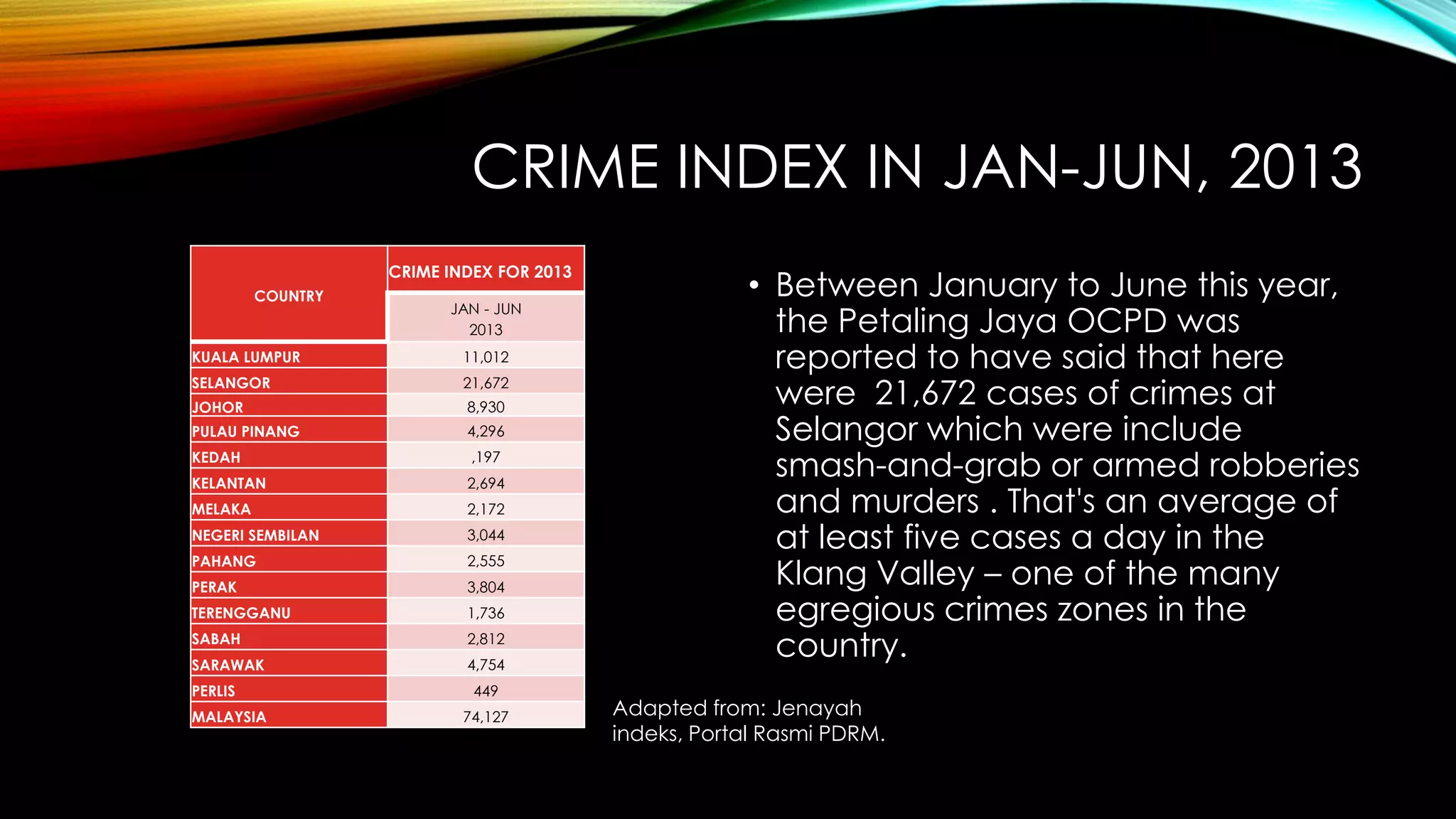
CRIME INDEX IN JAN-JUN, 2013
CRIME INDEX FOR 2013
COUNTRY

JAN - JUN
2013

KUALA LUMPUR

11,012

SELANGOR

21,672

JOHOR

8,930

PULAU PINANG

4,296

KEDAH

,197

KELANTAN

2,694

MELAKA

2,172

NEGERI SEMBILAN

3,044

PAHANG

2,555

PERAK

3,804

TERENGGANU

1,736

SABAH

2,812

SARAWAK

4,754

PERLIS
MALAYSIA

449
74,127

• Between January to June this year,
the Petaling Jaya OCPD was
reported to have said that here
were 21,672 cases of crimes at
Selangor which were include
smash-and-grab or armed robberies
and murders . That's an average of
at least five cases a day in the
Klang Valley – one of the many
egregious crimes zones in the
country.
Adapted from: Jenayah
indeks, Portal Rasmi PDRM.
• This statistically shows that there are few causes why Malaysia’s rising crime
levels is high and would exacerbate crime level because of family
background, poverty and peer influence.
POVERTY
• TOPIC SENTENCE: Poverty is one of the causes that lead to crime events such
as armed robberies and murders.
• S.D 1: Individuals in this category commit crime because they are desperate
of basic needs such as house, healthcare, education and employment.
(Asad Ullah, 2013 ).
• S.D 2: Example-the entry of illegal foreigner in our country.

• S.D 3: Freedom House on 30 September 2013 states that there are more than
2 million illegal workers in Malaysia.
FAMILY BACKGROUND
• TOPIC SENTENCE: Bad family background can be the cause for crime in
Malaysia because it can give bad influences for their children and cause
them to turn out to be offenders in the future.
• S.D 1: The lack of parent loves in family, such as single parent, gives bad
influences.
• As Rolf Loeber (year) stated that children should be taken care by adults in
family during important critical period that occur early in children’ lives in
order to help them learn social skill and avoid any aggressive behaviors.
FAMILY BACKGROUND
• S.D. 2: The home violence gives also the bad influences for children because
conflict between parent will hurt their children emotionally and cause them
to lose trust on their parent.
• According the Cambridge Somerville Youth Study, the happen of violence
behavior for children was higher in violence conflict family then broken
family that without conflict.
FAMILY BACKGROUND
• S.D. 3: In Malaysia, the offenders usually had bad family background when
they were young. According to the statistics of families background for sex
offenders from Department of Psychiatry (2005), 23% of the offenders come
from poor families, 15% from broken families, 6% had positive family history
but with alcohol and drug use, 6% of the offenders brought up from violence
families and 29% of the offenders had not lived with their parent since young.
• CONCLUDING PARAGRAPH: Parent should have good responsible and great
altitude in family in order to provide good family background for their
children, so as to prevent them from becoming offenders that involve in
crimes.
PEER INFLUENCES
• TOPIC SENTENCE: One of the strongest and robust correlates to crime and
delinquency is associating with delinquent peers (Warr, 2002, & Fairhurst, L,
n.d.).
• S.D 1: Youth at puberty tend to have the desire to grow older and get
mature by imitating other slightly older youths who committed crimes (The
Court of New Zealand, 2009).
• S.D 2: Youth with delinquent friends showed criminal behaviors (John et al,
2002).
PEER INFLUENCES
S.D 3: Involvement with gang members is the most serious level of peer
influence. (Joan, Cathy & Nancy, 2001.)
CONCLUDING PARAGRAPH: Therefore, it’s obvious that peer influences play
an important part too in contributing to the increase of armed robberies and
murders in Malaysia.
CONCLUSION
• In a nutshell, poverty, family background and peer influence are the factors
that lead to some crime events
• Ways on decreasing the crime events of armed robberies and murders..
-control the entry of illegal foreigner

-parents carry out their responsibility
-organize campaign and counseling in preventing crimes
REFERENCES
Aili, H. H., Manveen, K.S., Pillai, S.K., Muhsin, M., & Salvina, W. (n.d.). Clinical and
developmental characteristics of sex offenders in Malaysian Prisons.
Retrieved
from:
http://www.mjpsychiatry.org/index.php/mjp/article/bewfile/191/143.
Asad Ullah (2013 Apr 27). Does poverty contributed to more crime? In The
Daily Courier. Retrieved from:
http://www.dcourier.com/main.asp?sectionID=73&ArticleID=118590
Dewie, A. (2011). What makes crime happen? In Freedom House. Retrieved
from: http://www.detectiveightyfive.blogspot.com/2011/03/mengapajenayah-berlaku.html
Fairhurst, L. (n.d.). Study identifies gene in young men with delinquent peers.
College of Criminology and Criminal Jutice, The Florida University.
Retrieved from:http://www.criminology.fsu.edu/p/newsarchives.php?id=35
Fogam, P.F. (1993). The real root of violent crime. Retrieved from:
http://www.heritage.org/research/reports/1995/03/bg1026nbsp-the-real-rootcause-of-violent-crime

McCord, J., Widom, C.S., & Crowell, N.A. (Eds). (2001). Panel on juvenile crime:
prevention, treatment, and control. Juvenile Justice.
The Youth Court of New Zealand. (2009). What cause youth crime and what can we
do about it. NZ: Bluelight Ventures Inc – Conference & AGM.
Warr, M. (2002). Companions in crime. The social aspects of criminal conduct. UK:
Cambridge University Press.

Weatherburn, D. (2011). Crime and justice bulletin, contemporary issues in crime and
justice, No: 54. Australia: NSW Bureau of Crime Statistics and Research.
Warr, M. (2002). Companions in crime. The social aspects of criminal conduct. UK:
Cambridge University Press.
Weatherburn, D. (2011). Crime and justice bulletin, contemporary issues in crime and
justice, No: 54. Australia: NSW Bureau of Crime Statistics and Research.
THANK YOU!

Causes of Crime - Armed Robberies & Murders.

  • 1.
    CAUSES OF CRIMEIN MALAYSIA ARMED ROBBERIES AND MURDERS.
  • 2.
    INTRODUCTION • What iscrime? “... an act or the commission of an act that is forbidden or the omission of a duty that is commanded by a public law and that makes the offender liable to punishment by that law” Lim Kwan, 2012
  • 3.
    CRIME INDEX INJAN-JUN, 2013 CRIME INDEX FOR 2013 COUNTRY JAN - JUN 2013 KUALA LUMPUR 11,012 SELANGOR 21,672 JOHOR 8,930 PULAU PINANG 4,296 KEDAH ,197 KELANTAN 2,694 MELAKA 2,172 NEGERI SEMBILAN 3,044 PAHANG 2,555 PERAK 3,804 TERENGGANU 1,736 SABAH 2,812 SARAWAK 4,754 PERLIS MALAYSIA 449 74,127 • Between January to June this year, the Petaling Jaya OCPD was reported to have said that here were 21,672 cases of crimes at Selangor which were include smash-and-grab or armed robberies and murders . That's an average of at least five cases a day in the Klang Valley – one of the many egregious crimes zones in the country. Adapted from: Jenayah indeks, Portal Rasmi PDRM.
  • 4.
    • This statisticallyshows that there are few causes why Malaysia’s rising crime levels is high and would exacerbate crime level because of family background, poverty and peer influence.
  • 5.
    POVERTY • TOPIC SENTENCE:Poverty is one of the causes that lead to crime events such as armed robberies and murders. • S.D 1: Individuals in this category commit crime because they are desperate of basic needs such as house, healthcare, education and employment. (Asad Ullah, 2013 ). • S.D 2: Example-the entry of illegal foreigner in our country. • S.D 3: Freedom House on 30 September 2013 states that there are more than 2 million illegal workers in Malaysia.
  • 6.
    FAMILY BACKGROUND • TOPICSENTENCE: Bad family background can be the cause for crime in Malaysia because it can give bad influences for their children and cause them to turn out to be offenders in the future. • S.D 1: The lack of parent loves in family, such as single parent, gives bad influences. • As Rolf Loeber (year) stated that children should be taken care by adults in family during important critical period that occur early in children’ lives in order to help them learn social skill and avoid any aggressive behaviors.
  • 7.
    FAMILY BACKGROUND • S.D.2: The home violence gives also the bad influences for children because conflict between parent will hurt their children emotionally and cause them to lose trust on their parent. • According the Cambridge Somerville Youth Study, the happen of violence behavior for children was higher in violence conflict family then broken family that without conflict.
  • 8.
    FAMILY BACKGROUND • S.D.3: In Malaysia, the offenders usually had bad family background when they were young. According to the statistics of families background for sex offenders from Department of Psychiatry (2005), 23% of the offenders come from poor families, 15% from broken families, 6% had positive family history but with alcohol and drug use, 6% of the offenders brought up from violence families and 29% of the offenders had not lived with their parent since young. • CONCLUDING PARAGRAPH: Parent should have good responsible and great altitude in family in order to provide good family background for their children, so as to prevent them from becoming offenders that involve in crimes.
  • 9.
    PEER INFLUENCES • TOPICSENTENCE: One of the strongest and robust correlates to crime and delinquency is associating with delinquent peers (Warr, 2002, & Fairhurst, L, n.d.). • S.D 1: Youth at puberty tend to have the desire to grow older and get mature by imitating other slightly older youths who committed crimes (The Court of New Zealand, 2009). • S.D 2: Youth with delinquent friends showed criminal behaviors (John et al, 2002).
  • 10.
    PEER INFLUENCES S.D 3:Involvement with gang members is the most serious level of peer influence. (Joan, Cathy & Nancy, 2001.) CONCLUDING PARAGRAPH: Therefore, it’s obvious that peer influences play an important part too in contributing to the increase of armed robberies and murders in Malaysia.
  • 11.
    CONCLUSION • In anutshell, poverty, family background and peer influence are the factors that lead to some crime events • Ways on decreasing the crime events of armed robberies and murders.. -control the entry of illegal foreigner -parents carry out their responsibility -organize campaign and counseling in preventing crimes
  • 12.
    REFERENCES Aili, H. H.,Manveen, K.S., Pillai, S.K., Muhsin, M., & Salvina, W. (n.d.). Clinical and developmental characteristics of sex offenders in Malaysian Prisons. Retrieved from: http://www.mjpsychiatry.org/index.php/mjp/article/bewfile/191/143. Asad Ullah (2013 Apr 27). Does poverty contributed to more crime? In The Daily Courier. Retrieved from: http://www.dcourier.com/main.asp?sectionID=73&ArticleID=118590 Dewie, A. (2011). What makes crime happen? In Freedom House. Retrieved from: http://www.detectiveightyfive.blogspot.com/2011/03/mengapajenayah-berlaku.html Fairhurst, L. (n.d.). Study identifies gene in young men with delinquent peers. College of Criminology and Criminal Jutice, The Florida University. Retrieved from:http://www.criminology.fsu.edu/p/newsarchives.php?id=35
  • 13.
    Fogam, P.F. (1993).The real root of violent crime. Retrieved from: http://www.heritage.org/research/reports/1995/03/bg1026nbsp-the-real-rootcause-of-violent-crime McCord, J., Widom, C.S., & Crowell, N.A. (Eds). (2001). Panel on juvenile crime: prevention, treatment, and control. Juvenile Justice. The Youth Court of New Zealand. (2009). What cause youth crime and what can we do about it. NZ: Bluelight Ventures Inc – Conference & AGM. Warr, M. (2002). Companions in crime. The social aspects of criminal conduct. UK: Cambridge University Press. Weatherburn, D. (2011). Crime and justice bulletin, contemporary issues in crime and justice, No: 54. Australia: NSW Bureau of Crime Statistics and Research.
  • 14.
    Warr, M. (2002).Companions in crime. The social aspects of criminal conduct. UK: Cambridge University Press. Weatherburn, D. (2011). Crime and justice bulletin, contemporary issues in crime and justice, No: 54. Australia: NSW Bureau of Crime Statistics and Research.
  • 15.