Causative Verbs In English:
Make
Have
Get
Let
Help
HL
The English verbs let, make, have, get,
and help are called causative verbs
because they cause something else to
happen.
HL
How To Use Causative Verbs
in English
HL
Examples:
 After Billy broke the neighbor’s window, his parents made
him pay for it.
 My ex-boyfriend loved sci-fi and made me watch every
episode of his favorite show.
 The teacher made all the students rewrite their papers,
because the first drafts were not acceptable.
HL
When using the verbs require and force, we must use
to + verb.
Examples:
• The school requires the students to wear
uniforms. (Require often implies that there is a rule)
• The hijacker forced the pilots to take the plane in a
different direction. (Force often implies violence, threats, or
extremely strong pressure)
HL
Examples Structure # 1:
Have + Person + Verb (Base Form)
 I’ll have my assistant call you to reschedule the
appointment.
 The businessman had his secretary make copies of the
report.
HL
Examples Structure # 2:
Have + Thing + Verb (Past Participle)
 I’m going to have my hair cut tomorrow.
 We’re having our house painted this weekend.
 Bob had his teeth whitened; his smile looks great!
 My washing machine is broken; I need to have it repaired.
HL
 I’m going to get / have my hair cut tomorrow.
 We’re getting / having our house painted this weekend.
 Bob got / had his teeth whitened; his smile looks great!
 My washing machine is broken; I need to get / have it
repaired.
HL
Examples:
 How can we get all the employees to arrive on time?
 My husband hates housework; I can never get him to wash
the dishes!
 I was nervous about eating sushi, but my brother got me to
try it at a Japanese restaurant.
 You´ve got to get your students do the exam in less than 30
minutes.
HL
Remember: The past tense of let is also let; there is no
change!
Note: The verbs allow and permit are more formal
ways to say “let.” However, with allow and permit, we
use to + verb:
• I don’t allow my kids to watch violent movies.
• Our boss doesn’t permit us to eat lunch at our
desks.
HL
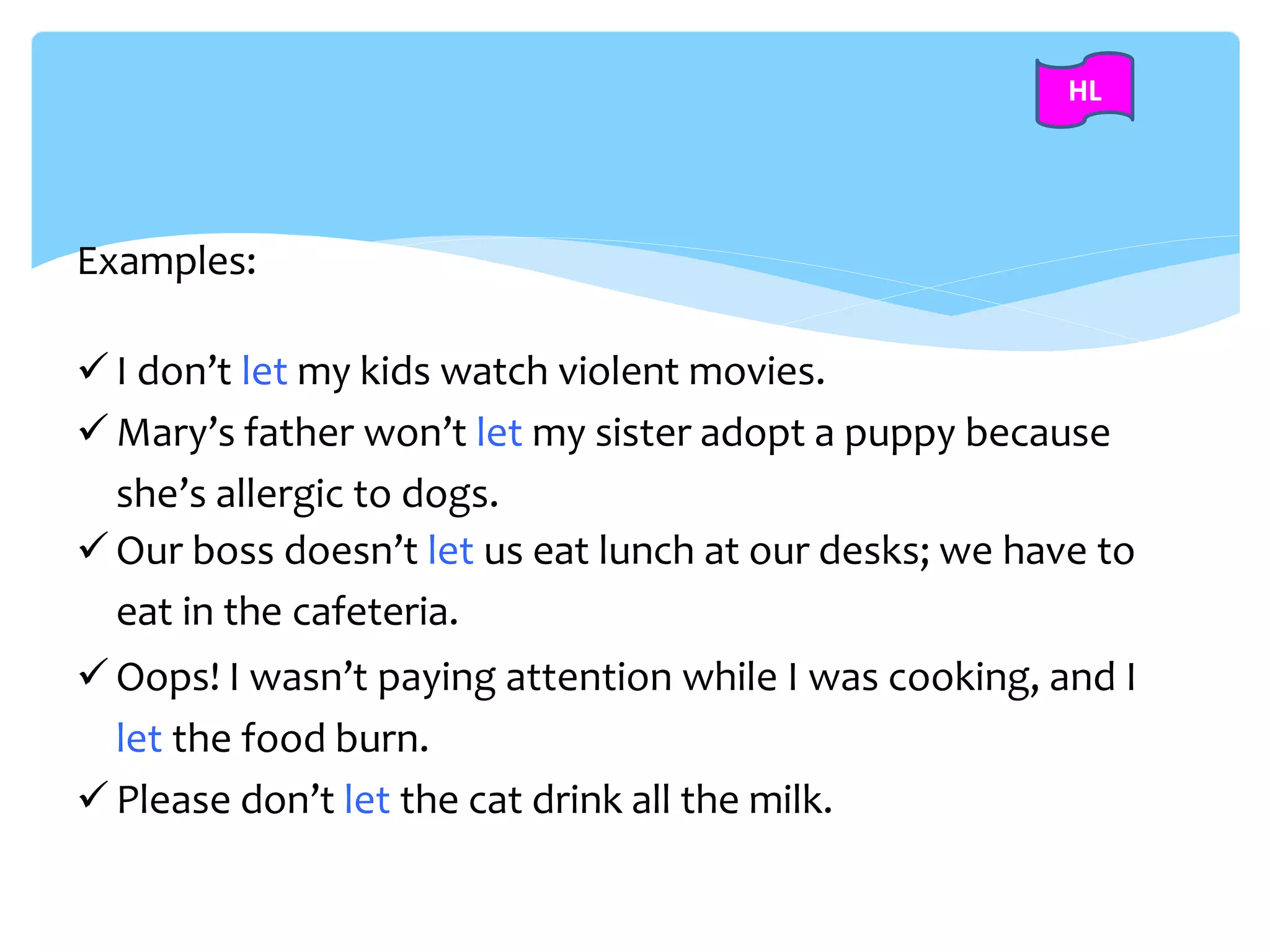
Examples:
 I don’t let my kids watch violent movies.
 Mary’s father won’t let my sister adopt a puppy because
she’s allergic to dogs.
 Our boss doesn’t let us eat lunch at our desks; we have to
eat in the cafeteria.
 Oops! I wasn’t paying attention while I was cooking, and I
let the food burn.
 Please don’t let the cat drink all the milk.
HL
Grammatical structure:
HELP + PERSON + VERB (base form)
HELP + PERSON + TO + VERB
After “help,” you can use “to” or not – both ways are correct.
In general, the form without “to” is more common:
• He helped me carry the boxes.
• He helped me to carry the boxes.
• Reading before bed helps me relax.
• Reading before bed helps me to relax.
HL
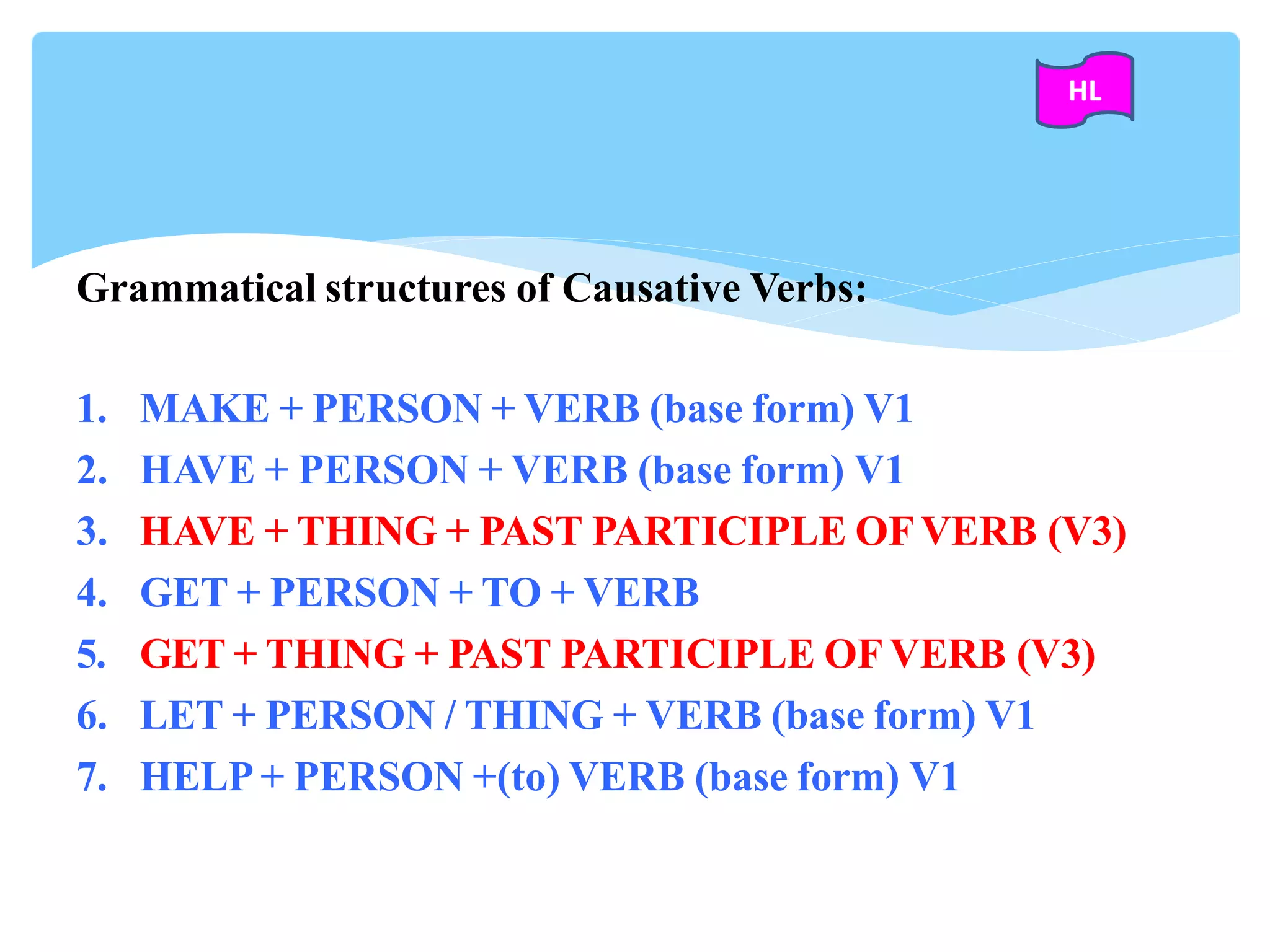
Grammatical structures of Causative Verbs:
1. MAKE + PERSON + VERB (base form) V1
2. HAVE + PERSON + VERB (base form) V1
3. HAVE + THING + PAST PARTICIPLE OF VERB (V3)
4. GET + PERSON + TO + VERB
5. GET + THING + PAST PARTICIPLE OF VERB (V3)
6. LET + PERSON / THING + VERB (base form) V1
7. HELP + PERSON +(to) VERB (base form) V1
HL
HIMAL

Causative verbs

  • 2.
    Causative Verbs InEnglish: Make Have Get Let Help HL
  • 3.
    The English verbslet, make, have, get, and help are called causative verbs because they cause something else to happen. HL
  • 4.
    How To UseCausative Verbs in English HL
  • 5.
    Examples:  After Billybroke the neighbor’s window, his parents made him pay for it.  My ex-boyfriend loved sci-fi and made me watch every episode of his favorite show.  The teacher made all the students rewrite their papers, because the first drafts were not acceptable. HL
  • 6.
    When using theverbs require and force, we must use to + verb. Examples: • The school requires the students to wear uniforms. (Require often implies that there is a rule) • The hijacker forced the pilots to take the plane in a different direction. (Force often implies violence, threats, or extremely strong pressure) HL
  • 7.
    Examples Structure #1: Have + Person + Verb (Base Form)  I’ll have my assistant call you to reschedule the appointment.  The businessman had his secretary make copies of the report. HL
  • 8.
    Examples Structure #2: Have + Thing + Verb (Past Participle)  I’m going to have my hair cut tomorrow.  We’re having our house painted this weekend.  Bob had his teeth whitened; his smile looks great!  My washing machine is broken; I need to have it repaired. HL
  • 9.
     I’m goingto get / have my hair cut tomorrow.  We’re getting / having our house painted this weekend.  Bob got / had his teeth whitened; his smile looks great!  My washing machine is broken; I need to get / have it repaired. HL
  • 10.
    Examples:  How canwe get all the employees to arrive on time?  My husband hates housework; I can never get him to wash the dishes!  I was nervous about eating sushi, but my brother got me to try it at a Japanese restaurant.  You´ve got to get your students do the exam in less than 30 minutes. HL
  • 11.
    Remember: The pasttense of let is also let; there is no change! Note: The verbs allow and permit are more formal ways to say “let.” However, with allow and permit, we use to + verb: • I don’t allow my kids to watch violent movies. • Our boss doesn’t permit us to eat lunch at our desks. HL
  • 12.
    Examples:  I don’tlet my kids watch violent movies.  Mary’s father won’t let my sister adopt a puppy because she’s allergic to dogs.  Our boss doesn’t let us eat lunch at our desks; we have to eat in the cafeteria.  Oops! I wasn’t paying attention while I was cooking, and I let the food burn.  Please don’t let the cat drink all the milk. HL
  • 13.
    Grammatical structure: HELP +PERSON + VERB (base form) HELP + PERSON + TO + VERB After “help,” you can use “to” or not – both ways are correct. In general, the form without “to” is more common: • He helped me carry the boxes. • He helped me to carry the boxes. • Reading before bed helps me relax. • Reading before bed helps me to relax. HL
  • 14.
    Grammatical structures ofCausative Verbs: 1. MAKE + PERSON + VERB (base form) V1 2. HAVE + PERSON + VERB (base form) V1 3. HAVE + THING + PAST PARTICIPLE OF VERB (V3) 4. GET + PERSON + TO + VERB 5. GET + THING + PAST PARTICIPLE OF VERB (V3) 6. LET + PERSON / THING + VERB (base form) V1 7. HELP + PERSON +(to) VERB (base form) V1 HL
  • 16.