MUFFAKHAM JAH
COLLEGE OF ENGINEERING AND
TECHNOLOGY
Title : Casting Technique
Md Naseeruddin Shah
1604-11-736-072
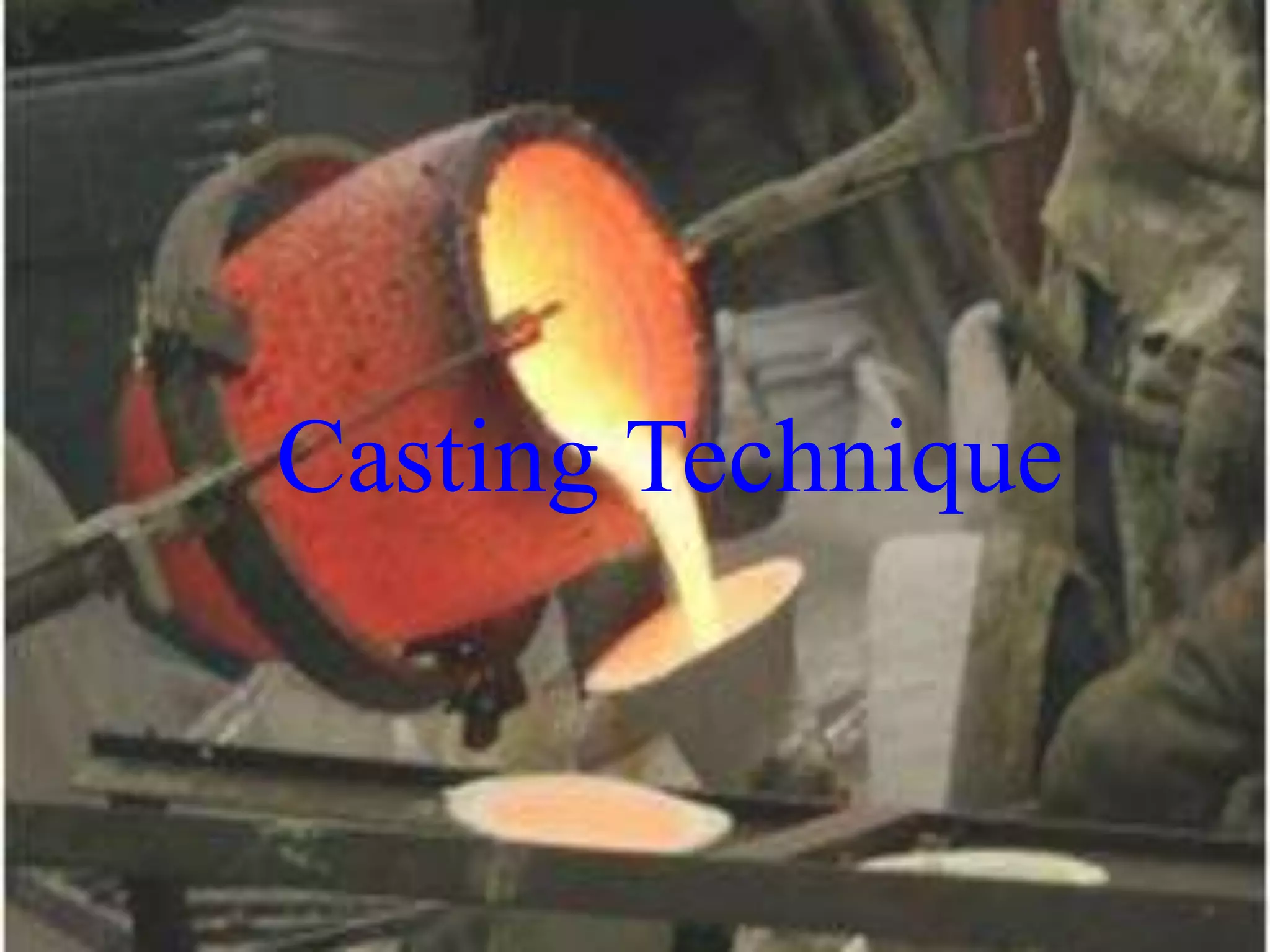
Casting Technique
Contents
 History
 Need of casting
 Classification of casting
 Sand casting
 Special casting methods
 Casting defects
 Inspection of casting
 Reference
History
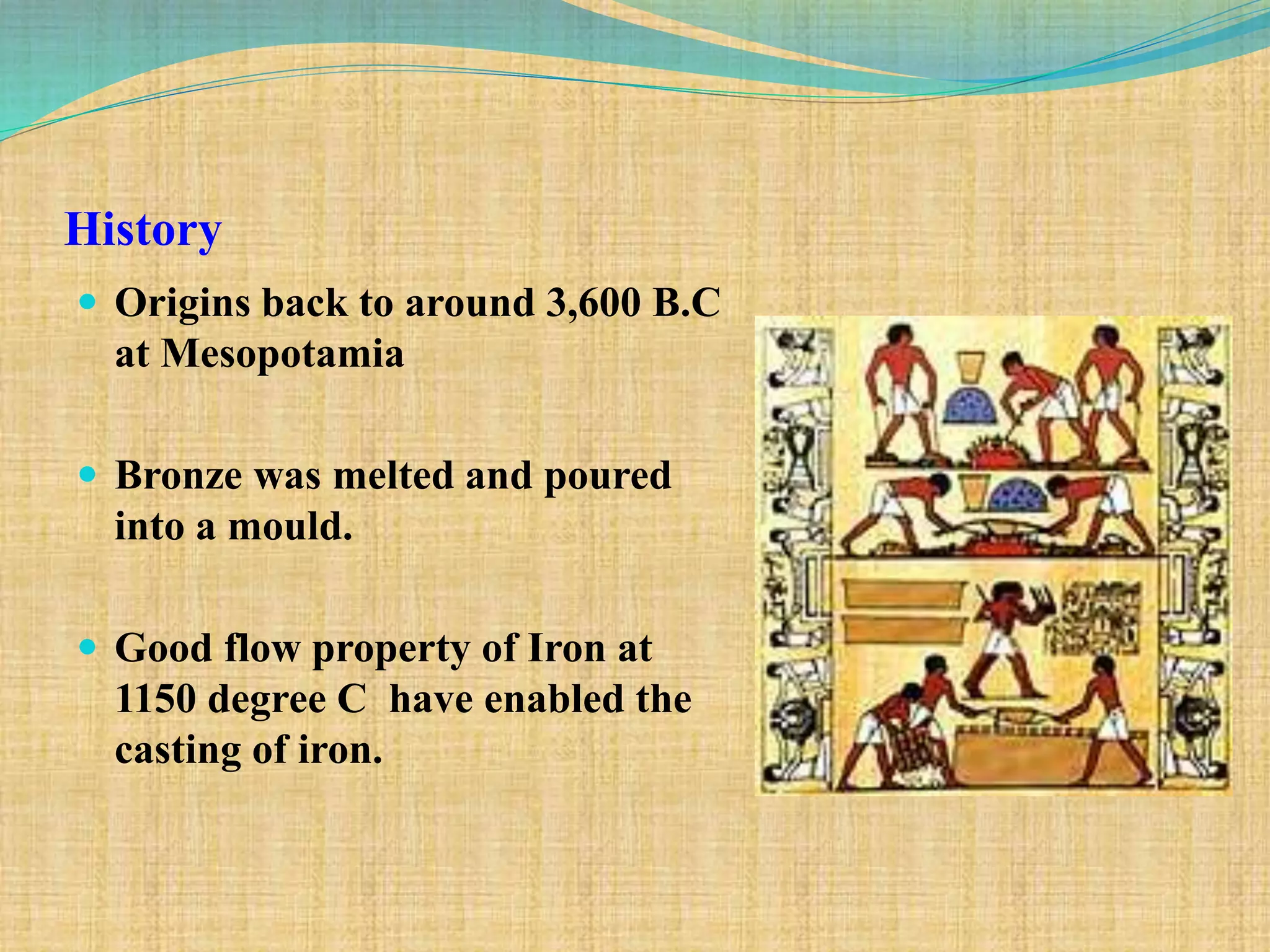
 Origins back to around 3,600 B.C
at Mesopotamia
 Bronze was melted and poured
into a mould.
 Good flow property of Iron at
1150 degree C have enabled the
casting of iron.
Need Of Casting
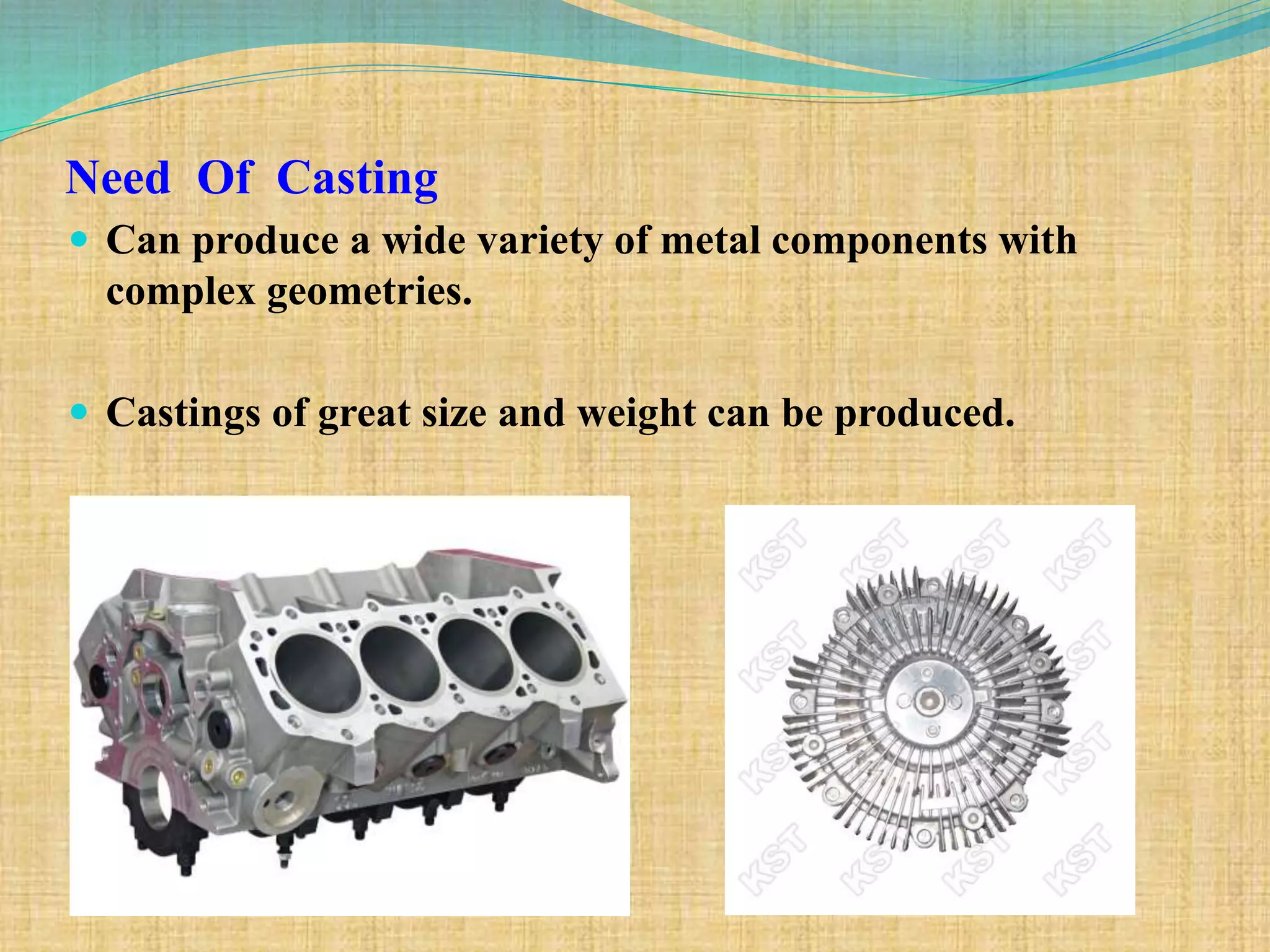
 Can produce a wide variety of metal components with
complex geometries.
 Castings of great size and weight can be produced.
Classification Of Casting Process
 Sand Casting
 Special Casting Methods
 Permanent Mould Casting
 Pressure Die Casting
 Centrifugal Casting
 Investment Casting
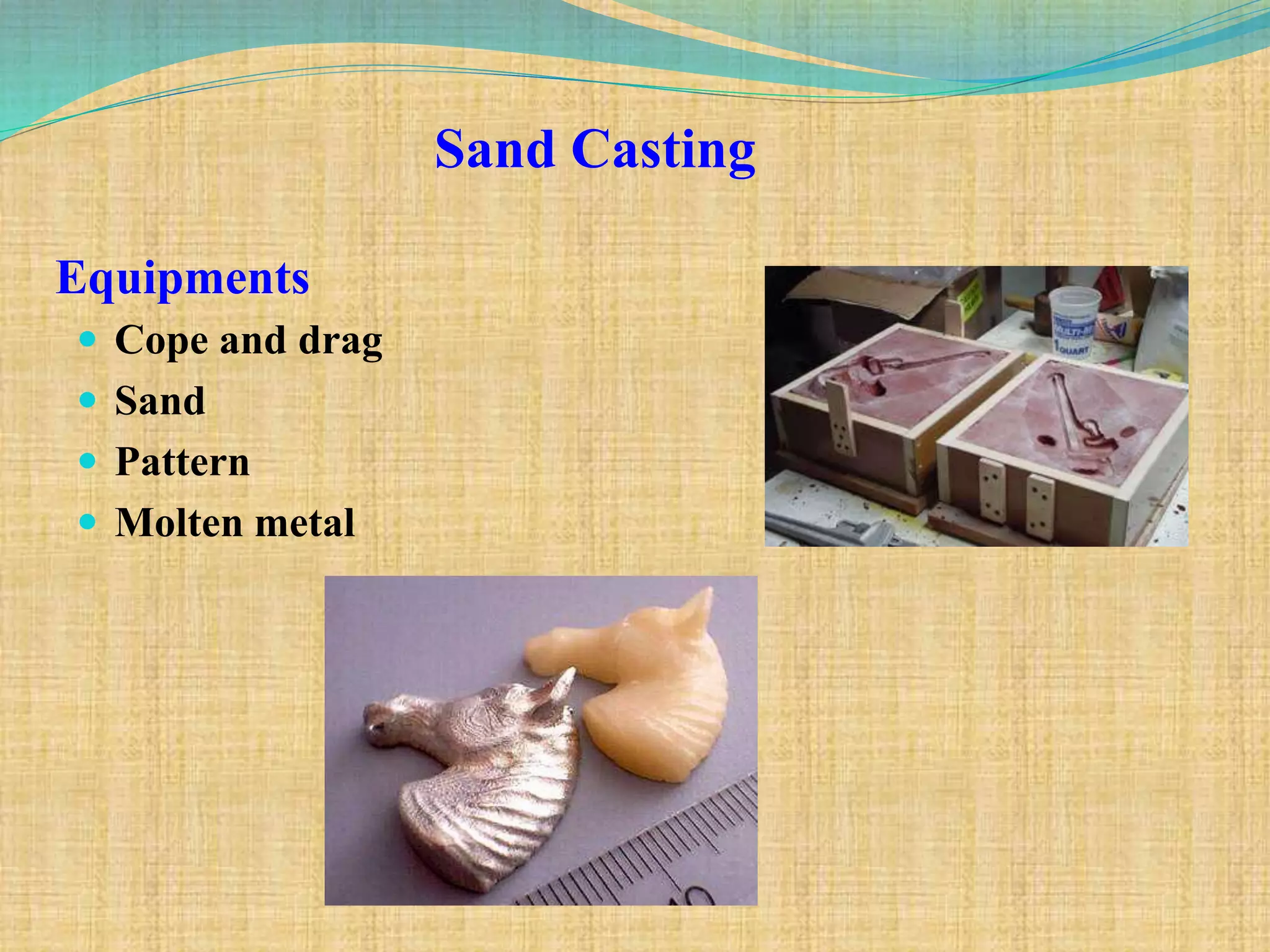
Equipments
 Cope and drag
 Sand
 Pattern
 Molten metal
Sand Casting
Governing Equations
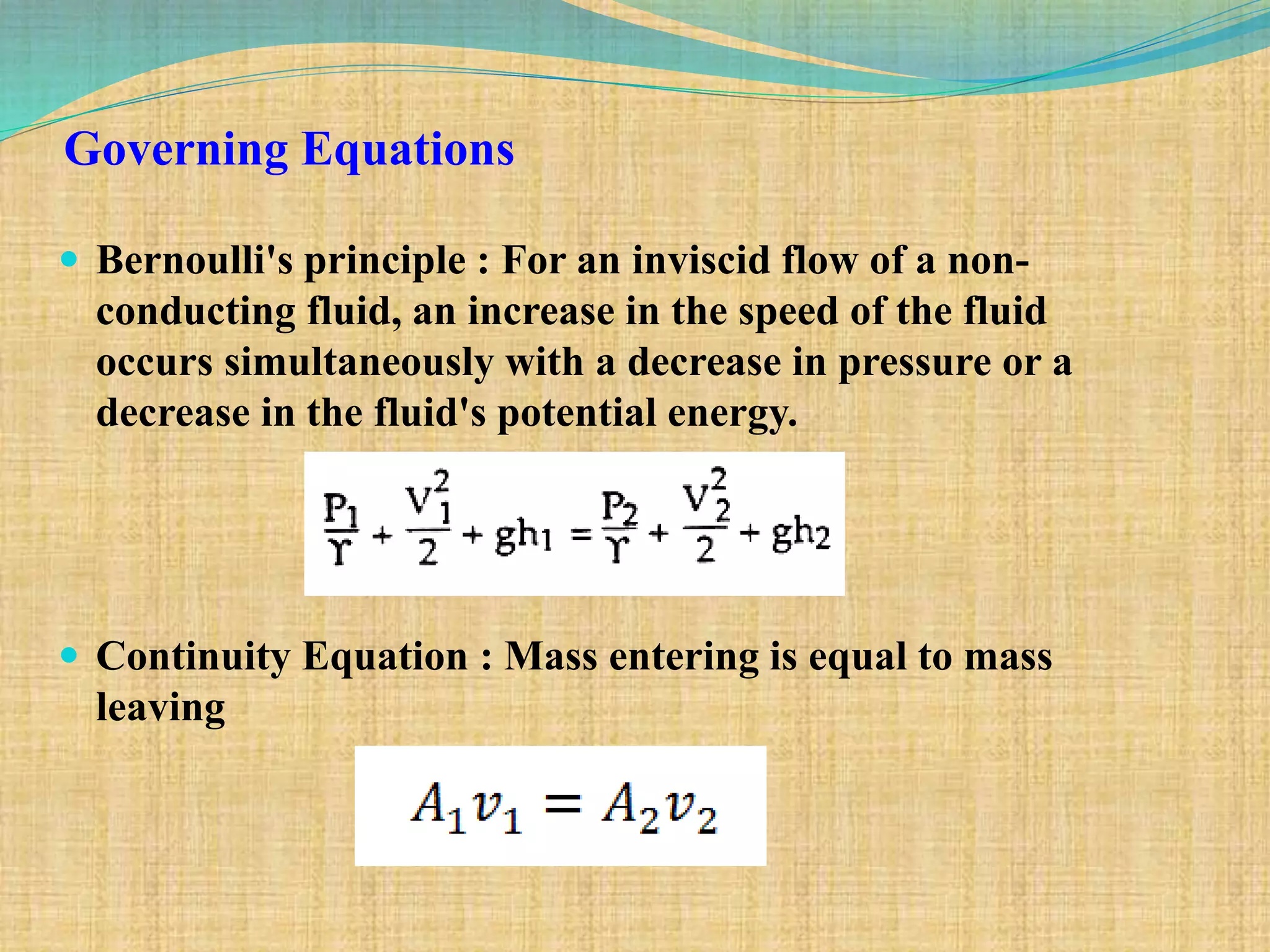
 Bernoulli's principle : For an inviscid flow of a non-
conducting fluid, an increase in the speed of the fluid
occurs simultaneously with a decrease in pressure or a
decrease in the fluid's potential energy.
 Continuity Equation : Mass entering is equal to mass
leaving
Mould making :
Moulding sand consists of three basic elements
1) Silica sand particles (75-80%) : Used for producing
required strength of mould
2) Clay (15-20) : Used for producing bond between the
sand particles.
3) Water or sodium silicate (6-8%) : Used for initiating
the formation of bond between the sand particles
Properties of moulding sand
1) Porosity property : The ability of escaping the air or gases through the
moulding sand
2) Cohesiveness property : The ability to form bond between same
material particles.
3) Adhesiveness : The ability of bond formation of sand particles with
other materials
4) Refractoriness : The ability of withstanding higher temperature
without loosing its strength and hardness.
5) Collapsibility : The ability of breaking the mould with little amount of
force
6) Flowability : The ability of flowing of moulding sand into each and
every corner of the mould.
Pattern
Pattern is the replica of casting to be made.
Pattern size = casting size ± allowances
Allowances
1) Shrinkage allowance : Shrinkage of metal during cooling
2) Machining allowance : The extra material provided on the pattern
3) Draft allowance : Making the vertical surface of pattern into incline
4) Shake allowance : Provided to avoid the damages during removing of
pattern
5) Distortion allowance : Distortion of shape due to differential cooling
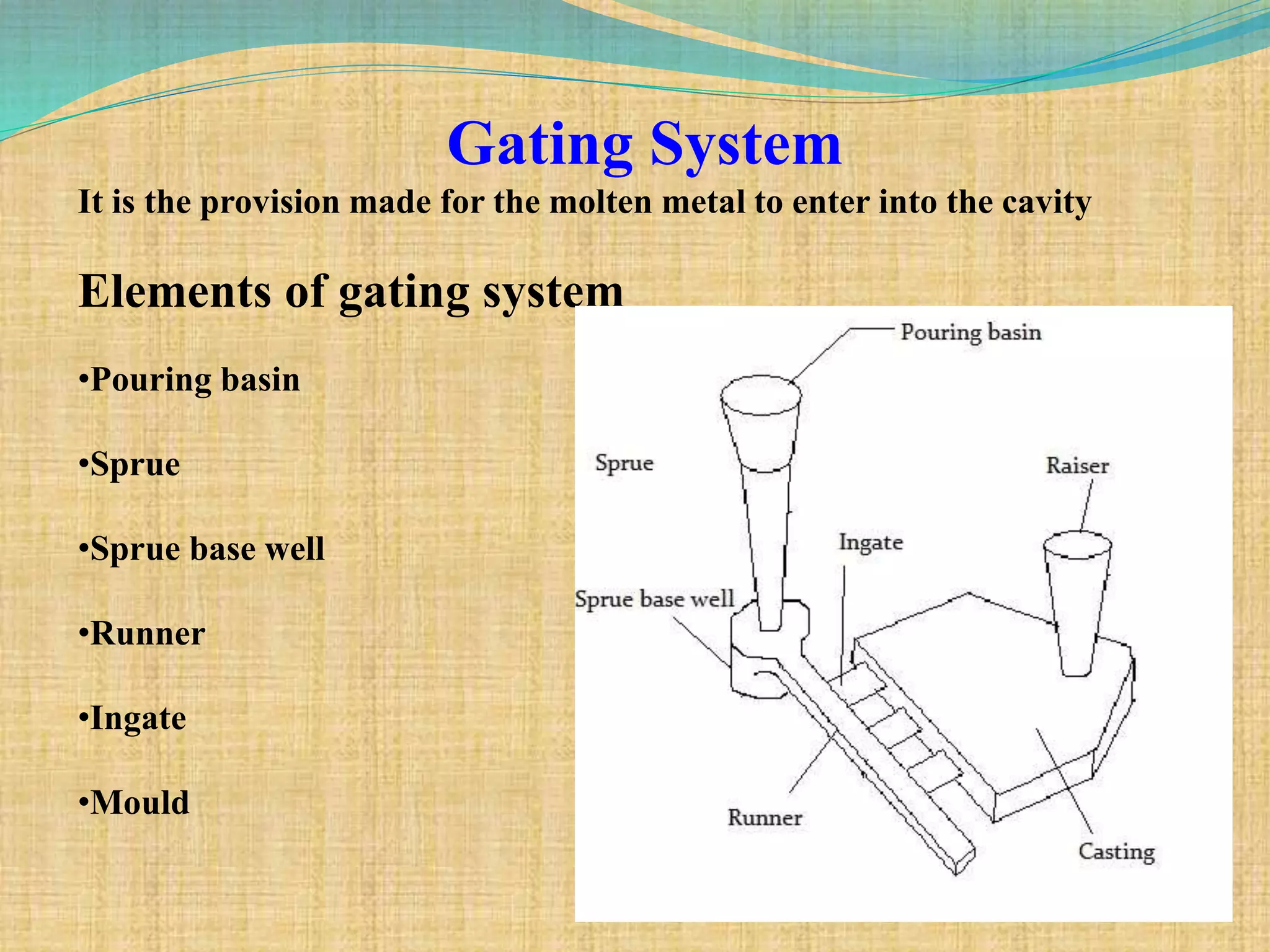
Gating System
It is the provision made for the molten metal to enter into the cavity
Elements of gating system
•Pouring basin
•Sprue
•Sprue base well
•Runner
•Ingate
•Mould
Special Casting Methods
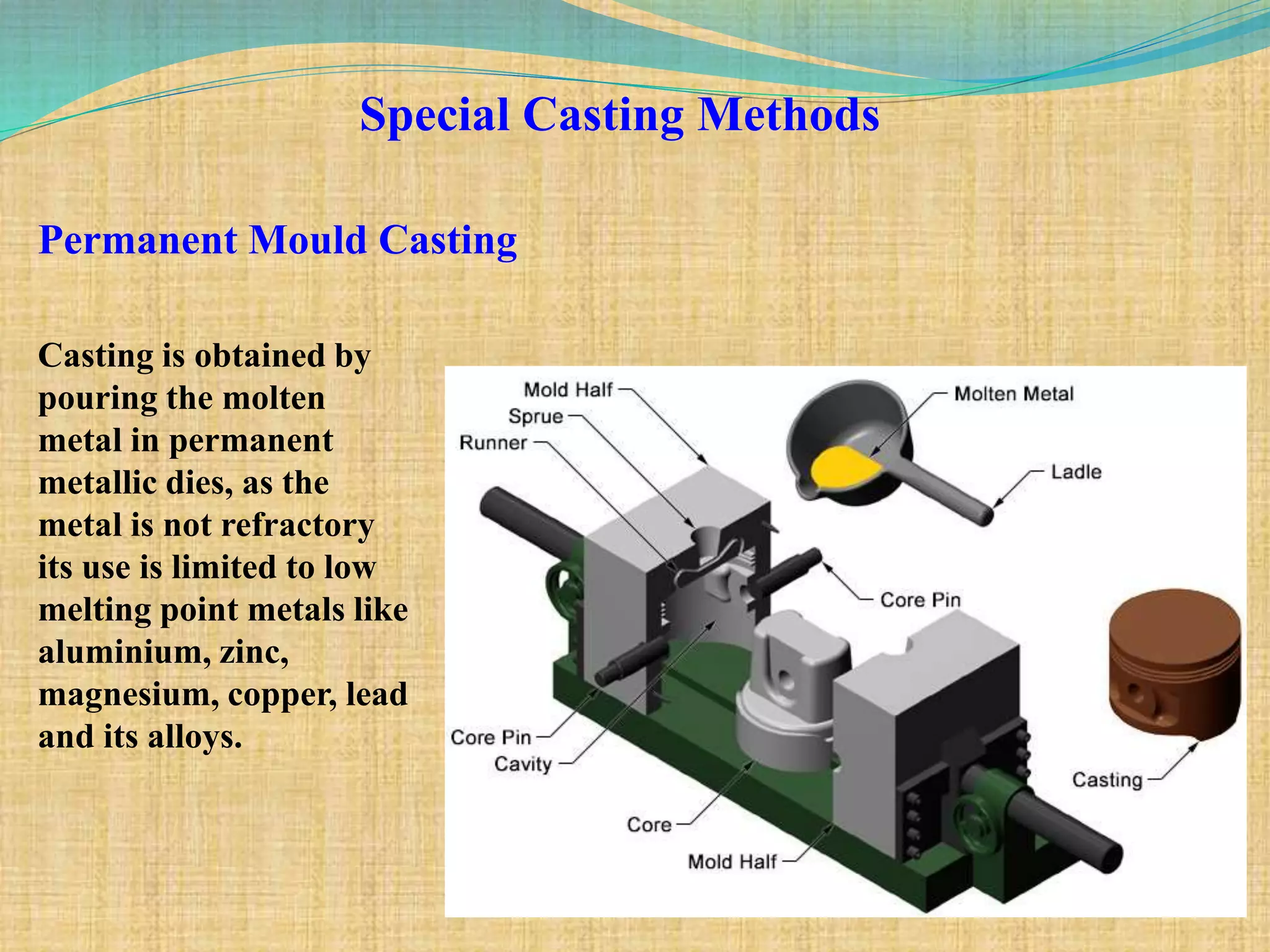
Permanent Mould Casting
Casting is obtained by
pouring the molten
metal in permanent
metallic dies, as the
metal is not refractory
its use is limited to low
melting point metals like
aluminium, zinc,
magnesium, copper, lead
and its alloys.
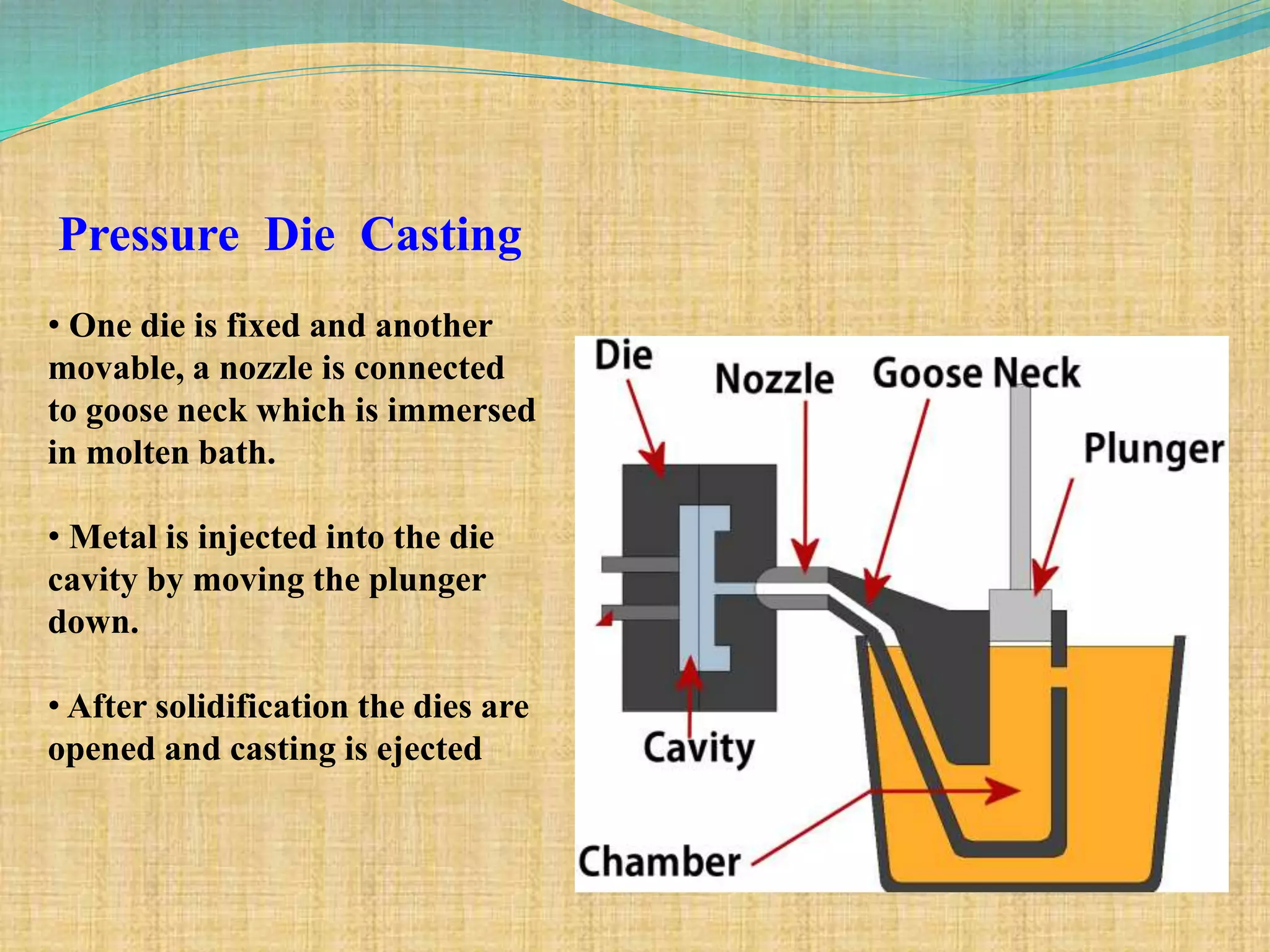
Pressure Die Casting
• One die is fixed and another
movable, a nozzle is connected
to goose neck which is immersed
in molten bath.
• Metal is injected into the die
cavity by moving the plunger
down.
• After solidification the dies are
opened and casting is ejected
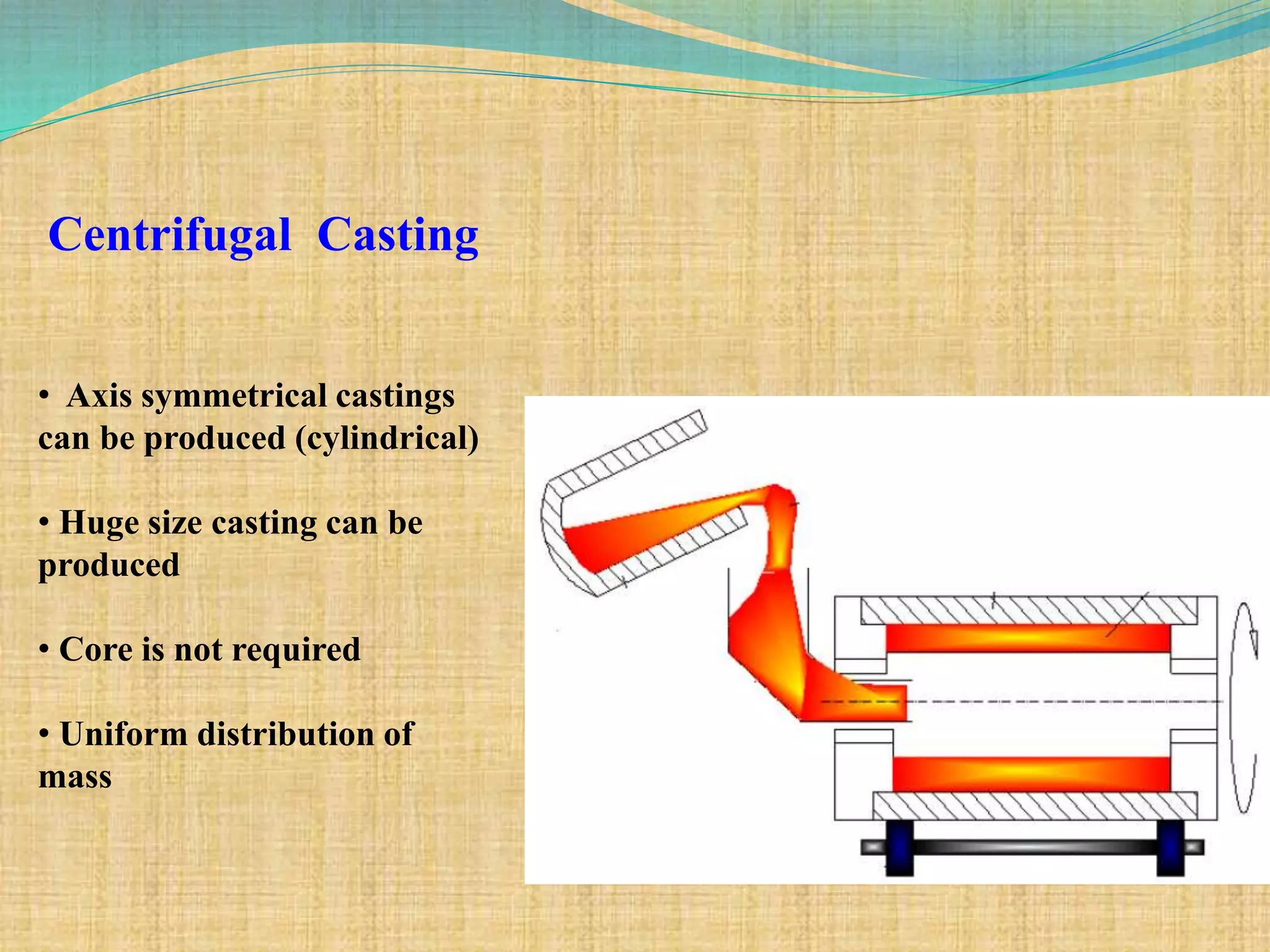
Centrifugal Casting
• Axis symmetrical castings
can be produced (cylindrical)
• Huge size casting can be
produced
• Core is not required
• Uniform distribution of
mass
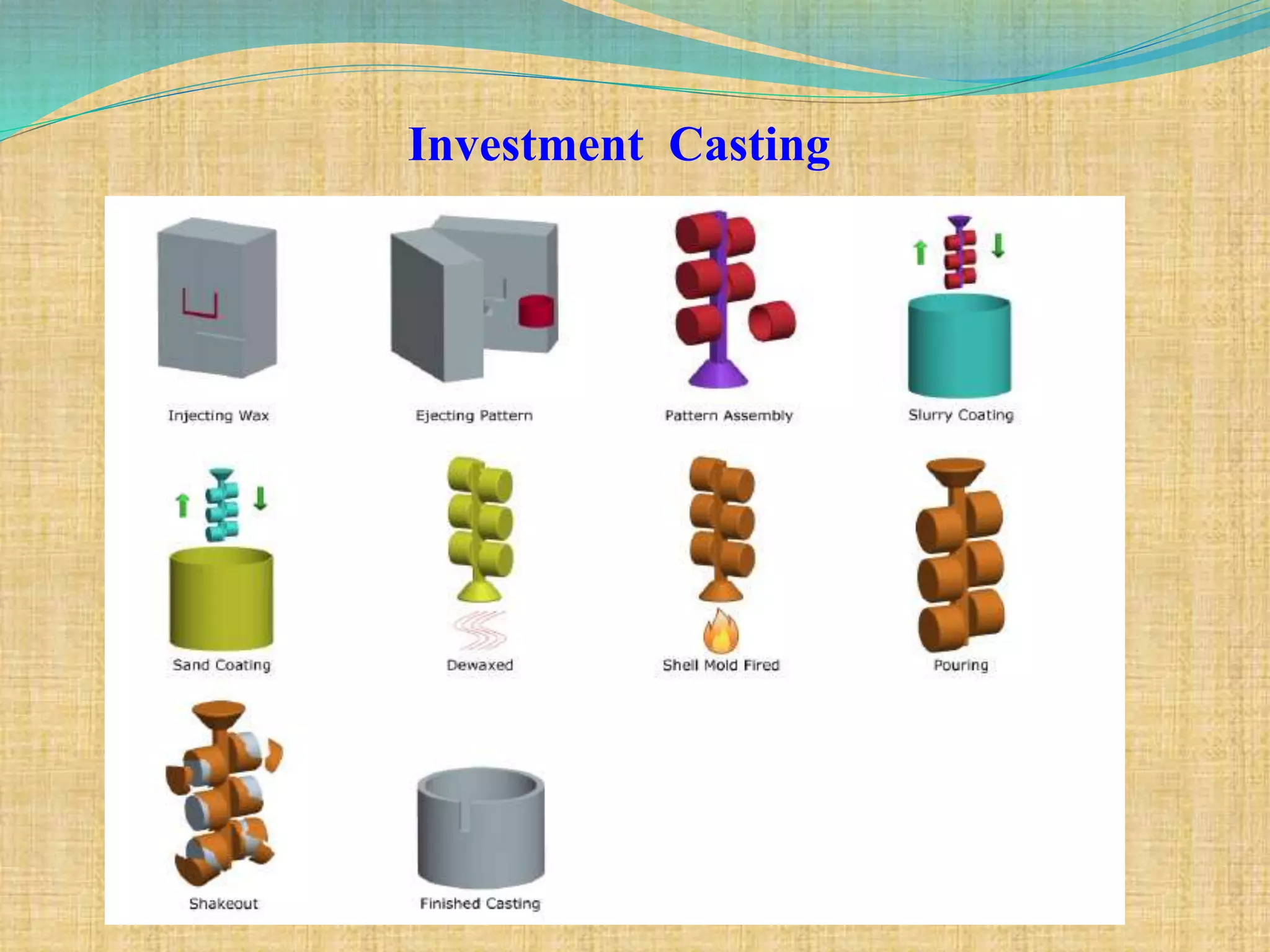
Investment Casting
Casting Defects
1. Blow holes : It is smooth almost spherical bubble inside the
casting.
2. Shrinkage cavity : It is flat rough cavity formed due to improper
design of gating system.
3. Hot cracks : Smooth edged single cracks formed due to
differential contraction of the casting
4. Cold cracks : Sharp edged branched cracks formed due to
improper handling of castings
5. Misrun : It is incomplete casting resulting from incomplete filling
of mould
6. Cold shut : It is incomplete fusion of two streams of liquid metals
7. Runout : Leakage of molten metal from parting plane.
8. Mis match : It is due to improper matching of cope and drag
parts of the casting
Inspection of Casting
1. Visual Inspection : Common defects such as rough surface, shifts,
surface cracks can be detected by a visual inspection of casting
2. Pressure Test : The pressure test is conducted on a casting to be used
as a pressure vessel.
3. Magnetic Particle Inspection : It is practised to check for very small
voids and cracks at or just below the surface of a casting of a
ferromagnetic material.
4. Dye-Penetrant Test : This method is used to detect invisible surface
defects in a nonmagnetic casting. The casting is sprayed by a dye
containing a fluorescent material. The surface to be inspected is then
wiped,dried and viewed in dark.
5. Ultrasonic Inspection : An oscillator is used to send an ultrasonic signal
through the casting . The signal is transmitted through the casting and
any discontinuity will reflect the signal back.
References
• Production Technology by ACE
• http://www.custompartnet.com/wu/SandCasting
•http://thelibraryofmanufacturing.com/metalcasting
_basics.html
• http://www.castingstechnology.com/
Casting technique

Casting technique

  • 1.
    MUFFAKHAM JAH COLLEGE OFENGINEERING AND TECHNOLOGY Title : Casting Technique Md Naseeruddin Shah 1604-11-736-072
  • 2.
  • 3.
    Contents  History  Needof casting  Classification of casting  Sand casting  Special casting methods  Casting defects  Inspection of casting  Reference
  • 4.
    History  Origins backto around 3,600 B.C at Mesopotamia  Bronze was melted and poured into a mould.  Good flow property of Iron at 1150 degree C have enabled the casting of iron.
  • 5.
    Need Of Casting Can produce a wide variety of metal components with complex geometries.  Castings of great size and weight can be produced.
  • 6.
    Classification Of CastingProcess  Sand Casting  Special Casting Methods  Permanent Mould Casting  Pressure Die Casting  Centrifugal Casting  Investment Casting
  • 7.
    Equipments  Cope anddrag  Sand  Pattern  Molten metal Sand Casting
  • 8.
    Governing Equations  Bernoulli'sprinciple : For an inviscid flow of a non- conducting fluid, an increase in the speed of the fluid occurs simultaneously with a decrease in pressure or a decrease in the fluid's potential energy.  Continuity Equation : Mass entering is equal to mass leaving
  • 9.
    Mould making : Mouldingsand consists of three basic elements 1) Silica sand particles (75-80%) : Used for producing required strength of mould 2) Clay (15-20) : Used for producing bond between the sand particles. 3) Water or sodium silicate (6-8%) : Used for initiating the formation of bond between the sand particles
  • 10.
    Properties of mouldingsand 1) Porosity property : The ability of escaping the air or gases through the moulding sand 2) Cohesiveness property : The ability to form bond between same material particles. 3) Adhesiveness : The ability of bond formation of sand particles with other materials 4) Refractoriness : The ability of withstanding higher temperature without loosing its strength and hardness. 5) Collapsibility : The ability of breaking the mould with little amount of force 6) Flowability : The ability of flowing of moulding sand into each and every corner of the mould.
  • 11.
    Pattern Pattern is thereplica of casting to be made. Pattern size = casting size ± allowances Allowances 1) Shrinkage allowance : Shrinkage of metal during cooling 2) Machining allowance : The extra material provided on the pattern 3) Draft allowance : Making the vertical surface of pattern into incline 4) Shake allowance : Provided to avoid the damages during removing of pattern 5) Distortion allowance : Distortion of shape due to differential cooling
  • 12.
    Gating System It isthe provision made for the molten metal to enter into the cavity Elements of gating system •Pouring basin •Sprue •Sprue base well •Runner •Ingate •Mould
  • 13.
    Special Casting Methods PermanentMould Casting Casting is obtained by pouring the molten metal in permanent metallic dies, as the metal is not refractory its use is limited to low melting point metals like aluminium, zinc, magnesium, copper, lead and its alloys.
  • 14.
    Pressure Die Casting •One die is fixed and another movable, a nozzle is connected to goose neck which is immersed in molten bath. • Metal is injected into the die cavity by moving the plunger down. • After solidification the dies are opened and casting is ejected
  • 15.
    Centrifugal Casting • Axissymmetrical castings can be produced (cylindrical) • Huge size casting can be produced • Core is not required • Uniform distribution of mass
  • 16.
  • 17.
    Casting Defects 1. Blowholes : It is smooth almost spherical bubble inside the casting. 2. Shrinkage cavity : It is flat rough cavity formed due to improper design of gating system. 3. Hot cracks : Smooth edged single cracks formed due to differential contraction of the casting 4. Cold cracks : Sharp edged branched cracks formed due to improper handling of castings 5. Misrun : It is incomplete casting resulting from incomplete filling of mould 6. Cold shut : It is incomplete fusion of two streams of liquid metals 7. Runout : Leakage of molten metal from parting plane. 8. Mis match : It is due to improper matching of cope and drag parts of the casting
  • 18.
    Inspection of Casting 1.Visual Inspection : Common defects such as rough surface, shifts, surface cracks can be detected by a visual inspection of casting 2. Pressure Test : The pressure test is conducted on a casting to be used as a pressure vessel. 3. Magnetic Particle Inspection : It is practised to check for very small voids and cracks at or just below the surface of a casting of a ferromagnetic material. 4. Dye-Penetrant Test : This method is used to detect invisible surface defects in a nonmagnetic casting. The casting is sprayed by a dye containing a fluorescent material. The surface to be inspected is then wiped,dried and viewed in dark. 5. Ultrasonic Inspection : An oscillator is used to send an ultrasonic signal through the casting . The signal is transmitted through the casting and any discontinuity will reflect the signal back.
  • 19.
    References • Production Technologyby ACE • http://www.custompartnet.com/wu/SandCasting •http://thelibraryofmanufacturing.com/metalcasting _basics.html • http://www.castingstechnology.com/