How to be an organised
MSc/MA/Mres/PhD
student
Dr. Caspar Addyman
Birkbeck Babylab
@BrainStraining
What’s the point of a Masters or Doctorate?
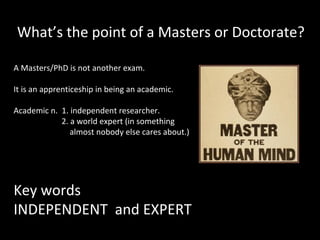
A Masters/PhD is not another exam.
It is an apprenticeship in being an academic.
Academic n. 1. independent researcher.
2. a world expert (in something
almost nobody else cares about.)

Key words
INDEPENDENT and EXPERT
Independence
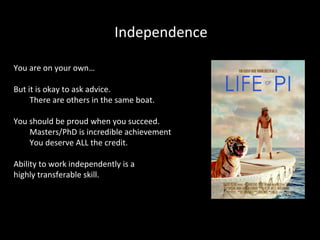
You are on your own…
But it is okay to ask advice.
There are others in the same boat.
You should be proud when you succeed.
Masters/PhD is incredible achievement
You deserve ALL the credit.
Ability to work independently is a
highly transferable skill.
Expertise
The bad news
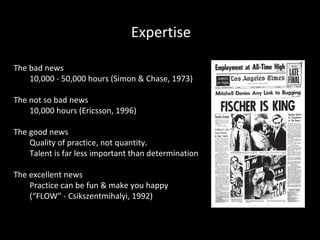
10,000 - 50,000 hours (Simon & Chase, 1973)
The not so bad news
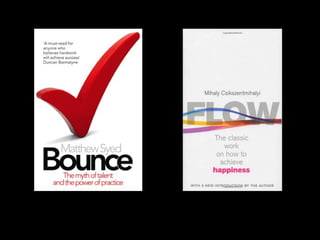
10,000 hours (Ericsson, 1996)
The good news
Quality of practice, not quantity.
Talent is far less important than determination
The excellent news
Practice can be fun & make you happy
(“FLOW” - Csikszentmihalyi, 1992)
The secret is to make better use of your time
1.

Meta-cognitive awareness
Being aware of your bad habits will
lead to good ones

2.

Work smarter, not harder
According to the experts.

3.

Technology
Your enemy and your friend.

4.

How to read
Tips on active reading of literature

5.

Final tips
1. Metacognitive awareness
We all have different strengths and weaknesses
AND THAT’S OKAY!!
Doesn’t mean you have to accept it
Play to your strengths
Work at your weaknesses
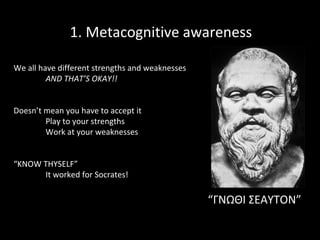
“KNOW THYSELF”
It worked for Socrates!

“ΓΝΩΘΙ ΣΕΑΥΤΟΝ”
Metacognitive Awareness Questionnaire
KNOWLEDGE ABOUT COGNITION
What type of learner are you?
1.Procedural – Learn by doing

>

Jump straight in

2.Declarative – Learn well from ‘facts’

>

Read widely.

1.Conditional/Contextual – Need background
knowledge & motivation

>

Evaluate your goals.

(Schraw & Dennison, 1994)
http://www.scribd.com/doc/175728784
Metacognitive Awareness Questionnaire
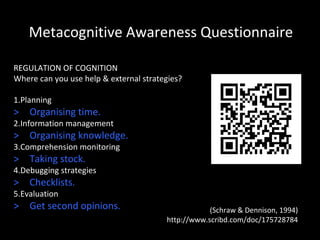
REGULATION OF COGNITION
Where can you use help & external strategies?
1.Planning

>

Organising time.

>

Organising knowledge.

>

Taking stock.

>

Checklists.

>

Get second opinions.

2.Information management

3.Comprehension monitoring
4.Debugging strategies
5.Evaluation

(Schraw & Dennison, 1994)
http://www.scribd.com/doc/175728784
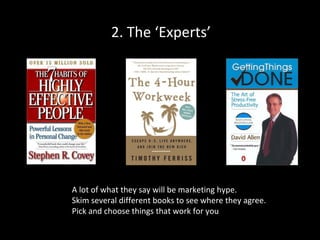
2. The ‘Experts’

A lot of what they say will be marketing hype.
Skim several different books to see where they agree.
Pick and choose things that work for you
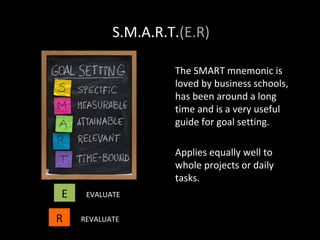
S.M.A.R.T.(E.R)
The SMART mnemonic is
loved by business schools,
has been around a long
time and is a very useful
guide for goal setting.
Applies equally well to
whole projects or daily
tasks.

E
R

EVALUATE
REVALUATE
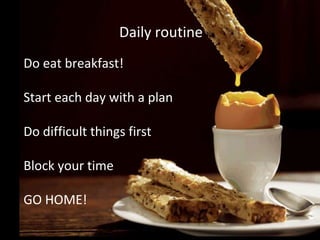
Daily routine
Do eat breakfast!
Start each day with a plan
Do difficult things first
Block your time
GO HOME!
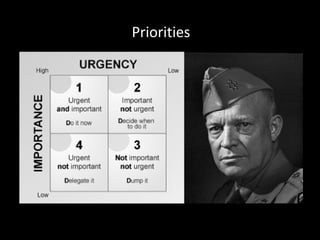
Priorities
3. Technology is your enemy
Thousands of new ways to
procrastinate
Variable time reinforcements in
Facebook, etc. are incredibly
addictive.
Divided attention & task
switching hurt your productivity
Despite 30 years to get it right
Microsoft Office products still
crash and lose your work.
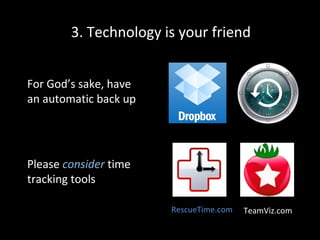
3. Technology is your friend
For God’s sake, have
an automatic back up

Please consider time
tracking tools
RescueTime.com

TeamViz.com
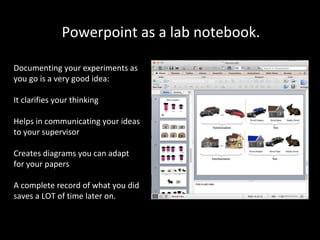
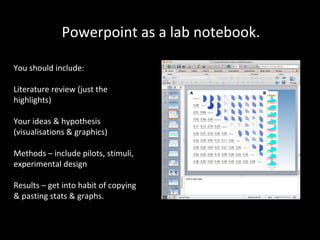
Powerpoint as a lab notebook.
Documenting your experiments as
you go is a very good idea:
It clarifies your thinking
Helps in communicating your ideas
to your supervisor
Creates diagrams you can adapt
for your papers
A complete record of what you did
saves a LOT of time later on.
Powerpoint as a lab notebook.
You should include:
Literature review (just the
highlights)
Your ideas & hypothesis
(visualisations & graphics)
Methods – include pilots, stimuli,
experimental design
Results – get into habit of copying
& pasting stats & graphs.
Researchers online
Twitter & Blogs:
Follow specialists in your field
and science communicators
e.g. @deevybee, @vaughanbell,
@brainstraining, @edyong209
and @YOU!

Academic social networks:
Keep you abreast of new
research, share your papers,
ask questions.
Reference management
Papers/citations are the
currency of academia.
Reviewers & examiners pay
most attention to references.
Reference management
software makes organising,
handling & using papers &
citations easy.
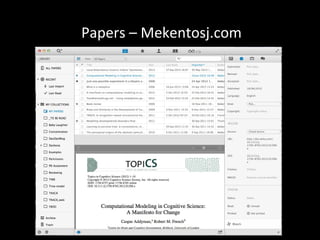
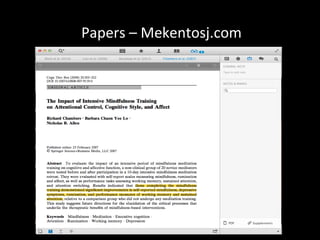
Papers – Mekentosj.com
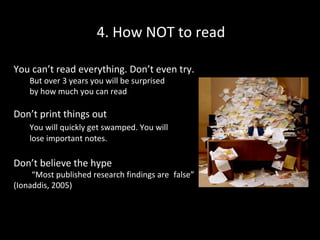
4. How NOT to read
You can’t read everything. Don’t even try.
But over 3 years you will be surprised
by how much you can read

Don’t print things out
You will quickly get swamped. You will
lose important notes.

Don’t believe the hype

“Most published research findings are false”
(Ionaddis, 2005)
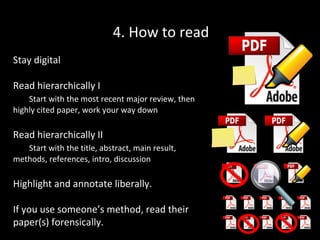
4. How to read
Stay digital
Read hierarchically I
Start with the most recent major review, then
highly cited paper, work your way down

Read hierarchically II
Start with the title, abstract, main result,
methods, references, intro, discussion

Highlight and annotate liberally.
If you use someone’s method, read their
paper(s) forensically.
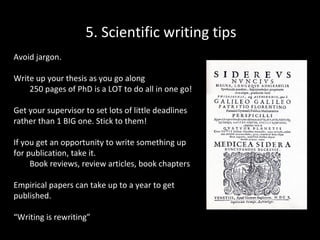
5. Scientific writing tips
Avoid jargon.
Write up your thesis as you go along
250 pages of PhD is a LOT to do all in one go!
Get your supervisor to set lots of little deadlines
rather than 1 BIG one. Stick to them!
If you get an opportunity to write something up
for publication, take it.
Book reviews, review articles, book chapters
Empirical papers can take up to a year to get
published.
“Writing is rewriting”
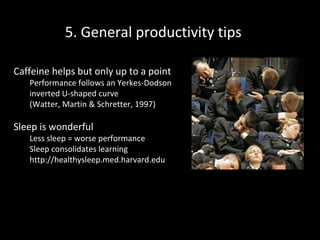
5. General productivity tips
Caffeine helps but only up to a point

Performance follows an Yerkes-Dodson
inverted U-shaped curve
(Watter, Martin & Schretter, 1997)

Sleep is wonderful

Less sleep = worse performance
Sleep consolidates learning
http://healthysleep.med.harvard.edu
5. General productivity tips
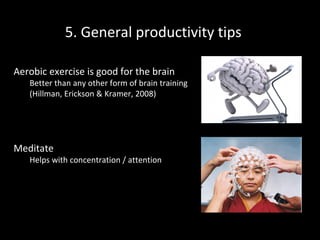
Aerobic exercise is good for the brain

Better than any other form of brain training
(Hillman, Erickson & Kramer, 2008)

Meditate

Helps with concentration / attention
Thank you for your time.
@BrainStraining

This presentation is available at
http://www.scribd.com/doc/176137593/

How to be an organised MSc/MA/Mres/PhD student

  • 1.
    How to bean organised MSc/MA/Mres/PhD student Dr. Caspar Addyman Birkbeck Babylab @BrainStraining
  • 2.
    What’s the pointof a Masters or Doctorate? A Masters/PhD is not another exam. It is an apprenticeship in being an academic. Academic n. 1. independent researcher. 2. a world expert (in something almost nobody else cares about.) Key words INDEPENDENT and EXPERT
  • 3.
    Independence You are onyour own… But it is okay to ask advice. There are others in the same boat. You should be proud when you succeed. Masters/PhD is incredible achievement You deserve ALL the credit. Ability to work independently is a highly transferable skill.
  • 4.
    Expertise The bad news 10,000- 50,000 hours (Simon & Chase, 1973) The not so bad news 10,000 hours (Ericsson, 1996) The good news Quality of practice, not quantity. Talent is far less important than determination The excellent news Practice can be fun & make you happy (“FLOW” - Csikszentmihalyi, 1992)
  • 6.
    The secret isto make better use of your time 1. Meta-cognitive awareness Being aware of your bad habits will lead to good ones 2. Work smarter, not harder According to the experts. 3. Technology Your enemy and your friend. 4. How to read Tips on active reading of literature 5. Final tips
  • 7.
    1. Metacognitive awareness Weall have different strengths and weaknesses AND THAT’S OKAY!! Doesn’t mean you have to accept it Play to your strengths Work at your weaknesses “KNOW THYSELF” It worked for Socrates! “ΓΝΩΘΙ ΣΕΑΥΤΟΝ”
  • 8.
    Metacognitive Awareness Questionnaire KNOWLEDGEABOUT COGNITION What type of learner are you? 1.Procedural – Learn by doing > Jump straight in 2.Declarative – Learn well from ‘facts’ > Read widely. 1.Conditional/Contextual – Need background knowledge & motivation > Evaluate your goals. (Schraw & Dennison, 1994) http://www.scribd.com/doc/175728784
  • 9.
    Metacognitive Awareness Questionnaire REGULATIONOF COGNITION Where can you use help & external strategies? 1.Planning > Organising time. > Organising knowledge. > Taking stock. > Checklists. > Get second opinions. 2.Information management 3.Comprehension monitoring 4.Debugging strategies 5.Evaluation (Schraw & Dennison, 1994) http://www.scribd.com/doc/175728784
  • 10.
    2. The ‘Experts’ Alot of what they say will be marketing hype. Skim several different books to see where they agree. Pick and choose things that work for you
  • 11.
    S.M.A.R.T.(E.R) The SMART mnemonicis loved by business schools, has been around a long time and is a very useful guide for goal setting. Applies equally well to whole projects or daily tasks. E R EVALUATE REVALUATE
  • 12.
    Daily routine Do eatbreakfast! Start each day with a plan Do difficult things first Block your time GO HOME!
  • 13.
  • 14.
    3. Technology isyour enemy Thousands of new ways to procrastinate Variable time reinforcements in Facebook, etc. are incredibly addictive. Divided attention & task switching hurt your productivity Despite 30 years to get it right Microsoft Office products still crash and lose your work.
  • 15.
    3. Technology isyour friend For God’s sake, have an automatic back up Please consider time tracking tools RescueTime.com TeamViz.com
  • 16.
    Powerpoint as alab notebook. Documenting your experiments as you go is a very good idea: It clarifies your thinking Helps in communicating your ideas to your supervisor Creates diagrams you can adapt for your papers A complete record of what you did saves a LOT of time later on.
  • 17.
    Powerpoint as alab notebook. You should include: Literature review (just the highlights) Your ideas & hypothesis (visualisations & graphics) Methods – include pilots, stimuli, experimental design Results – get into habit of copying & pasting stats & graphs.
  • 18.
    Researchers online Twitter &Blogs: Follow specialists in your field and science communicators e.g. @deevybee, @vaughanbell, @brainstraining, @edyong209 and @YOU! Academic social networks: Keep you abreast of new research, share your papers, ask questions.
  • 19.
    Reference management Papers/citations arethe currency of academia. Reviewers & examiners pay most attention to references. Reference management software makes organising, handling & using papers & citations easy.
  • 20.
  • 21.
  • 22.
    4. How NOTto read You can’t read everything. Don’t even try. But over 3 years you will be surprised by how much you can read Don’t print things out You will quickly get swamped. You will lose important notes. Don’t believe the hype “Most published research findings are false” (Ionaddis, 2005)
  • 23.
    4. How toread Stay digital Read hierarchically I Start with the most recent major review, then highly cited paper, work your way down Read hierarchically II Start with the title, abstract, main result, methods, references, intro, discussion Highlight and annotate liberally. If you use someone’s method, read their paper(s) forensically.
  • 24.
    5. Scientific writingtips Avoid jargon. Write up your thesis as you go along 250 pages of PhD is a LOT to do all in one go! Get your supervisor to set lots of little deadlines rather than 1 BIG one. Stick to them! If you get an opportunity to write something up for publication, take it. Book reviews, review articles, book chapters Empirical papers can take up to a year to get published. “Writing is rewriting”
  • 25.
    5. General productivitytips Caffeine helps but only up to a point Performance follows an Yerkes-Dodson inverted U-shaped curve (Watter, Martin & Schretter, 1997) Sleep is wonderful Less sleep = worse performance Sleep consolidates learning http://healthysleep.med.harvard.edu
  • 26.
    5. General productivitytips Aerobic exercise is good for the brain Better than any other form of brain training (Hillman, Erickson & Kramer, 2008) Meditate Helps with concentration / attention
  • 27.
    Thank you foryour time. @BrainStraining This presentation is available at http://www.scribd.com/doc/176137593/

Editor's Notes

  • #2 {"1":"Some people very successful\nSurprisingly low correlation between talent and success across many disciplines\n"}