Time Management Tips
Your Presenter
Jacqueline Frank
Instruction & Accessibility Librarian
Jacqueline.frank@montana.edu
406-994-4978
Ask the Library
 Chat, email, & schedule appointments
 ask.lib.montana.edu
Outline
 Benefits of time management
 Quick tips
 A few specific methods
 Tools you can use
 What works for you?
 Questions
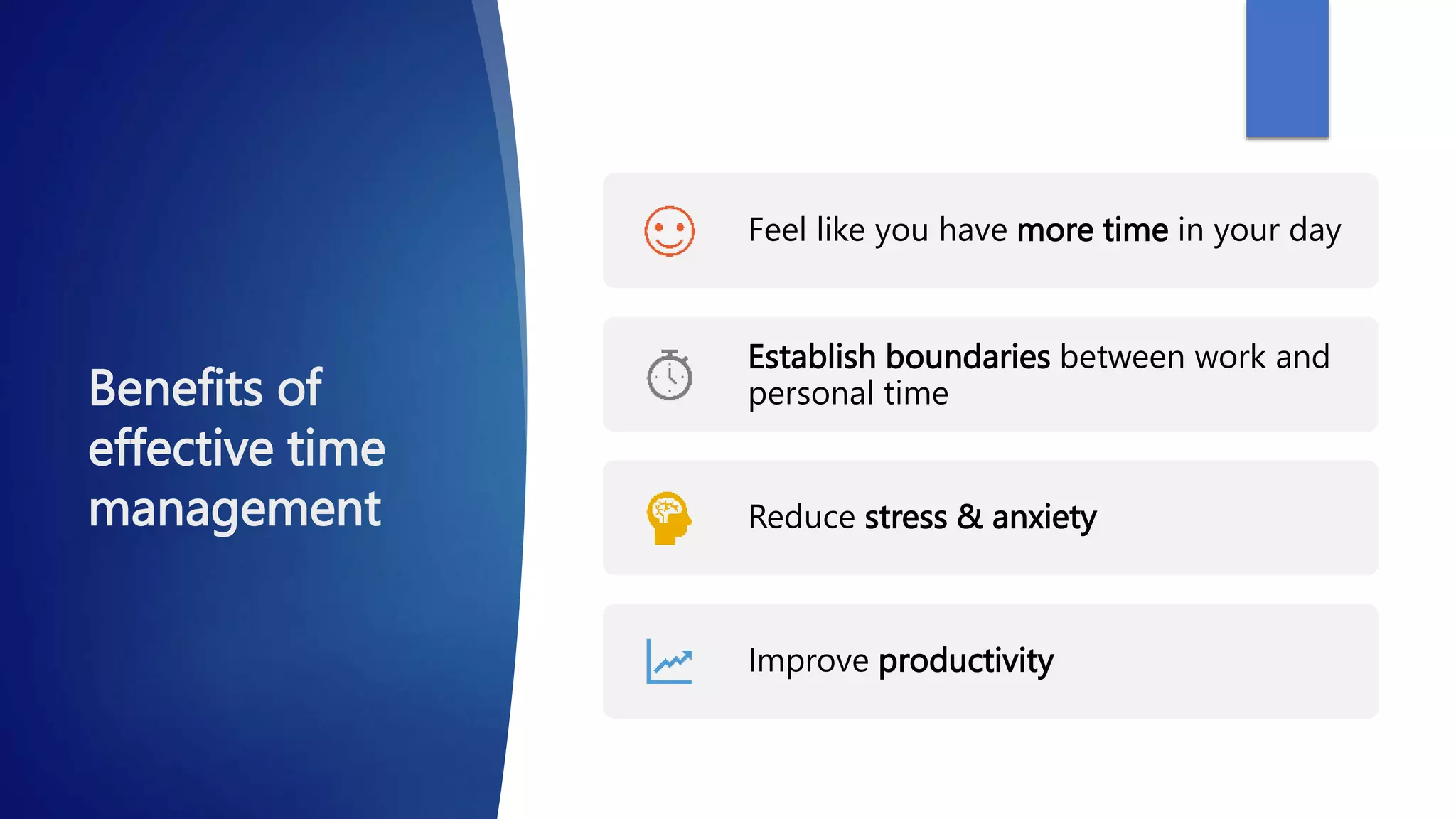
Benefits of
effective time
management
Feel like you have more time in your day
Establish boundaries between work and
personal time
Reduce stress & anxiety
Improve productivity
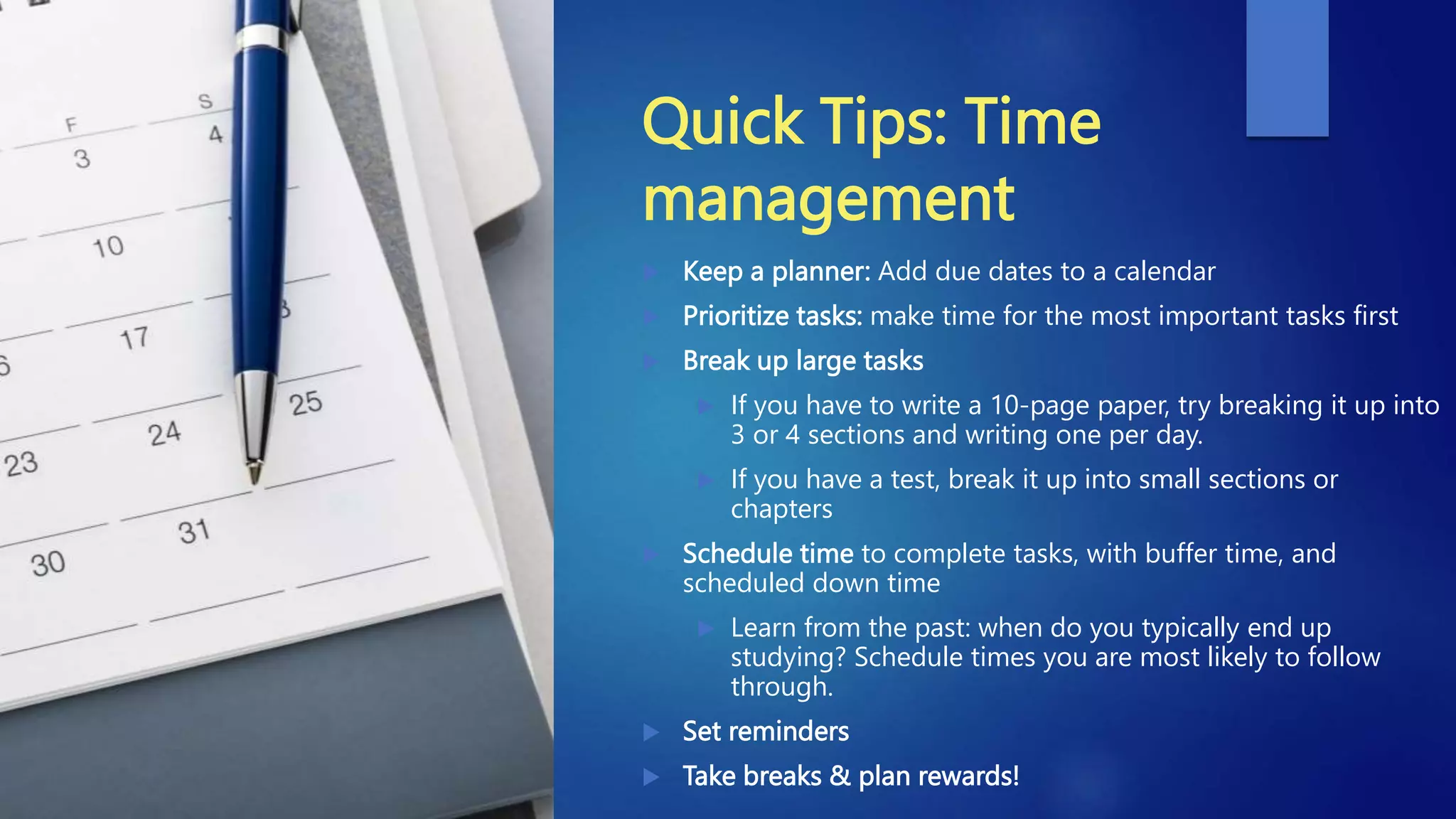
Quick Tips: Time
management
 Keep a planner: Add due dates to a calendar
 Prioritize tasks: make time for the most important tasks first
 Break up large tasks
 If you have to write a 10-page paper, try breaking it up into
3 or 4 sections and writing one per day.
 If you have a test, break it up into small sections or
chapters
 Schedule time to complete tasks, with buffer time, and
scheduled down time
 Learn from the past: when do you typically end up
studying? Schedule times you are most likely to follow
through.
 Set reminders
 Take breaks & plan rewards!
Strategies: Pomodoro
Method
 25 minutes of work, followed by a 5 minute break.
 You can change the suggested timeframe, based on
what works for you
 Repeat the process, and after the fourth working
session, take a longer 20-30 minute break.
Strategies: Eat
the Frog
Mark Twain famously said, “If it’s your job to eat a
frog, it’s best to do it first thing in the morning.”
Tackle big or complex tasks first before working on
your less important items.
Ensure you’re getting to your most important work
every day
Gives sense of accomplishment
Reduced stress & anxiety, and frees up mental space
to keep tackling smaller items on your to do list
Strategies: Pareto Principle
The opposite of the Eat The Frog method
Encourages you to get quick tasks out of the way, so you can feel more accomplished
and motivated as you head into your day
Gives sense of accomplishment
The“80/20 rule”  Spend 20% of your time on 80% of your work (the small tasks).
 This frees up your workday to tackle the 20% of your work (the big
tasks) that will take 80% of your time.
Strategies:
Study with a
Partner
Study with a partner,
if it works for you
Ask to hold each
other accountable,
at least 80% of the
time
Divy it up: make a plan to review
different sections & ‘present’ to each
other
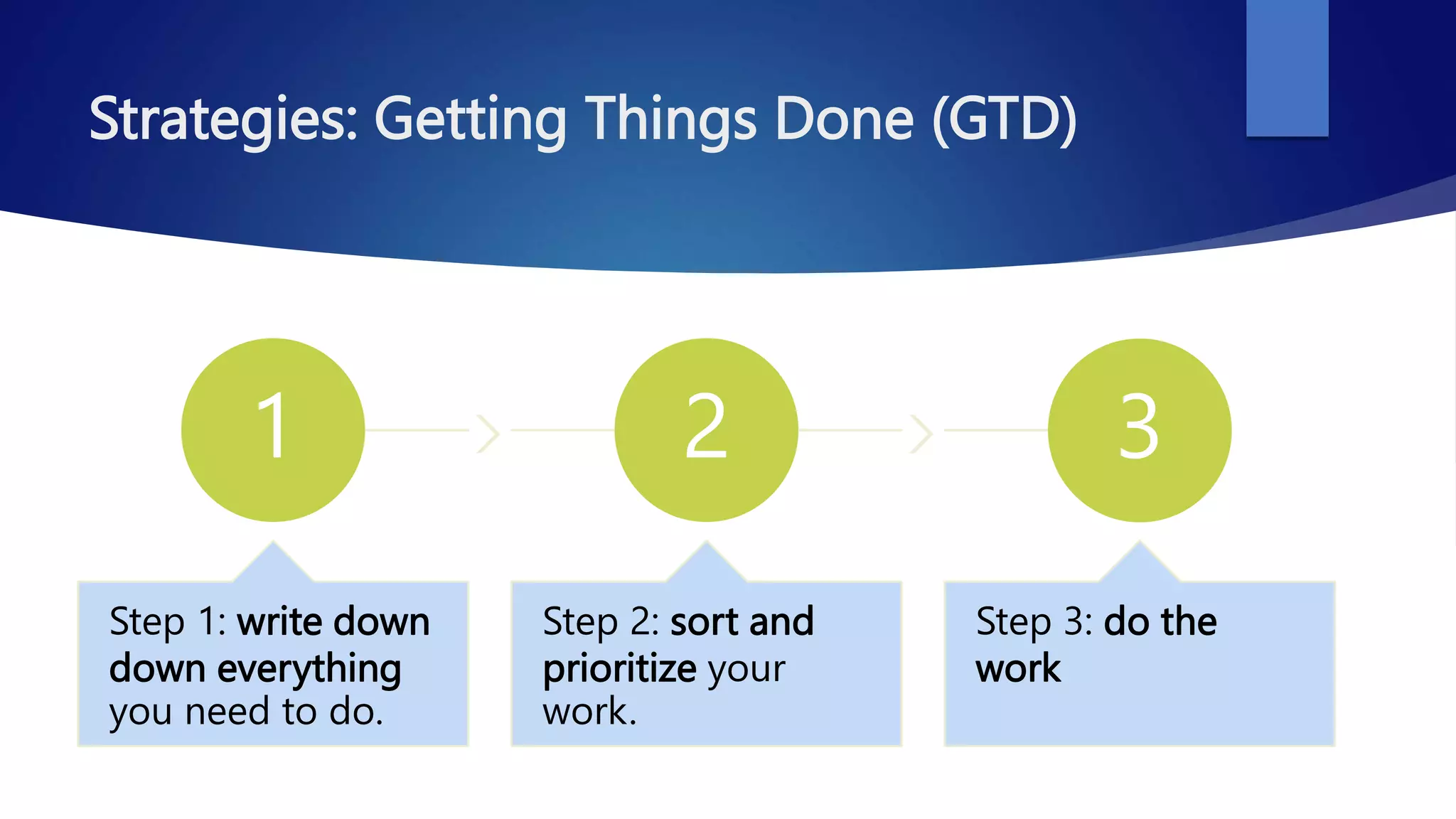
Strategies: Getting Things Done (GTD)
1
Step 1: write down
down everything
you need to do.
2
Step 2: sort and
prioritize your
work.
3
Step 3: do the
work
Get
motivated
 Connect tasks to larger
goals: for example, my
goal is to graduate so I
need to complete my
work and study
 Remember the feeling
of accomplishment after
completing a task, and
look forward to having
that feeling again
Starting a task
 Do a body check:
 are you hungry? Thirsty? Cold? Etc.
 Make yourself comfortable
 Start with a 2 minute mind-dump: write your to-
do list, what your thinking or worried about
 Re-read your assignment
 Consider making a list of the criteria, such as word
count, number of references for a paper, or number
of chapters or sections to study
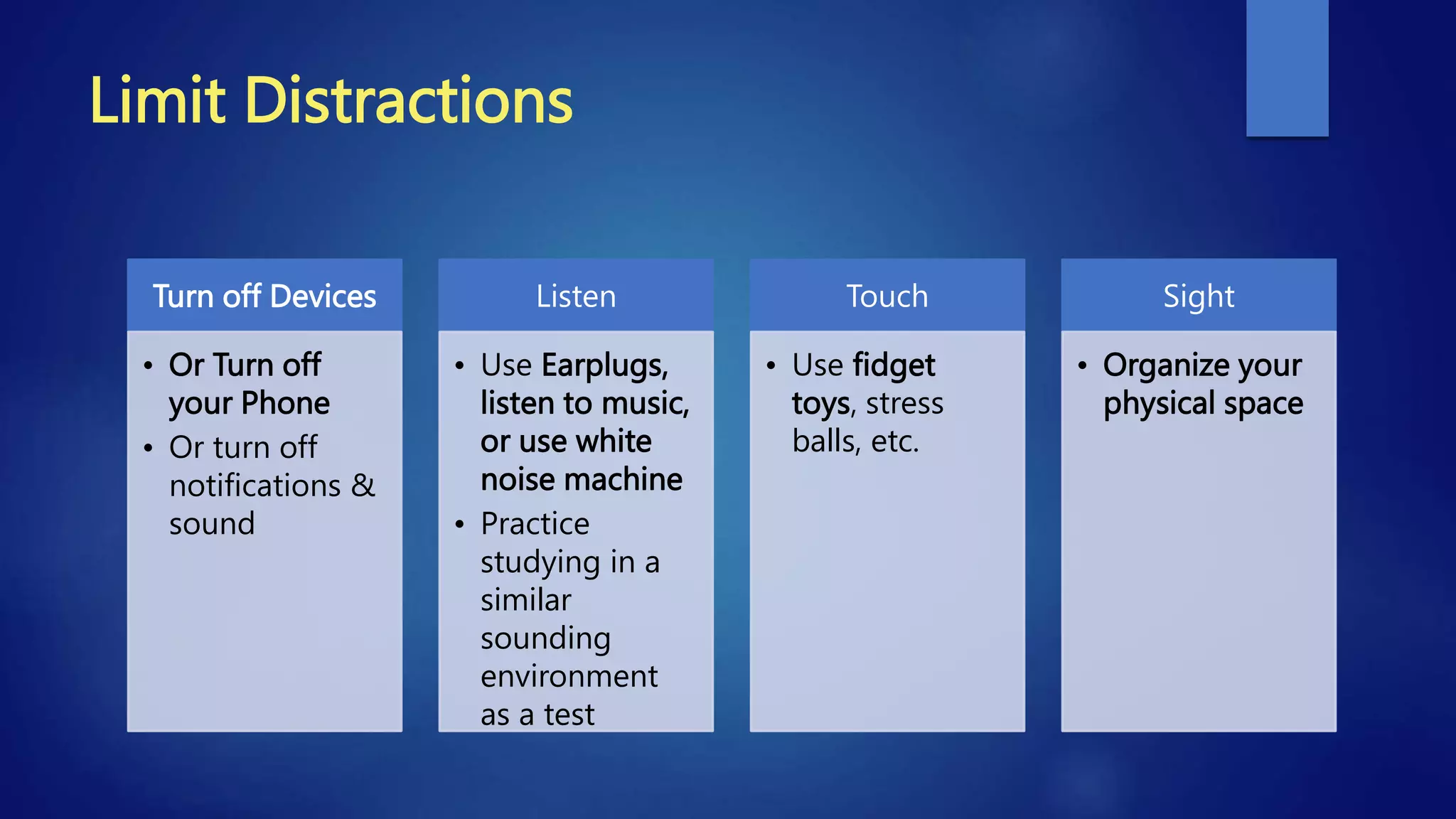
Limit Distractions
Turn off Devices
• Or Turn off
your Phone
• Or turn off
notifications &
sound
Listen
• Use Earplugs,
listen to music,
or use white
noise machine
• Practice
studying in a
similar
sounding
environment
as a test
Touch
• Use fidget
toys, stress
balls, etc.
Sight
• Organize your
physical space
Set yourself up for
success with
self care
 Sleep problems are associated with a
poorer working memory (Sciberras,
et. al., 2015)
 Routine helps: get up & go to bed the
same time each day
 Avoid caffeine after noon
 Avoid screens before bed time
 Exercise can help focus
 Eat nutritious foods for your brain
 Relax and do something you enjoy
Tools you can
use
 Pomodoro Timer
 Focus Booster, etc.
 Time on your phone or device
 Planners
 Physical planner
 Online calendar
 Apps: Reminders app, Evernote,
Trello, etc.
 Assignment Calculator (from
University of Minnesota)
This Photo by Unknown Author is licensed under CC BY-NC
References & resources
 https://asana.com/resources/time-management-tips.
 https://www.purdueglobal.edu/blog/student-life/time-management-busy-college-students/
 https://todayslearner.cengage.com/build-your-students-time-management-skills/
 https://students.dartmouth.edu/academic-skills/learning-resources/time-management-tips
 https://www.indeed.com/lead/time-management-
strategies?gclid=CjwKCAjwov6hBhBsEiwAvrvN6FqmoFOSm7z1fr14-AnQY_AIjgu0zh-
sxWHBl_k1qskvUBkx_Ib5-RoCuRQQAvD_BwE&gbraid=123&aceid=&gclsrc=aw.ds
Get Help: Ask
the Library
 ask.lib.montana.edu/
 Chat
 Email
 Schedule an online appointment

Time Management Tips

  • 1.
  • 2.
    Your Presenter Jacqueline Frank Instruction& Accessibility Librarian Jacqueline.frank@montana.edu 406-994-4978 Ask the Library  Chat, email, & schedule appointments  ask.lib.montana.edu
  • 3.
    Outline  Benefits oftime management  Quick tips  A few specific methods  Tools you can use  What works for you?  Questions
  • 4.
    Benefits of effective time management Feellike you have more time in your day Establish boundaries between work and personal time Reduce stress & anxiety Improve productivity
  • 5.
    Quick Tips: Time management Keep a planner: Add due dates to a calendar  Prioritize tasks: make time for the most important tasks first  Break up large tasks  If you have to write a 10-page paper, try breaking it up into 3 or 4 sections and writing one per day.  If you have a test, break it up into small sections or chapters  Schedule time to complete tasks, with buffer time, and scheduled down time  Learn from the past: when do you typically end up studying? Schedule times you are most likely to follow through.  Set reminders  Take breaks & plan rewards!
  • 6.
    Strategies: Pomodoro Method  25minutes of work, followed by a 5 minute break.  You can change the suggested timeframe, based on what works for you  Repeat the process, and after the fourth working session, take a longer 20-30 minute break.
  • 7.
    Strategies: Eat the Frog MarkTwain famously said, “If it’s your job to eat a frog, it’s best to do it first thing in the morning.” Tackle big or complex tasks first before working on your less important items. Ensure you’re getting to your most important work every day Gives sense of accomplishment Reduced stress & anxiety, and frees up mental space to keep tackling smaller items on your to do list
  • 8.
    Strategies: Pareto Principle Theopposite of the Eat The Frog method Encourages you to get quick tasks out of the way, so you can feel more accomplished and motivated as you head into your day Gives sense of accomplishment The“80/20 rule”  Spend 20% of your time on 80% of your work (the small tasks).  This frees up your workday to tackle the 20% of your work (the big tasks) that will take 80% of your time.
  • 9.
    Strategies: Study with a Partner Studywith a partner, if it works for you Ask to hold each other accountable, at least 80% of the time Divy it up: make a plan to review different sections & ‘present’ to each other
  • 10.
    Strategies: Getting ThingsDone (GTD) 1 Step 1: write down down everything you need to do. 2 Step 2: sort and prioritize your work. 3 Step 3: do the work
  • 11.
    Get motivated  Connect tasksto larger goals: for example, my goal is to graduate so I need to complete my work and study  Remember the feeling of accomplishment after completing a task, and look forward to having that feeling again
  • 12.
    Starting a task Do a body check:  are you hungry? Thirsty? Cold? Etc.  Make yourself comfortable  Start with a 2 minute mind-dump: write your to- do list, what your thinking or worried about  Re-read your assignment  Consider making a list of the criteria, such as word count, number of references for a paper, or number of chapters or sections to study
  • 13.
    Limit Distractions Turn offDevices • Or Turn off your Phone • Or turn off notifications & sound Listen • Use Earplugs, listen to music, or use white noise machine • Practice studying in a similar sounding environment as a test Touch • Use fidget toys, stress balls, etc. Sight • Organize your physical space
  • 14.
    Set yourself upfor success with self care  Sleep problems are associated with a poorer working memory (Sciberras, et. al., 2015)  Routine helps: get up & go to bed the same time each day  Avoid caffeine after noon  Avoid screens before bed time  Exercise can help focus  Eat nutritious foods for your brain  Relax and do something you enjoy
  • 15.
    Tools you can use Pomodoro Timer  Focus Booster, etc.  Time on your phone or device  Planners  Physical planner  Online calendar  Apps: Reminders app, Evernote, Trello, etc.  Assignment Calculator (from University of Minnesota) This Photo by Unknown Author is licensed under CC BY-NC
  • 16.
    References & resources https://asana.com/resources/time-management-tips.  https://www.purdueglobal.edu/blog/student-life/time-management-busy-college-students/  https://todayslearner.cengage.com/build-your-students-time-management-skills/  https://students.dartmouth.edu/academic-skills/learning-resources/time-management-tips  https://www.indeed.com/lead/time-management- strategies?gclid=CjwKCAjwov6hBhBsEiwAvrvN6FqmoFOSm7z1fr14-AnQY_AIjgu0zh- sxWHBl_k1qskvUBkx_Ib5-RoCuRQQAvD_BwE&gbraid=123&aceid=&gclsrc=aw.ds
  • 17.
    Get Help: Ask theLibrary  ask.lib.montana.edu/  Chat  Email  Schedule an online appointment