CASE STUDY
Tesla Autopilot Car Crash
TESLA MOTORS, INC.
▪ An American automotive and energy storage company
▪ Designs, manufactures, and sells electric cars, electric vehicle
powertrain components, and battery products
VEHICLES
A full-sized all-
electric
crossover SUV
First deliveries
of the Model X
began in
September 2015
Tesla Model X
A fully electric
luxury sedan
Announced in
a press
release on
June , 2008
Tesla Model S
The first fully
electric car
Gaining
widespread
attention
Tesla Roadster
MODEL S
World’s best-selling plug-in electric
car in 2015
Word’s second best-selling plug-in
electric car in history after the Nissan
Leaf
In late September 2014, all new
Model S were equipped with a
camera, allowing vehicles to detect
road signs, lane markings, obstacles
and other vehicles.
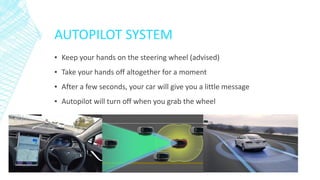
AUTOPILOT SYSTEM
▪ Keep your hands on the steering wheel (advised)
▪ Take your hands off altogether for a moment
▪ After a few seconds, your car will give you a little message
▪ Autopilot will turn off when you grab the wheel
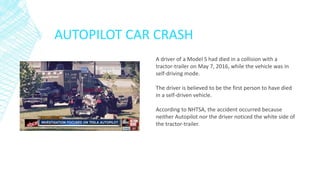
AUTOPILOT CAR CRASH
A driver of a Model S had died in a collision with a
tractor-trailer on May 7, 2016, while the vehicle was in
self-driving mode.
The driver is believed to be the first person to have died
in a self-driven vehicle.
According to NHTSA, the accident occurred because
neither Autopilot nor the driver noticed the white side of
the tractor-trailer.
OFFICIAL RESPONSE
It acknowledged the problem.
▪ “We learned yesterday evening that
NHTSA is opening a preliminary
evaluation into the performance of
Autopilot during a recent fatal crash that
occurred in a Model S.”
▪ “Neither Autopilot nor the driver noticed
the white side of the tractor trailer
against a brightly lit sky, so the brake was
not applied”
It reiterated Autopilot's limitations,
and reminded drivers to stay alert,
even with the feature activated.
▪ “It is important to note that Tesla disables
Autopilot by default and requires explicit
acknowledgement that the system is new
technology and still in a public beta phase
before it can be enabled.”
▪ “It is not perfect and still requires the driver
to remain alert. ”
It emphasized its low rate of
accident.
▪ “This is the first known fatality in just
over 130 million miles where Autopilot
was activated. Among all vehicles in the
US, there is a fatality every 94 million
miles. Worldwide, there is a fatality
approximately every 60 million miles.”
CONCLUSION
1. It responded timely and acknowledged the problem;
2. It restated the limitations in autopilot;
3. By comparing rate of accidents, it successfully
transferred people’s attention to the safety and
stability of Tesla cars;
4. Its successful brand image as a tech innovator.

Case study1

  • 1.
  • 2.
    TESLA MOTORS, INC. ▪An American automotive and energy storage company ▪ Designs, manufactures, and sells electric cars, electric vehicle powertrain components, and battery products
  • 3.
    VEHICLES A full-sized all- electric crossoverSUV First deliveries of the Model X began in September 2015 Tesla Model X A fully electric luxury sedan Announced in a press release on June , 2008 Tesla Model S The first fully electric car Gaining widespread attention Tesla Roadster
  • 4.
    MODEL S World’s best-sellingplug-in electric car in 2015 Word’s second best-selling plug-in electric car in history after the Nissan Leaf In late September 2014, all new Model S were equipped with a camera, allowing vehicles to detect road signs, lane markings, obstacles and other vehicles.
  • 5.
    AUTOPILOT SYSTEM ▪ Keepyour hands on the steering wheel (advised) ▪ Take your hands off altogether for a moment ▪ After a few seconds, your car will give you a little message ▪ Autopilot will turn off when you grab the wheel
  • 6.
    AUTOPILOT CAR CRASH Adriver of a Model S had died in a collision with a tractor-trailer on May 7, 2016, while the vehicle was in self-driving mode. The driver is believed to be the first person to have died in a self-driven vehicle. According to NHTSA, the accident occurred because neither Autopilot nor the driver noticed the white side of the tractor-trailer.
  • 7.
    OFFICIAL RESPONSE It acknowledgedthe problem. ▪ “We learned yesterday evening that NHTSA is opening a preliminary evaluation into the performance of Autopilot during a recent fatal crash that occurred in a Model S.” ▪ “Neither Autopilot nor the driver noticed the white side of the tractor trailer against a brightly lit sky, so the brake was not applied”
  • 8.
    It reiterated Autopilot'slimitations, and reminded drivers to stay alert, even with the feature activated. ▪ “It is important to note that Tesla disables Autopilot by default and requires explicit acknowledgement that the system is new technology and still in a public beta phase before it can be enabled.” ▪ “It is not perfect and still requires the driver to remain alert. ”
  • 9.
    It emphasized itslow rate of accident. ▪ “This is the first known fatality in just over 130 million miles where Autopilot was activated. Among all vehicles in the US, there is a fatality every 94 million miles. Worldwide, there is a fatality approximately every 60 million miles.”
  • 10.
    CONCLUSION 1. It respondedtimely and acknowledged the problem; 2. It restated the limitations in autopilot; 3. By comparing rate of accidents, it successfully transferred people’s attention to the safety and stability of Tesla cars; 4. Its successful brand image as a tech innovator.