Group Case Study on McDonalds:
By:-
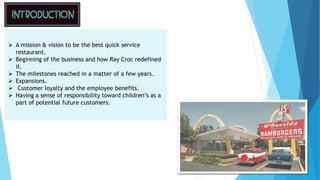
 A mission & vision to be the best quick service
restaurant.
 Beginning of the business and how Ray Croc redefined
it.
 The milestones reached in a matter of a few years.
 Expansions.
 Customer loyalty and the employee benefits.
 Having a sense of responsibility toward children’s as a
part of potential future customers.
 started in 1948 by brothers Maurice (“Mac”) and
Richard McDonald in San Bernardino, California.
 Fast food company with a number of 35,000+
restaurants globally.
 An employment of more than 4 million individuals.
 Wide varieties of fast food and dessert available on the
menu.
 Availability of changed menus based on location.
 Practice of conveying client experience with a
trademark approach.
 Plan to Win strategy through five P’s.
• McDonald’s growth from 1960’s to 2000’s and
later on.
• How Ray Kroc made a vital impact on the
restaurant’s business outlook.
• Development in the local and global marketplace
aligned with its trademark approach.
• Introducing restaurants in areas all through
Europe, Asia, the Philippines and Malaysia during
the 1980's.
• Noticeable changes made to the menu in order to
gain back its customers.
• An extension in the coffee industry with the
McCafe business.
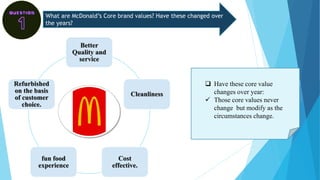
Better
Quality and
service
Cleanliness
Cost
effective.
fun food
experience
Refurbished
on the basis
of customer
choice.
 Have these core value
changes over year:
 Those core values never
change but modify as the
circumstances change.
What are McDonald’s Core brand values? Have these changed over
the years?
How has McDonald's grown its brand equity over the years? Has
McDonald's changed in differ economic times or in different parts of
the world? Explain.
Brand equity is a brands value and overall perception of a brand.
Customers positive or negative respond towards brands is called
customer based brand equity.
Brand knowledge carries all the user distinctive thought.
What a brand should be doing towards it customers is known as
brand promise.
McDonald's changed from it's initial stage.
With new adaptive environment, they've changed.
1
2
3
4
5
6
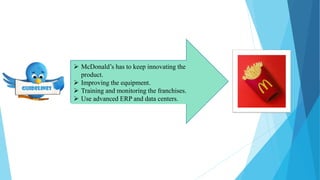
• Changing lifestyle can be a threat to
McDonald's.
• New entrance of local fast food chain with
relatively low price.
• Less healthier food option in McDonald's
menu.
• Changing taste and preference of the
customers.
• Less concentration in employee training will
be a problem to maintain the same quality
reputation.
What risks do you think McDonald's will face in the future?
 Healthier choices.
 Locally focused menu choices.
 Use local food sources where possible.
 Usage of eco-friendly materials, ensuring efficient solid
waste disposal.
 Necessary changes in ambience space as per
requirements.
 Allocation of budget for research and development
(R&D) should be increased.
 Elasticity in operational time.
 Streamlining of menu.
 McDonald’s has to keep innovating the
product.
 Improving the equipment.
 Training and monitoring the franchises.
 Use advanced ERP and data centers.
The rapid growth of McDonald’s from one small store in 1948, to its first
restaurant in 1955, to its worldwide dominance and market saturation at the turn of
the twenty-first century, is a story of capitalist enterprise, at its worst and (to its
shareholders) sometimes at its best. The business practices of McDonald’s are
innovative, diversified, and aggressive. For these McDonald’s is one of the most
successful companies in the world today. The company’s challenges of presenting
healthier foods to its buyers have offered to its financial success, thus enabling
loyal consumers. However, as the company advances to settle into its new
circumstances, it will slowly cater to the lower class, as can be seen in the United
States. To concluded that we can advise the plans developed by its authorities must
see to it that the changes are well planned and implemented carefully, thus allows
for the company to increase profits, quality, and bring about consumer satisfaction.
By-

Case Study on McDonalds.pdf

  • 1.
    Group Case Studyon McDonalds: By:-
  • 2.
     A mission& vision to be the best quick service restaurant.  Beginning of the business and how Ray Croc redefined it.  The milestones reached in a matter of a few years.  Expansions.  Customer loyalty and the employee benefits.  Having a sense of responsibility toward children’s as a part of potential future customers.
  • 3.
     started in1948 by brothers Maurice (“Mac”) and Richard McDonald in San Bernardino, California.  Fast food company with a number of 35,000+ restaurants globally.  An employment of more than 4 million individuals.  Wide varieties of fast food and dessert available on the menu.  Availability of changed menus based on location.  Practice of conveying client experience with a trademark approach.  Plan to Win strategy through five P’s.
  • 4.
    • McDonald’s growthfrom 1960’s to 2000’s and later on. • How Ray Kroc made a vital impact on the restaurant’s business outlook. • Development in the local and global marketplace aligned with its trademark approach. • Introducing restaurants in areas all through Europe, Asia, the Philippines and Malaysia during the 1980's. • Noticeable changes made to the menu in order to gain back its customers. • An extension in the coffee industry with the McCafe business.
  • 5.
    Better Quality and service Cleanliness Cost effective. fun food experience Refurbished onthe basis of customer choice.  Have these core value changes over year:  Those core values never change but modify as the circumstances change. What are McDonald’s Core brand values? Have these changed over the years?
  • 6.
    How has McDonald'sgrown its brand equity over the years? Has McDonald's changed in differ economic times or in different parts of the world? Explain. Brand equity is a brands value and overall perception of a brand. Customers positive or negative respond towards brands is called customer based brand equity. Brand knowledge carries all the user distinctive thought. What a brand should be doing towards it customers is known as brand promise. McDonald's changed from it's initial stage. With new adaptive environment, they've changed. 1 2 3 4 5 6
  • 7.
    • Changing lifestylecan be a threat to McDonald's. • New entrance of local fast food chain with relatively low price. • Less healthier food option in McDonald's menu. • Changing taste and preference of the customers. • Less concentration in employee training will be a problem to maintain the same quality reputation. What risks do you think McDonald's will face in the future?
  • 8.
     Healthier choices. Locally focused menu choices.  Use local food sources where possible.  Usage of eco-friendly materials, ensuring efficient solid waste disposal.  Necessary changes in ambience space as per requirements.  Allocation of budget for research and development (R&D) should be increased.  Elasticity in operational time.  Streamlining of menu.
  • 9.
     McDonald’s hasto keep innovating the product.  Improving the equipment.  Training and monitoring the franchises.  Use advanced ERP and data centers.
  • 10.
    The rapid growthof McDonald’s from one small store in 1948, to its first restaurant in 1955, to its worldwide dominance and market saturation at the turn of the twenty-first century, is a story of capitalist enterprise, at its worst and (to its shareholders) sometimes at its best. The business practices of McDonald’s are innovative, diversified, and aggressive. For these McDonald’s is one of the most successful companies in the world today. The company’s challenges of presenting healthier foods to its buyers have offered to its financial success, thus enabling loyal consumers. However, as the company advances to settle into its new circumstances, it will slowly cater to the lower class, as can be seen in the United States. To concluded that we can advise the plans developed by its authorities must see to it that the changes are well planned and implemented carefully, thus allows for the company to increase profits, quality, and bring about consumer satisfaction.
  • 11.