CASE STUDY ANALYSIS
OF MERGER –ACQUISITION
By
ANIL LEO
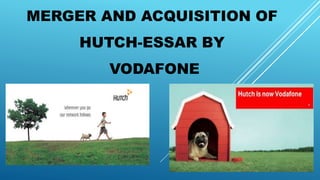
MERGER AND ACQUISITION OF
HUTCH-ESSAR BY
VODAFONE
Why did Hutch wanted to exit ?
• Urban markets in the country had become saturated.
• Future expansion would have had to be only in the rural areas, which
would lead to falling average revenue per user(ARPU) and consequently
lower returns on its investment.
• HTIL also wanted to use the money earned through this deal to fund it's
business in Europe.
• The sale of the its interest in India will enable HTIL to become one of the
Asia's best capitalized company.
Why Everyone Wants Hutch
• It the fastest-growing cellular market in the world.
• Fourth largest mobile operator in India with 24.41 million
subscribers.
• Present in 16 of 23 circles. Has license for six others barring
Madhya Pradesh.
• Revenues of $908 million (Rs 4,086 crore) in H1 2006
against $1.29 billion (Rs 5,800 crore) in 2005.
• Operating profits of Rs 1,017 crore, EBITDA margins at
32.7 per cent in H1 2006
Why Vodafone wants to acquire Hutch-Essar?
• Vodafone is the 3rd largest telecom industry in terms of revenue and
ARPUs in world, but it does not have any control over Indian market.
• Hutch was top industry in India in terms of ARPUs and also revenues.
So to control Vodafone acquired 67% of Hutch-Essar and renamed as
Vodafone Essar. But products are branded in name of Vodafone.
• By this Vodafone can expand its market share and can have big growth
in industry.
Merger Details
• The partners have agreed that Hutchison Essar will be renamed
Vodafone Essar
• On February 11, 2007, Vodafone agreed to acquire the
controlling interest of 67% in Hutch-Essar for US$11.1 billion
• Deal size and stake Fourth largest deal of the year 2007
at $13.3bn ($11.1bn plus $2bn debt).
• Hutchison Essar valued at $18.8bn.
• The sale of its interests in India will enable Hutchison Telecom
to become one of Asia’s best capitalized companies.
Financing the Deal
• Vodafone has $5 billion from the sale of its Japanese unit for $15 billion
last year (the remaining $10 billion is expected to go back
to shareholders).
• It will also get $1.62 billion cash from its 5.6 per cent stake sale in Bharti.
• In addition, Vodafone has free cash reserves (for the first six months of
2006) in excess of $3 billion.
• It has also sold its 25 per cent stake in Swisscom Mobile and exited
Belgium
Synergies claimed
• Vodafone gets access to the fastest growing mobile phone market in the
world that is expected to touch 500 million subscribers by 2010.
• Cellular penetration in rural India is below 2%, but 67% of India's
population lives in rural India.
• 3G is set to take off in India, allowing data and video to ride on
cellular networks.

Case study - Hutch Essar & Vodafone merger & acquisition

  • 1.
    CASE STUDY ANALYSIS OFMERGER –ACQUISITION By ANIL LEO
  • 2.
    MERGER AND ACQUISITIONOF HUTCH-ESSAR BY VODAFONE
  • 3.
    Why did Hutchwanted to exit ? • Urban markets in the country had become saturated. • Future expansion would have had to be only in the rural areas, which would lead to falling average revenue per user(ARPU) and consequently lower returns on its investment. • HTIL also wanted to use the money earned through this deal to fund it's business in Europe. • The sale of the its interest in India will enable HTIL to become one of the Asia's best capitalized company.
  • 4.
    Why Everyone WantsHutch • It the fastest-growing cellular market in the world. • Fourth largest mobile operator in India with 24.41 million subscribers. • Present in 16 of 23 circles. Has license for six others barring Madhya Pradesh. • Revenues of $908 million (Rs 4,086 crore) in H1 2006 against $1.29 billion (Rs 5,800 crore) in 2005. • Operating profits of Rs 1,017 crore, EBITDA margins at 32.7 per cent in H1 2006
  • 5.
    Why Vodafone wantsto acquire Hutch-Essar? • Vodafone is the 3rd largest telecom industry in terms of revenue and ARPUs in world, but it does not have any control over Indian market. • Hutch was top industry in India in terms of ARPUs and also revenues. So to control Vodafone acquired 67% of Hutch-Essar and renamed as Vodafone Essar. But products are branded in name of Vodafone. • By this Vodafone can expand its market share and can have big growth in industry.
  • 6.
    Merger Details • Thepartners have agreed that Hutchison Essar will be renamed Vodafone Essar • On February 11, 2007, Vodafone agreed to acquire the controlling interest of 67% in Hutch-Essar for US$11.1 billion • Deal size and stake Fourth largest deal of the year 2007 at $13.3bn ($11.1bn plus $2bn debt). • Hutchison Essar valued at $18.8bn. • The sale of its interests in India will enable Hutchison Telecom to become one of Asia’s best capitalized companies.
  • 7.
    Financing the Deal •Vodafone has $5 billion from the sale of its Japanese unit for $15 billion last year (the remaining $10 billion is expected to go back to shareholders). • It will also get $1.62 billion cash from its 5.6 per cent stake sale in Bharti. • In addition, Vodafone has free cash reserves (for the first six months of 2006) in excess of $3 billion. • It has also sold its 25 per cent stake in Swisscom Mobile and exited Belgium
  • 8.
    Synergies claimed • Vodafonegets access to the fastest growing mobile phone market in the world that is expected to touch 500 million subscribers by 2010. • Cellular penetration in rural India is below 2%, but 67% of India's population lives in rural India. • 3G is set to take off in India, allowing data and video to ride on cellular networks.