CASE STUDY
• Harvard Business School developed the
use of business cases in 1920.
• It analysis in depth description or reports
of business problems.
• It reveals the decision making process
CASE STUDIES ANALYSIS
FRAMEWORK
4 Steps Process:
• Define Problem
• Formulated alternative Course of action to
solve problem
• Analyzed alternatives in terms of strength
& weakness
• Alternatives accepted Recommended
Course of Action
PROBLEM
• It does not mean writing up a history of the firm but entails the type of analysis like
1. Environment
To study the environment in which the firm is opening like
1.1 Economic Environment: It can have a
decided effect on an industry, firm & making
program
Example – Depressed economy with high employment
may not be an ideal solution for
implementing a large price increase. Say
A/AI
1.2 Social and Cultural Environment
2. Industry
Categorized it by the Standard Industrial Classification (SCI):
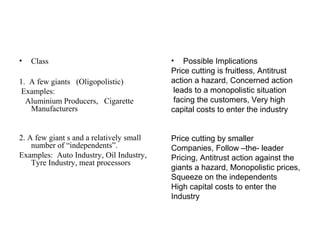
• Class
1. A few giants (Oligopolistic)
Examples:
Aluminium Producers, Cigarette
Manufacturers
2. A few giant s and a relatively small
number of “independents”.
Examples: Auto Industry, Oil Industry,
Tyre Industry, meat processors
• Possible Implications
Price cutting is fruitless, Antitrust
action a hazard, Concerned action
leads to a monopolistic situation
facing the customers, Very high
capital costs to enter the industry
Price cutting by smaller
Companies, Follow –the- leader
Pricing, Antitrust action against the
giants a hazard, Monopolistic prices,
Squeeze on the independents
High capital costs to enter the
Industry
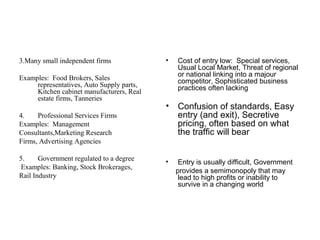
3.Many small independent firms
Examples: Food Brokers, Sales
representatives, Auto Supply parts,
Kitchen cabinet manufacturers, Real
estate firms, Tanneries
4. Professional Services Firms
Examples: Management
Consultants,Marketing Research
Firms, Advertising Agencies
5. Government regulated to a degree
Examples: Banking, Stock Brokerages,
Rail Industry
• Cost of entry low: Special services,
Usual Local Market, Threat of regional
or national linking into a majour
competitor, Sophisticated business
practices often lacking
• Confusion of standards, Easy
entry (and exit), Secretive
pricing, often based on what
the traffic will bear
• Entry is usually difficult, Government
provides a semimonopoly that may
lead to high profits or inability to
survive in a changing world
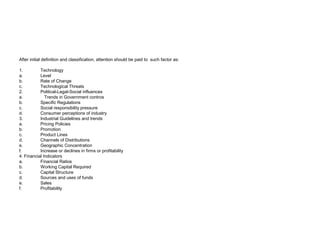
After initial definition and classification, attention should be paid to such factor as:
1. Technology
a. Level
b. Rate of Change
c. Technological Threats
2. Political-Legal-Social influences
a. Trends in Government contros
b. Specific Regulations
c. Social responsibility pressure
d. Consumer perceptions of industry
3. Industrial Guidelines and trends
a. Pricing Policies
b. Promotion
c. Product Lines
d. Channels of Distributions
e. Geographic Concentration
f. Increase or declines in firms or profitability
4. Financial Indicators
a. Financial Ratios
b. Working Capital Required
c. Capital Structure
d. Sources and uses of funds
e. Sales
f. Profitability
The Firm
Key areas of concern objectives,
Constraints, management philosophy,
strengths, weakness, and structure of the
Firm
4. The Marketing Program

Case Studies Analysis Framework

  • 1.
    CASE STUDY • HarvardBusiness School developed the use of business cases in 1920. • It analysis in depth description or reports of business problems. • It reveals the decision making process
  • 2.
    CASE STUDIES ANALYSIS FRAMEWORK 4Steps Process: • Define Problem • Formulated alternative Course of action to solve problem • Analyzed alternatives in terms of strength & weakness • Alternatives accepted Recommended Course of Action
  • 3.
    PROBLEM • It doesnot mean writing up a history of the firm but entails the type of analysis like 1. Environment To study the environment in which the firm is opening like 1.1 Economic Environment: It can have a decided effect on an industry, firm & making program Example – Depressed economy with high employment may not be an ideal solution for implementing a large price increase. Say A/AI 1.2 Social and Cultural Environment 2. Industry Categorized it by the Standard Industrial Classification (SCI):
  • 4.
    • Class 1. Afew giants (Oligopolistic) Examples: Aluminium Producers, Cigarette Manufacturers 2. A few giant s and a relatively small number of “independents”. Examples: Auto Industry, Oil Industry, Tyre Industry, meat processors • Possible Implications Price cutting is fruitless, Antitrust action a hazard, Concerned action leads to a monopolistic situation facing the customers, Very high capital costs to enter the industry Price cutting by smaller Companies, Follow –the- leader Pricing, Antitrust action against the giants a hazard, Monopolistic prices, Squeeze on the independents High capital costs to enter the Industry
  • 5.
    3.Many small independentfirms Examples: Food Brokers, Sales representatives, Auto Supply parts, Kitchen cabinet manufacturers, Real estate firms, Tanneries 4. Professional Services Firms Examples: Management Consultants,Marketing Research Firms, Advertising Agencies 5. Government regulated to a degree Examples: Banking, Stock Brokerages, Rail Industry • Cost of entry low: Special services, Usual Local Market, Threat of regional or national linking into a majour competitor, Sophisticated business practices often lacking • Confusion of standards, Easy entry (and exit), Secretive pricing, often based on what the traffic will bear • Entry is usually difficult, Government provides a semimonopoly that may lead to high profits or inability to survive in a changing world
  • 6.
    After initial definitionand classification, attention should be paid to such factor as: 1. Technology a. Level b. Rate of Change c. Technological Threats 2. Political-Legal-Social influences a. Trends in Government contros b. Specific Regulations c. Social responsibility pressure d. Consumer perceptions of industry 3. Industrial Guidelines and trends a. Pricing Policies b. Promotion c. Product Lines d. Channels of Distributions e. Geographic Concentration f. Increase or declines in firms or profitability 4. Financial Indicators a. Financial Ratios b. Working Capital Required c. Capital Structure d. Sources and uses of funds e. Sales f. Profitability
  • 7.
    The Firm Key areasof concern objectives, Constraints, management philosophy, strengths, weakness, and structure of the Firm 4. The Marketing Program