on
Cascade
reaction
Department of chemistry, University of Rajshahi
Cascade reaction
Presentation outline
Definition of cascade reaction.
Example of cascade reaction.
Classification of cascade reaction
Mechanism
Cascade Reaction
Cascade reaction is a chemical process that comprises at least two
consecutive reaction such that each subsequent reaction occurs
only in virtue of the chemical functionality formed in the previous
step.
In cascade reaction,
Isolation of intermediate is not possible
Reaction condition do not change among the consecutive steps
of cascade
No reagents are added after the initial step
A cascade is also called tandem reaction or domino reaction
• A cascade (also called tandem, also called domino) reaction must
satisfy three criteria:
1. Multiple transformations are achieved in a single
pot.
2. In this single pot, a single set of reaction conditions
is maintained.
3. Each transformation is dependent on the preceding
transformation.
Cascade Reaction
Cascade Reaction
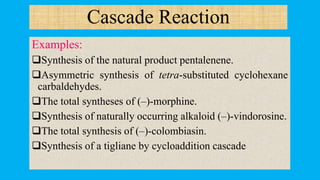
Examples:
Synthesis of the natural product pentalenene.
Asymmetric synthesis of tetra-substituted cyclohexane
carbaldehydes.
The total syntheses of (–)-morphine.
Synthesis of naturally occurring alkaloid (–)-vindorosine.
The total synthesis of (–)-colombiasin.
Synthesis of a tigliane by cycloaddition cascade
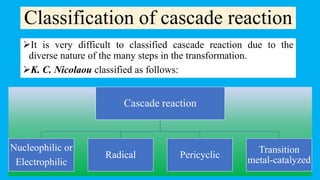
Classification of cascade reaction
It is very difficult to classified cascade reaction due to the
diverse nature of the many steps in the transformation.
K. C. Nicolaou classified as follows:
Cascade reaction
Nucleophilic or
Electrophilic
Radical Pericyclic
Transition
metal-catalyzed
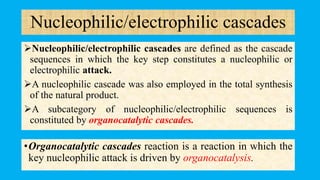
Nucleophilic/electrophilic cascades
Nucleophilic/electrophilic cascades are defined as the cascade
sequences in which the key step constitutes a nucleophilic or
electrophilic attack.
A nucleophilic cascade was also employed in the total synthesis
of the natural product.
A subcategory of nucleophilic/electrophilic sequences is
constituted by organocatalytic cascades.
•Organocatalytic cascades reaction is a reaction in which the
key nucleophilic attack is driven by organocatalysis.
Nucleophilic/electrophilic cascades
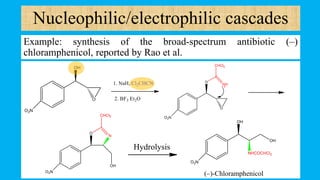
Example: synthesis of the broad-spectrum antibiotic (–)
chloramphenicol, reported by Rao et al.
Hydrolysis
(–)-Chloramphenicol
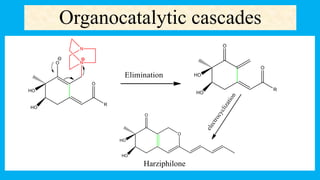
Organocatalytic cascades
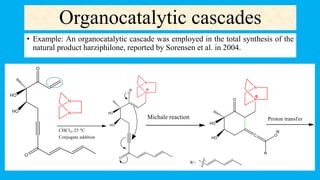
• Example: An organocatalytic cascade was employed in the total synthesis of the
natural product harziphilone, reported by Sorensen et al. in 2004.
Organocatalytic cascades
Harziphilone
Radical Cascade
Radical cascades are those in which the key step constitutes a
radical reaction.
 The high reactivity of free radical species renders radical-based
synthetic approaches decidedly suitable for cascade reactions.
the synthetic utility of radical cascades is the cyclization sequence
employed in the total synthesis of (±)-hirsutene, in 1985
A cascade radical process was also used in one of the total
syntheses of (–)-morphine
Radical Cascade
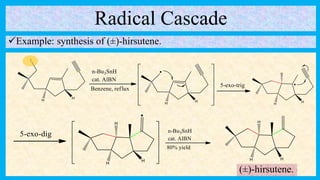
Example: synthesis of (±)-hirsutene.
(±)-hirsutene.
Pericyclic Cascade
Pericyclic reactions include cycloadditions, electrocyclic reactions
and sigmatropic rearrangements.
Although some of the abovementioned instances of
nucleophilic/electrophilic and radical cascades involved pericyclic
processes, this section contains only cascade sequences that are
solely composed of pericyclic reactions or in which such a reaction
arguably constitutes the key step.
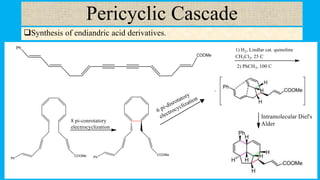
A representative example of a pericyclic cascade is the endiandric
acid cascade reported by Nicolaou et al. in 1982
Pericyclic Cascade
Synthesis of endiandric acid derivatives.
Transition metal-catalyzed
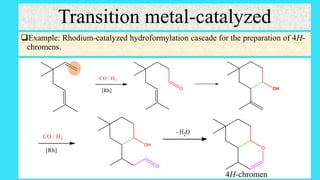
Example: Rhodium-catalyzed hydroformylation cascade for the preparation of 4H-
chromens.
4H-chromen
References
Cascade Reactions in Organic Chemistry - Baran Lab
( https://baranlab.org/wp-
content/uploads/2018/02/Cascade_reactions_Reisberg2018.pdf )
Wikipedia
(https://en.wikipedia.org/wiki/Cascade_reaction )

Cascade reactions

  • 1.
  • 2.
  • 3.
    Presentation outline Definition ofcascade reaction. Example of cascade reaction. Classification of cascade reaction Mechanism
  • 4.
    Cascade Reaction Cascade reactionis a chemical process that comprises at least two consecutive reaction such that each subsequent reaction occurs only in virtue of the chemical functionality formed in the previous step. In cascade reaction, Isolation of intermediate is not possible Reaction condition do not change among the consecutive steps of cascade No reagents are added after the initial step A cascade is also called tandem reaction or domino reaction
  • 5.
    • A cascade(also called tandem, also called domino) reaction must satisfy three criteria: 1. Multiple transformations are achieved in a single pot. 2. In this single pot, a single set of reaction conditions is maintained. 3. Each transformation is dependent on the preceding transformation. Cascade Reaction
  • 6.
    Cascade Reaction Examples: Synthesis ofthe natural product pentalenene. Asymmetric synthesis of tetra-substituted cyclohexane carbaldehydes. The total syntheses of (–)-morphine. Synthesis of naturally occurring alkaloid (–)-vindorosine. The total synthesis of (–)-colombiasin. Synthesis of a tigliane by cycloaddition cascade
  • 7.
    Classification of cascadereaction It is very difficult to classified cascade reaction due to the diverse nature of the many steps in the transformation. K. C. Nicolaou classified as follows: Cascade reaction Nucleophilic or Electrophilic Radical Pericyclic Transition metal-catalyzed
  • 8.
    Nucleophilic/electrophilic cascades Nucleophilic/electrophilic cascadesare defined as the cascade sequences in which the key step constitutes a nucleophilic or electrophilic attack. A nucleophilic cascade was also employed in the total synthesis of the natural product. A subcategory of nucleophilic/electrophilic sequences is constituted by organocatalytic cascades. •Organocatalytic cascades reaction is a reaction in which the key nucleophilic attack is driven by organocatalysis.
  • 9.
    Nucleophilic/electrophilic cascades Example: synthesisof the broad-spectrum antibiotic (–) chloramphenicol, reported by Rao et al. Hydrolysis (–)-Chloramphenicol
  • 10.
    Organocatalytic cascades • Example:An organocatalytic cascade was employed in the total synthesis of the natural product harziphilone, reported by Sorensen et al. in 2004.
  • 11.
  • 12.
    Radical Cascade Radical cascadesare those in which the key step constitutes a radical reaction.  The high reactivity of free radical species renders radical-based synthetic approaches decidedly suitable for cascade reactions. the synthetic utility of radical cascades is the cyclization sequence employed in the total synthesis of (±)-hirsutene, in 1985 A cascade radical process was also used in one of the total syntheses of (–)-morphine
  • 13.
    Radical Cascade Example: synthesisof (±)-hirsutene. (±)-hirsutene.
  • 14.
    Pericyclic Cascade Pericyclic reactionsinclude cycloadditions, electrocyclic reactions and sigmatropic rearrangements. Although some of the abovementioned instances of nucleophilic/electrophilic and radical cascades involved pericyclic processes, this section contains only cascade sequences that are solely composed of pericyclic reactions or in which such a reaction arguably constitutes the key step. A representative example of a pericyclic cascade is the endiandric acid cascade reported by Nicolaou et al. in 1982
  • 15.
    Pericyclic Cascade Synthesis ofendiandric acid derivatives.
  • 16.
    Transition metal-catalyzed Example: Rhodium-catalyzedhydroformylation cascade for the preparation of 4H- chromens. 4H-chromen
  • 17.
    References Cascade Reactions inOrganic Chemistry - Baran Lab ( https://baranlab.org/wp- content/uploads/2018/02/Cascade_reactions_Reisberg2018.pdf ) Wikipedia (https://en.wikipedia.org/wiki/Cascade_reaction )

Editor's Notes

  • #7 the total synthesis is the complete chemical synthesis of a complex molecule , often a naturla product.
  • #10 the chiral epoxy-alcohol was first treated with dichloroacetonitrile in the presence of NaH. The resulting intermediate then undergo a BF3·Et2O-mediated cascade reaction. Intramolecular opening of the epoxide ring yielded intermediate 3, which undergo hydrolysis to form(–)-chloramphenicol
  • #11 treatment of the enone starting material with organocatalyst yielded intermediate via conjugate addition. Subsequent cyclization by the intramolecular Michael addition of the enolate into the triple bond of the system gave this species
  • #12 This intermediate speies is produced by proton transfer. The cascade was completed by elimination of the organocatalyst and a spontaneous 6π-electrocyclic ring closure of the resultant cis-dienone to (+)-harziphilone.
  • #14 alkyl iodide was converted to the primary radical intermediate, which undergo a 5-exo-trig cyclization to form reactive species. A subsequent 5-exo-dig radical cyclization lead to intermediate, which upon quenching gave the target product hirsutene in 80% overall yield
  • #16 The highly unsaturated system was first hydrogenated to the conjugated tetraene species, which upon heating undergo an 8π-conrotatory electrocyclic ring closure, yielding cyclic intermediate. Again a second spontaneous electrocyclization, this time a 6π-disrotatory ring closure, converted to the bicyclic species, the geometry and stereochemistry of which favored a subsequent intramolecular Diels-Alder reaction. The methyl ester of endiandric acid was thus obtained in 23% overall yield
  • #17 acyclic monoterpenes First, selective rhodium-catalyzed hydroformylation of the olefin formed unsaturated aldehyde, which under the same conditions was converted to intermediate via a carbonyl-ene reaction. A second rhodium-catalyzed hydroformylation to this species  was followed by condensation to form 4H-chromen with in 40% overall yield