Carved Visual Hulls for Image-Based Modeling
                  Yasutaka Furukawa, Jean Ponce


                             presented by
                       Phongsathorn Eakamongul

                          Department of Computer Science
                           Asian Institute of Technology


                                 2009, July 27


Phongsathorn (AIT)     Carved Visual Hulls for Image-Based Modeling   Machine Vision Student Presentation   1 / 49
Outline


1   Reference

2   Introduction

3   Steps

4   Identify Rims

5   Global Optimization

6   Local Refinement

7   Result

8   Comparison

9   Limitation & Future work


        Phongsathorn (AIT)     Carved Visual Hulls for Image-Based Modeling   Machine Vision Student Presentation   2 / 49
Reference


   silhouette image from http://www.flickr.com/photos/alexfrance/3693058077/
   space carving, shadow curving, voxel coloring from Silvio Savarese’s slide.
   http://www.cs.cornell.edu/courses/cs664/2005fa/Lectures/lecture15.pdf
   graph cut from ECCV 2006 tutorial
   Multi-view shape reconstruction, lecture from Dana Cobzas, PIMS Postdoc


     Phongsathorn (AIT)     Carved Visual Hulls for Image-Based Modeling   Machine Vision Student Presentation   3 / 49
Outline


1   Reference

2   Introduction

3   Steps

4   Identify Rims

5   Global Optimization

6   Local Refinement

7   Result

8   Comparison

9   Limitation & Future work


        Phongsathorn (AIT)     Carved Visual Hulls for Image-Based Modeling   Machine Vision Student Presentation   4 / 49
Introduction


    image-based Modeling
    optimization


      Phongsathorn (AIT)   Carved Visual Hulls for Image-Based Modeling   Machine Vision Student Presentation   5 / 49
image-based Modeling


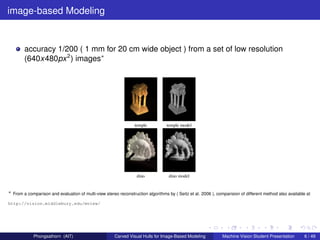
        accuracy 1/200 ( 1 mm for 20 cm wide object ) from a set of low resolution
        (640x480px 2 ) images∗


∗ From a comparison and evaluation of multi-view stereo reconstruction algorithms by ( Seitz et al. 2006 ), comparision of different method also available at

http://vision.middlebury.edu/mview/


             Phongsathorn (AIT)                        Carved Visual Hulls for Image-Based Modeling            Machine Vision Student Presentation        6 / 49
image-based Modeling


   choose a surface representation
   define a photo-consistency function ( discrepancy between different projections
   of their surface points )
   solve the following minimization


     Phongsathorn (AIT)      Carved Visual Hulls for Image-Based Modeling   Machine Vision Student Presentation   7 / 49
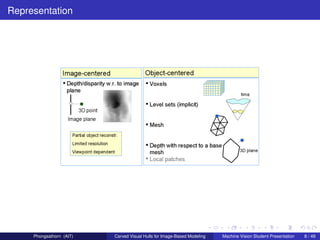
Representation


     Phongsathorn (AIT)   Carved Visual Hulls for Image-Based Modeling   Machine Vision Student Presentation   8 / 49
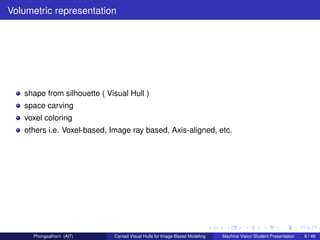
Volumetric representation


   shape from silhouette ( Visual Hull )
   space carving
   voxel coloring
   others i.e. Voxel-based, Image ray based, Axis-aligned, etc.


     Phongsathorn (AIT)      Carved Visual Hulls for Image-Based Modeling   Machine Vision Student Presentation   9 / 49
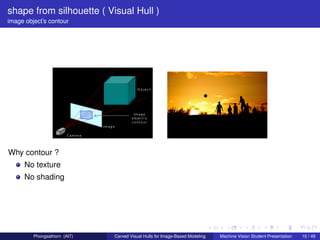
shape from silhouette ( Visual Hull )
image object’s contour


Why contour ?
      No texture
      No shading


         Phongsathorn (AIT)   Carved Visual Hulls for Image-Based Modeling   Machine Vision Student Presentation   10 / 49
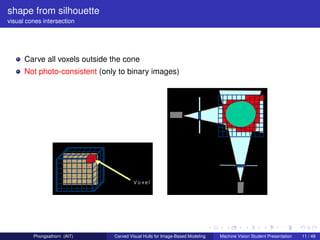
shape from silhouette
visual cones intersection


      Carve all voxels outside the cone
      Not photo-consistent (only to binary images)


         Phongsathorn (AIT)    Carved Visual Hulls for Image-Based Modeling   Machine Vision Student Presentation   11 / 49
Space carving algorithm


   Initialize to a volume V containing the true scene
   Choose a voxel on the current surface
   Project to visible input images
   Carve away voxels if not photo-consistent with images
   Repeat until convergence


     Phongsathorn (AIT)       Carved Visual Hulls for Image-Based Modeling   Machine Vision Student Presentation   12 / 49
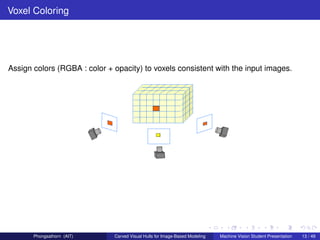
Voxel Coloring


Assign colors (RGBA : color + opacity) to voxels consistent with the input images.


       Phongsathorn (AIT)     Carved Visual Hulls for Image-Based Modeling   Machine Vision Student Presentation   13 / 49
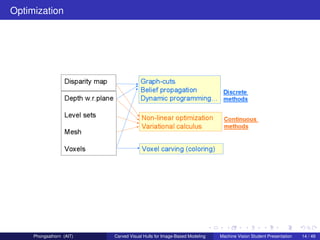
Optimization


     Phongsathorn (AIT)   Carved Visual Hulls for Image-Based Modeling   Machine Vision Student Presentation   14 / 49
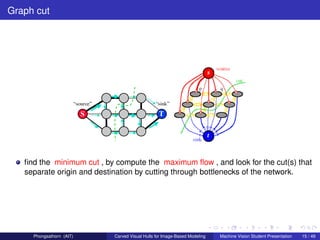
Graph cut


   find the minimum cut , by compute the maximum flow , and look for the cut(s) that
   separate origin and destination by cutting through bottlenecks of the network.


     Phongsathorn (AIT)    Carved Visual Hulls for Image-Based Modeling   Machine Vision Student Presentation   15 / 49
Outline


1   Reference

2   Introduction

3   Steps

4   Identify Rims

5   Global Optimization

6   Local Refinement

7   Result

8   Comparison

9   Limitation & Future work


        Phongsathorn (AIT)     Carved Visual Hulls for Image-Based Modeling   Machine Vision Student Presentation   16 / 49
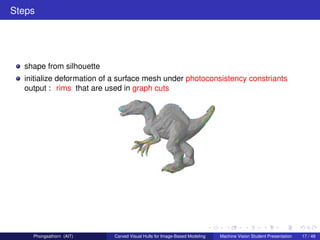
Steps


  shape from silhouette
  initialize deformation of a surface mesh under photoconsistency constriants
  output : rims that are used in graph cuts


    Phongsathorn (AIT)     Carved Visual Hulls for Image-Based Modeling   Machine Vision Student Presentation   17 / 49
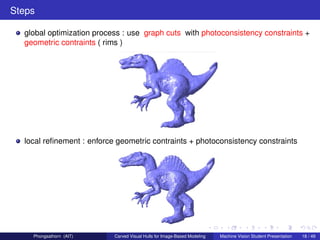
Steps

  global optimization process : use graph cuts with photoconsistency constraints +
  geometric contraints ( rims )


  local refinement : enforce geometric contraints + photoconsistency constraints


    Phongsathorn (AIT)     Carved Visual Hulls for Image-Based Modeling   Machine Vision Student Presentation   18 / 49
Outline


1   Reference

2   Introduction

3   Steps

4   Identify Rims

5   Global Optimization

6   Local Refinement

7   Result

8   Comparison

9   Limitation & Future work


        Phongsathorn (AIT)     Carved Visual Hulls for Image-Based Modeling   Machine Vision Student Presentation   19 / 49
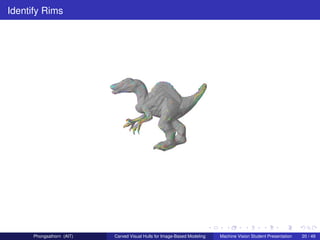
Identify Rims


      Phongsathorn (AIT)   Carved Visual Hulls for Image-Based Modeling   Machine Vision Student Presentation   20 / 49
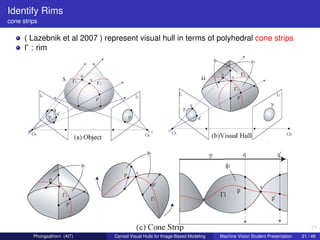
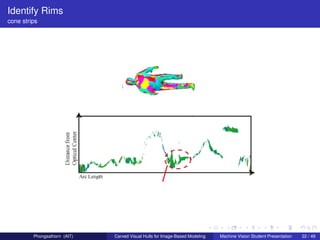
Identify Rims
cone strips

      ( Lazebnik et al 2007 ) represent visual hull in terms of polyhedral cone strips
      Γ : rim


         Phongsathorn (AIT)     Carved Visual Hulls for Image-Based Modeling   Machine Vision Student Presentation   21 / 49
Identify Rims
cone strips


         Phongsathorn (AIT)   Carved Visual Hulls for Image-Based Modeling   Machine Vision Student Presentation   22 / 49
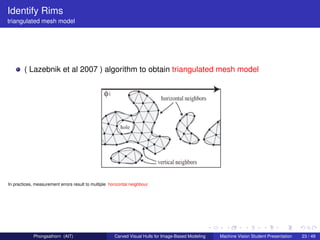
Identify Rims
triangulated mesh model


        ( Lazebnik et al 2007 ) algorithm to obtain triangulated mesh model


In practices, measurement errors result to multiple horizontal neighbour


             Phongsathorn (AIT)                       Carved Visual Hulls for Image-Based Modeling   Machine Vision Student Presentation   23 / 49
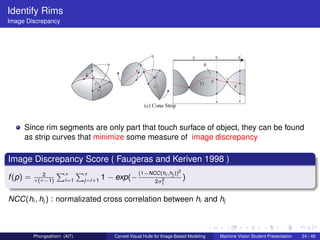
Identify Rims
Image Discrepancy


     Since rim segments are only part that touch surface of object, they can be found
     as strip curves that minimize some measure of image discrepancy

Image Discrepancy Score ( Faugeras and Keriven 1998 )
              2
                     Pτ Pτ                           (1−NCC(hi ,hj ))2
f (p) =   τ (τ −1)      i=1    j=i+1   1 − exp(−               2
                                                             2σ1
                                                                          )

NCC(hi , hj ) : normalizated cross correlation between hi and hj


          Phongsathorn (AIT)              Carved Visual Hulls for Image-Based Modeling   Machine Vision Student Presentation   24 / 49
Identify Rims


   image discrepancy is smallest values, so find shortest path ; path length = image
   discrepancy function
   find shortest path by dynamic programming


      Phongsathorn (AIT)    Carved Visual Hulls for Image-Based Modeling   Machine Vision Student Presentation   25 / 49
Identify Rims
find shortest path by dynamic programming


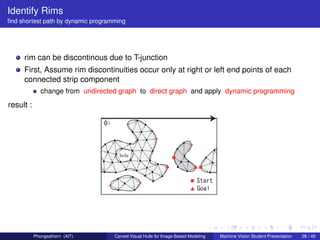
     rim can be discontinous due to T-junction
     First, Assume rim discontinuities occur only at right or left end points of each
     connected strip component
              change from undirected graph to direct graph and apply dynamic programming
result :


           Phongsathorn (AIT)       Carved Visual Hulls for Image-Based Modeling   Machine Vision Student Presentation   26 / 49
Identify Rims
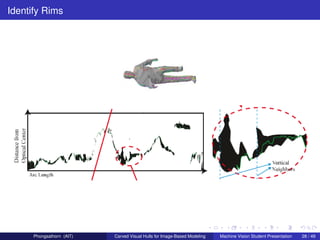
remove false rim segmentation


     assumption break at complicated structure i.e. the fold of human cloth
     remove false rim segmentation
             Among all vertics identified as rim points, filter out false-positives
             vertex v is detected as false positive if
                   either 4Rl < g(v ) or Rl < g(v ) [vertical size is too large] and
                   f ∗ (v ) < η [vertical size is not small enough] and [average NCC wrose than η]


average NCC score ( Faugeras and Keriven 1998 )
                       Pτ Pτ
f ∗ (p) =       2
            τ (τ −1)     i=1   j=i+1   NCC(hi , hj )


         Phongsathorn (AIT)               Carved Visual Hulls for Image-Based Modeling   Machine Vision Student Presentation   27 / 49
Identify Rims


      Phongsathorn (AIT)   Carved Visual Hulls for Image-Based Modeling   Machine Vision Student Presentation   28 / 49
Outline


1   Reference

2   Introduction

3   Steps

4   Identify Rims

5   Global Optimization

6   Local Refinement

7   Result

8   Comparison

9   Limitation & Future work


        Phongsathorn (AIT)     Carved Visual Hulls for Image-Based Modeling   Machine Vision Student Presentation   29 / 49
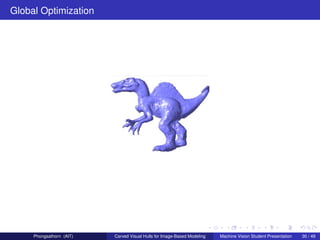
Global Optimization


     Phongsathorn (AIT)   Carved Visual Hulls for Image-Based Modeling   Machine Vision Student Presentation   30 / 49
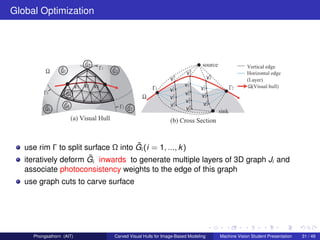
Global Optimization


                                     ¯
   use rim Γ to split surface Ω into Gi (i = 1, ..., k )
                       ¯
   iteratively deform Gi inwards to generate multiple layers of 3D graph Ji and
   associate photoconsistency weights to the edge of this graph
   use graph cuts to carve surface


     Phongsathorn (AIT)     Carved Visual Hulls for Image-Based Modeling   Machine Vision Student Presentation   31 / 49
Global Optimization
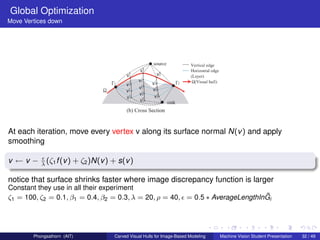
Move Vertices down


At each iteration, move every vertex v along its surface normal N(v ) and apply
smoothing

v ← v − λ (ζ1 f (v ) + ζ2 )N(v ) + s(v )

notice that surface shrinks faster where image discrepancy function is larger
Constant they use in all their experiment
                                                                               ¯
ζ1 = 100, ζ2 = 0.1, β1 = 0.4, β2 = 0.3, λ = 20, ρ = 40, = 0.5 ∗ AverageLengthInGi


        Phongsathorn (AIT)       Carved Visual Hulls for Image-Based Modeling   Machine Vision Student Presentation   32 / 49
Global Optimization
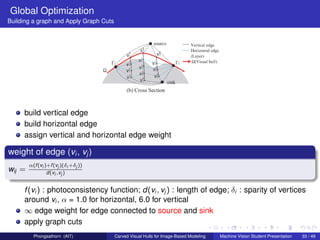
Building a graph and Apply Graph Cuts


     build vertical edge
     build horizontal edge
     assign vertical and horizontal edge weight

weight of edge (vi , vj )
        α(f (vi )+f (vj )(δi +δj ))
wij =            d(vi ,vj )


     f (vi ) : photoconsistency function; d(vi , vj ) : length of edge; δi : sparity of vertices
     around vi , α = 1.0 for horizontal, 6.0 for vertical
     ∞ edge weight for edge connected to source and sink
     apply graph cuts
          Phongsathorn (AIT)            Carved Visual Hulls for Image-Based Modeling   Machine Vision Student Presentation   33 / 49
Outline


1   Reference

2   Introduction

3   Steps

4   Identify Rims

5   Global Optimization

6   Local Refinement

7   Result

8   Comparison

9   Limitation & Future work


        Phongsathorn (AIT)     Carved Visual Hulls for Image-Based Modeling   Machine Vision Student Presentation   34 / 49
Local Refinement


     Phongsathorn (AIT)   Carved Visual Hulls for Image-Based Modeling   Machine Vision Student Presentation   35 / 49
Local Refinement
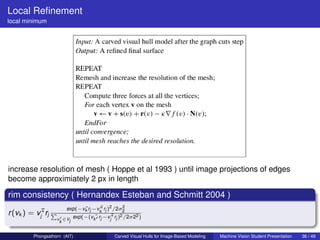
local minimum


increase resolution of mesh ( Hoppe et al 1993 ) until image projections of edges
become approximiately 2 px in length

rim consistency ( Hernandex Esteban and Schmitt 2004 )
                       exp(−vk rj −vk¯ rj )2 /2σ2
                             ¯      ∗           2
r (vk ) = vj¯rj P
            ∗
                                            ¯
                         exp(−(vk¯ rj −v ∗ rj )2 /2σ22 )
                    v ∈Vj                 j
                     k


        Phongsathorn (AIT)                    Carved Visual Hulls for Image-Based Modeling   Machine Vision Student Presentation   36 / 49
Outline


1   Reference

2   Introduction

3   Steps

4   Identify Rims

5   Global Optimization

6   Local Refinement

7   Result

8   Comparison

9   Limitation & Future work


        Phongsathorn (AIT)     Carved Visual Hulls for Image-Based Modeling   Machine Vision Student Presentation   37 / 49
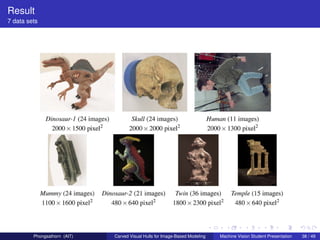
Result
7 data sets


         Phongsathorn (AIT)   Carved Visual Hulls for Image-Based Modeling   Machine Vision Student Presentation   38 / 49
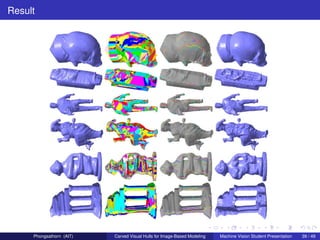
Result


     Phongsathorn (AIT)   Carved Visual Hulls for Image-Based Modeling   Machine Vision Student Presentation   39 / 49
Result
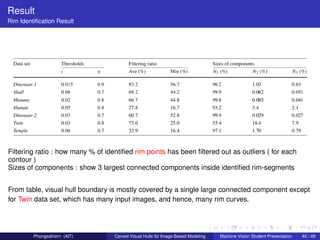
Rim Identification Result


Filtering ratio : how many % of identified rim points has been filtered out as outliers ( for each
contour )
Sizes of components : show 3 largest connected components inside identified rim-segments


From table, visual hull boundary is mostly covered by a single large connected component except
for Twin data set, which has many input images, and hence, many rim curves.


         Phongsathorn (AIT)        Carved Visual Hulls for Image-Based Modeling   Machine Vision Student Presentation   40 / 49
Result
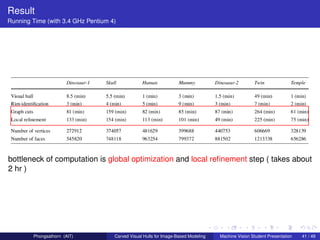
Running Time (with 3.4 GHz Pentium 4)


bottleneck of computation is global optimization and local refinement step ( takes about
2 hr )


        Phongsathorn (AIT)          Carved Visual Hulls for Image-Based Modeling   Machine Vision Student Presentation   41 / 49
Result
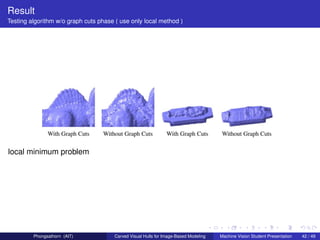
Testing algorithm w/o graph cuts phase ( use only local method )


local minimum problem


         Phongsathorn (AIT)            Carved Visual Hulls for Image-Based Modeling   Machine Vision Student Presentation   42 / 49
Outline


1   Reference

2   Introduction

3   Steps

4   Identify Rims

5   Global Optimization

6   Local Refinement

7   Result

8   Comparison

9   Limitation & Future work


        Phongsathorn (AIT)     Carved Visual Hulls for Image-Based Modeling   Machine Vision Student Presentation   43 / 49
Comparisons


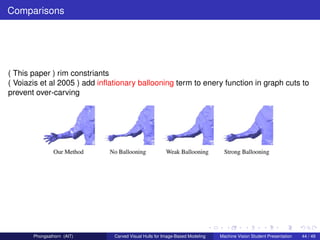
( This paper ) rim constriants
( Voiazis et al 2005 ) add inflationary ballooning term to enery function in graph cuts to
prevent over-carving


       Phongsathorn (AIT)      Carved Visual Hulls for Image-Based Modeling   Machine Vision Student Presentation   44 / 49
Comparisons

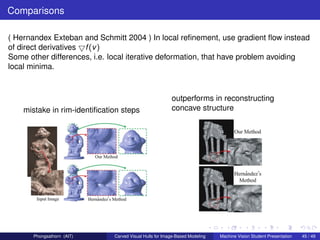
( Hernandex Exteban and Schmitt 2004 ) In local refinement, use gradient flow instead
of direct derivatives f (v )
Some other differences, i.e. local iterative deformation, that have problem avoiding
local minima.


                                                         outperforms in reconstructing
    mistake in rim-identification steps                   concave structure


       Phongsathorn (AIT)     Carved Visual Hulls for Image-Based Modeling   Machine Vision Student Presentation   45 / 49
Comparisons


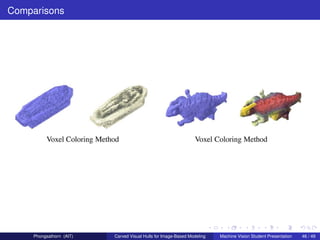
     Phongsathorn (AIT)   Carved Visual Hulls for Image-Based Modeling   Machine Vision Student Presentation   46 / 49
Comparisons
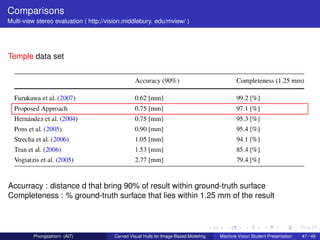
Multi-view stereo evaluation ( http://vision.middlebury. edu/mview/ )


Temple data set


Accurracy : distance d that bring 90% of result within ground-truth surface
Completeness : % ground-truth surface that lies within 1.25 mm of the result


         Phongsathorn (AIT)             Carved Visual Hulls for Image-Based Modeling   Machine Vision Student Presentation   47 / 49
Outline


1   Reference

2   Introduction

3   Steps

4   Identify Rims

5   Global Optimization

6   Local Refinement

7   Result

8   Comparison

9   Limitation & Future work


        Phongsathorn (AIT)     Carved Visual Hulls for Image-Based Modeling   Machine Vision Student Presentation   48 / 49
Limitation & Future work


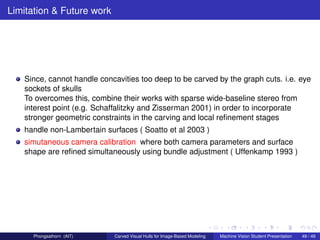
   Since, cannot handle concavities too deep to be carved by the graph cuts. i.e. eye
   sockets of skulls
   To overcomes this, combine their works with sparse wide-baseline stereo from
   interest point (e.g. Schaffalitzky and Zisserman 2001) in order to incorporate
   stronger geometric constraints in the carving and local refinement stages
   handle non-Lambertain surfaces ( Soatto et al 2003 )
   simutaneous camera calibration where both camera parameters and surface
   shape are refined simultaneously using bundle adjustment ( Uffenkamp 1993 )


      Phongsathorn (AIT)    Carved Visual Hulls for Image-Based Modeling   Machine Vision Student Presentation   49 / 49

Carved Visual Hulls for Image-Based Modeling

  • 1.
    Carved Visual Hullsfor Image-Based Modeling Yasutaka Furukawa, Jean Ponce presented by Phongsathorn Eakamongul Department of Computer Science Asian Institute of Technology 2009, July 27 Phongsathorn (AIT) Carved Visual Hulls for Image-Based Modeling Machine Vision Student Presentation 1 / 49
  • 2.
    Outline 1 Reference 2 Introduction 3 Steps 4 Identify Rims 5 Global Optimization 6 Local Refinement 7 Result 8 Comparison 9 Limitation & Future work Phongsathorn (AIT) Carved Visual Hulls for Image-Based Modeling Machine Vision Student Presentation 2 / 49
  • 3.
    Reference silhouette image from http://www.flickr.com/photos/alexfrance/3693058077/ space carving, shadow curving, voxel coloring from Silvio Savarese’s slide. http://www.cs.cornell.edu/courses/cs664/2005fa/Lectures/lecture15.pdf graph cut from ECCV 2006 tutorial Multi-view shape reconstruction, lecture from Dana Cobzas, PIMS Postdoc Phongsathorn (AIT) Carved Visual Hulls for Image-Based Modeling Machine Vision Student Presentation 3 / 49
  • 4.
    Outline 1 Reference 2 Introduction 3 Steps 4 Identify Rims 5 Global Optimization 6 Local Refinement 7 Result 8 Comparison 9 Limitation & Future work Phongsathorn (AIT) Carved Visual Hulls for Image-Based Modeling Machine Vision Student Presentation 4 / 49
  • 5.
    Introduction image-based Modeling optimization Phongsathorn (AIT) Carved Visual Hulls for Image-Based Modeling Machine Vision Student Presentation 5 / 49
  • 6.
    image-based Modeling accuracy 1/200 ( 1 mm for 20 cm wide object ) from a set of low resolution (640x480px 2 ) images∗ ∗ From a comparison and evaluation of multi-view stereo reconstruction algorithms by ( Seitz et al. 2006 ), comparision of different method also available at http://vision.middlebury.edu/mview/ Phongsathorn (AIT) Carved Visual Hulls for Image-Based Modeling Machine Vision Student Presentation 6 / 49
  • 7.
    image-based Modeling choose a surface representation define a photo-consistency function ( discrepancy between different projections of their surface points ) solve the following minimization Phongsathorn (AIT) Carved Visual Hulls for Image-Based Modeling Machine Vision Student Presentation 7 / 49
  • 8.
    Representation Phongsathorn (AIT) Carved Visual Hulls for Image-Based Modeling Machine Vision Student Presentation 8 / 49
  • 9.
    Volumetric representation shape from silhouette ( Visual Hull ) space carving voxel coloring others i.e. Voxel-based, Image ray based, Axis-aligned, etc. Phongsathorn (AIT) Carved Visual Hulls for Image-Based Modeling Machine Vision Student Presentation 9 / 49
  • 10.
    shape from silhouette( Visual Hull ) image object’s contour Why contour ? No texture No shading Phongsathorn (AIT) Carved Visual Hulls for Image-Based Modeling Machine Vision Student Presentation 10 / 49
  • 11.
    shape from silhouette visualcones intersection Carve all voxels outside the cone Not photo-consistent (only to binary images) Phongsathorn (AIT) Carved Visual Hulls for Image-Based Modeling Machine Vision Student Presentation 11 / 49
  • 12.
    Space carving algorithm Initialize to a volume V containing the true scene Choose a voxel on the current surface Project to visible input images Carve away voxels if not photo-consistent with images Repeat until convergence Phongsathorn (AIT) Carved Visual Hulls for Image-Based Modeling Machine Vision Student Presentation 12 / 49
  • 13.
    Voxel Coloring Assign colors(RGBA : color + opacity) to voxels consistent with the input images. Phongsathorn (AIT) Carved Visual Hulls for Image-Based Modeling Machine Vision Student Presentation 13 / 49
  • 14.
    Optimization Phongsathorn (AIT) Carved Visual Hulls for Image-Based Modeling Machine Vision Student Presentation 14 / 49
  • 15.
    Graph cut find the minimum cut , by compute the maximum flow , and look for the cut(s) that separate origin and destination by cutting through bottlenecks of the network. Phongsathorn (AIT) Carved Visual Hulls for Image-Based Modeling Machine Vision Student Presentation 15 / 49
  • 16.
    Outline 1 Reference 2 Introduction 3 Steps 4 Identify Rims 5 Global Optimization 6 Local Refinement 7 Result 8 Comparison 9 Limitation & Future work Phongsathorn (AIT) Carved Visual Hulls for Image-Based Modeling Machine Vision Student Presentation 16 / 49
  • 17.
    Steps shapefrom silhouette initialize deformation of a surface mesh under photoconsistency constriants output : rims that are used in graph cuts Phongsathorn (AIT) Carved Visual Hulls for Image-Based Modeling Machine Vision Student Presentation 17 / 49
  • 18.
    Steps globaloptimization process : use graph cuts with photoconsistency constraints + geometric contraints ( rims ) local refinement : enforce geometric contraints + photoconsistency constraints Phongsathorn (AIT) Carved Visual Hulls for Image-Based Modeling Machine Vision Student Presentation 18 / 49
  • 19.
    Outline 1 Reference 2 Introduction 3 Steps 4 Identify Rims 5 Global Optimization 6 Local Refinement 7 Result 8 Comparison 9 Limitation & Future work Phongsathorn (AIT) Carved Visual Hulls for Image-Based Modeling Machine Vision Student Presentation 19 / 49
  • 20.
    Identify Rims Phongsathorn (AIT) Carved Visual Hulls for Image-Based Modeling Machine Vision Student Presentation 20 / 49
  • 21.
    Identify Rims cone strips ( Lazebnik et al 2007 ) represent visual hull in terms of polyhedral cone strips Γ : rim Phongsathorn (AIT) Carved Visual Hulls for Image-Based Modeling Machine Vision Student Presentation 21 / 49
  • 22.
    Identify Rims cone strips Phongsathorn (AIT) Carved Visual Hulls for Image-Based Modeling Machine Vision Student Presentation 22 / 49
  • 23.
    Identify Rims triangulated meshmodel ( Lazebnik et al 2007 ) algorithm to obtain triangulated mesh model In practices, measurement errors result to multiple horizontal neighbour Phongsathorn (AIT) Carved Visual Hulls for Image-Based Modeling Machine Vision Student Presentation 23 / 49
  • 24.
    Identify Rims Image Discrepancy Since rim segments are only part that touch surface of object, they can be found as strip curves that minimize some measure of image discrepancy Image Discrepancy Score ( Faugeras and Keriven 1998 ) 2 Pτ Pτ (1−NCC(hi ,hj ))2 f (p) = τ (τ −1) i=1 j=i+1 1 − exp(− 2 2σ1 ) NCC(hi , hj ) : normalizated cross correlation between hi and hj Phongsathorn (AIT) Carved Visual Hulls for Image-Based Modeling Machine Vision Student Presentation 24 / 49
  • 25.
    Identify Rims image discrepancy is smallest values, so find shortest path ; path length = image discrepancy function find shortest path by dynamic programming Phongsathorn (AIT) Carved Visual Hulls for Image-Based Modeling Machine Vision Student Presentation 25 / 49
  • 26.
    Identify Rims find shortestpath by dynamic programming rim can be discontinous due to T-junction First, Assume rim discontinuities occur only at right or left end points of each connected strip component change from undirected graph to direct graph and apply dynamic programming result : Phongsathorn (AIT) Carved Visual Hulls for Image-Based Modeling Machine Vision Student Presentation 26 / 49
  • 27.
    Identify Rims remove falserim segmentation assumption break at complicated structure i.e. the fold of human cloth remove false rim segmentation Among all vertics identified as rim points, filter out false-positives vertex v is detected as false positive if either 4Rl < g(v ) or Rl < g(v ) [vertical size is too large] and f ∗ (v ) < η [vertical size is not small enough] and [average NCC wrose than η] average NCC score ( Faugeras and Keriven 1998 ) Pτ Pτ f ∗ (p) = 2 τ (τ −1) i=1 j=i+1 NCC(hi , hj ) Phongsathorn (AIT) Carved Visual Hulls for Image-Based Modeling Machine Vision Student Presentation 27 / 49
  • 28.
    Identify Rims Phongsathorn (AIT) Carved Visual Hulls for Image-Based Modeling Machine Vision Student Presentation 28 / 49
  • 29.
    Outline 1 Reference 2 Introduction 3 Steps 4 Identify Rims 5 Global Optimization 6 Local Refinement 7 Result 8 Comparison 9 Limitation & Future work Phongsathorn (AIT) Carved Visual Hulls for Image-Based Modeling Machine Vision Student Presentation 29 / 49
  • 30.
    Global Optimization Phongsathorn (AIT) Carved Visual Hulls for Image-Based Modeling Machine Vision Student Presentation 30 / 49
  • 31.
    Global Optimization ¯ use rim Γ to split surface Ω into Gi (i = 1, ..., k ) ¯ iteratively deform Gi inwards to generate multiple layers of 3D graph Ji and associate photoconsistency weights to the edge of this graph use graph cuts to carve surface Phongsathorn (AIT) Carved Visual Hulls for Image-Based Modeling Machine Vision Student Presentation 31 / 49
  • 32.
    Global Optimization Move Verticesdown At each iteration, move every vertex v along its surface normal N(v ) and apply smoothing v ← v − λ (ζ1 f (v ) + ζ2 )N(v ) + s(v ) notice that surface shrinks faster where image discrepancy function is larger Constant they use in all their experiment ¯ ζ1 = 100, ζ2 = 0.1, β1 = 0.4, β2 = 0.3, λ = 20, ρ = 40, = 0.5 ∗ AverageLengthInGi Phongsathorn (AIT) Carved Visual Hulls for Image-Based Modeling Machine Vision Student Presentation 32 / 49
  • 33.
    Global Optimization Building agraph and Apply Graph Cuts build vertical edge build horizontal edge assign vertical and horizontal edge weight weight of edge (vi , vj ) α(f (vi )+f (vj )(δi +δj )) wij = d(vi ,vj ) f (vi ) : photoconsistency function; d(vi , vj ) : length of edge; δi : sparity of vertices around vi , α = 1.0 for horizontal, 6.0 for vertical ∞ edge weight for edge connected to source and sink apply graph cuts Phongsathorn (AIT) Carved Visual Hulls for Image-Based Modeling Machine Vision Student Presentation 33 / 49
  • 34.
    Outline 1 Reference 2 Introduction 3 Steps 4 Identify Rims 5 Global Optimization 6 Local Refinement 7 Result 8 Comparison 9 Limitation & Future work Phongsathorn (AIT) Carved Visual Hulls for Image-Based Modeling Machine Vision Student Presentation 34 / 49
  • 35.
    Local Refinement Phongsathorn (AIT) Carved Visual Hulls for Image-Based Modeling Machine Vision Student Presentation 35 / 49
  • 36.
    Local Refinement local minimum increaseresolution of mesh ( Hoppe et al 1993 ) until image projections of edges become approximiately 2 px in length rim consistency ( Hernandex Esteban and Schmitt 2004 ) exp(−vk rj −vk¯ rj )2 /2σ2 ¯ ∗ 2 r (vk ) = vj¯rj P ∗ ¯ exp(−(vk¯ rj −v ∗ rj )2 /2σ22 ) v ∈Vj j k Phongsathorn (AIT) Carved Visual Hulls for Image-Based Modeling Machine Vision Student Presentation 36 / 49
  • 37.
    Outline 1 Reference 2 Introduction 3 Steps 4 Identify Rims 5 Global Optimization 6 Local Refinement 7 Result 8 Comparison 9 Limitation & Future work Phongsathorn (AIT) Carved Visual Hulls for Image-Based Modeling Machine Vision Student Presentation 37 / 49
  • 38.
    Result 7 data sets Phongsathorn (AIT) Carved Visual Hulls for Image-Based Modeling Machine Vision Student Presentation 38 / 49
  • 39.
    Result Phongsathorn (AIT) Carved Visual Hulls for Image-Based Modeling Machine Vision Student Presentation 39 / 49
  • 40.
    Result Rim Identification Result Filteringratio : how many % of identified rim points has been filtered out as outliers ( for each contour ) Sizes of components : show 3 largest connected components inside identified rim-segments From table, visual hull boundary is mostly covered by a single large connected component except for Twin data set, which has many input images, and hence, many rim curves. Phongsathorn (AIT) Carved Visual Hulls for Image-Based Modeling Machine Vision Student Presentation 40 / 49
  • 41.
    Result Running Time (with3.4 GHz Pentium 4) bottleneck of computation is global optimization and local refinement step ( takes about 2 hr ) Phongsathorn (AIT) Carved Visual Hulls for Image-Based Modeling Machine Vision Student Presentation 41 / 49
  • 42.
    Result Testing algorithm w/ograph cuts phase ( use only local method ) local minimum problem Phongsathorn (AIT) Carved Visual Hulls for Image-Based Modeling Machine Vision Student Presentation 42 / 49
  • 43.
    Outline 1 Reference 2 Introduction 3 Steps 4 Identify Rims 5 Global Optimization 6 Local Refinement 7 Result 8 Comparison 9 Limitation & Future work Phongsathorn (AIT) Carved Visual Hulls for Image-Based Modeling Machine Vision Student Presentation 43 / 49
  • 44.
    Comparisons ( This paper) rim constriants ( Voiazis et al 2005 ) add inflationary ballooning term to enery function in graph cuts to prevent over-carving Phongsathorn (AIT) Carved Visual Hulls for Image-Based Modeling Machine Vision Student Presentation 44 / 49
  • 45.
    Comparisons ( Hernandex Extebanand Schmitt 2004 ) In local refinement, use gradient flow instead of direct derivatives f (v ) Some other differences, i.e. local iterative deformation, that have problem avoiding local minima. outperforms in reconstructing mistake in rim-identification steps concave structure Phongsathorn (AIT) Carved Visual Hulls for Image-Based Modeling Machine Vision Student Presentation 45 / 49
  • 46.
    Comparisons Phongsathorn (AIT) Carved Visual Hulls for Image-Based Modeling Machine Vision Student Presentation 46 / 49
  • 47.
    Comparisons Multi-view stereo evaluation( http://vision.middlebury. edu/mview/ ) Temple data set Accurracy : distance d that bring 90% of result within ground-truth surface Completeness : % ground-truth surface that lies within 1.25 mm of the result Phongsathorn (AIT) Carved Visual Hulls for Image-Based Modeling Machine Vision Student Presentation 47 / 49
  • 48.
    Outline 1 Reference 2 Introduction 3 Steps 4 Identify Rims 5 Global Optimization 6 Local Refinement 7 Result 8 Comparison 9 Limitation & Future work Phongsathorn (AIT) Carved Visual Hulls for Image-Based Modeling Machine Vision Student Presentation 48 / 49
  • 49.
    Limitation & Futurework Since, cannot handle concavities too deep to be carved by the graph cuts. i.e. eye sockets of skulls To overcomes this, combine their works with sparse wide-baseline stereo from interest point (e.g. Schaffalitzky and Zisserman 2001) in order to incorporate stronger geometric constraints in the carving and local refinement stages handle non-Lambertain surfaces ( Soatto et al 2003 ) simutaneous camera calibration where both camera parameters and surface shape are refined simultaneously using bundle adjustment ( Uffenkamp 1993 ) Phongsathorn (AIT) Carved Visual Hulls for Image-Based Modeling Machine Vision Student Presentation 49 / 49