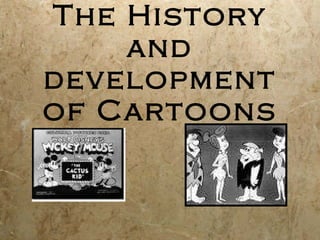
The History and development of Cartoons
What does a cartoon mean?
A cartoon (from the  Italian  "cartone" and  Dutch  word "karton", is a full-size  drawing  made on sturdy  paper  as a study or  modello  for a  painting ,  stained glass , or  tapestry . In fine arts :- a preparatory  drawing  for a piece of art such as a painting or  tapestry .
Historical background When Leo X was elected pope in 1513, he had the opportunity to make his own contribution to the ambitious programme of decoration in the Sistine Chapel. Leo X commissioned a set of tapestry designs, or cartoons, from Raphael in 1515
 
Common man
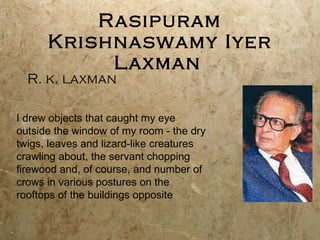
Rasipuram Krishnaswamy Iyer Laxman   R. k. laxman I drew objects that caught my eye outside the window of my room - the dry twigs, leaves and lizard-like creatures crawling about, the servant chopping firewood and, of course, and number of crows in various postures on the rooftops of the buildings opposite
Do you know? He has never kept a diary nor worn a wrist watch in his entire life [11] The Common Man in his cartoons never speaks anything. The Common Man has even travelled to  Antarctica  once in a cartoon. The Common Man speaks once in an early cartoon about Nehru. He tells Nehru even as he doesn't recognize him, "...Don't know all that Sir, but I'm voting for that man...!", pointing to Nehru's statue. (from the book 'Brushing Up the Years')
An  animated cartoon  is a short, hand-drawn film for the cinema, television or computer screen, featuring some kind of story or plot
PRE HISTORIC CARTOONS
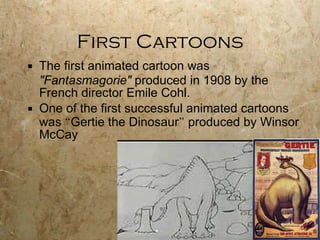
First Cartoons The first animated cartoon was  "Fantasmagorie"  produced in 1908 by the French director Emile Cohl. One of the first successful animated cartoons was  “ Gertie the Dinosaur ”  produced by Winsor McCay
 
Walt elias disney "I never called my work an 'art' It's part of show business, the business of building entertainment."
In the 1930s to 1960s, cartoons were produced in huge numbers, and usually shown before a movie to keep audiences entertained.
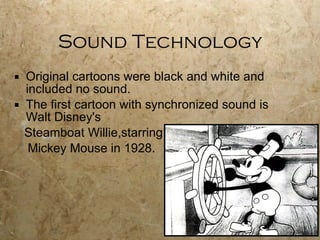
Sound Technology Original cartoons were black and white and included no sound. The first cartoon with synchronized sound is Walt Disney's  Steamboat Willie,starring  Mickey Mouse in 1928.
Sound Film With the advent of  “ sound film ” , musical themes were now included. Animated characters would perform an action in "loops", where drawings were repeated over and over, synchronized with the music. Disney produced the first full-color cartoon in Technicolor,  “ Flowers and Trees ” , in 1931
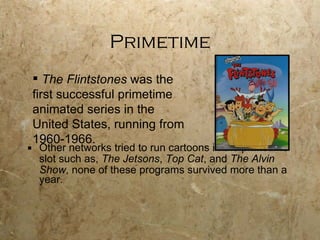
Primetime Other networks tried to run cartoons in the primetime slot such as,  The Jetsons ,  Top Cat , and  The Alvin Show , none of these programs survived more than a year. The Flintstones  was the  first successful primetime animated series in the United States, running from 1960-1966.
Saturday Morning Cartoons Networks moved these failed shows to Saturday morning. Reaching smaller audiences with more demographic unity  among children  These cartoons became popular and played for years!
Today’s Technology Today, animation is commonly produced with computers, giving the animator new tools not available in hand-drawn traditional animation. Professionals argue that today ’ s, computer generated films, are not officially cartoons
And now the most recent
zoo zoo
Thank you

cartoons

  • 1.
    The History anddevelopment of Cartoons
  • 2.
    What does acartoon mean?
  • 3.
    A cartoon (fromthe Italian "cartone" and Dutch word "karton", is a full-size drawing made on sturdy paper as a study or modello for a painting , stained glass , or tapestry . In fine arts :- a preparatory drawing for a piece of art such as a painting or tapestry .
  • 4.
    Historical background WhenLeo X was elected pope in 1513, he had the opportunity to make his own contribution to the ambitious programme of decoration in the Sistine Chapel. Leo X commissioned a set of tapestry designs, or cartoons, from Raphael in 1515
  • 5.
  • 6.
  • 7.
    Rasipuram Krishnaswamy IyerLaxman R. k. laxman I drew objects that caught my eye outside the window of my room - the dry twigs, leaves and lizard-like creatures crawling about, the servant chopping firewood and, of course, and number of crows in various postures on the rooftops of the buildings opposite
  • 8.
    Do you know?He has never kept a diary nor worn a wrist watch in his entire life [11] The Common Man in his cartoons never speaks anything. The Common Man has even travelled to Antarctica once in a cartoon. The Common Man speaks once in an early cartoon about Nehru. He tells Nehru even as he doesn't recognize him, "...Don't know all that Sir, but I'm voting for that man...!", pointing to Nehru's statue. (from the book 'Brushing Up the Years')
  • 9.
    An animatedcartoon is a short, hand-drawn film for the cinema, television or computer screen, featuring some kind of story or plot
  • 10.
  • 11.
    First Cartoons Thefirst animated cartoon was "Fantasmagorie" produced in 1908 by the French director Emile Cohl. One of the first successful animated cartoons was “ Gertie the Dinosaur ” produced by Winsor McCay
  • 12.
  • 13.
    Walt elias disney"I never called my work an 'art' It's part of show business, the business of building entertainment."
  • 14.
    In the 1930sto 1960s, cartoons were produced in huge numbers, and usually shown before a movie to keep audiences entertained.
  • 15.
    Sound Technology Originalcartoons were black and white and included no sound. The first cartoon with synchronized sound is Walt Disney's Steamboat Willie,starring Mickey Mouse in 1928.
  • 16.
    Sound Film Withthe advent of “ sound film ” , musical themes were now included. Animated characters would perform an action in "loops", where drawings were repeated over and over, synchronized with the music. Disney produced the first full-color cartoon in Technicolor, “ Flowers and Trees ” , in 1931
  • 17.
    Primetime Other networkstried to run cartoons in the primetime slot such as, The Jetsons , Top Cat , and The Alvin Show , none of these programs survived more than a year. The Flintstones was the first successful primetime animated series in the United States, running from 1960-1966.
  • 18.
    Saturday Morning CartoonsNetworks moved these failed shows to Saturday morning. Reaching smaller audiences with more demographic unity among children These cartoons became popular and played for years!
  • 19.
    Today’s Technology Today,animation is commonly produced with computers, giving the animator new tools not available in hand-drawn traditional animation. Professionals argue that today ’ s, computer generated films, are not officially cartoons
  • 20.
    And now themost recent
  • 21.
  • 22.