




 Presented by: Group 8
Poluri Pavani
HOBEDENG20160043
Dainy Daniel
HOBEDENG20160028
Govind Ram
HOBEDENG20160029
Ishan Mukhopadhyay
HOBEDENG20160030
Roshni R
HOBEDENG20160014
 The origin of Indian arts can be traced to pre-
historic Hominid settlements in the 3rd
millennium BC.
 On its way to modern times, Indian art has had
cultural influences (e.g., Indus Valley
and Hellenistic), as well as religious influences
such as Hinduism, Buddhism, Jainism
and Islam.
 In spite of this complex mixture of religious
traditions, generally the prevailing artistic style
at any time and place has been shared by the
major religious groups.
 Indian paintings have always been considered
exquisite but the main point ignored by us is
that most of these art forms depict the daily
routines of the people living at that time and
also shows pictures of festivals and epics from
Mahabharata, Ramayana, etc.
 All these heritage art forms convey some
stories to us.
 A cartoon is a type of two-
dimensional illustration.
 While the specific definition has changed over
time, modern usage refers to (a) a typically
non-realistic or semi-realistic artistic style
of drawing or painting, (b) an image or series
of images intended for satire, caricature,
or humor, or (c) a motion picture that relies on
a sequence of illustrations for its animation.
 An artist who creates cartoons is called
a cartoonist.
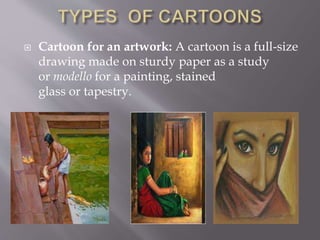
 Cartoon for an artwork: A cartoon is a full-size
drawing made on sturdy paper as a study
or modello for a painting, stained
glass or tapestry.
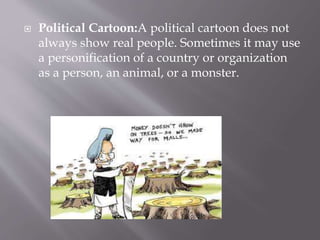
 Political Cartoon:A political cartoon does not
always show real people. Sometimes it may use
a personification of a country or organization
as a person, an animal, or a monster.
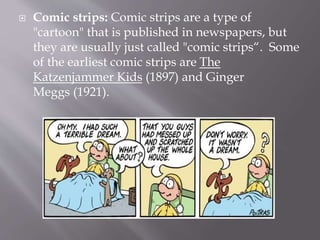
 Comic strips: Comic strips are a type of
"cartoon" that is published in newspapers, but
they are usually just called "comic strips“. Some
of the earliest comic strips are The
Katzenjammer Kids (1897) and Ginger
Meggs (1921).
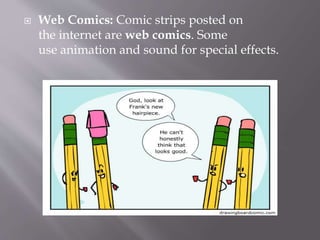
 Web Comics: Comic strips posted on
the internet are web comics. Some
use animation and sound for special effects.
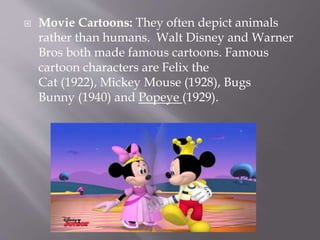
 Movie Cartoons: They often depict animals
rather than humans. Walt Disney and Warner
Bros both made famous cartoons. Famous
cartoon characters are Felix the
Cat (1922), Mickey Mouse (1928), Bugs
Bunny (1940) and Popeye (1929).
 Animated Cartoons: An animated cartoon is a
film for the cinema, television or computer
screen, which is made using sequential
drawings, as opposed to animations in general,
which include films made using clay, puppet
and other means.
Cartoons in Education:
 Cartoons snatch attention.
 Cartoons lead to a superior understanding.
 Cartoons can develop public speaking.
 Cartoons are an effective way of teaching
moral education.
 Cartoons will enhance thinking skills.
 Cartoons can improve vocabulary.
 Cartoons will improve teacher-student
relationship.
Cartoons in Sciences:
 Cartoons help the students to have a visual
look of the experiments.
 Cartoons are helpful in a comic representation
of science for the easy understanding.
 Science concepts of cartoons helps the students
to know more about the tools and experiments
in a comic way.
Cartoons in Social Sciences:
 Comics helps students learn about the past
and present of the society in which they reside.
 Comics helps to encounter various details
about other societies.
 Students are given the opportunity to learn
about the rich and cultural experiences of
mankind throughout history.
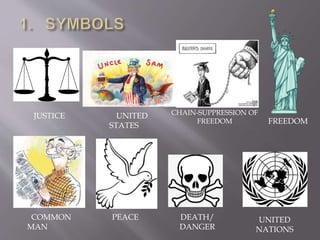
JUSTICE UNITED
STATES
FREEDOM
COMMON
MAN
PEACE DEATH/
DANGER
CHAIN-SUPPRESSION OF
FREEDOM
UNITED
NATIONS
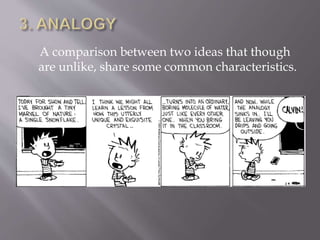
A comparison between two ideas that though
are unlike, share some common characteristics.
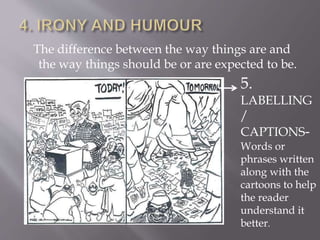
The difference between the way things are and
the way things should be or are expected to be.
5.
LABELLING
/
CAPTIONS-
Words or
phrases written
along with the
cartoons to help
the reader
understand it
better.
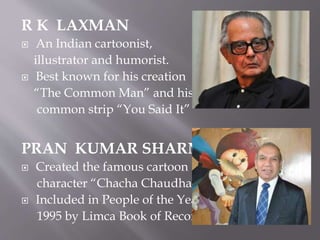
R K LAXMAN
 An Indian cartoonist,
illustrator and humorist.
 Best known for his creation
“The Common Man” and his
common strip “You Said It”
PRAN KUMAR SHARMA
 Created the famous cartoon
character “Chacha Chaudhary”
 Included in People of the Year
1995 by Limca Book of Records
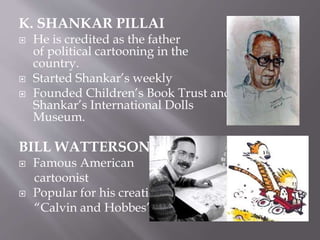
K. SHANKAR PILLAI
 He is credited as the father
of political cartooning in the
country.
 Started Shankar’s weekly
 Founded Children’s Book Trust and
Shankar’s International Dolls
Museum.
BILL WATTERSON
 Famous American
cartoonist
 Popular for his creation
“Calvin and Hobbes”
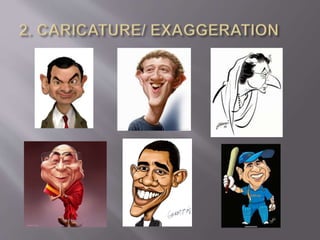
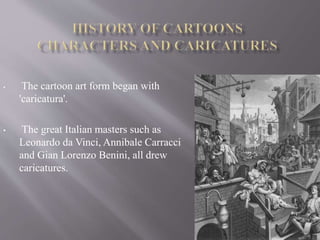
• The cartoon art form began with
'caricatura'.
• The great Italian masters such as
Leonardo da Vinci, Annibale Carracci
and Gian Lorenzo Benini, all drew
caricatures.
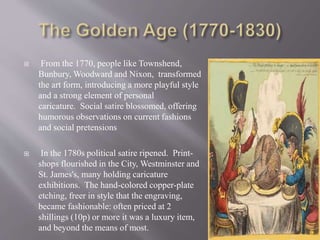
 From the 1770, people like Townshend,
Bunbury, Woodward and Nixon, transformed
the art form, introducing a more playful style
and a strong element of personal
caricature. Social satire blossomed, offering
humorous observations on current fashions
and social pretensions
 In the 1780s political satire ripened. Print-
shops flourished in the City, Westminster and
St. James's, many holding caricature
exhibitions. The hand-colored copper-plate
etching, freer in style that the engraving,
became fashionable: often priced at 2
shillings (10p) or more it was a luxury item,
and beyond the means of most.
 Vanity Fair was founded in 1868 and
revived the tradition of the single-figure
caricature in genial color portraits of
celebrities and professional men.
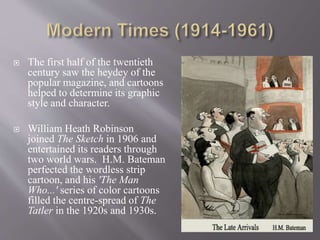
 The first half of the twentieth
century saw the heydey of the
popular magazine, and cartoons
helped to determine its graphic
style and character.
 William Heath Robinson
joined The Sketch in 1906 and
entertained its readers through
two world wars. H.M. Bateman
perfected the wordless strip
cartoon, and his 'The Man
Who...' series of color cartoons
filled the centre-spread of The
Tatler in the 1920s and 1930s.
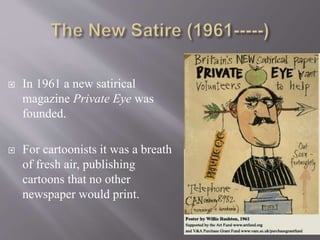
 In 1961 a new satirical
magazine Private Eye was
founded.
 For cartoonists it was a breath
of fresh air, publishing
cartoons that no other
newspaper would print.
 W. K.Haselden is regarded as the father of the
British newspaper cartoon strip. During the
First World War he effectively lampooned the
German Kaiser and Crown Prince in his
series Big and Little Willie.
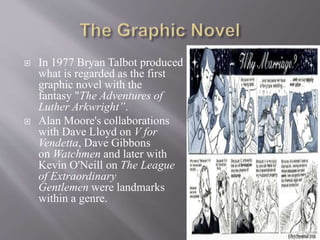
 In 1977 Bryan Talbot produced
what is regarded as the first
graphic novel with the
fantasy "The Adventures of
Luther Arkwright”.
 Alan Moore's collaborations
with Dave Lloyd on V for
Vendetta, Dave Gibbons
on Watchmen and later with
Kevin O'Neill on The League
of Extraordinary
Gentlemen were landmarks
within a genre.
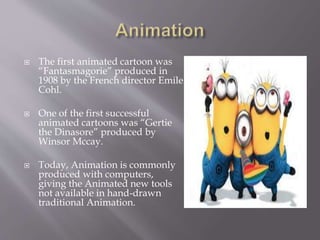
 The first animated cartoon was
“Fantasmagorie” produced in
1908 by the French director Emile
Cohl.
 One of the first successful
animated cartoons was “Gertie
the Dinasore” produced by
Winsor Mccay.
 Today, Animation is commonly
produced with computers,
giving the Animated new tools
not available in hand-drawn
traditional Animation.
 Engages students and increases their concentration through
visual learning
 LSRW, vocabulary and visual representation skills can be
developed. It also helps in the cognitive development of
students.
 Cartoons always give more impact to a lesson and they can be
utilized to help learners perceive familiar situations or objects
in a different way.
 Raises the enthusiasm for reading texts.
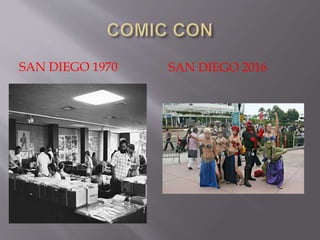
SAN DIEGO 1970 SAN DIEGO 2016
 Comic Con is a multi-genre comic convention.
 The first ever Comic Con was held in San Diego in
1970.
 Genres: Comic books and science fiction/fantasy
related film, television, horror, animation, anime,
manga (a form of Japanese cartoon) etc.
 Events: Panel discussions, preview of films, book-
reviews, cos-play (Costume Masquerade) etc.
• DELHI
• MUMBAI
• BANGLAORE
• HYDERABAD
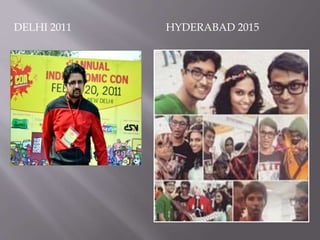
DELHI 2011 HYDERABAD 2015
 With Amar Chitrakatha by Anant Pai the Indian
comic scene started, more or less.
 Brands: Diamond Comics, Raj Comics, Tinkle
Digest, Virgin Comics etc.
 Illustrators: RK Narayanan, Narayan Debnath,
Pran Kumar Sharma, Sumit Kumar, Orijit Sen.
 Characters: Chacha Choudhary, Batul the Great,
Handa-Bhonda, Shikari Shambhu etc.
 Graphic novels are books in graphic
(pictorial) formats.
 They contain pictures and texts.
 Some eminent examples are Sarnath
Banerjee’s “The Barn Owl’s
Wondrous Capers”, “Bhimayana” –
the graphic novel based on
Ambedkar’s life.
 Animated films in India started in 1956
with Disney’s Clair Weeks
 The first film: The Banyan Deer (1957)
 The first 3d animated film: Roadside
Romeo (2008)
 Awards: National Film Award for best
non-feature animation film, 24 FPS,
Anifest India etc.
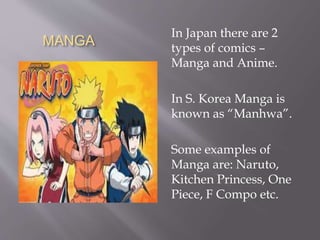
MANGA
In Japan there are 2
types of comics –
Manga and Anime.
In S. Korea Manga is
known as “Manhwa”.
Some examples of
Manga are: Naruto,
Kitchen Princess, One
Piece, F Compo etc.
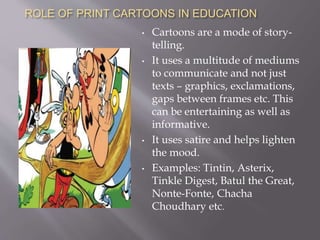
ROLE OF PRINT CARTOONS IN EDUCATION
• Cartoons are a mode of story-
telling.
• It uses a multitude of mediums
to communicate and not just
texts – graphics, exclamations,
gaps between frames etc. This
can be entertaining as well as
informative.
• It uses satire and helps lighten
the mood.
• Examples: Tintin, Asterix,
Tinkle Digest, Batul the Great,
Nonte-Fonte, Chacha
Choudhary etc.
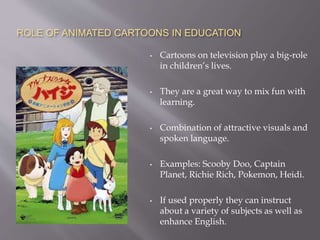
ROLE OF ANIMATED CARTOONS IN EDUCATION
• Cartoons on television play a big-role
in children’s lives.
• They are a great way to mix fun with
learning.
• Combination of attractive visuals and
spoken language.
• Examples: Scooby Doo, Captain
Planet, Richie Rich, Pokemon, Heidi.
• If used properly they can instruct
about a variety of subjects as well as
enhance English.
BENEFITS OF USING CARTOONS
AND COMICS FOR LANGUAGE
LEARNING & CLIL
JIM DAVIS
 American cartoonist and illustrator
 Known for the popular
Garfield The Cat character.
CHARLES M. SCHULZ
 American cartoonist
 Best known for his comic
strip “Peanuts”
 Peanuts became the most
widely read comic strip
in the world.
WHY USE CARTOONS AND
COMICS?
• The visual images - help encourage students to
observe and analyze the situation.
• promote students’ analytical skills and activate
higher level thinking ability. [Analysis
(comparing two panels) and Synthesis (creating
a comic) in Bloom’s Taxonomy ]
...CONTINUED.
• Promotes target language through student-
centered work.
• Grammar and vocabulary in context
• Subtleties beneath the surface of familiar
situations, and gain a better understanding of
symbolism, sarcasm, satire, and humor.
• Humour helps lighten the classroom environment.
• can spark thoughtful conversation
SOME USES OF COMICS AND
CARTOONS IN CLASSROOMS:
• to demonstrate high-frequency vocabulary in context
• to illustrate idioms and expressions
• to teach verbs and other parts of speech as examples of
connected speech
• to simulate dialogues to inject humor into class sessions
• to provide a basis for oral discourse and writing activities
• to illustrate culture and values
Cartoons and comics can act
as sources and indicators to
know the historical, political,
social, scientific and
technological development
perspectives during different
periods
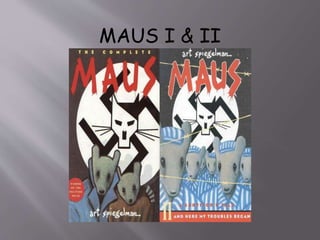
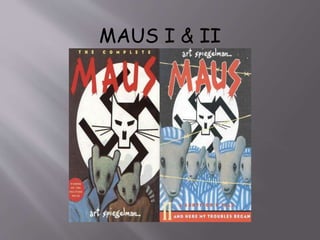
MAUS I & II
MAUS I & II
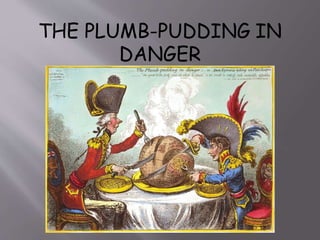
THE PLUMB-PUDDING IN
DANGER
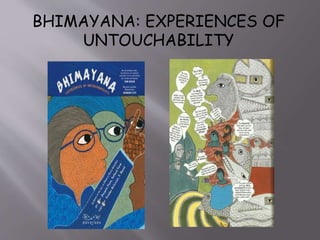
BHIMAYANA: EXPERIENCES OF
UNTOUCHABILITY
BHIMAYANA: EXPERIENCES OF
UNTOUCHABILITY
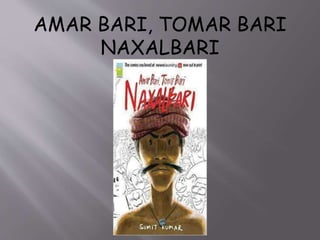
AMAR BARI, TOMAR BARI
NAXALBARI
Presentation on cartoons as language arts

Presentation on cartoons as language arts

  • 1.
     Presented by:Group 8 Poluri Pavani HOBEDENG20160043 Dainy Daniel HOBEDENG20160028 Govind Ram HOBEDENG20160029 Ishan Mukhopadhyay HOBEDENG20160030 Roshni R HOBEDENG20160014
  • 3.
     The originof Indian arts can be traced to pre- historic Hominid settlements in the 3rd millennium BC.  On its way to modern times, Indian art has had cultural influences (e.g., Indus Valley and Hellenistic), as well as religious influences such as Hinduism, Buddhism, Jainism and Islam.  In spite of this complex mixture of religious traditions, generally the prevailing artistic style at any time and place has been shared by the major religious groups.
  • 4.
     Indian paintingshave always been considered exquisite but the main point ignored by us is that most of these art forms depict the daily routines of the people living at that time and also shows pictures of festivals and epics from Mahabharata, Ramayana, etc.  All these heritage art forms convey some stories to us.
  • 6.
     A cartoonis a type of two- dimensional illustration.  While the specific definition has changed over time, modern usage refers to (a) a typically non-realistic or semi-realistic artistic style of drawing or painting, (b) an image or series of images intended for satire, caricature, or humor, or (c) a motion picture that relies on a sequence of illustrations for its animation.  An artist who creates cartoons is called a cartoonist.
  • 7.
     Cartoon foran artwork: A cartoon is a full-size drawing made on sturdy paper as a study or modello for a painting, stained glass or tapestry.
  • 8.
     Political Cartoon:Apolitical cartoon does not always show real people. Sometimes it may use a personification of a country or organization as a person, an animal, or a monster.
  • 9.
     Comic strips:Comic strips are a type of "cartoon" that is published in newspapers, but they are usually just called "comic strips“. Some of the earliest comic strips are The Katzenjammer Kids (1897) and Ginger Meggs (1921).
  • 10.
     Web Comics:Comic strips posted on the internet are web comics. Some use animation and sound for special effects.
  • 11.
     Movie Cartoons:They often depict animals rather than humans. Walt Disney and Warner Bros both made famous cartoons. Famous cartoon characters are Felix the Cat (1922), Mickey Mouse (1928), Bugs Bunny (1940) and Popeye (1929).
  • 12.
     Animated Cartoons:An animated cartoon is a film for the cinema, television or computer screen, which is made using sequential drawings, as opposed to animations in general, which include films made using clay, puppet and other means.
  • 13.
    Cartoons in Education: Cartoons snatch attention.  Cartoons lead to a superior understanding.  Cartoons can develop public speaking.  Cartoons are an effective way of teaching moral education.  Cartoons will enhance thinking skills.  Cartoons can improve vocabulary.  Cartoons will improve teacher-student relationship.
  • 15.
    Cartoons in Sciences: Cartoons help the students to have a visual look of the experiments.  Cartoons are helpful in a comic representation of science for the easy understanding.  Science concepts of cartoons helps the students to know more about the tools and experiments in a comic way.
  • 17.
    Cartoons in SocialSciences:  Comics helps students learn about the past and present of the society in which they reside.  Comics helps to encounter various details about other societies.  Students are given the opportunity to learn about the rich and cultural experiences of mankind throughout history.
  • 20.
  • 22.
    A comparison betweentwo ideas that though are unlike, share some common characteristics.
  • 23.
    The difference betweenthe way things are and the way things should be or are expected to be. 5. LABELLING / CAPTIONS- Words or phrases written along with the cartoons to help the reader understand it better.
  • 26.
    R K LAXMAN An Indian cartoonist, illustrator and humorist.  Best known for his creation “The Common Man” and his common strip “You Said It” PRAN KUMAR SHARMA  Created the famous cartoon character “Chacha Chaudhary”  Included in People of the Year 1995 by Limca Book of Records
  • 27.
    K. SHANKAR PILLAI He is credited as the father of political cartooning in the country.  Started Shankar’s weekly  Founded Children’s Book Trust and Shankar’s International Dolls Museum. BILL WATTERSON  Famous American cartoonist  Popular for his creation “Calvin and Hobbes”
  • 29.
    • The cartoonart form began with 'caricatura'. • The great Italian masters such as Leonardo da Vinci, Annibale Carracci and Gian Lorenzo Benini, all drew caricatures.
  • 30.
     From the1770, people like Townshend, Bunbury, Woodward and Nixon, transformed the art form, introducing a more playful style and a strong element of personal caricature. Social satire blossomed, offering humorous observations on current fashions and social pretensions  In the 1780s political satire ripened. Print- shops flourished in the City, Westminster and St. James's, many holding caricature exhibitions. The hand-colored copper-plate etching, freer in style that the engraving, became fashionable: often priced at 2 shillings (10p) or more it was a luxury item, and beyond the means of most.
  • 31.
     Vanity Fairwas founded in 1868 and revived the tradition of the single-figure caricature in genial color portraits of celebrities and professional men.
  • 32.
     The firsthalf of the twentieth century saw the heydey of the popular magazine, and cartoons helped to determine its graphic style and character.  William Heath Robinson joined The Sketch in 1906 and entertained its readers through two world wars. H.M. Bateman perfected the wordless strip cartoon, and his 'The Man Who...' series of color cartoons filled the centre-spread of The Tatler in the 1920s and 1930s.
  • 33.
     In 1961a new satirical magazine Private Eye was founded.  For cartoonists it was a breath of fresh air, publishing cartoons that no other newspaper would print.
  • 34.
     W. K.Haseldenis regarded as the father of the British newspaper cartoon strip. During the First World War he effectively lampooned the German Kaiser and Crown Prince in his series Big and Little Willie.
  • 35.
     In 1977Bryan Talbot produced what is regarded as the first graphic novel with the fantasy "The Adventures of Luther Arkwright”.  Alan Moore's collaborations with Dave Lloyd on V for Vendetta, Dave Gibbons on Watchmen and later with Kevin O'Neill on The League of Extraordinary Gentlemen were landmarks within a genre.
  • 36.
     The firstanimated cartoon was “Fantasmagorie” produced in 1908 by the French director Emile Cohl.  One of the first successful animated cartoons was “Gertie the Dinasore” produced by Winsor Mccay.  Today, Animation is commonly produced with computers, giving the Animated new tools not available in hand-drawn traditional Animation.
  • 37.
     Engages studentsand increases their concentration through visual learning  LSRW, vocabulary and visual representation skills can be developed. It also helps in the cognitive development of students.  Cartoons always give more impact to a lesson and they can be utilized to help learners perceive familiar situations or objects in a different way.  Raises the enthusiasm for reading texts.
  • 39.
    SAN DIEGO 1970SAN DIEGO 2016
  • 40.
     Comic Conis a multi-genre comic convention.  The first ever Comic Con was held in San Diego in 1970.  Genres: Comic books and science fiction/fantasy related film, television, horror, animation, anime, manga (a form of Japanese cartoon) etc.  Events: Panel discussions, preview of films, book- reviews, cos-play (Costume Masquerade) etc.
  • 41.
    • DELHI • MUMBAI •BANGLAORE • HYDERABAD
  • 42.
  • 44.
     With AmarChitrakatha by Anant Pai the Indian comic scene started, more or less.  Brands: Diamond Comics, Raj Comics, Tinkle Digest, Virgin Comics etc.  Illustrators: RK Narayanan, Narayan Debnath, Pran Kumar Sharma, Sumit Kumar, Orijit Sen.  Characters: Chacha Choudhary, Batul the Great, Handa-Bhonda, Shikari Shambhu etc.
  • 45.
     Graphic novelsare books in graphic (pictorial) formats.  They contain pictures and texts.  Some eminent examples are Sarnath Banerjee’s “The Barn Owl’s Wondrous Capers”, “Bhimayana” – the graphic novel based on Ambedkar’s life.
  • 46.
     Animated filmsin India started in 1956 with Disney’s Clair Weeks  The first film: The Banyan Deer (1957)  The first 3d animated film: Roadside Romeo (2008)  Awards: National Film Award for best non-feature animation film, 24 FPS, Anifest India etc.
  • 47.
    MANGA In Japan thereare 2 types of comics – Manga and Anime. In S. Korea Manga is known as “Manhwa”. Some examples of Manga are: Naruto, Kitchen Princess, One Piece, F Compo etc.
  • 48.
    ROLE OF PRINTCARTOONS IN EDUCATION • Cartoons are a mode of story- telling. • It uses a multitude of mediums to communicate and not just texts – graphics, exclamations, gaps between frames etc. This can be entertaining as well as informative. • It uses satire and helps lighten the mood. • Examples: Tintin, Asterix, Tinkle Digest, Batul the Great, Nonte-Fonte, Chacha Choudhary etc.
  • 49.
    ROLE OF ANIMATEDCARTOONS IN EDUCATION • Cartoons on television play a big-role in children’s lives. • They are a great way to mix fun with learning. • Combination of attractive visuals and spoken language. • Examples: Scooby Doo, Captain Planet, Richie Rich, Pokemon, Heidi. • If used properly they can instruct about a variety of subjects as well as enhance English.
  • 50.
    BENEFITS OF USINGCARTOONS AND COMICS FOR LANGUAGE LEARNING & CLIL
  • 51.
    JIM DAVIS  Americancartoonist and illustrator  Known for the popular Garfield The Cat character. CHARLES M. SCHULZ  American cartoonist  Best known for his comic strip “Peanuts”  Peanuts became the most widely read comic strip in the world.
  • 52.
    WHY USE CARTOONSAND COMICS? • The visual images - help encourage students to observe and analyze the situation. • promote students’ analytical skills and activate higher level thinking ability. [Analysis (comparing two panels) and Synthesis (creating a comic) in Bloom’s Taxonomy ]
  • 53.
    ...CONTINUED. • Promotes targetlanguage through student- centered work. • Grammar and vocabulary in context • Subtleties beneath the surface of familiar situations, and gain a better understanding of symbolism, sarcasm, satire, and humor. • Humour helps lighten the classroom environment. • can spark thoughtful conversation
  • 54.
    SOME USES OFCOMICS AND CARTOONS IN CLASSROOMS: • to demonstrate high-frequency vocabulary in context • to illustrate idioms and expressions • to teach verbs and other parts of speech as examples of connected speech • to simulate dialogues to inject humor into class sessions • to provide a basis for oral discourse and writing activities • to illustrate culture and values
  • 62.
    Cartoons and comicscan act as sources and indicators to know the historical, political, social, scientific and technological development perspectives during different periods
  • 63.
  • 65.
  • 66.
  • 67.
  • 68.
  • 69.
    AMAR BARI, TOMARBARI NAXALBARI

Editor's Notes