It’s digital or never!
A business transformation proposition by
Maria Clara Parada
Hyper Island - DMM7
2016
“The newspaper industry is changing, and that change is being driven by readers,” said (Evgeny) Lebedev. “They’re showing us that the
future is digital.” (Sweney, 2016)
The Independent, one of Britain’s largest newspapers, ceased its physical circulation in March 2016. Its owner, Evgeny Lebedev, as quoted
above, shared his thoughts on the newspaper industry. He could’ve been even broader: the whole journalism industry is changing rapidly.
According to Carat’s latest report concerning advertising spends in 2016 and 2017, magazines will have a 1.7% drop in market share. In
2017, forecasting indicates that more advertising money will be spent with radio than with magazines.
CartaCapital is no stranger to changes. It was one of the first Brazilian magazines to launch its digital version; the website receives more
investment year after year; and video is being taken seriously, with 2 or 3 new stories per week. However, it must embrace transformation if it
expects to survive.
The goal of this proposition is to pitch ideas of how CartaCapital could reduce its costs and increase its revenue, while keeping true to its
Value Proposition and loyal to its community.
Current
1.7 million likes
1.2 million followers
1.1 million video views*
2.9 million users on the website*
*data from April/2016
11 thousand weekly issues
15 thousand subscribers
6 thousand digital subscribers
scenario
Digital
Magazine
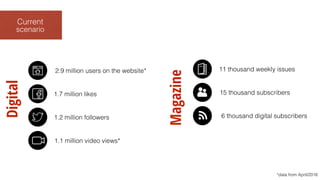
The numbers regarding Digital Media are very good. Carta’s Facebook page is very influential, provoking and starting long debates on the
comments. Also, compared to YouTube, Facebook’s embedded videos receive a lot of attention, with 1 million views on average per month.
The website’s access numbers are growing: 2.9 million users on April 2016 indicates a 6.3% increase, if compared to the same period last year.
It could be even better. If we take a look on our magazine’s numbers, we can see clearly that CartaCapital’s physical reach cannot even
compare to digital.
Advertisers - large
corporations and
government
Reader community
Creation, publishing and
distribution of content, on
and offline
Selling ads
Planning and execution of
events
R&D
Human
Intellectual capital
Office, newsroom and
video equipment
A different point of view
Content containing critical
thinking
Analysis over hard news
Supervision of power
Commitment to the factual
truth
CartaCapital delivers the
content, readers comment
it on social media
Customer service - Call
centre
Magazine - physical and
digital
Website
Social Media
Online and physical stores
Events
Paying customers for issues
of the magazine (physical
and digital)
Paying subscribers of the
magazine (physical and
digital)
Non-paying customers that
visit our website and social
media
Staff salary
Office structure
Printing and distribution
Servers
Execution of events
News budget
R&D
Marketing
Advertisement
Magazine Sales
Subscriptions
Events
Native content
Carta Educação
CurrentBusinessCanvas
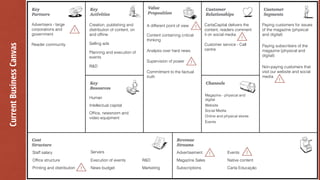
“It could be even better you say?” Why yes. Let’s take a look at Carta’s current business canvas. The red caution
marks indicate areas that could be changed or improved. If the company embraces transformation, it could not
only increase its website accesses, but also its profits by reducing costs and aggregating new forms of revenue.
The world
is changing
64%
Millennials
facebook
website
44%
Mobile
Content being produced by smartphones
for smartphones
Mobile
Multimedia
Ad blockers
facebook
website
45%
65%
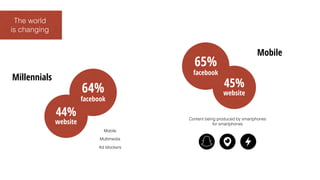
The world is changing. It now belongs to mobile and Millennials, people born since the year of 1981. These are people
who are dictating how content is conveyed and how much companies profit at the end of the year. They cannot live
without their phones, they have a desire for multimedia and less dense content, and finally, they don’t like ads
(Newman, 2016).
Speaking of mobile, the trend is real. Carta’s users are using smartphones to access our facebook page and our website.
According to Newman (2016) “With the entry price for an Android phone now around $35, smartphones are projected to
reach around 80% of the world’s population by 2020.” This exponential increase indicates that content should be
produced with this mindset: people are looking less for a wall of text and more for diluted content. This is one of the real
challenges for Carta, since its pieces tend to be more analytical than hard news.
Not only that, mobile is bringing new habits to people, such as vertical videos and live streaming on platforms like
snapchat or periscope. Also, instant articles on facebook are blooming, with shorter download times and seamless
transitions. These are platforms where Carta is not yet present and it must be.
Research
insights 536 responses
44,3% 70% 50%
Millennials People outside of
São Paulo state
Don’t watch our
videos
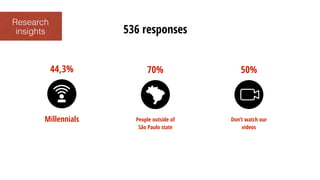
Almost half of the survey’s participants were Millennials. This corroborates with Carta’s analytics and with the thesis of
the Millennial mindset.
CartaCapital’s headquarters are located in Sao Paulo. This has a direct impact on its news: most of it is produced in
that city. What our survey indicates, however, is that 70% of the website’s users don’t live in SP. Many interviewees also
demanded diversification of content concerning regions. Brazil is a continental country and CartaCapital has been
neglecting that.
On a downside to the Millennial multimedia thesis, 50% of the interviewees have a habit of watching Carta’s videos.
While the ones that watch find them very good (92%), we must think about what could be done to increase that
audience, as there is a clear space for improvement, as according to Newman (2016) “Video is expected to grow 14x
within five years and account for 70% of mobile network traffic.” CartaCapital must take advantage of this scenario.
CartaCapital was launched over 20 years ago. Since then, the country’s political scenario has shifted a few times and
the magazine gained notoriety. However, its audience also changed and Carta never once talked to its new consumers
in any way. This is why I decided to create a survey: to open a dialogue in order to understand who is accessing Carta’s
website and social media.
The questionnaire was published on twitter and the website on Monday May 2nd. As this report is being finalised, on
May 5th, we have had 536 answers and many interesting insights.
58,7% 98% 49%
Read the magazine
(75% in digital format)
Haven’t been to our
events
Would pay for
exclusive content
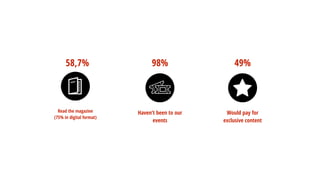
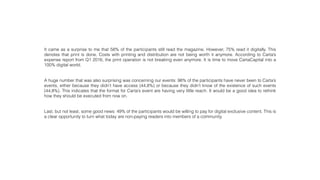
It came as a surprise to me that 58% of the participants still read the magazine. However, 75% read it digitally. This
denotes that print is done. Costs with printing and distribution are not being worth it anymore. According to Carta’s
expense report from Q1 2016, the print operation is not breaking even anymore. It is time to move CartaCapital into a
100% digital world.
A huge number that was also surprising was concerning our events: 98% of the participants have never been to Carta’s
events, either because they didn’t have access (44,8%) or because they didn’t know of the existence of such events
(44,8%). This indicates that the format for Carta’s event are having very little reach. It would be a good idea to rethink
how they should be executed from now on.
Last, but not least, some good news: 49% of the participants would be willing to pay for digital exclusive content. This is
a clear opportunity to turn what today are non-paying readers into members of a community.
ProposedBusinessCanvas
Reputable companies,
both large and small
Reader community
Creation, publishing and
distribution of content, on
and offline
Building partnerships
Planning and execution of
events
R&D
Human
Intellectual capital
Office, newsroom and
video equipment
A different point of view
Content containing critical
thinking
Analysis over hard news
Supervision of power
Commitment to the factual
truth
CartaCapital delivers the content,
readers comment it on social media
Customer service - chat and call centre
Digital magazine
Website
Social Media
Online stores
Events
Paying subscribers for
issues of the magazine
Non-paying customers that
visit our website and social
media
Staff salary
Office structure
Servers
Execution of events
News budget
R&D
Marketing
Magazine subscriptions and sales
Events
Crowdfunding
Regional independent
news outlets
Partners
Capital Society
Project Pnyx
Members of Capital Society
Capital Society - members interact with
the newsroom, giving suggestions and
prototyping new products, while having
access to benefits
Project Pnyx - CartaCapital as a
moderator between the people and the
govenment
Data
Carta Educação
Transparency
Independence
Contributors of Project Pnyx
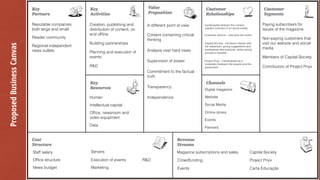
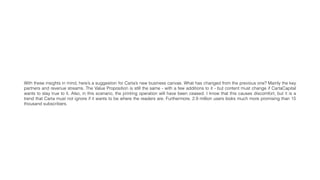
With these insights in mind, here’s a suggestion for Carta’s new business canvas. What has changed from the previous one? Mainly the key
partners and revenue streams. The Value Proposition is still the same - with a few additions to it - but content must change if CartaCapital
wants to stay true to it. Also, in this scenario, the printing operation will have been ceased. I know that this causes discomfort, but it is a
trend that Carta must not ignore if it wants to be where the readers are. Furthermore, 2.9 million users looks much more promising than 15
thousand subscribers.
partners
Key
Government
Non reputable companies
Even though only 20% of interviewees think that CartaCapital is biased, many people responded that the magazine and website’s defence
of the government has become extreme. This comes after an important moment for our country, concerning the impeachment of our
president, who is a member of the Workers Party, which Carta has supported for many years. Also, CartaCapital has been accused of being
a government “minion” continuously. If the company wants to declare itself as ethically independent, it must severe its ties to all political
parties. This will build trust with a larger amount of readers and strengthen Carta’s image as a just and pondered communication outlet.
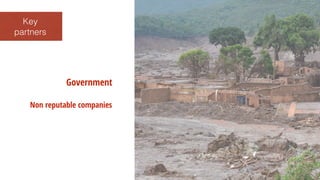
The same can be said about large, non reputable corporations. In 2014, CartaCapital advertised for Vale in some of its events. The mining
company was responsible for Brazil’s biggest environmental catastrophe in November 2015. If Carta wants to maintain its value proposition
of being a precursor of critical thinking and commitment to the factual truth, it must not be hypocritical towards its community. From now on,
the company should only partner up with reputable companies, but not focusing on ads. A code of conduct must be written, including what
kind of brand Carta wants or does not want to be associated with.
This does not mean that Carta will become neutral, as there is no such thing as impartial journalism. However, it can distance itself from
parties and figures that may be accused of clouding Carta’s judgment. CartaCapital must be a defender of ideas, not specific people.
Capital Society
X
No ads Discounts and
prizes
!
Dialogue
partners
New
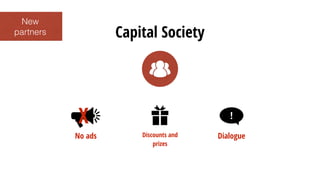
This is where Capital Society comes in. Many outlets, such as Spain’s El Diario, have been launching benefit clubs for their readers. In El
Diario’s model for instance, for €5 per month the subscriber has access to discounts, prizes and meetings with the newsroom to suggest
ideas for pieces. Furthermore, the website would block advertisements and send the member news with a few hours of advantage. As we
were talking about partnering up with reputable companies, such as movie theatres or tech companies: they could provide the benefits for
Capital Society’s members and benefit from exposure on a website that reaches millions per month. Not only that, CartaCapital has a very
qualified audience, specially concerning students and millennials, every companies' target since a few years ago.
Capital Society would apply many learnings from our dialogue with readers. Many complained about too many ads on our website, which
CS would abolish for members. As said before, 49% of our participants would be willing to pay for exclusive content, which indicates that
this initiative would be welcome. The survey itself proves that readers want to interact with CartaCapital, as 44% left their e-mail, opting in for
qualitative research. Carta would become more open and plural, as it would have a constant conversation with its readers.
Capital Society would be completely transparent, with regular expense reports divulged to its members. The more subscribers Carta would
have, the more independent it would become from big corporations.
Project Pnyx
revenue stream
New
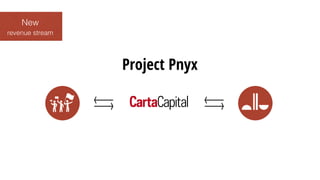
The desire to be heard does not stop there. According to Brazilian economist Luiz Gonzaga Belluzzo, our country is going through a rough
representative crisis. This is even more evident after the President’s impeachment. Voters are feeling impotent, as their voice meant nothing.
CartaCapital could remedy that, by bridging the relation between the people and the government. As a credible news outlet with a very
engaged community, Carta could be a new platform of debate.
Pnyx was the hill where the Greeks used to gather for discussions. It was stage for democracy for many years. Project Pynx would be a
website that would allow people to have healthy debates, with a feeling of accomplishment and resolution. This sensation would be installed
as Carta would be responsible for not only moderating the online discussions, but for summarising suggestions and solutions and delivering
them to the competent authority.
Carta would offer a free debate for new members so they could try it out. After that, to enter a forum, a person would have to contribute with
a micropayment - or as much as it would like - to keep the platform up and running.
content/partners
New
“I would like to see more
content being produced
outside Sao Paulo”
Partnerships with regional
independent news outlets.
“CartaCapital could show
other points of view”
Heads or tails
“I would like more
international content”
Crowdfunding
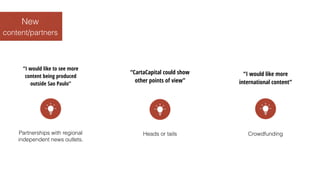
As for new ways to explore Carta’s content: one recurring answer to our question “what would you change in CartaCapital” was “I would like
to see more content being produced outside Sao Paulo.” One possible solution to this would be partnering up with regional news outlets. It
could function based on exchange of content and exposure on each other’s webpage and social media. Also, Carta could increase their
freelancer web with more regional columnists.
As said before, most of the survey’s participants think that Carta is honest and pondered. However, 20% think that the magazine is too
biased towards supporting the Worker’s Party. What was surprising was that even some people from the first group commented that Carta’s
position has become too extreme and demanded more pluralism of opinions. “Heads or Tails” would be a section of the website, where two
credible people with opposing opinions would be asked the same questions regarding the same subject and comment on it. This would
stimulate a healthy debate, even complementing Project Pnyx, and CartaCapital could be perceived as more diverse and open.
Many participants also questioned why Carta doesn’t produce more international content. Generally, international news comes from our
news agency partners, but also from a few correspondents. What could be done in order to enable our readers to know more about the
world that they live in would be crowdfunding campaigns for lengthy pieces about a country. For instance, we could create a campaign for a
reporter to go to China and create a hotsite that would be constantly updated with articles, videos and photos while he/she is on the go.
content/partners
New
98% has not been
to our events
Live streaming
50% don’t watch our
videos
+ =
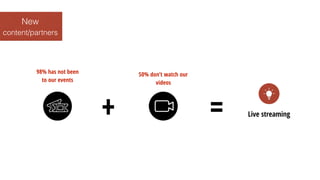
98% of our participants have never attended CartaCapital’s events. This indicates that the reach is very little. Only very privileged few can
benefit from it. The strategy could be offer physical events for Capital Society members and webinars for non paying members. This would
done via live streaming, a rising trend according to Newman (2016). We could go from full on debates, or even a movie club, where a
columnist could recommend a movie for the week and talk about it with the readers. This would also enable more interaction between Carta
and the audience, which is something that has already been talked about.
efficiency
Operational
Design Thinking
Research with
customers
Working in teams
to find solutions
Prototyping and being
open to failure
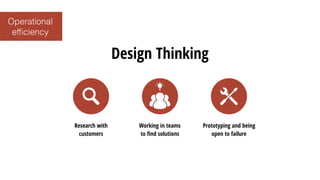
Design Thinking is a methodology that I believe could improve Carta’s operation efficiency. It is a framework that has been adopted in many
companies, specially startups. The workflow values research with users and prototyping. The good design thinker is empathic and talks to
its customers to find out where its product or brand could be improved. After this inspiration (Brown, 2009) process, it’s time to brainstorm
solutions. According to Martin and Euchner (2012), interdisciplinary teams tend to work best, as each member’s background is different.
This allows creativity to scale and very innovative ideas are usually a result of the process.
Prototyping and failing is key to Design Thinking. Once an idea is born, it must be tested with beta users and allowed to fail. Only then
iterations can be made and the solution can reach its full potential. Again, it comes down to an interaction between company and user.
CartaCapital is a small company but it does not escape from the fear of loosing money. However, prototyping can be done very cheaply with
accessible technology. The most important part is showing something, even a paper mock up, to the customer. One of the most positive
results of our survey is a database of 200 users that would be willing to help Carta improve.
are you ready to
change?
Change is not easy. Human beings are used to get accustomed to a set of rules and routines and follow it for as long as they can. However, in
order to stay relevant, one must be malleable as to shape itself according to its customers needs. The journalism industry has been adapting
for centuries now: each time a new technology was born, it shifted to accommodate its audience. It’s not always easy - or cheap - but through
this business transformation proposition I have shown options of how CartaCapital can achieve that. They can be done with a short amount of
money and prototyped with a vast database of users. A survey has showed us its needs and its desires. Carta must listen to it.
Breiner, J. (2016) Jornal El Diario da Espanha faz sucesso com modelo de negócios. Available at:
https://ijnet.org/pt-br/blog/jornal-el-diario-da-espanha-faz-sucesso-com-modelo-de-neg%C3%B3cios
(Accessed: 5 April 2016).
Brown, T. and Katz, B. (2011) ‘Change by design’, Journal of Product Innovation Management, 28(3),
pp. 381–383. doi: 10.1111/j.1540-5885.2011.00806.x.
Business model canvas (no date) Available at: http://www.businessmodelgeneration.com/canvas/bmc
(Accessed: 29 April 2016).
Carat Ad Spend Report (2016) Available at: http://www.dentsuaegisnetwork.com/m/en-UK/Carat%20Ad
%20Spend%20March%202016/Carat%20Ad%20Spend%20March%202016%20FINAL.pdf (Accessed:
1 May 2016).
CartaCapital (2015) Available at: http://www.cartacapital.com.br/editora/cartacapital (Accessed: 6 May
2016).
Council, D. (2015) Innovation by design. Available at: http://www.designcouncil.org.uk/sites/default/files/
asset/document/innovation-by-design.pdf (Accessed: 4 February 2016).
Desastre de Mariana (MG): ‘Medidas do governo, Vale e BHP Billiton foram claramente
insuficientes’ (2015) Available at: https://nacoesunidas.org/desastre-de-mariana-mg-medidas-do-
governo-vale-e-bhp-billiton-foram-claramente-insuficientes/ (Accessed: 3 May 2016).
Fixson, S.K. and Rao, J. (2014) ‘Learning emergent strategies through design thinking’, Design
Management Review, 25(1), pp. 46–53. doi: 10.1111/drev.10271.
Hazte socio (no date) Available at: http://www.eldiario.es/hazte_socio/ (Accessed: 1 May 2016).
Martin, R. and Euchner, J. (2012) ‘Conversations: Design thinking: An interview with Roger Martin’,
Research-Technology Management, 55(3), pp. 10–14. doi: 10.5437/08956308x5503003.
Bibliography
Newman, N. (2016) Journalism, Media and Technology Predictions 2016. Available at: http://
reutersinstitute.politics.ox.ac.uk/sites/default/files/Journalism%2C%20media%20and%20technology
%20predictions%202016.pdf (Accessed: 18 March 2016).
Sinek, S. (2010) How great leaders inspire action. Available at: http://www.ted.com/talks/
s i m o n _ s i n e k _ h o w _ g r e a t _ l e a d e r s _ i n s p i r e _ a c t i o n ? u t m _ c o n t e n t = a d d t h i s -
custom&utm_campaign=&utm_source=direct-on.ted.com&utm_medium=on.ted.com-
twitter&awesm=on.ted.com_iwoD&source=twitter#.UrG50TXly2N.twitter (Accessed: 2 February
2016).
Sweney, M. (2016) Independent and independent on Sunday print closures confirmed. Available at:
http://www.theguardian.com/media/2016/feb/12/independent-and-independent-on-sunday-closures-
confirmed (Accessed: 1 May 2016).
TED (2014) Bruno Torturra: Got a smartphone? Start broadcasting. Available at: https://youtu.be/
2r_qTWYOIog .
The independent (2016) Available at: http://www.independent.co.uk/ (Accessed: 3 May 2016).
tv Carta (2013) Zerovinte. Available at: https://www.youtube.com/watch?v=YBu09di_XHE (Accessed:
3 May 2016).
Sources
Link to the survey’s responses: https://docs.google.com/forms/d/1rtA-8X4nO3JjOB_C-
jOTk4__vXi4RKkLrW1TwtlxH5s/edit?usp=drive_web#responses
CartaCapital’s Google Analytics, Facebook Insights and Expenses report were provided by the own
company.

CartaCapital Communications Plan

  • 1.
    It’s digital ornever! A business transformation proposition by Maria Clara Parada Hyper Island - DMM7 2016
  • 2.
    “The newspaper industryis changing, and that change is being driven by readers,” said (Evgeny) Lebedev. “They’re showing us that the future is digital.” (Sweney, 2016) The Independent, one of Britain’s largest newspapers, ceased its physical circulation in March 2016. Its owner, Evgeny Lebedev, as quoted above, shared his thoughts on the newspaper industry. He could’ve been even broader: the whole journalism industry is changing rapidly. According to Carat’s latest report concerning advertising spends in 2016 and 2017, magazines will have a 1.7% drop in market share. In 2017, forecasting indicates that more advertising money will be spent with radio than with magazines. CartaCapital is no stranger to changes. It was one of the first Brazilian magazines to launch its digital version; the website receives more investment year after year; and video is being taken seriously, with 2 or 3 new stories per week. However, it must embrace transformation if it expects to survive. The goal of this proposition is to pitch ideas of how CartaCapital could reduce its costs and increase its revenue, while keeping true to its Value Proposition and loyal to its community.
  • 3.
    Current 1.7 million likes 1.2million followers 1.1 million video views* 2.9 million users on the website* *data from April/2016 11 thousand weekly issues 15 thousand subscribers 6 thousand digital subscribers scenario Digital Magazine
  • 4.
    The numbers regardingDigital Media are very good. Carta’s Facebook page is very influential, provoking and starting long debates on the comments. Also, compared to YouTube, Facebook’s embedded videos receive a lot of attention, with 1 million views on average per month. The website’s access numbers are growing: 2.9 million users on April 2016 indicates a 6.3% increase, if compared to the same period last year. It could be even better. If we take a look on our magazine’s numbers, we can see clearly that CartaCapital’s physical reach cannot even compare to digital.
  • 5.
    Advertisers - large corporationsand government Reader community Creation, publishing and distribution of content, on and offline Selling ads Planning and execution of events R&D Human Intellectual capital Office, newsroom and video equipment A different point of view Content containing critical thinking Analysis over hard news Supervision of power Commitment to the factual truth CartaCapital delivers the content, readers comment it on social media Customer service - Call centre Magazine - physical and digital Website Social Media Online and physical stores Events Paying customers for issues of the magazine (physical and digital) Paying subscribers of the magazine (physical and digital) Non-paying customers that visit our website and social media Staff salary Office structure Printing and distribution Servers Execution of events News budget R&D Marketing Advertisement Magazine Sales Subscriptions Events Native content Carta Educação CurrentBusinessCanvas
  • 6.
    “It could beeven better you say?” Why yes. Let’s take a look at Carta’s current business canvas. The red caution marks indicate areas that could be changed or improved. If the company embraces transformation, it could not only increase its website accesses, but also its profits by reducing costs and aggregating new forms of revenue.
  • 7.
    The world is changing 64% Millennials facebook website 44% Mobile Contentbeing produced by smartphones for smartphones Mobile Multimedia Ad blockers facebook website 45% 65%
  • 8.
    The world ischanging. It now belongs to mobile and Millennials, people born since the year of 1981. These are people who are dictating how content is conveyed and how much companies profit at the end of the year. They cannot live without their phones, they have a desire for multimedia and less dense content, and finally, they don’t like ads (Newman, 2016). Speaking of mobile, the trend is real. Carta’s users are using smartphones to access our facebook page and our website. According to Newman (2016) “With the entry price for an Android phone now around $35, smartphones are projected to reach around 80% of the world’s population by 2020.” This exponential increase indicates that content should be produced with this mindset: people are looking less for a wall of text and more for diluted content. This is one of the real challenges for Carta, since its pieces tend to be more analytical than hard news. Not only that, mobile is bringing new habits to people, such as vertical videos and live streaming on platforms like snapchat or periscope. Also, instant articles on facebook are blooming, with shorter download times and seamless transitions. These are platforms where Carta is not yet present and it must be.
  • 9.
    Research insights 536 responses 44,3%70% 50% Millennials People outside of São Paulo state Don’t watch our videos
  • 10.
    Almost half ofthe survey’s participants were Millennials. This corroborates with Carta’s analytics and with the thesis of the Millennial mindset. CartaCapital’s headquarters are located in Sao Paulo. This has a direct impact on its news: most of it is produced in that city. What our survey indicates, however, is that 70% of the website’s users don’t live in SP. Many interviewees also demanded diversification of content concerning regions. Brazil is a continental country and CartaCapital has been neglecting that. On a downside to the Millennial multimedia thesis, 50% of the interviewees have a habit of watching Carta’s videos. While the ones that watch find them very good (92%), we must think about what could be done to increase that audience, as there is a clear space for improvement, as according to Newman (2016) “Video is expected to grow 14x within five years and account for 70% of mobile network traffic.” CartaCapital must take advantage of this scenario. CartaCapital was launched over 20 years ago. Since then, the country’s political scenario has shifted a few times and the magazine gained notoriety. However, its audience also changed and Carta never once talked to its new consumers in any way. This is why I decided to create a survey: to open a dialogue in order to understand who is accessing Carta’s website and social media. The questionnaire was published on twitter and the website on Monday May 2nd. As this report is being finalised, on May 5th, we have had 536 answers and many interesting insights.
  • 11.
    58,7% 98% 49% Readthe magazine (75% in digital format) Haven’t been to our events Would pay for exclusive content
  • 12.
    It came asa surprise to me that 58% of the participants still read the magazine. However, 75% read it digitally. This denotes that print is done. Costs with printing and distribution are not being worth it anymore. According to Carta’s expense report from Q1 2016, the print operation is not breaking even anymore. It is time to move CartaCapital into a 100% digital world. A huge number that was also surprising was concerning our events: 98% of the participants have never been to Carta’s events, either because they didn’t have access (44,8%) or because they didn’t know of the existence of such events (44,8%). This indicates that the format for Carta’s event are having very little reach. It would be a good idea to rethink how they should be executed from now on. Last, but not least, some good news: 49% of the participants would be willing to pay for digital exclusive content. This is a clear opportunity to turn what today are non-paying readers into members of a community.
  • 13.
    ProposedBusinessCanvas Reputable companies, both largeand small Reader community Creation, publishing and distribution of content, on and offline Building partnerships Planning and execution of events R&D Human Intellectual capital Office, newsroom and video equipment A different point of view Content containing critical thinking Analysis over hard news Supervision of power Commitment to the factual truth CartaCapital delivers the content, readers comment it on social media Customer service - chat and call centre Digital magazine Website Social Media Online stores Events Paying subscribers for issues of the magazine Non-paying customers that visit our website and social media Staff salary Office structure Servers Execution of events News budget R&D Marketing Magazine subscriptions and sales Events Crowdfunding Regional independent news outlets Partners Capital Society Project Pnyx Members of Capital Society Capital Society - members interact with the newsroom, giving suggestions and prototyping new products, while having access to benefits Project Pnyx - CartaCapital as a moderator between the people and the govenment Data Carta Educação Transparency Independence Contributors of Project Pnyx
  • 14.
    With these insightsin mind, here’s a suggestion for Carta’s new business canvas. What has changed from the previous one? Mainly the key partners and revenue streams. The Value Proposition is still the same - with a few additions to it - but content must change if CartaCapital wants to stay true to it. Also, in this scenario, the printing operation will have been ceased. I know that this causes discomfort, but it is a trend that Carta must not ignore if it wants to be where the readers are. Furthermore, 2.9 million users looks much more promising than 15 thousand subscribers.
  • 15.
  • 16.
    Even though only20% of interviewees think that CartaCapital is biased, many people responded that the magazine and website’s defence of the government has become extreme. This comes after an important moment for our country, concerning the impeachment of our president, who is a member of the Workers Party, which Carta has supported for many years. Also, CartaCapital has been accused of being a government “minion” continuously. If the company wants to declare itself as ethically independent, it must severe its ties to all political parties. This will build trust with a larger amount of readers and strengthen Carta’s image as a just and pondered communication outlet. The same can be said about large, non reputable corporations. In 2014, CartaCapital advertised for Vale in some of its events. The mining company was responsible for Brazil’s biggest environmental catastrophe in November 2015. If Carta wants to maintain its value proposition of being a precursor of critical thinking and commitment to the factual truth, it must not be hypocritical towards its community. From now on, the company should only partner up with reputable companies, but not focusing on ads. A code of conduct must be written, including what kind of brand Carta wants or does not want to be associated with. This does not mean that Carta will become neutral, as there is no such thing as impartial journalism. However, it can distance itself from parties and figures that may be accused of clouding Carta’s judgment. CartaCapital must be a defender of ideas, not specific people.
  • 17.
    Capital Society X No adsDiscounts and prizes ! Dialogue partners New
  • 18.
    This is whereCapital Society comes in. Many outlets, such as Spain’s El Diario, have been launching benefit clubs for their readers. In El Diario’s model for instance, for €5 per month the subscriber has access to discounts, prizes and meetings with the newsroom to suggest ideas for pieces. Furthermore, the website would block advertisements and send the member news with a few hours of advantage. As we were talking about partnering up with reputable companies, such as movie theatres or tech companies: they could provide the benefits for Capital Society’s members and benefit from exposure on a website that reaches millions per month. Not only that, CartaCapital has a very qualified audience, specially concerning students and millennials, every companies' target since a few years ago. Capital Society would apply many learnings from our dialogue with readers. Many complained about too many ads on our website, which CS would abolish for members. As said before, 49% of our participants would be willing to pay for exclusive content, which indicates that this initiative would be welcome. The survey itself proves that readers want to interact with CartaCapital, as 44% left their e-mail, opting in for qualitative research. Carta would become more open and plural, as it would have a constant conversation with its readers. Capital Society would be completely transparent, with regular expense reports divulged to its members. The more subscribers Carta would have, the more independent it would become from big corporations.
  • 19.
  • 20.
    The desire tobe heard does not stop there. According to Brazilian economist Luiz Gonzaga Belluzzo, our country is going through a rough representative crisis. This is even more evident after the President’s impeachment. Voters are feeling impotent, as their voice meant nothing. CartaCapital could remedy that, by bridging the relation between the people and the government. As a credible news outlet with a very engaged community, Carta could be a new platform of debate. Pnyx was the hill where the Greeks used to gather for discussions. It was stage for democracy for many years. Project Pynx would be a website that would allow people to have healthy debates, with a feeling of accomplishment and resolution. This sensation would be installed as Carta would be responsible for not only moderating the online discussions, but for summarising suggestions and solutions and delivering them to the competent authority. Carta would offer a free debate for new members so they could try it out. After that, to enter a forum, a person would have to contribute with a micropayment - or as much as it would like - to keep the platform up and running.
  • 21.
    content/partners New “I would liketo see more content being produced outside Sao Paulo” Partnerships with regional independent news outlets. “CartaCapital could show other points of view” Heads or tails “I would like more international content” Crowdfunding
  • 22.
    As for newways to explore Carta’s content: one recurring answer to our question “what would you change in CartaCapital” was “I would like to see more content being produced outside Sao Paulo.” One possible solution to this would be partnering up with regional news outlets. It could function based on exchange of content and exposure on each other’s webpage and social media. Also, Carta could increase their freelancer web with more regional columnists. As said before, most of the survey’s participants think that Carta is honest and pondered. However, 20% think that the magazine is too biased towards supporting the Worker’s Party. What was surprising was that even some people from the first group commented that Carta’s position has become too extreme and demanded more pluralism of opinions. “Heads or Tails” would be a section of the website, where two credible people with opposing opinions would be asked the same questions regarding the same subject and comment on it. This would stimulate a healthy debate, even complementing Project Pnyx, and CartaCapital could be perceived as more diverse and open. Many participants also questioned why Carta doesn’t produce more international content. Generally, international news comes from our news agency partners, but also from a few correspondents. What could be done in order to enable our readers to know more about the world that they live in would be crowdfunding campaigns for lengthy pieces about a country. For instance, we could create a campaign for a reporter to go to China and create a hotsite that would be constantly updated with articles, videos and photos while he/she is on the go.
  • 23.
    content/partners New 98% has notbeen to our events Live streaming 50% don’t watch our videos + =
  • 24.
    98% of ourparticipants have never attended CartaCapital’s events. This indicates that the reach is very little. Only very privileged few can benefit from it. The strategy could be offer physical events for Capital Society members and webinars for non paying members. This would done via live streaming, a rising trend according to Newman (2016). We could go from full on debates, or even a movie club, where a columnist could recommend a movie for the week and talk about it with the readers. This would also enable more interaction between Carta and the audience, which is something that has already been talked about.
  • 25.
    efficiency Operational Design Thinking Research with customers Workingin teams to find solutions Prototyping and being open to failure
  • 26.
    Design Thinking isa methodology that I believe could improve Carta’s operation efficiency. It is a framework that has been adopted in many companies, specially startups. The workflow values research with users and prototyping. The good design thinker is empathic and talks to its customers to find out where its product or brand could be improved. After this inspiration (Brown, 2009) process, it’s time to brainstorm solutions. According to Martin and Euchner (2012), interdisciplinary teams tend to work best, as each member’s background is different. This allows creativity to scale and very innovative ideas are usually a result of the process. Prototyping and failing is key to Design Thinking. Once an idea is born, it must be tested with beta users and allowed to fail. Only then iterations can be made and the solution can reach its full potential. Again, it comes down to an interaction between company and user. CartaCapital is a small company but it does not escape from the fear of loosing money. However, prototyping can be done very cheaply with accessible technology. The most important part is showing something, even a paper mock up, to the customer. One of the most positive results of our survey is a database of 200 users that would be willing to help Carta improve.
  • 27.
    are you readyto change?
  • 28.
    Change is noteasy. Human beings are used to get accustomed to a set of rules and routines and follow it for as long as they can. However, in order to stay relevant, one must be malleable as to shape itself according to its customers needs. The journalism industry has been adapting for centuries now: each time a new technology was born, it shifted to accommodate its audience. It’s not always easy - or cheap - but through this business transformation proposition I have shown options of how CartaCapital can achieve that. They can be done with a short amount of money and prototyped with a vast database of users. A survey has showed us its needs and its desires. Carta must listen to it.
  • 29.
    Breiner, J. (2016)Jornal El Diario da Espanha faz sucesso com modelo de negócios. Available at: https://ijnet.org/pt-br/blog/jornal-el-diario-da-espanha-faz-sucesso-com-modelo-de-neg%C3%B3cios (Accessed: 5 April 2016). Brown, T. and Katz, B. (2011) ‘Change by design’, Journal of Product Innovation Management, 28(3), pp. 381–383. doi: 10.1111/j.1540-5885.2011.00806.x. Business model canvas (no date) Available at: http://www.businessmodelgeneration.com/canvas/bmc (Accessed: 29 April 2016). Carat Ad Spend Report (2016) Available at: http://www.dentsuaegisnetwork.com/m/en-UK/Carat%20Ad %20Spend%20March%202016/Carat%20Ad%20Spend%20March%202016%20FINAL.pdf (Accessed: 1 May 2016). CartaCapital (2015) Available at: http://www.cartacapital.com.br/editora/cartacapital (Accessed: 6 May 2016). Council, D. (2015) Innovation by design. Available at: http://www.designcouncil.org.uk/sites/default/files/ asset/document/innovation-by-design.pdf (Accessed: 4 February 2016). Desastre de Mariana (MG): ‘Medidas do governo, Vale e BHP Billiton foram claramente insuficientes’ (2015) Available at: https://nacoesunidas.org/desastre-de-mariana-mg-medidas-do- governo-vale-e-bhp-billiton-foram-claramente-insuficientes/ (Accessed: 3 May 2016). Fixson, S.K. and Rao, J. (2014) ‘Learning emergent strategies through design thinking’, Design Management Review, 25(1), pp. 46–53. doi: 10.1111/drev.10271. Hazte socio (no date) Available at: http://www.eldiario.es/hazte_socio/ (Accessed: 1 May 2016). Martin, R. and Euchner, J. (2012) ‘Conversations: Design thinking: An interview with Roger Martin’, Research-Technology Management, 55(3), pp. 10–14. doi: 10.5437/08956308x5503003. Bibliography Newman, N. (2016) Journalism, Media and Technology Predictions 2016. Available at: http:// reutersinstitute.politics.ox.ac.uk/sites/default/files/Journalism%2C%20media%20and%20technology %20predictions%202016.pdf (Accessed: 18 March 2016). Sinek, S. (2010) How great leaders inspire action. Available at: http://www.ted.com/talks/ s i m o n _ s i n e k _ h o w _ g r e a t _ l e a d e r s _ i n s p i r e _ a c t i o n ? u t m _ c o n t e n t = a d d t h i s - custom&utm_campaign=&utm_source=direct-on.ted.com&utm_medium=on.ted.com- twitter&awesm=on.ted.com_iwoD&source=twitter#.UrG50TXly2N.twitter (Accessed: 2 February 2016). Sweney, M. (2016) Independent and independent on Sunday print closures confirmed. Available at: http://www.theguardian.com/media/2016/feb/12/independent-and-independent-on-sunday-closures- confirmed (Accessed: 1 May 2016). TED (2014) Bruno Torturra: Got a smartphone? Start broadcasting. Available at: https://youtu.be/ 2r_qTWYOIog . The independent (2016) Available at: http://www.independent.co.uk/ (Accessed: 3 May 2016). tv Carta (2013) Zerovinte. Available at: https://www.youtube.com/watch?v=YBu09di_XHE (Accessed: 3 May 2016). Sources Link to the survey’s responses: https://docs.google.com/forms/d/1rtA-8X4nO3JjOB_C- jOTk4__vXi4RKkLrW1TwtlxH5s/edit?usp=drive_web#responses CartaCapital’s Google Analytics, Facebook Insights and Expenses report were provided by the own company.