
CARRYING CAPACITY OF VARANASI
B
y
S
U
H
A
S
R
A
J
A
G
U
R
U
Hello!
Again….
Suhas Rajaguru
I am here to aware you all about Theory of
Tourism carrying capacity & the Implimentation of
sustainable development measures.
“Varanasi Older than history, older than tradition, older
even than legend, And looks twice as old as all of them
put together”
Varanasi is the oldest city of the world. Varanasi is more than 3000 years old and is famous as the city of temples. In Varanasi, there
are temples at every few paces. Vaishnavism and Shaivism have co-existed in Varanasi harmoniously. With a number of temples,
Ayurveda is said to be originated at Varanasi and is believed to be the basis of modern medical sciences such as Plastic surgery,
Cataract and Calculus operations. Maharshi Patanjali, the preceptor of Ayurveda and Yoga, was also affiliated with Varanasi, the
holy city.
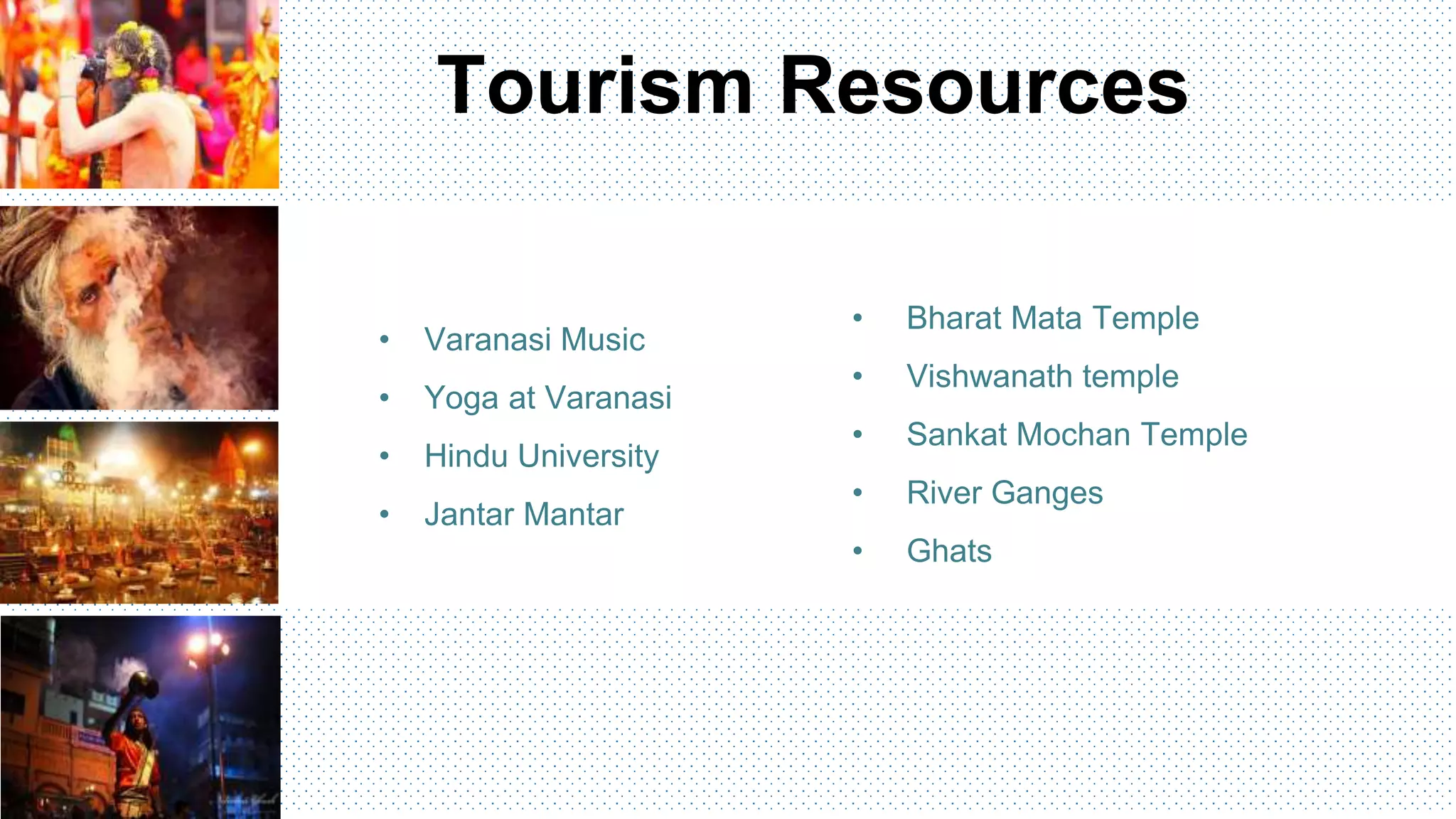
• Bharat Mata Temple
• Vishwanath temple
• Sankat Mochan Temple
• River Ganges
• Ghats
• Varanasi Music
• Yoga at Varanasi
• Hindu University
• Jantar Mantar
Tourism Resources
The Approach: TCC as part of a planning process
Assessment and implementation of TCC needs to be considered as a
process within a planning process for tourism development.
The
characteristics
of the locality
The
tourism/environ
ment interface
The type of
tourism
determines
The Characterstics of locality
→ The characteristics of the locality provide
the basic structure for the development of
tourism. These can be evidenced in terms of
local resources, the vulnerability of local
natural ecosystems, population size,
economic structure, culture and local
heritage, etc. To some extent the
characteristics of a locality determine its
resilience to pressures from tourism. The
size, the structure and dynamism of the
local society, culture and economy can be
significant factors which influence the local
ability to cope with pressures and impacts
from tourism.
THE CHARACTERISTICS OF THE LOCALITY
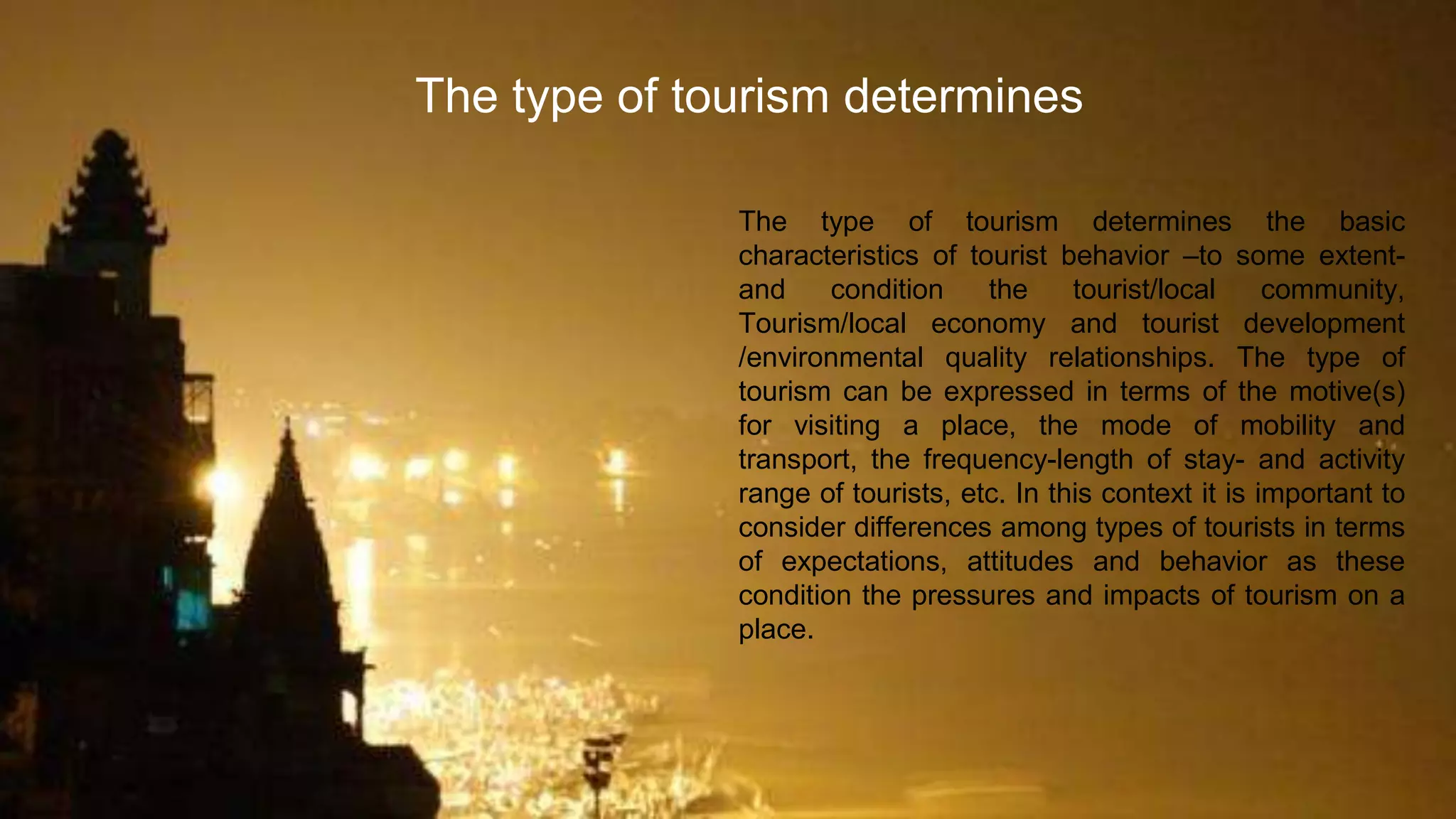
The type of tourism determines the basic
characteristics of tourist behavior –to some extent-
and condition the tourist/local community,
Tourism/local economy and tourist development
/environmental quality relationships. The type of
tourism can be expressed in terms of the motive(s)
for visiting a place, the mode of mobility and
transport, the frequency-length of stay- and activity
range of tourists, etc. In this context it is important to
consider differences among types of tourists in terms
of expectations, attitudes and behavior as these
condition the pressures and impacts of tourism on a
place.
The type of tourism determines
→ The tourism/environment interface is a composite
of the previous two factors mainly in the form and
type of tourist development (spatial patterns), the
phase in a life-cycle context of the destination, the
level of organizational and technological systems
employed, the management regime, etc.
→ The tourism/environment interface is expressed in
terms of constraints evolving either from the
impacts of tourism on the environment or from the
degradation of the environment on tourism.
The Tourism/Environment Interface
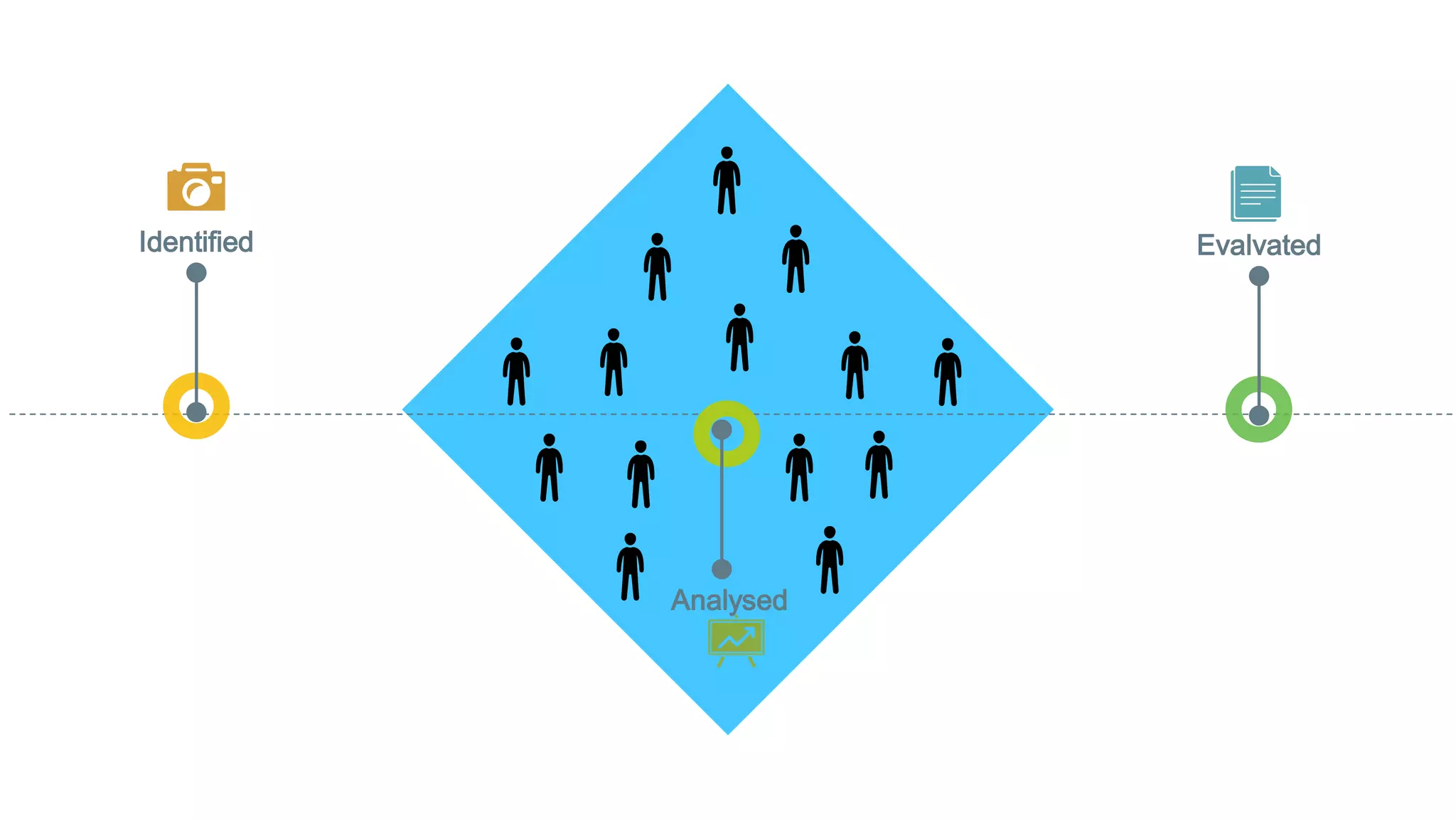
Identified
Analysed
Evalvated
Institutional drivers
Regulatory drivers
Organizational drivers
Indicators imapcts
Economic drivers
TOURISM CARRYING CAPACITY DRIVERS
The process of defining TCC is composed of two parts (it follows in principle
the conceptual framework for TCC as described by Shelby and Heberlein
(1986)).
Descriptive part (A): Describes how the system (tourist destination) under
study works, including physical, ecological, social, political and economic
aspects of tourist development. Within this context of particular importance is
the identification of:
 Bottlenecks: limiting factors of the system, which managers can
manipulate (number of visitors at a particular place)
 Impacts: elements of the system affected by the intensity and type of use.
The type of impact determines the type of capacity (ecological-physical,
social, etc). Emphasis should be placed on significant impacts
INSTITUTIONAL DRIVERS
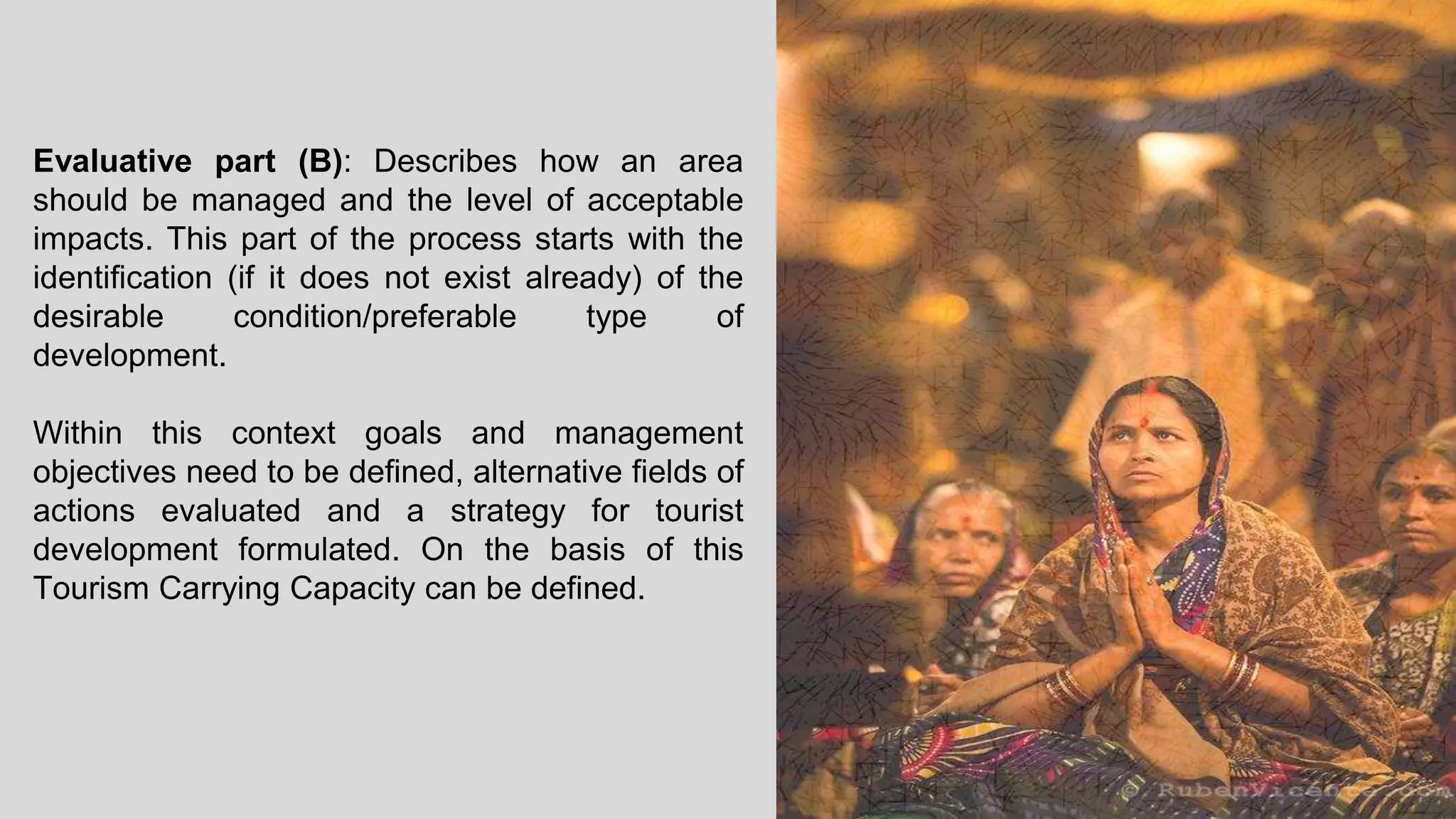
Evaluative part (B): Describes how an area
should be managed and the level of acceptable
impacts. This part of the process starts with the
identification (if it does not exist already) of the
desirable condition/preferable type of
development.
Within this context goals and management
objectives need to be defined, alternative fields of
actions evaluated and a strategy for tourist
development formulated. On the basis of this
Tourism Carrying Capacity can be defined.
Instruments that may encourage and facilitate the application of tourism carrying
capacity. There are opportunities to include TCC (as guidelines) in existing
interventions and tools which are well accepted :
• Rely on the Compensation Principle. It is one of the ways to put priorities on
capacity considerations.
• Tourism carrying capacity as a required concern in Environmental Impact
Assessment. It should be applied to proposed development projects and programmes
in order to evaluate the potential impacts in light of forecasted tourism growth and
peak demand. Alternative sites for development should be considered, taking into
account local constraints and carrying capacity limits.
• TCC could be a central concern required in SEA (Strategic Environmental
Assessment) since this reflects anticipating development on the basis of the capacity
of local systems to support it.
• Zoning is a rather useful tool, easy to be applied. It is
applied mainly in protected areas, since their special status
allows the definition and delimitation of zones where
protection, conservation and limitations in the various uses
are imposed. A typical division in zones is the following:
Zone A – Most valuable and vulnerable. Entry only to
authorized scientific teams
Zone B – Highly sensitive. Escorted visits in small groups
Zone C – Considerable natural interest. Some traditional
and tourism activities, limited car access
Zone D – Mild development and buffer: Tourism and visitor
facilities, car access and parking, compatible activities
REGULATORY DRIVERS
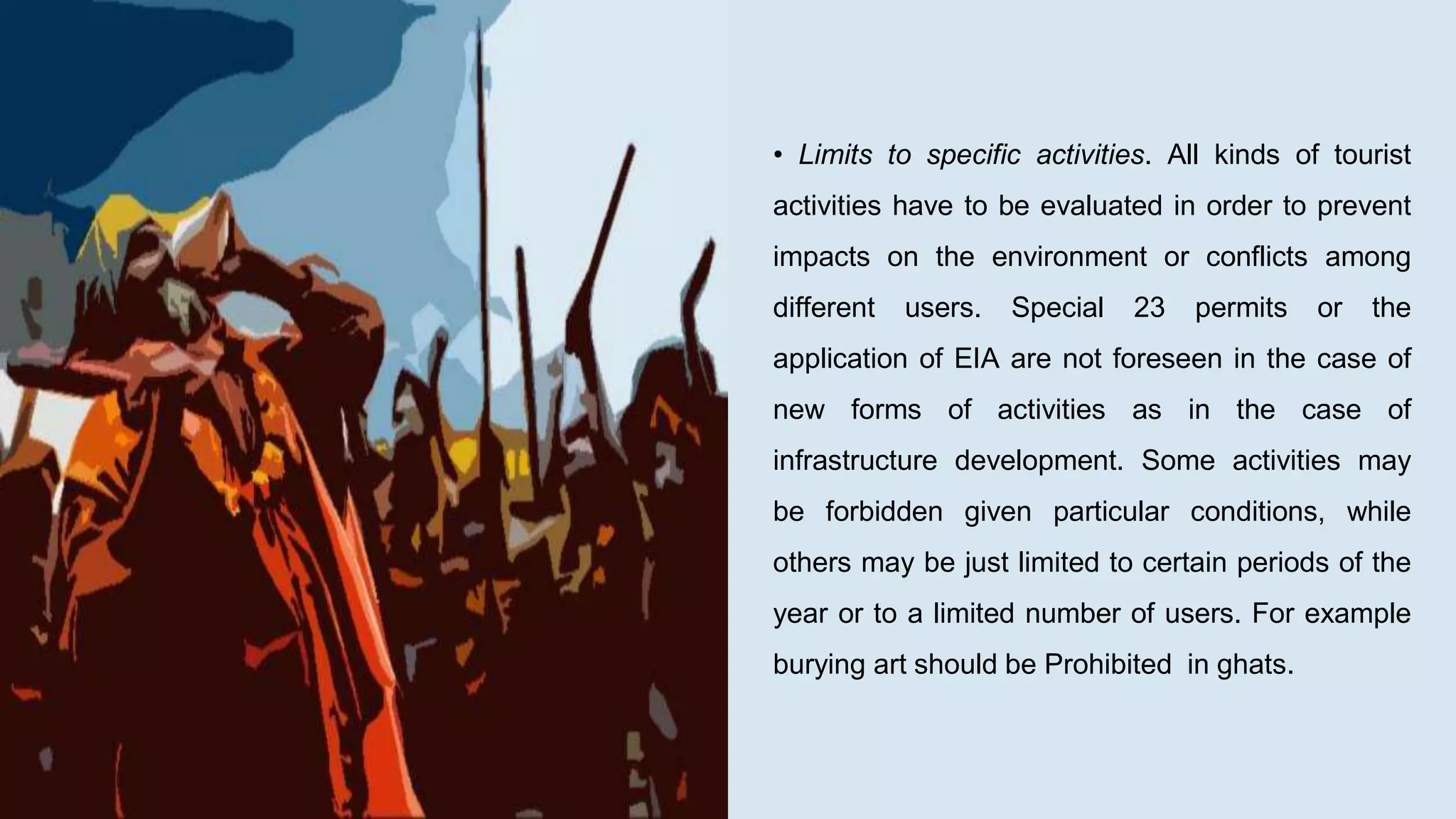
• Limits to specific activities. All kinds of tourist
activities have to be evaluated in order to prevent
impacts on the environment or conflicts among
different users. Special 23 permits or the
application of EIA are not foreseen in the case of
new forms of activities as in the case of
infrastructure development. Some activities may
be forbidden given particular conditions, while
others may be just limited to certain periods of the
year or to a limited number of users. For example
burying art should be Prohibited in ghats.
• Limits to free access. It could help significant
environmental protection. However, many Indian
laws protect free access. It is not possible to
discriminate people on the basis of various factors.
Imposing limits to accessibility is allowed only in
certain cases like the application on devotees
activities.
Land use/spatial planning is a process par
excellence to implement carrying capacity
assessment.
value institutional mechanisms seem to be a
more appropriate way in order to ensure
protection. As far as historical centres, where
the pressure is not from land development, the
management of flows could prove to be a more
suitable way to go. However, attention needs to
be placed on the changes of the functions/uses
within the
cities
Pricing It is not always the most appropriate tool to use in order to
limit/control tourism development /growth. In the case of Varanasi such a
policy is expected to penalize tourists and not excursionists, who do not
consist a preferable target group. Imposing such a policy selectively to
certain groups.
However, there are occasions when pricing for parking and entry to major
attractions should be imposed in order to discourage visitors. Although
pricing is considered, as the least desirable solution, it remains the most
effective at least in the short-term.
Taxes may be used as a way to incorporate in prices various externalities
like environmental destruction. Increased prices can discourage tourists
and entrepreneurs as well.
ECONOMICAL DRIVERS
Cost-benefits analysis should be conducted in the different phases of the life-
cycle of a tourist destination. Costs are always higher in the earlier phases of
tourist development.
Incentive schemes should be applied in both public and private sectors in
order to spread tourism demand over time and space and optimises the use of
accommodation.
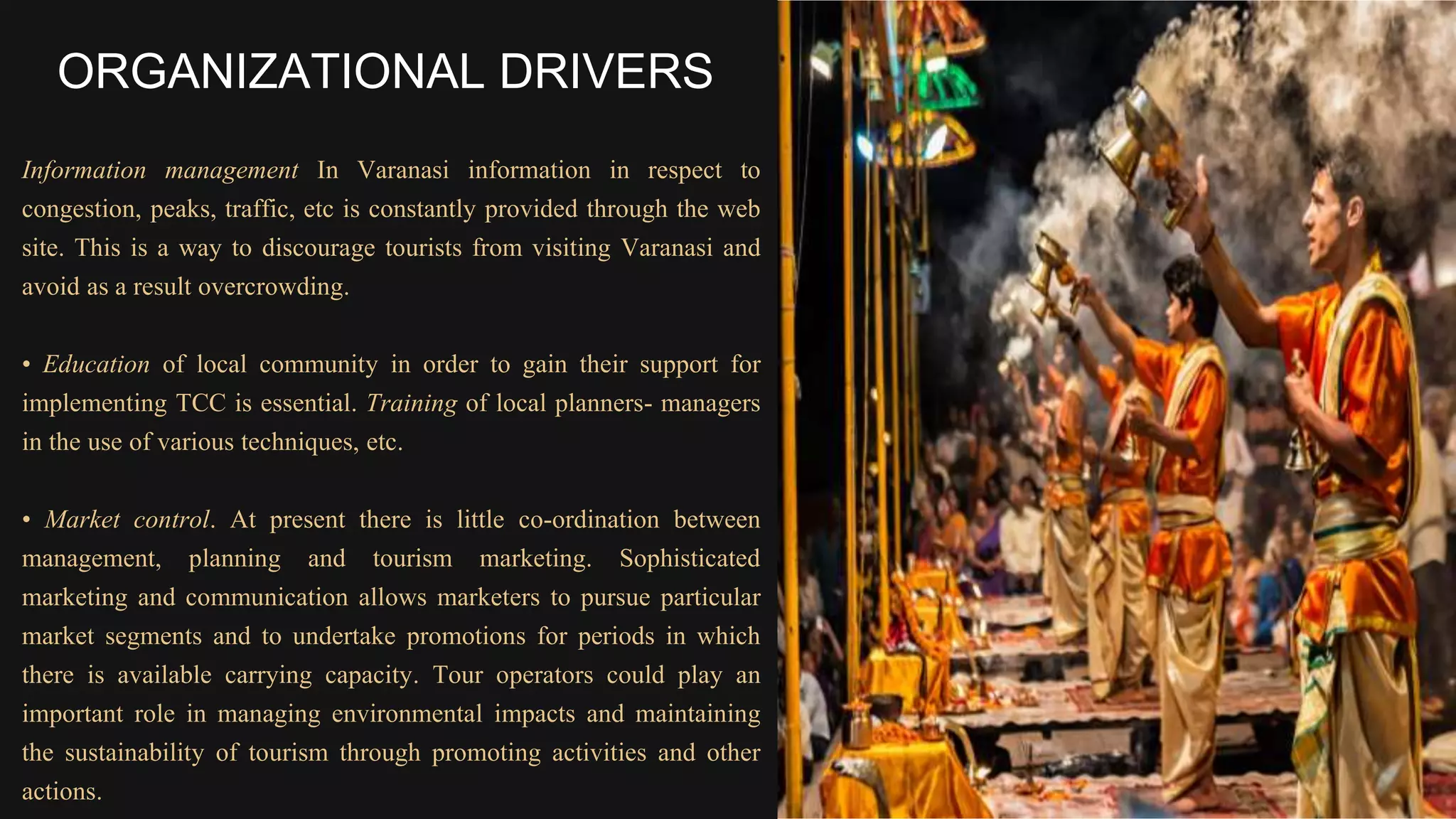
Information management In Varanasi information in respect to
congestion, peaks, traffic, etc is constantly provided through the web
site. This is a way to discourage tourists from visiting Varanasi and
avoid as a result overcrowding.
• Education of local community in order to gain their support for
implementing TCC is essential. Training of local planners- managers
in the use of various techniques, etc.
• Market control. At present there is little co-ordination between
management, planning and tourism marketing. Sophisticated
marketing and communication allows marketers to pursue particular
market segments and to undertake promotions for periods in which
there is available carrying capacity. Tour operators could play an
important role in managing environmental impacts and maintaining
the sustainability of tourism through promoting activities and other
actions.
ORGANIZATIONAL DRIVERS
89,526,124$That’s a lot of money
100%Total success!
185,244 users
And a lot of users
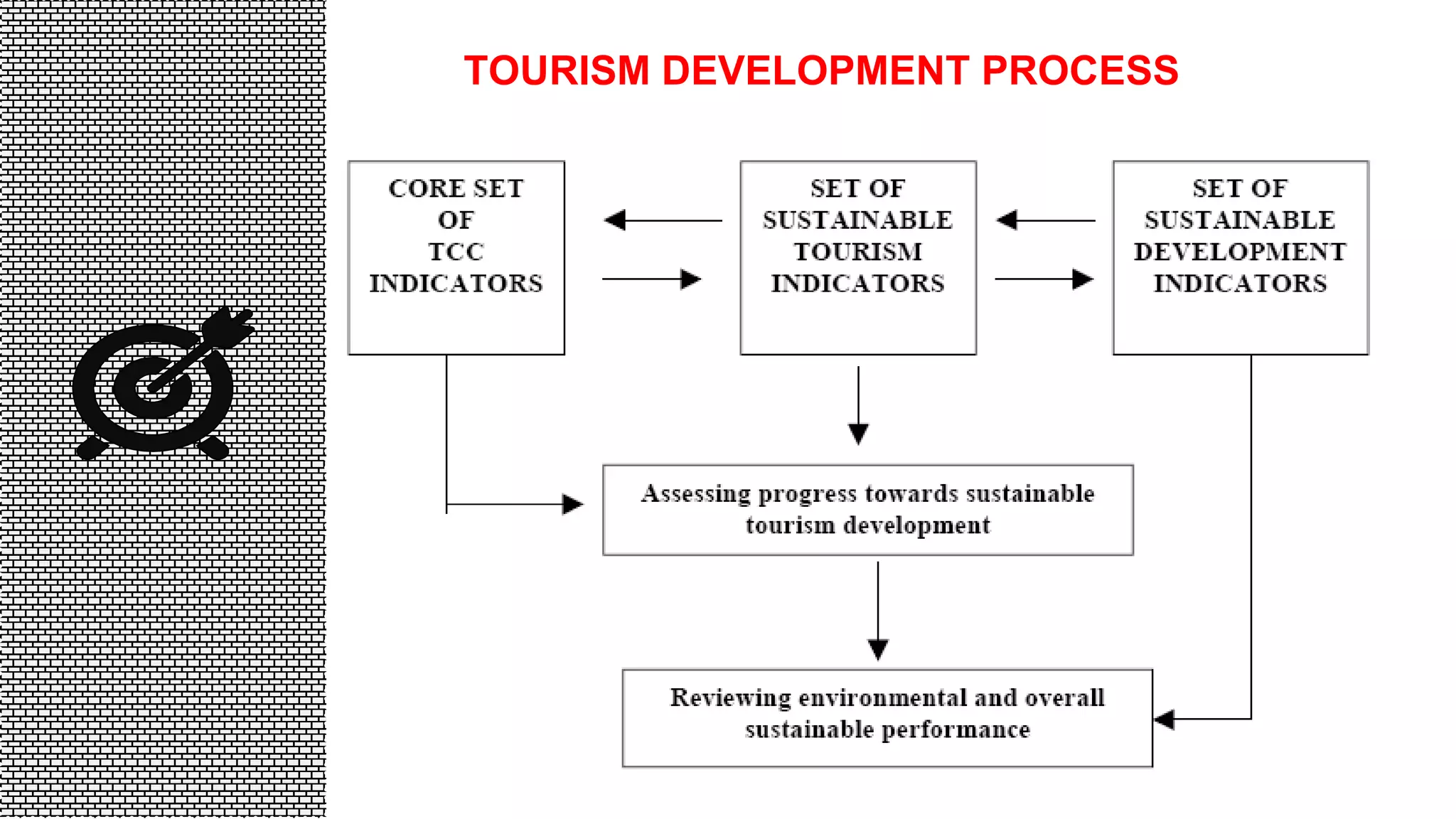
TOURISM DEVELOPMENT PROCESS
TCC INDICATORS
 Total area
 Tourist beds/ permanent population
 Average number of days
 Energy consumption of tourism related activities/local
capacity for energy supply
 Urbanised land for tourism (second houses, hotels,
recreation centres, etc)/ total urbanised land.
 Average distance and time per tourist to
reach the destination
 Density of tourism development (No. of
beds/ tourism urbanised land)
 Number of parking places
 Number of tourists'
SUSTAINABLE TOURISM INDICATORS
 Change of critical areas due to tourism development
 Percent occupancy of key facilities
 Cost of waste management/number of tourist
 Average and maximum height of construction
 No and type of crimes against tourists
 Rate of tourists satisfied from their vacation
 Number of local establishments
 Presence of tourism restriction measures
 Presence of services, necessary to support tourism
Tourism sustainability
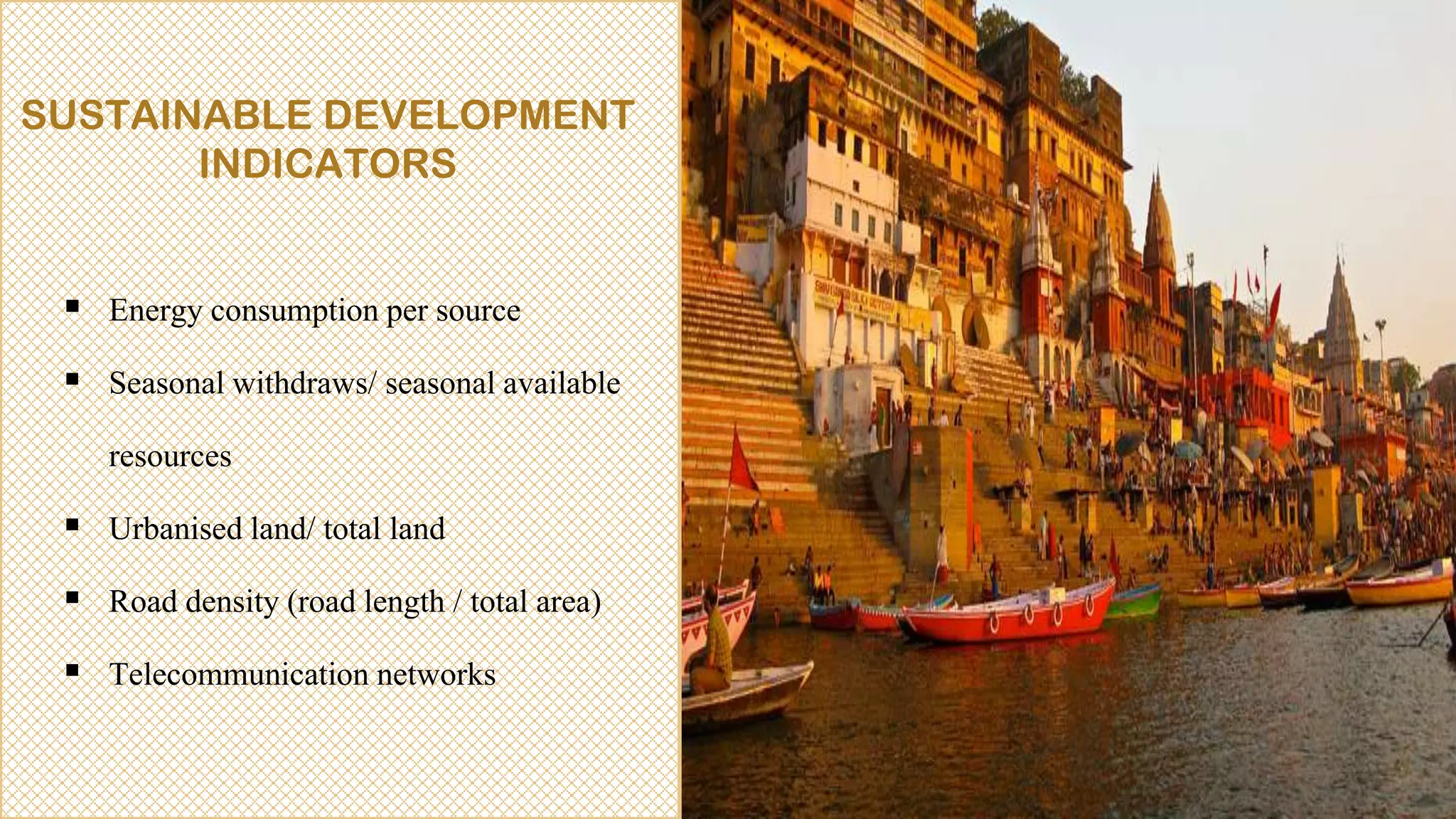
SUSTAINABLE DEVELOPMENT
INDICATORS
 Energy consumption per source
 Seasonal withdraws/ seasonal available
resources
 Urbanised land/ total land
 Road density (road length / total area)
 Telecommunication networks
THANK
YOU

CARRYING CAPACITY OF VARANASI

  • 1.
    CARRYING CAPACITY OFVARANASI B y S U H A S R A J A G U R U
  • 2.
    Hello! Again…. Suhas Rajaguru I amhere to aware you all about Theory of Tourism carrying capacity & the Implimentation of sustainable development measures.
  • 3.
    “Varanasi Older thanhistory, older than tradition, older even than legend, And looks twice as old as all of them put together” Varanasi is the oldest city of the world. Varanasi is more than 3000 years old and is famous as the city of temples. In Varanasi, there are temples at every few paces. Vaishnavism and Shaivism have co-existed in Varanasi harmoniously. With a number of temples, Ayurveda is said to be originated at Varanasi and is believed to be the basis of modern medical sciences such as Plastic surgery, Cataract and Calculus operations. Maharshi Patanjali, the preceptor of Ayurveda and Yoga, was also affiliated with Varanasi, the holy city.
  • 4.
    • Bharat MataTemple • Vishwanath temple • Sankat Mochan Temple • River Ganges • Ghats • Varanasi Music • Yoga at Varanasi • Hindu University • Jantar Mantar Tourism Resources
  • 5.
    The Approach: TCCas part of a planning process Assessment and implementation of TCC needs to be considered as a process within a planning process for tourism development. The characteristics of the locality The tourism/environ ment interface The type of tourism determines
  • 6.
    The Characterstics oflocality → The characteristics of the locality provide the basic structure for the development of tourism. These can be evidenced in terms of local resources, the vulnerability of local natural ecosystems, population size, economic structure, culture and local heritage, etc. To some extent the characteristics of a locality determine its resilience to pressures from tourism. The size, the structure and dynamism of the local society, culture and economy can be significant factors which influence the local ability to cope with pressures and impacts from tourism. THE CHARACTERISTICS OF THE LOCALITY
  • 7.
    The type oftourism determines the basic characteristics of tourist behavior –to some extent- and condition the tourist/local community, Tourism/local economy and tourist development /environmental quality relationships. The type of tourism can be expressed in terms of the motive(s) for visiting a place, the mode of mobility and transport, the frequency-length of stay- and activity range of tourists, etc. In this context it is important to consider differences among types of tourists in terms of expectations, attitudes and behavior as these condition the pressures and impacts of tourism on a place. The type of tourism determines
  • 8.
    → The tourism/environmentinterface is a composite of the previous two factors mainly in the form and type of tourist development (spatial patterns), the phase in a life-cycle context of the destination, the level of organizational and technological systems employed, the management regime, etc. → The tourism/environment interface is expressed in terms of constraints evolving either from the impacts of tourism on the environment or from the degradation of the environment on tourism. The Tourism/Environment Interface
  • 9.
  • 10.
    Institutional drivers Regulatory drivers Organizationaldrivers Indicators imapcts Economic drivers TOURISM CARRYING CAPACITY DRIVERS
  • 11.
    The process ofdefining TCC is composed of two parts (it follows in principle the conceptual framework for TCC as described by Shelby and Heberlein (1986)). Descriptive part (A): Describes how the system (tourist destination) under study works, including physical, ecological, social, political and economic aspects of tourist development. Within this context of particular importance is the identification of:  Bottlenecks: limiting factors of the system, which managers can manipulate (number of visitors at a particular place)  Impacts: elements of the system affected by the intensity and type of use. The type of impact determines the type of capacity (ecological-physical, social, etc). Emphasis should be placed on significant impacts INSTITUTIONAL DRIVERS
  • 12.
    Evaluative part (B):Describes how an area should be managed and the level of acceptable impacts. This part of the process starts with the identification (if it does not exist already) of the desirable condition/preferable type of development. Within this context goals and management objectives need to be defined, alternative fields of actions evaluated and a strategy for tourist development formulated. On the basis of this Tourism Carrying Capacity can be defined.
  • 13.
    Instruments that mayencourage and facilitate the application of tourism carrying capacity. There are opportunities to include TCC (as guidelines) in existing interventions and tools which are well accepted : • Rely on the Compensation Principle. It is one of the ways to put priorities on capacity considerations. • Tourism carrying capacity as a required concern in Environmental Impact Assessment. It should be applied to proposed development projects and programmes in order to evaluate the potential impacts in light of forecasted tourism growth and peak demand. Alternative sites for development should be considered, taking into account local constraints and carrying capacity limits. • TCC could be a central concern required in SEA (Strategic Environmental Assessment) since this reflects anticipating development on the basis of the capacity of local systems to support it.
  • 14.
    • Zoning isa rather useful tool, easy to be applied. It is applied mainly in protected areas, since their special status allows the definition and delimitation of zones where protection, conservation and limitations in the various uses are imposed. A typical division in zones is the following: Zone A – Most valuable and vulnerable. Entry only to authorized scientific teams Zone B – Highly sensitive. Escorted visits in small groups Zone C – Considerable natural interest. Some traditional and tourism activities, limited car access Zone D – Mild development and buffer: Tourism and visitor facilities, car access and parking, compatible activities REGULATORY DRIVERS
  • 15.
    • Limits tospecific activities. All kinds of tourist activities have to be evaluated in order to prevent impacts on the environment or conflicts among different users. Special 23 permits or the application of EIA are not foreseen in the case of new forms of activities as in the case of infrastructure development. Some activities may be forbidden given particular conditions, while others may be just limited to certain periods of the year or to a limited number of users. For example burying art should be Prohibited in ghats.
  • 16.
    • Limits tofree access. It could help significant environmental protection. However, many Indian laws protect free access. It is not possible to discriminate people on the basis of various factors. Imposing limits to accessibility is allowed only in certain cases like the application on devotees activities.
  • 17.
    Land use/spatial planningis a process par excellence to implement carrying capacity assessment. value institutional mechanisms seem to be a more appropriate way in order to ensure protection. As far as historical centres, where the pressure is not from land development, the management of flows could prove to be a more suitable way to go. However, attention needs to be placed on the changes of the functions/uses within the cities
  • 18.
    Pricing It isnot always the most appropriate tool to use in order to limit/control tourism development /growth. In the case of Varanasi such a policy is expected to penalize tourists and not excursionists, who do not consist a preferable target group. Imposing such a policy selectively to certain groups. However, there are occasions when pricing for parking and entry to major attractions should be imposed in order to discourage visitors. Although pricing is considered, as the least desirable solution, it remains the most effective at least in the short-term. Taxes may be used as a way to incorporate in prices various externalities like environmental destruction. Increased prices can discourage tourists and entrepreneurs as well. ECONOMICAL DRIVERS
  • 19.
    Cost-benefits analysis shouldbe conducted in the different phases of the life- cycle of a tourist destination. Costs are always higher in the earlier phases of tourist development. Incentive schemes should be applied in both public and private sectors in order to spread tourism demand over time and space and optimises the use of accommodation.
  • 20.
    Information management InVaranasi information in respect to congestion, peaks, traffic, etc is constantly provided through the web site. This is a way to discourage tourists from visiting Varanasi and avoid as a result overcrowding. • Education of local community in order to gain their support for implementing TCC is essential. Training of local planners- managers in the use of various techniques, etc. • Market control. At present there is little co-ordination between management, planning and tourism marketing. Sophisticated marketing and communication allows marketers to pursue particular market segments and to undertake promotions for periods in which there is available carrying capacity. Tour operators could play an important role in managing environmental impacts and maintaining the sustainability of tourism through promoting activities and other actions. ORGANIZATIONAL DRIVERS
  • 21.
    89,526,124$That’s a lotof money 100%Total success! 185,244 users And a lot of users TOURISM DEVELOPMENT PROCESS
  • 22.
    TCC INDICATORS  Totalarea  Tourist beds/ permanent population  Average number of days  Energy consumption of tourism related activities/local capacity for energy supply  Urbanised land for tourism (second houses, hotels, recreation centres, etc)/ total urbanised land.  Average distance and time per tourist to reach the destination  Density of tourism development (No. of beds/ tourism urbanised land)  Number of parking places  Number of tourists'
  • 23.
    SUSTAINABLE TOURISM INDICATORS Change of critical areas due to tourism development  Percent occupancy of key facilities  Cost of waste management/number of tourist  Average and maximum height of construction  No and type of crimes against tourists  Rate of tourists satisfied from their vacation  Number of local establishments  Presence of tourism restriction measures  Presence of services, necessary to support tourism Tourism sustainability
  • 24.
    SUSTAINABLE DEVELOPMENT INDICATORS  Energyconsumption per source  Seasonal withdraws/ seasonal available resources  Urbanised land/ total land  Road density (road length / total area)  Telecommunication networks
  • 25.