PEDAGOGICAL AND TECHNOLOGICAL UNIVERSITY OF COLOMBIAHOTEL AND TOURISM MANAGEMENTOURISM THEORY AND PRACTICEPresented to: Hector Garcia LopezPresented by: Hugo Hernan Sanchez Baez3th September 2010
Tourism is a collection of activities, services and industries that delivers a travel experience, including transportation, accommodations, eating and drinking establishments, retail shops, entertainment businesses, activity facilities and other hospitality services provided for individuals or groups traveling away from home.What is Tourism? (WTO)
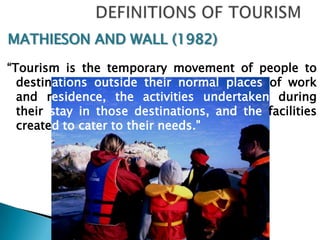
DEFINITIONS OF TOURISM MATHIESON AND WALL (1982)“Tourism is the temporary movement of people to destinationsoutside their normal places of work and residence,the activities undertaken during their stay in those destinations, and the facilities created to cater to their needs."
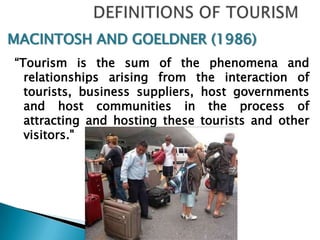
DEFINITIONS OF TOURISM MACINTOSH AND GOELDNER (1986)“Tourism is the sum of the phenomena and relationships arising from the interaction of tourists, business suppliers, host governments and host communities in the process of attracting and hosting these tourists and other visitors."
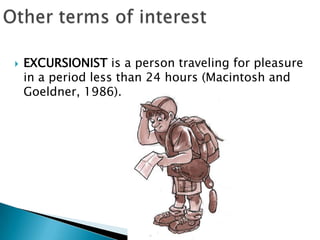
Other terms of interestEXCURSIONISTis a person traveling for pleasure in a period less than 24 hours (Macintosh and Goeldner, 1986).
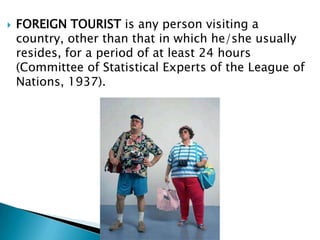
FOREIGN TOURISTis any person visiting a country, other than that in which he/she usually resides, for a period of at least 24 hours (Committee of Statistical Experts of the League of Nations, 1937).
VISITOR is any person visiting a country other than that in which he/she has his/her usual place of residence, for any reason other than following an occupation remunerated from within the country visited (United Nations Conference on International Travel and Tourism, 1963).
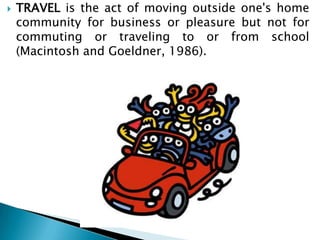
TRAVELis the act of moving outside one's home community for business or pleasure but not for commuting or traveling to or from school (Macintosh and Goeldner, 1986).
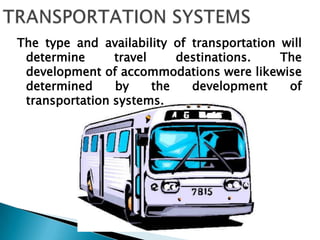
TRANSPORTATION SYSTEMSThe type and availability of transportation will determine travel destinations. The development of accommodations were likewise determined by the development of transportation systems.
STAGECOACH (1500 A.D.) Invented in Hungary.RAILROADS (1825)First passenger train was in England.BOATS & SHIPS (early 400 B.C., but first ocean liner 1840).AUTOMOBILE (1908) Henry Ford's Model T.AIR TRAVEL (1919) by what is now know as Lufthansa Airline.SPACE TRAVEL (2015) estimated date for passenger travel into suborbital space. These systems are
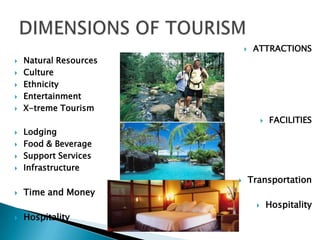
ATTRACTIONSNatural ResourcesCultureEthnicityEntertainmentX-treme TourismFACILITIESLodgingFood & BeverageSupport ServicesInfrastructureTransportationTime and MoneyHospitalityHospitalityDIMENSIONS OF TOURISM
TimeMoneyMobilityMotivationESSENTIAL REQUIREMENTS FOR TOURISM
Advocacy platform: 1950's - 1960's. Tourism considered an ideal activity with few negative impacts for tourist destinations. Governmentshouldpromotetourism.Cautionary platform: 1970's. Proposed that tourism would eventually result in negative impacts for tourism destinations unless it was carefully planned and regulated.Adaptancy platform: 1980"s. Promoted less mass tourism and more alternative tourism. Alternative tourism included: home stays; cultural villages and volunteer tourism.Knowledge-based platform: 1990's. Promotes planning for specific tourism activities and destinations which attempt to scientifically determine impacts and capacities for tourism destinations.JAFARI'S FOUR PLATFORMS
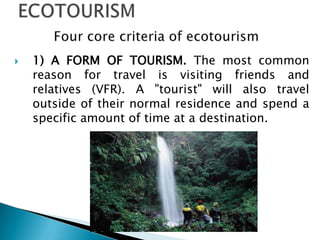
ECOTOURISMFour core criteria of ecotourism1) A FORM OF TOURISM. The most common reason for travel is visiting friends and relatives (VFR). A "tourist" will also travel outside of their normal residence and spend a specific amount of time at a destination.
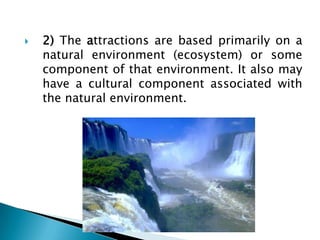
2) The attractions are based primarily on a natural environment (ecosystem) or some component of that environment. It also may have a cultural component associated with the natural environment.
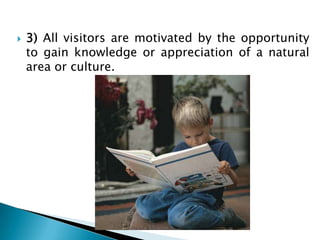
3) All visitors are motivated by the opportunity to gain knowledge or appreciation of a natural area or culture.
4) THE SUSTAINABILITY is a critical factor in any ecotourism definition. It is "development that meets the needs of the present without compromising the ability of future generations to meet their own needs"  (WCED, 1987, p. 43).
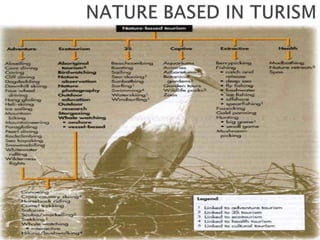
ECOTOURISM AND OTHER TOURISM TYPESNATURE-BASED TOURISM. Any type of tourism that relies on attractions directly related to the natural environment.. Ecotourismis a subset of nature-basedtourism.CULTURAL TOURISM. Cultural tourism's focus is on the cultural aspects of a visitor's experience.
ECOTOURISM AND OTHER TOURISM TYPESADVENTURE TOURISM. This includes: an element of risk; a higher level of physical exertion; and a need for specialized skills to participate successfully and safely in the activity.HYBRIDS. These forms of tourism address complex and multi-faceted visitor experiences. They include: trekking, ACE tourism (adventure, culture and ecotourism);  and NEAT (nature-based, ecotourism, and adventure tourism).
ECOTOURISM AND OTHER TOURISM TYPES3S (SEA, SAND AND SUN) TOURISM. Tourism based mostly on mass tourism (resort).ALTERNATIVE TOURISM AND MASS TOURISM. This spans the variety of tourism form small-scale to mass tourism. One being no better or worse that the other depending on the impacts and sustainability of the activities.
ECOTOURISM AND OTHER TOURISM TYPESSUSTAINABLE TOURISM. An area of sustainable tourism that includes all ecotourism, most of alternative tourism and mass tourism.
NATURE BASED IN TURISM
SUPPLY AND DEMAND Is the relationship between the quantity that tourism enterprises provided. tourism enterprises wish to sell at various prices and the quantity of tourism services that consumers wish to buy.
THANK YOU

Tourism theory and practice

  • 1.
    PEDAGOGICAL AND TECHNOLOGICALUNIVERSITY OF COLOMBIAHOTEL AND TOURISM MANAGEMENTOURISM THEORY AND PRACTICEPresented to: Hector Garcia LopezPresented by: Hugo Hernan Sanchez Baez3th September 2010
  • 2.
    Tourism is acollection of activities, services and industries that delivers a travel experience, including transportation, accommodations, eating and drinking establishments, retail shops, entertainment businesses, activity facilities and other hospitality services provided for individuals or groups traveling away from home.What is Tourism? (WTO)
  • 3.
    DEFINITIONS OF TOURISMMATHIESON AND WALL (1982)“Tourism is the temporary movement of people to destinationsoutside their normal places of work and residence,the activities undertaken during their stay in those destinations, and the facilities created to cater to their needs."
  • 4.
    DEFINITIONS OF TOURISMMACINTOSH AND GOELDNER (1986)“Tourism is the sum of the phenomena and relationships arising from the interaction of tourists, business suppliers, host governments and host communities in the process of attracting and hosting these tourists and other visitors."
  • 5.
    Other terms ofinterestEXCURSIONISTis a person traveling for pleasure in a period less than 24 hours (Macintosh and Goeldner, 1986).
  • 6.
    FOREIGN TOURISTis anyperson visiting a country, other than that in which he/she usually resides, for a period of at least 24 hours (Committee of Statistical Experts of the League of Nations, 1937).
  • 7.
    VISITOR is anyperson visiting a country other than that in which he/she has his/her usual place of residence, for any reason other than following an occupation remunerated from within the country visited (United Nations Conference on International Travel and Tourism, 1963).
  • 8.
    TRAVELis the actof moving outside one's home community for business or pleasure but not for commuting or traveling to or from school (Macintosh and Goeldner, 1986).
  • 9.
    TRANSPORTATION SYSTEMSThe typeand availability of transportation will determine travel destinations. The development of accommodations were likewise determined by the development of transportation systems.
  • 10.
    STAGECOACH (1500 A.D.)Invented in Hungary.RAILROADS (1825)First passenger train was in England.BOATS & SHIPS (early 400 B.C., but first ocean liner 1840).AUTOMOBILE (1908) Henry Ford's Model T.AIR TRAVEL (1919) by what is now know as Lufthansa Airline.SPACE TRAVEL (2015) estimated date for passenger travel into suborbital space. These systems are
  • 11.
    ATTRACTIONSNatural ResourcesCultureEthnicityEntertainmentX-treme TourismFACILITIESLodgingFood& BeverageSupport ServicesInfrastructureTransportationTime and MoneyHospitalityHospitalityDIMENSIONS OF TOURISM
  • 12.
  • 13.
    Advocacy platform: 1950's- 1960's. Tourism considered an ideal activity with few negative impacts for tourist destinations. Governmentshouldpromotetourism.Cautionary platform: 1970's. Proposed that tourism would eventually result in negative impacts for tourism destinations unless it was carefully planned and regulated.Adaptancy platform: 1980"s. Promoted less mass tourism and more alternative tourism. Alternative tourism included: home stays; cultural villages and volunteer tourism.Knowledge-based platform: 1990's. Promotes planning for specific tourism activities and destinations which attempt to scientifically determine impacts and capacities for tourism destinations.JAFARI'S FOUR PLATFORMS
  • 14.
    ECOTOURISMFour core criteriaof ecotourism1) A FORM OF TOURISM. The most common reason for travel is visiting friends and relatives (VFR). A "tourist" will also travel outside of their normal residence and spend a specific amount of time at a destination.
  • 15.
    2) The attractionsare based primarily on a natural environment (ecosystem) or some component of that environment. It also may have a cultural component associated with the natural environment.
  • 16.
    3) All visitorsare motivated by the opportunity to gain knowledge or appreciation of a natural area or culture.
  • 17.
    4) THE SUSTAINABILITYis a critical factor in any ecotourism definition. It is "development that meets the needs of the present without compromising the ability of future generations to meet their own needs"  (WCED, 1987, p. 43).
  • 18.
    ECOTOURISM AND OTHERTOURISM TYPESNATURE-BASED TOURISM. Any type of tourism that relies on attractions directly related to the natural environment.. Ecotourismis a subset of nature-basedtourism.CULTURAL TOURISM. Cultural tourism's focus is on the cultural aspects of a visitor's experience.
  • 19.
    ECOTOURISM AND OTHERTOURISM TYPESADVENTURE TOURISM. This includes: an element of risk; a higher level of physical exertion; and a need for specialized skills to participate successfully and safely in the activity.HYBRIDS. These forms of tourism address complex and multi-faceted visitor experiences. They include: trekking, ACE tourism (adventure, culture and ecotourism);  and NEAT (nature-based, ecotourism, and adventure tourism).
  • 20.
    ECOTOURISM AND OTHERTOURISM TYPES3S (SEA, SAND AND SUN) TOURISM. Tourism based mostly on mass tourism (resort).ALTERNATIVE TOURISM AND MASS TOURISM. This spans the variety of tourism form small-scale to mass tourism. One being no better or worse that the other depending on the impacts and sustainability of the activities.
  • 21.
    ECOTOURISM AND OTHERTOURISM TYPESSUSTAINABLE TOURISM. An area of sustainable tourism that includes all ecotourism, most of alternative tourism and mass tourism.
  • 22.
  • 23.
    SUPPLY AND DEMANDIs the relationship between the quantity that tourism enterprises provided. tourism enterprises wish to sell at various prices and the quantity of tourism services that consumers wish to buy.
  • 24.