
Anti-DebuggingA Developers ViewpointMarch 13, 2008
Presenter BackgroundCurrentlySr. Security Researcher for Veracode, Inc.PreviouslySecurity Consultant - SymantecSecurity Consultant - @StakeIncident Response and Forensics Handler – US GovernmentWishes He WasInfinitely RichPersonal Trainer to hot Hollywood starletsGeneral all-around rockstar
What we will cover…Definition of Problem Statement and TermsWhy Bother?Isn’t this a futile effort?Standing On The Shoulders of GiantsBrief reference of anti-debuggingClasses of Anti-Debugging MethodsThe six styles of anti-debug fuSome Known Anti-Debugging MethodsNot enough time to cover them all
Problem Statement and Definition of Terms
Problem StatementAnti-debugging methods are consistently presented as machine code or assembly language constructs making knowledge transfer difficult and limiting widespread use of the techniques.
Let’s Do An ExperimentCan you tell what the following code does in five seconds or less?Be Honest!
Assembly Dumppush    ebpmovebp, espsub     esp, 0C0hpush    ebxpush    esipush    edilea     edi, [ebp+var_C0]movecx, 30hmoveax, 0CCCCCCCChrep stosdmovesi, espcall    ds:__imp__IsDebuggerPresent@0cmpesi, espcall    j___RTC_CheckEsptest    eax, eaxjz      short loc_411400movesi, esppush    0               ; uTypepush    offset Caption push    offset Text     push    0               ; hWndcall    ds:__imp__MessageBoxW@16 cmpesi, espcall    j___RTC_CheckEspshort loc_41141Dloc_411400:                             ; CODE XREF: antidebug(void)+2Fjmovesi, esppush    0               ; uTypepush    offset aNoDebuggerpush    offset aNoDebuggerDetepush    0               ; hWndcall    ds:__imp__MessageBoxW@16 cmpesi, espj___RTC_CheckEsploc_41141D:                             ; CODE XREF: antidebug(void)+4Ejpop     edipop     esipop     ebxadd     esp, 0C0hcmpebp, espcall    j___RTC_CheckEspmovesp, ebppop     ebpRetnantidebug@@YAXXZ endp
Assembly Dump
Assembly Dump – Highlight Important Bitsvar_C0 = byte ptr -0C0hpush	ebpmovebp, espsub 	esp, 0C0hPush	ebxPush	esiPush	edilea 		edi, [ebp+var_C0]movecx, 30hmoveax, 0CCCCCCCChRep stosdmovesi, espCall		ds:__imp__IsDebuggerPresent@0 cmpesi, espCall	j___RTC_CheckEspTest	eax, eaxjz 		short loc_411400movesi, esppush    	0  ; uTypepush    	offset Caption push    	offset Text    push    	0  ; hWndcall    	ds:__imp__MessageBoxW@16cmpesi, espcall    	j___RTC_CheckEspjmp     	short loc_41141Dloc_411400:      movesi, esppush    	0  ; uTypepush    	offset aNoDebuggerpush    	offset aNoDebuggerDetepush    	0 ; hWndcall    	ds:__imp__MessageBoxW@16cmpesi, espcall    	j___RTC_CheckEsploc_41141D:      pop     	edipop     	esipop     	ebxadd     	esp, 0C0hcmpebp, espcall    	j___RTC_CheckEspmovesp, ebppop     	ebpRetn?antidebug@@YAXXZ endp
Assembly Dump
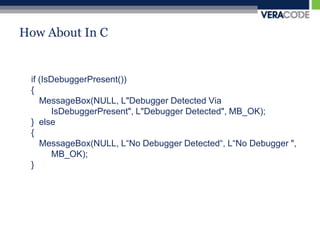
How About In Cif (IsDebuggerPresent()){ MessageBox(NULL, L"Debugger Detected Via 	IsDebuggerPresent", L"Debugger Detected", MB_OK);}  else{MessageBox(NULL, L“No Debugger Detected“, L“No Debugger ", 	MB_OK);}
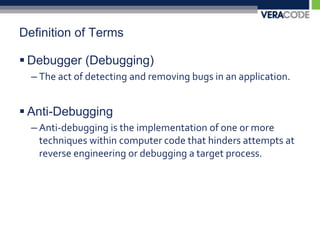
Definition of TermsDebugger (Debugging)The act of detecting and removing bugs in an application.Anti-DebuggingAnti-debugging is the implementation of one or more techniques within computer code that hinders attempts at reverse engineering or debugging a target process.
Definition of TermsDumpingDumping of a running process in memory to disk so that the image can be executed as a separate binary. Anti-DumpingTechnique that is used to inhibit the dumping of a running process from memory to disk
Definition of TermsAnti-Anti-DebuggingTechniques used to detect and bypass anti-debugging effortsAnti-Anti-DumpingTechniques used to detect and bypass anti-dumping efforts.Anti-Anti-Anti-…. You get the picture
Why Bother?Isn’t this a futile effort
Why Should I Care?Protecting your intellectual propertyLaws can’t possibly work Neither do EULA or other soft methodsSlow down subversion of software registration CrackingImpede application feature and code theftLow costShort code segments equals quick implementationWrite a basic anti-debugging library for reuse
Why Should I Care?Raise the barImplement multiple layers of defenseMakes reversing an arduous taskIt’s no longer as simple as a debugger + disassembler + timeMalware analysisKnowledge of anti-debugging techniques can help your incident response and analysisDebug the random binary found on your accounting systemImplement IDS/IPS signatures in shorter timeframesExercise the brainKeeps the synapses firingImplementation (and bypass) is FUN!
Standing On the Shoulders Of GiantsA Brief Reference of Anti-Debugging
ReferencesBania, P, “Antidebugging for the (m)asses - protecting the env.”Brulez, N., “Crimeware Anti-Reverse Engineering Uncovered”“Lord Julus”, “Anti-Debugger and Anti-Emulator Lair”Liston, T., and Skoudis, E., “ Thwarting Virtual Machine Detection”Bania, P., “Playing with RTDSC”Quist, D., Smith, V., “Detecting the Presence of Virtual Machines Using the Local Data Table”Omella, A. A., “Methods for Virtual Machine Detection”Tariq, T. B., “Detecting Virtualization”Rutkowska, J., " Red Pill... or how to detect VMM using (almost) one CPU instruction”
ReferencesJackson, J., “An Anti-Reverse Engineering Guide”Falliere, N., “Windows Anti-Debug Reference”Gagnon, M. N., Taylor, S., and Ghosh, “Software Protection through Anti-Debugging”Ferrie, P., “Anti-Unpacker Tricks”OpenRCE: “Anti Reverse Engineering Techniques Database”Ferrie, P., “Attacks on More Virtual Machine Emulators”Brulez, N., “Anti-Reverse Engineering Uncovered”
Anti-Debugging Classes
Let’s Get Started
Let’s Get Started
Anti-Debugging Classes
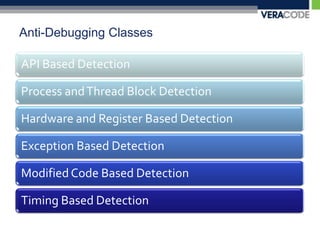
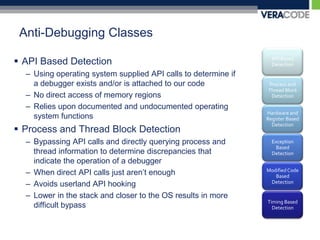
Anti-Debugging ClassesAPI Based DetectionUsing operating system supplied API calls to determine if a debugger exists and/or is attached to our codeNo direct access of memory regionsRelies upon documented and undocumented operating system functionsProcess and Thread Block DetectionBypassing API calls and directly querying process and thread information to determine discrepancies that indicate the operation of a debuggerWhen direct API calls just aren’t enoughAvoids userland API hookingLower in the stack and closer to the OS results in more difficult bypass
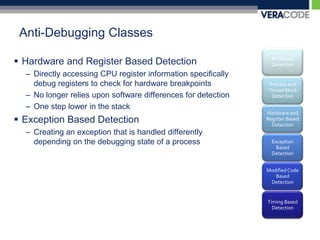
Anti-Debugging ClassesHardware and Register Based DetectionDirectly accessing CPU register information specifically debug registers to check for hardware breakpointsNo longer relies upon software differences for detectionOne step lower in the stackException Based DetectionCreating an exception that is handled differently depending on the debugging state of a process
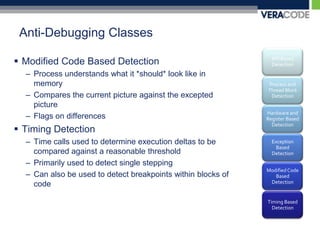
Anti-Debugging ClassesModified Code Based DetectionProcess understands what it *should* look like in memoryCompares the current picture against the excepted pictureFlags on differencesTiming DetectionTime calls used to determine execution deltas to be compared against a reasonable thresholdPrimarily used to detect single steppingCan also be used to detect breakpoints within blocks of code
API Anti-Debugging
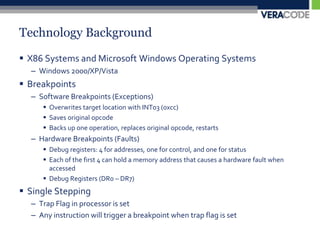
Technology BackgroundX86 Systems and Microsoft Windows Operating SystemsWindows 2000/XP/VistaBreakpointsSoftware Breakpoints (Exceptions)Overwrites target location with INT03 (0xcc)Saves original opcodeBacks up one operation, replaces original opcode, restartsHardware Breakpoints (Faults)Debug registers: 4 for addresses, one for control, and one for statusEach of the first 4 can hold a memory address that causes a hardware fault when accessedDebug Registers (DR0 – DR7)Single SteppingTrap Flag in processor is setAny instruction will trigger a breakpoint when trap flag is set
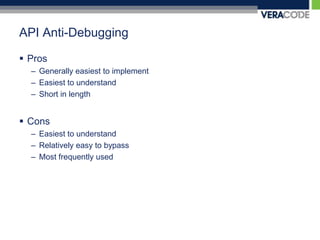
API Anti-DebuggingProsGenerally easiest to implementEasiest to understandShort in lengthConsEasiest to understandRelatively easy to bypassMost frequently used
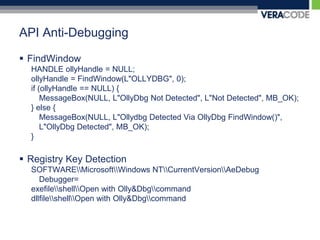
API Anti-DebuggingFindWindowHANDLE ollyHandle = NULL; ollyHandle = FindWindow(L"OLLYDBG", 0);if (ollyHandle == NULL) {MessageBox(NULL, L"OllyDbg Not Detected", L"Not Detected", MB_OK);} else {MessageBox(NULL, L"Ollydbg Detected Via OllyDbgFindWindow()", L"OllyDbg Detected", MB_OK);}Registry Key DetectionSOFTWARE\\Microsoft\\Windows NT\\CurrentVersion\\AeDebug Debugger=exefile\\shell\\Open with Olly&Dbg\\commanddllfile\\shell\\Open with Olly&Dbg\\command
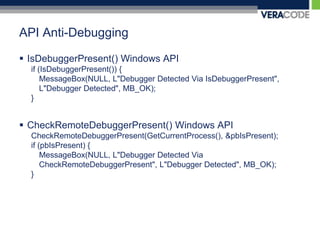
API Anti-DebuggingIsDebuggerPresent() Windows API  if (IsDebuggerPresent()) { MessageBox(NULL, L"Debugger Detected Via IsDebuggerPresent", L"Debugger Detected", MB_OK);} CheckRemoteDebuggerPresent() Windows APICheckRemoteDebuggerPresent(GetCurrentProcess(), &pbIsPresent);if (pbIsPresent) {MessageBox(NULL, L"Debugger Detected Via CheckRemoteDebuggerPresent", L"Debugger Detected", MB_OK);}
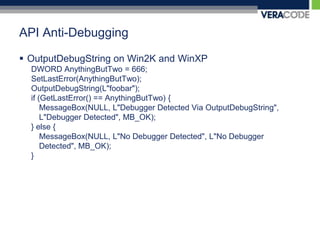
API Anti-DebuggingOutputDebugString on Win2K and WinXPDWORD AnythingButTwo = 666;SetLastError(AnythingButTwo);OutputDebugString(L"foobar");if (GetLastError() == AnythingButTwo) {MessageBox(NULL, L"Debugger Detected Via OutputDebugString", L"Debugger Detected", MB_OK);} else {MessageBox(NULL, L"No Debugger Detected", L"No Debugger Detected", MB_OK);}
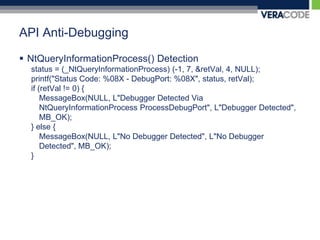
API Anti-DebuggingNtQueryInformationProcess() Detectionstatus = (_NtQueryInformationProcess) (-1, 7, &retVal, 4, NULL);printf("Status Code: %08X - DebugPort: %08X", status, retVal);if (retVal != 0) {MessageBox(NULL, L"Debugger Detected Via NtQueryInformationProcessProcessDebugPort", L"Debugger Detected", MB_OK);} else {MessageBox(NULL, L"No Debugger Detected", L"No Debugger Detected", MB_OK);}
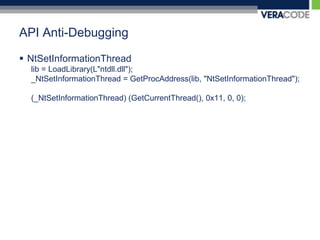
API Anti-DebuggingNtSetInformationThreadlib = LoadLibrary(L"ntdll.dll");_NtSetInformationThread = GetProcAddress(lib, "NtSetInformationThread");(_NtSetInformationThread) (GetCurrentThread(), 0x11, 0, 0);
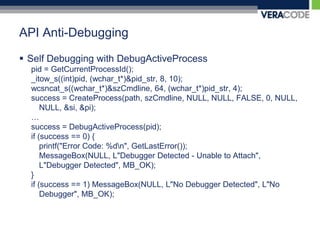
API Anti-DebuggingSelf Debugging with DebugActiveProcesspid = GetCurrentProcessId();_itow_s((int)pid, (wchar_t*)&pid_str, 8, 10);wcsncat_s((wchar_t*)&szCmdline, 64, (wchar_t*)pid_str, 4);success = CreateProcess(path, szCmdline, NULL, NULL, FALSE, 0, NULL, NULL, &si, &pi);… success = DebugActiveProcess(pid);if (success == 0) {printf("Error Code: %d\n", GetLastError());MessageBox(NULL, L"Debugger Detected - Unable to Attach", L"Debugger Detected", MB_OK);}if (success == 1) MessageBox(NULL, L"No Debugger Detected", L"No Debugger", MB_OK);
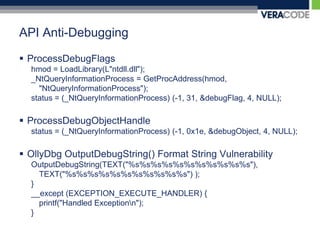
API Anti-DebuggingProcessDebugFlagshmod = LoadLibrary(L"ntdll.dll");_NtQueryInformationProcess = GetProcAddress(hmod, "NtQueryInformationProcess");status = (_NtQueryInformationProcess) (-1, 31, &debugFlag, 4, NULL);ProcessDebugObjectHandlestatus = (_NtQueryInformationProcess) (-1, 0x1e, &debugObject, 4, NULL);OllyDbg OutputDebugString() Format String VulnerabilityOutputDebugString(TEXT("%s%s%s%s%s%s%s%s%s%s%s"), TEXT("%s%s%s%s%s%s%s%s%s%s%s") );}__except (EXCEPTION_EXECUTE_HANDLER) {printf("Handled Exception\n");}
Exception Anti-Debugging
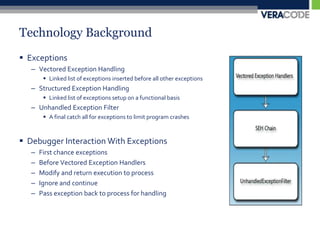
Technology BackgroundExceptionsVectored Exception HandlingLinked list of exceptions inserted before all other exceptionsStructured Exception HandlingLinked list of exceptions setup on a functional basisUnhandled Exception FilterA final catch all for exceptions to limit program crashesDebugger Interaction With ExceptionsFirst chance exceptions Before Vectored Exception HandlersModify and return execution to processIgnore and continuePass exception back to process for handling
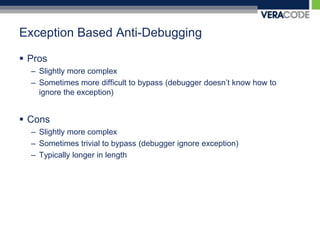
Exception Based Anti-DebuggingProsSlightly more complexSometimes more difficult to bypass (debugger doesn’t know how to ignore the exception)ConsSlightly more complex Sometimes trivial to bypass (debugger ignore exception)Typically longer in length
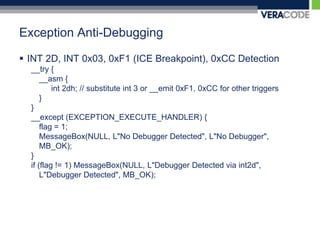
Exception Anti-DebuggingINT 2D, INT 0x03, 0xF1 (ICE Breakpoint), 0xCC Detection__try {	__asm {int 2dh; // substitute int 3 or __emit 0xF1, 0xCC for other triggers	}}__except (EXCEPTION_EXECUTE_HANDLER) {	flag = 1;MessageBox(NULL, L"No Debugger Detected", L"No Debugger", MB_OK);} if (flag != 1) MessageBox(NULL, L"Debugger Detected via int2d", L"Debugger Detected", MB_OK);
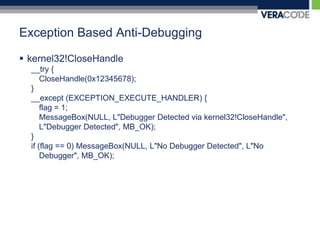
Exception Based Anti-Debuggingkernel32!CloseHandle __try {CloseHandle(0x12345678);}__except (EXCEPTION_EXECUTE_HANDLER) {	flag = 1;MessageBox(NULL, L"Debugger Detected via kernel32!CloseHandle", L"Debugger Detected", MB_OK);}if (flag == 0) MessageBox(NULL, L"No Debugger Detected", L"No Debugger", MB_OK);
Exception Anti-DebuggingSingle Step Detection (Trap Flag)__try {	__asm {		PUSHFD; //Saves the flag registers		OR BYTE PTR[ESP+1], 1; // Sets the Trap Flag in EFlags		POPFD; //Restore the flag registers		NOP; // NOP	}}__except (EXCEPTION_EXECUTE_HANDLER) {	flag = 1;MessageBox(NULL, L"No Debugger Detected", L"No Debugger", MB_OK);}if (flag == 0) MessageBox(NULL, L"Debugger Detected Via Trap Flag", L"Debugger Detected", MB_OK);
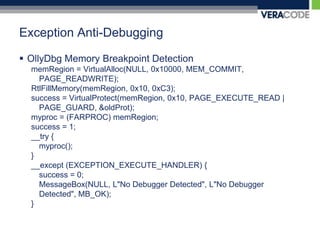
Exception Anti-DebuggingOllyDbg Memory Breakpoint DetectionmemRegion = VirtualAlloc(NULL, 0x10000, MEM_COMMIT, PAGE_READWRITE);RtlFillMemory(memRegion, 0x10, 0xC3); success = VirtualProtect(memRegion, 0x10, PAGE_EXECUTE_READ | PAGE_GUARD, &oldProt);myproc = (FARPROC) memRegion;success = 1;__try {myproc();}__except (EXCEPTION_EXECUTE_HANDLER) {	success = 0;MessageBox(NULL, L"No Debugger Detected", L"No Debugger Detected", MB_OK);}
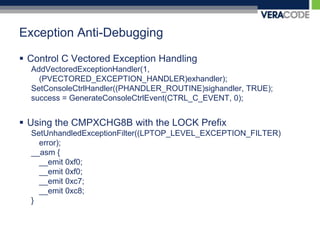
Exception Anti-DebuggingControl C Vectored Exception HandlingAddVectoredExceptionHandler(1, (PVECTORED_EXCEPTION_HANDLER)exhandler);SetConsoleCtrlHandler((PHANDLER_ROUTINE)sighandler, TRUE);success = GenerateConsoleCtrlEvent(CTRL_C_EVENT, 0);Using the CMPXCHG8B with the LOCK PrefixSetUnhandledExceptionFilter((LPTOP_LEVEL_EXCEPTION_FILTER) error);__asm {	__emit 0xf0;	__emit 0xf0;	__emit 0xc7;	__emit 0xc8;}
Process and Thread BlockAnti-Debugging
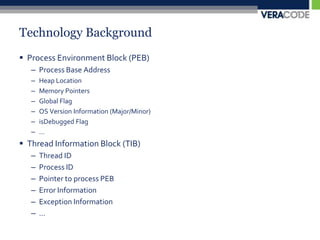
Technology BackgroundProcess Environment Block (PEB)Process Base AddressHeap LocationMemory PointersGlobal FlagOS Version Information (Major/Minor)isDebugged Flag…Thread Information Block (TIB)Thread IDProcess IDPointer to process PEBError InformationException Information…
Process and Thread Block Anti-DebuggingProsDirect to the process and thread informationLess chance of detection via hookingHarder to bypass overallConsRequires use of undocumented structuresRequires understanding of runtime dynamic linkingMore complex to understand
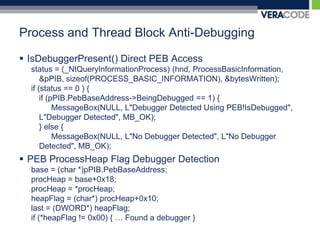
Process and Thread Block Anti-DebuggingIsDebuggerPresent() Direct PEB Accessstatus = (_NtQueryInformationProcess) (hnd, ProcessBasicInformation, &pPIB, sizeof(PROCESS_BASIC_INFORMATION), &bytesWritten); if (status == 0 ) {	if (pPIB.PebBaseAddress->BeingDebugged == 1) {MessageBox(NULL, L"Debugger Detected Using PEB!IsDebugged", L"Debugger Detected", MB_OK);	} else {MessageBox(NULL, L"No Debugger Detected", L"No Debugger Detected", MB_OK);PEB ProcessHeap Flag Debugger Detectionbase = (char *)pPIB.PebBaseAddress;procHeap = base+0x18;procHeap = *procHeap;heapFlag = (char*) procHeap+0x10;last = (DWORD*) heapFlag;if (*heapFlag != 0x00) { … Found a debugger }
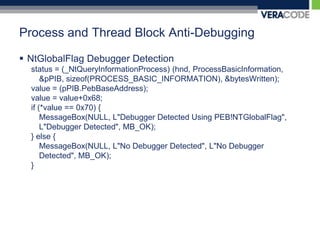
Process and Thread Block Anti-DebuggingNtGlobalFlag Debugger Detectionstatus = (_NtQueryInformationProcess) (hnd, ProcessBasicInformation, &pPIB, sizeof(PROCESS_BASIC_INFORMATION), &bytesWritten); value = (pPIB.PebBaseAddress);value = value+0x68; if (*value == 0x70) {MessageBox(NULL, L"Debugger Detected Using PEB!NTGlobalFlag", L"Debugger Detected", MB_OK);} else {MessageBox(NULL, L"No Debugger Detected", L"No Debugger Detected", MB_OK);}
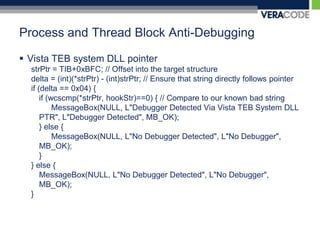
Process and Thread Block Anti-DebuggingVista TEB system DLL pointerstrPtr = TIB+0xBFC; // Offset into the target structuredelta = (int)(*strPtr) - (int)strPtr; // Ensure that string directly follows pointerif (delta == 0x04) {	if (wcscmp(*strPtr, hookStr)==0) { // Compare to our known bad stringMessageBox(NULL, L"Debugger Detected Via Vista TEB System DLL PTR", L"Debugger Detected", MB_OK);	} else {MessageBox(NULL, L"No Debugger Detected", L"No Debugger", MB_OK);	}} else {MessageBox(NULL, L"No Debugger Detected", L"No Debugger", MB_OK);}
Hardware and RegisterAnti-Debugging
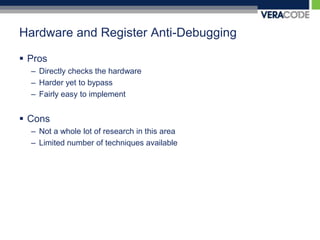
Hardware and Register Anti-DebuggingProsDirectly checks the hardwareHarder yet to bypassFairly easy to implementConsNot a whole lot of research in this areaLimited number of techniques available
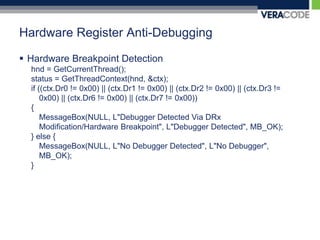
Hardware Register Anti-DebuggingHardware Breakpoint Detectionhnd = GetCurrentThread();status = GetThreadContext(hnd, &ctx); if ((ctx.Dr0 != 0x00) || (ctx.Dr1 != 0x00) || (ctx.Dr2 != 0x00) || (ctx.Dr3 != 0x00) || (ctx.Dr6 != 0x00) || (ctx.Dr7 != 0x00)){MessageBox(NULL, L"Debugger Detected Via DRx Modification/Hardware Breakpoint", L"Debugger Detected", MB_OK);} else {MessageBox(NULL, L"No Debugger Detected", L"No Debugger", MB_OK);}
Hardware Register Anti-DebuggingVmwaresldt detection__asm {sldtldt_info;}if ((ldt_info[0] != 0x00) && (ldt_info[1] != 0x00)) ldt_flag = 1;
Timing Based Anti-Debugging
Timing Based Anti-DebuggingProsSuper easy to implementConceptually easy to understandCan monitor blocks or individual instructionsConsVery easy to bypassCan be spotted a mile away
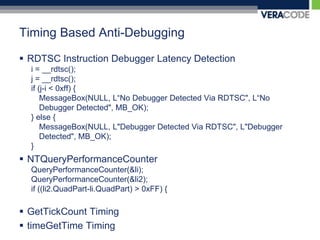
Timing Based Anti-DebuggingRDTSC Instruction Debugger Latency Detectioni = __rdtsc();j = __rdtsc();if (j-i < 0xff) {MessageBox(NULL, L“No Debugger Detected Via RDTSC", L“No Debugger Detected", MB_OK);} else {MessageBox(NULL, L"Debugger Detected Via RDTSC", L"Debugger Detected", MB_OK);}NTQueryPerformanceCounterQueryPerformanceCounter(&li);QueryPerformanceCounter(&li2);if ((li2.QuadPart-li.QuadPart) > 0xFF) {GetTickCount TimingtimeGetTime Timing
Paper Linkhttp://www.veracode.com/images/pdf/whitepaper_antidebugging.pdf
Questions
ContactTyler ShieldsSr. Security ResearcherVeracode, Inc.tshields@veracode.com

CarolinaCon 2009 Anti-Debugging

  • 1.
  • 2.
    Presenter BackgroundCurrentlySr. SecurityResearcher for Veracode, Inc.PreviouslySecurity Consultant - SymantecSecurity Consultant - @StakeIncident Response and Forensics Handler – US GovernmentWishes He WasInfinitely RichPersonal Trainer to hot Hollywood starletsGeneral all-around rockstar
  • 3.
    What we willcover…Definition of Problem Statement and TermsWhy Bother?Isn’t this a futile effort?Standing On The Shoulders of GiantsBrief reference of anti-debuggingClasses of Anti-Debugging MethodsThe six styles of anti-debug fuSome Known Anti-Debugging MethodsNot enough time to cover them all
  • 4.
    Problem Statement andDefinition of Terms
  • 5.
    Problem StatementAnti-debugging methodsare consistently presented as machine code or assembly language constructs making knowledge transfer difficult and limiting widespread use of the techniques.
  • 6.
    Let’s Do AnExperimentCan you tell what the following code does in five seconds or less?Be Honest!
  • 7.
    Assembly Dumppush ebpmovebp, espsub esp, 0C0hpush ebxpush esipush edilea edi, [ebp+var_C0]movecx, 30hmoveax, 0CCCCCCCChrep stosdmovesi, espcall ds:__imp__IsDebuggerPresent@0cmpesi, espcall j___RTC_CheckEsptest eax, eaxjz short loc_411400movesi, esppush 0 ; uTypepush offset Caption push offset Text push 0 ; hWndcall ds:__imp__MessageBoxW@16 cmpesi, espcall j___RTC_CheckEspshort loc_41141Dloc_411400: ; CODE XREF: antidebug(void)+2Fjmovesi, esppush 0 ; uTypepush offset aNoDebuggerpush offset aNoDebuggerDetepush 0 ; hWndcall ds:__imp__MessageBoxW@16 cmpesi, espj___RTC_CheckEsploc_41141D: ; CODE XREF: antidebug(void)+4Ejpop edipop esipop ebxadd esp, 0C0hcmpebp, espcall j___RTC_CheckEspmovesp, ebppop ebpRetnantidebug@@YAXXZ endp
  • 8.
  • 9.
    Assembly Dump –Highlight Important Bitsvar_C0 = byte ptr -0C0hpush ebpmovebp, espsub esp, 0C0hPush ebxPush esiPush edilea edi, [ebp+var_C0]movecx, 30hmoveax, 0CCCCCCCChRep stosdmovesi, espCall ds:__imp__IsDebuggerPresent@0 cmpesi, espCall j___RTC_CheckEspTest eax, eaxjz short loc_411400movesi, esppush 0 ; uTypepush offset Caption push offset Text push 0 ; hWndcall ds:__imp__MessageBoxW@16cmpesi, espcall j___RTC_CheckEspjmp short loc_41141Dloc_411400: movesi, esppush 0 ; uTypepush offset aNoDebuggerpush offset aNoDebuggerDetepush 0 ; hWndcall ds:__imp__MessageBoxW@16cmpesi, espcall j___RTC_CheckEsploc_41141D: pop edipop esipop ebxadd esp, 0C0hcmpebp, espcall j___RTC_CheckEspmovesp, ebppop ebpRetn?antidebug@@YAXXZ endp
  • 10.
  • 11.
    How About InCif (IsDebuggerPresent()){ MessageBox(NULL, L"Debugger Detected Via IsDebuggerPresent", L"Debugger Detected", MB_OK);} else{MessageBox(NULL, L“No Debugger Detected“, L“No Debugger ", MB_OK);}
  • 12.
    Definition of TermsDebugger(Debugging)The act of detecting and removing bugs in an application.Anti-DebuggingAnti-debugging is the implementation of one or more techniques within computer code that hinders attempts at reverse engineering or debugging a target process.
  • 13.
    Definition of TermsDumpingDumpingof a running process in memory to disk so that the image can be executed as a separate binary. Anti-DumpingTechnique that is used to inhibit the dumping of a running process from memory to disk
  • 14.
    Definition of TermsAnti-Anti-DebuggingTechniquesused to detect and bypass anti-debugging effortsAnti-Anti-DumpingTechniques used to detect and bypass anti-dumping efforts.Anti-Anti-Anti-…. You get the picture
  • 15.
  • 16.
    Why Should ICare?Protecting your intellectual propertyLaws can’t possibly work Neither do EULA or other soft methodsSlow down subversion of software registration CrackingImpede application feature and code theftLow costShort code segments equals quick implementationWrite a basic anti-debugging library for reuse
  • 17.
    Why Should ICare?Raise the barImplement multiple layers of defenseMakes reversing an arduous taskIt’s no longer as simple as a debugger + disassembler + timeMalware analysisKnowledge of anti-debugging techniques can help your incident response and analysisDebug the random binary found on your accounting systemImplement IDS/IPS signatures in shorter timeframesExercise the brainKeeps the synapses firingImplementation (and bypass) is FUN!
  • 18.
    Standing On theShoulders Of GiantsA Brief Reference of Anti-Debugging
  • 19.
    ReferencesBania, P, “Antidebuggingfor the (m)asses - protecting the env.”Brulez, N., “Crimeware Anti-Reverse Engineering Uncovered”“Lord Julus”, “Anti-Debugger and Anti-Emulator Lair”Liston, T., and Skoudis, E., “ Thwarting Virtual Machine Detection”Bania, P., “Playing with RTDSC”Quist, D., Smith, V., “Detecting the Presence of Virtual Machines Using the Local Data Table”Omella, A. A., “Methods for Virtual Machine Detection”Tariq, T. B., “Detecting Virtualization”Rutkowska, J., " Red Pill... or how to detect VMM using (almost) one CPU instruction”
  • 20.
    ReferencesJackson, J., “AnAnti-Reverse Engineering Guide”Falliere, N., “Windows Anti-Debug Reference”Gagnon, M. N., Taylor, S., and Ghosh, “Software Protection through Anti-Debugging”Ferrie, P., “Anti-Unpacker Tricks”OpenRCE: “Anti Reverse Engineering Techniques Database”Ferrie, P., “Attacks on More Virtual Machine Emulators”Brulez, N., “Anti-Reverse Engineering Uncovered”
  • 21.
  • 22.
  • 23.
  • 24.
  • 25.
    Anti-Debugging ClassesAPI BasedDetectionUsing operating system supplied API calls to determine if a debugger exists and/or is attached to our codeNo direct access of memory regionsRelies upon documented and undocumented operating system functionsProcess and Thread Block DetectionBypassing API calls and directly querying process and thread information to determine discrepancies that indicate the operation of a debuggerWhen direct API calls just aren’t enoughAvoids userland API hookingLower in the stack and closer to the OS results in more difficult bypass
  • 26.
    Anti-Debugging ClassesHardware andRegister Based DetectionDirectly accessing CPU register information specifically debug registers to check for hardware breakpointsNo longer relies upon software differences for detectionOne step lower in the stackException Based DetectionCreating an exception that is handled differently depending on the debugging state of a process
  • 27.
    Anti-Debugging ClassesModified CodeBased DetectionProcess understands what it *should* look like in memoryCompares the current picture against the excepted pictureFlags on differencesTiming DetectionTime calls used to determine execution deltas to be compared against a reasonable thresholdPrimarily used to detect single steppingCan also be used to detect breakpoints within blocks of code
  • 28.
  • 29.
    Technology BackgroundX86 Systemsand Microsoft Windows Operating SystemsWindows 2000/XP/VistaBreakpointsSoftware Breakpoints (Exceptions)Overwrites target location with INT03 (0xcc)Saves original opcodeBacks up one operation, replaces original opcode, restartsHardware Breakpoints (Faults)Debug registers: 4 for addresses, one for control, and one for statusEach of the first 4 can hold a memory address that causes a hardware fault when accessedDebug Registers (DR0 – DR7)Single SteppingTrap Flag in processor is setAny instruction will trigger a breakpoint when trap flag is set
  • 30.
    API Anti-DebuggingProsGenerally easiestto implementEasiest to understandShort in lengthConsEasiest to understandRelatively easy to bypassMost frequently used
  • 31.
    API Anti-DebuggingFindWindowHANDLE ollyHandle= NULL; ollyHandle = FindWindow(L"OLLYDBG", 0);if (ollyHandle == NULL) {MessageBox(NULL, L"OllyDbg Not Detected", L"Not Detected", MB_OK);} else {MessageBox(NULL, L"Ollydbg Detected Via OllyDbgFindWindow()", L"OllyDbg Detected", MB_OK);}Registry Key DetectionSOFTWARE\\Microsoft\\Windows NT\\CurrentVersion\\AeDebug Debugger=exefile\\shell\\Open with Olly&Dbg\\commanddllfile\\shell\\Open with Olly&Dbg\\command
  • 32.
    API Anti-DebuggingIsDebuggerPresent() WindowsAPI if (IsDebuggerPresent()) { MessageBox(NULL, L"Debugger Detected Via IsDebuggerPresent", L"Debugger Detected", MB_OK);} CheckRemoteDebuggerPresent() Windows APICheckRemoteDebuggerPresent(GetCurrentProcess(), &pbIsPresent);if (pbIsPresent) {MessageBox(NULL, L"Debugger Detected Via CheckRemoteDebuggerPresent", L"Debugger Detected", MB_OK);}
  • 33.
    API Anti-DebuggingOutputDebugString onWin2K and WinXPDWORD AnythingButTwo = 666;SetLastError(AnythingButTwo);OutputDebugString(L"foobar");if (GetLastError() == AnythingButTwo) {MessageBox(NULL, L"Debugger Detected Via OutputDebugString", L"Debugger Detected", MB_OK);} else {MessageBox(NULL, L"No Debugger Detected", L"No Debugger Detected", MB_OK);}
  • 34.
    API Anti-DebuggingNtQueryInformationProcess() Detectionstatus= (_NtQueryInformationProcess) (-1, 7, &retVal, 4, NULL);printf("Status Code: %08X - DebugPort: %08X", status, retVal);if (retVal != 0) {MessageBox(NULL, L"Debugger Detected Via NtQueryInformationProcessProcessDebugPort", L"Debugger Detected", MB_OK);} else {MessageBox(NULL, L"No Debugger Detected", L"No Debugger Detected", MB_OK);}
  • 35.
    API Anti-DebuggingNtSetInformationThreadlib =LoadLibrary(L"ntdll.dll");_NtSetInformationThread = GetProcAddress(lib, "NtSetInformationThread");(_NtSetInformationThread) (GetCurrentThread(), 0x11, 0, 0);
  • 36.
    API Anti-DebuggingSelf Debuggingwith DebugActiveProcesspid = GetCurrentProcessId();_itow_s((int)pid, (wchar_t*)&pid_str, 8, 10);wcsncat_s((wchar_t*)&szCmdline, 64, (wchar_t*)pid_str, 4);success = CreateProcess(path, szCmdline, NULL, NULL, FALSE, 0, NULL, NULL, &si, &pi);… success = DebugActiveProcess(pid);if (success == 0) {printf("Error Code: %d\n", GetLastError());MessageBox(NULL, L"Debugger Detected - Unable to Attach", L"Debugger Detected", MB_OK);}if (success == 1) MessageBox(NULL, L"No Debugger Detected", L"No Debugger", MB_OK);
  • 37.
    API Anti-DebuggingProcessDebugFlagshmod =LoadLibrary(L"ntdll.dll");_NtQueryInformationProcess = GetProcAddress(hmod, "NtQueryInformationProcess");status = (_NtQueryInformationProcess) (-1, 31, &debugFlag, 4, NULL);ProcessDebugObjectHandlestatus = (_NtQueryInformationProcess) (-1, 0x1e, &debugObject, 4, NULL);OllyDbg OutputDebugString() Format String VulnerabilityOutputDebugString(TEXT("%s%s%s%s%s%s%s%s%s%s%s"), TEXT("%s%s%s%s%s%s%s%s%s%s%s") );}__except (EXCEPTION_EXECUTE_HANDLER) {printf("Handled Exception\n");}
  • 38.
  • 39.
    Technology BackgroundExceptionsVectored ExceptionHandlingLinked list of exceptions inserted before all other exceptionsStructured Exception HandlingLinked list of exceptions setup on a functional basisUnhandled Exception FilterA final catch all for exceptions to limit program crashesDebugger Interaction With ExceptionsFirst chance exceptions Before Vectored Exception HandlersModify and return execution to processIgnore and continuePass exception back to process for handling
  • 40.
    Exception Based Anti-DebuggingProsSlightlymore complexSometimes more difficult to bypass (debugger doesn’t know how to ignore the exception)ConsSlightly more complex Sometimes trivial to bypass (debugger ignore exception)Typically longer in length
  • 41.
    Exception Anti-DebuggingINT 2D,INT 0x03, 0xF1 (ICE Breakpoint), 0xCC Detection__try { __asm {int 2dh; // substitute int 3 or __emit 0xF1, 0xCC for other triggers }}__except (EXCEPTION_EXECUTE_HANDLER) { flag = 1;MessageBox(NULL, L"No Debugger Detected", L"No Debugger", MB_OK);} if (flag != 1) MessageBox(NULL, L"Debugger Detected via int2d", L"Debugger Detected", MB_OK);
  • 42.
    Exception Based Anti-Debuggingkernel32!CloseHandle__try {CloseHandle(0x12345678);}__except (EXCEPTION_EXECUTE_HANDLER) { flag = 1;MessageBox(NULL, L"Debugger Detected via kernel32!CloseHandle", L"Debugger Detected", MB_OK);}if (flag == 0) MessageBox(NULL, L"No Debugger Detected", L"No Debugger", MB_OK);
  • 43.
    Exception Anti-DebuggingSingle StepDetection (Trap Flag)__try { __asm { PUSHFD; //Saves the flag registers OR BYTE PTR[ESP+1], 1; // Sets the Trap Flag in EFlags POPFD; //Restore the flag registers NOP; // NOP }}__except (EXCEPTION_EXECUTE_HANDLER) { flag = 1;MessageBox(NULL, L"No Debugger Detected", L"No Debugger", MB_OK);}if (flag == 0) MessageBox(NULL, L"Debugger Detected Via Trap Flag", L"Debugger Detected", MB_OK);
  • 44.
    Exception Anti-DebuggingOllyDbg MemoryBreakpoint DetectionmemRegion = VirtualAlloc(NULL, 0x10000, MEM_COMMIT, PAGE_READWRITE);RtlFillMemory(memRegion, 0x10, 0xC3); success = VirtualProtect(memRegion, 0x10, PAGE_EXECUTE_READ | PAGE_GUARD, &oldProt);myproc = (FARPROC) memRegion;success = 1;__try {myproc();}__except (EXCEPTION_EXECUTE_HANDLER) { success = 0;MessageBox(NULL, L"No Debugger Detected", L"No Debugger Detected", MB_OK);}
  • 45.
    Exception Anti-DebuggingControl CVectored Exception HandlingAddVectoredExceptionHandler(1, (PVECTORED_EXCEPTION_HANDLER)exhandler);SetConsoleCtrlHandler((PHANDLER_ROUTINE)sighandler, TRUE);success = GenerateConsoleCtrlEvent(CTRL_C_EVENT, 0);Using the CMPXCHG8B with the LOCK PrefixSetUnhandledExceptionFilter((LPTOP_LEVEL_EXCEPTION_FILTER) error);__asm { __emit 0xf0; __emit 0xf0; __emit 0xc7; __emit 0xc8;}
  • 46.
    Process and ThreadBlockAnti-Debugging
  • 47.
    Technology BackgroundProcess EnvironmentBlock (PEB)Process Base AddressHeap LocationMemory PointersGlobal FlagOS Version Information (Major/Minor)isDebugged Flag…Thread Information Block (TIB)Thread IDProcess IDPointer to process PEBError InformationException Information…
  • 48.
    Process and ThreadBlock Anti-DebuggingProsDirect to the process and thread informationLess chance of detection via hookingHarder to bypass overallConsRequires use of undocumented structuresRequires understanding of runtime dynamic linkingMore complex to understand
  • 49.
    Process and ThreadBlock Anti-DebuggingIsDebuggerPresent() Direct PEB Accessstatus = (_NtQueryInformationProcess) (hnd, ProcessBasicInformation, &pPIB, sizeof(PROCESS_BASIC_INFORMATION), &bytesWritten); if (status == 0 ) { if (pPIB.PebBaseAddress->BeingDebugged == 1) {MessageBox(NULL, L"Debugger Detected Using PEB!IsDebugged", L"Debugger Detected", MB_OK); } else {MessageBox(NULL, L"No Debugger Detected", L"No Debugger Detected", MB_OK);PEB ProcessHeap Flag Debugger Detectionbase = (char *)pPIB.PebBaseAddress;procHeap = base+0x18;procHeap = *procHeap;heapFlag = (char*) procHeap+0x10;last = (DWORD*) heapFlag;if (*heapFlag != 0x00) { … Found a debugger }
  • 50.
    Process and ThreadBlock Anti-DebuggingNtGlobalFlag Debugger Detectionstatus = (_NtQueryInformationProcess) (hnd, ProcessBasicInformation, &pPIB, sizeof(PROCESS_BASIC_INFORMATION), &bytesWritten); value = (pPIB.PebBaseAddress);value = value+0x68; if (*value == 0x70) {MessageBox(NULL, L"Debugger Detected Using PEB!NTGlobalFlag", L"Debugger Detected", MB_OK);} else {MessageBox(NULL, L"No Debugger Detected", L"No Debugger Detected", MB_OK);}
  • 51.
    Process and ThreadBlock Anti-DebuggingVista TEB system DLL pointerstrPtr = TIB+0xBFC; // Offset into the target structuredelta = (int)(*strPtr) - (int)strPtr; // Ensure that string directly follows pointerif (delta == 0x04) { if (wcscmp(*strPtr, hookStr)==0) { // Compare to our known bad stringMessageBox(NULL, L"Debugger Detected Via Vista TEB System DLL PTR", L"Debugger Detected", MB_OK); } else {MessageBox(NULL, L"No Debugger Detected", L"No Debugger", MB_OK); }} else {MessageBox(NULL, L"No Debugger Detected", L"No Debugger", MB_OK);}
  • 52.
  • 53.
    Hardware and RegisterAnti-DebuggingProsDirectly checks the hardwareHarder yet to bypassFairly easy to implementConsNot a whole lot of research in this areaLimited number of techniques available
  • 54.
    Hardware Register Anti-DebuggingHardwareBreakpoint Detectionhnd = GetCurrentThread();status = GetThreadContext(hnd, &ctx); if ((ctx.Dr0 != 0x00) || (ctx.Dr1 != 0x00) || (ctx.Dr2 != 0x00) || (ctx.Dr3 != 0x00) || (ctx.Dr6 != 0x00) || (ctx.Dr7 != 0x00)){MessageBox(NULL, L"Debugger Detected Via DRx Modification/Hardware Breakpoint", L"Debugger Detected", MB_OK);} else {MessageBox(NULL, L"No Debugger Detected", L"No Debugger", MB_OK);}
  • 55.
    Hardware Register Anti-DebuggingVmwaresldtdetection__asm {sldtldt_info;}if ((ldt_info[0] != 0x00) && (ldt_info[1] != 0x00)) ldt_flag = 1;
  • 56.
  • 57.
    Timing Based Anti-DebuggingProsSupereasy to implementConceptually easy to understandCan monitor blocks or individual instructionsConsVery easy to bypassCan be spotted a mile away
  • 58.
    Timing Based Anti-DebuggingRDTSCInstruction Debugger Latency Detectioni = __rdtsc();j = __rdtsc();if (j-i < 0xff) {MessageBox(NULL, L“No Debugger Detected Via RDTSC", L“No Debugger Detected", MB_OK);} else {MessageBox(NULL, L"Debugger Detected Via RDTSC", L"Debugger Detected", MB_OK);}NTQueryPerformanceCounterQueryPerformanceCounter(&li);QueryPerformanceCounter(&li2);if ((li2.QuadPart-li.QuadPart) > 0xFF) {GetTickCount TimingtimeGetTime Timing
  • 59.
  • 60.
  • 61.
    ContactTyler ShieldsSr. SecurityResearcherVeracode, Inc.tshields@veracode.com