RESTORING RELATIONSHIPS FOR
HAPPIER WORKPLACES
DEALING WITH THE DIFFICULT WHILST IT’S STILL EASY
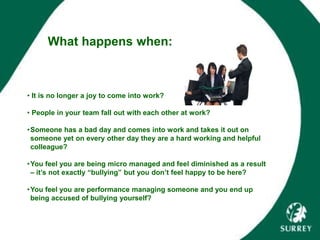
What happens when:
• It is no longer a joy to come into work?
• People in your team fall out with each other at work?
•Someone has a bad day and comes into work and takes it out on
someone yet on every other day they are a hard working and helpful
colleague?
•You feel you are being micro managed and feel diminished as a result
– it’s not exactly “bullying” but you don’t feel happy to be here?
•You feel you are performance managing someone and you end up
being accused of bullying yourself?
OUR INTERNAL RESEARCH :
AS A MANAGER,
FOR 85 – 95% OF THE DAY-TO-DAY,
YOU DO NOT NEED AN
HR POLICY FOR OR AN HR PERSON.
IT IS ABOUT HAVING THE CONFIDENCE TO LEAD
WITHIN THE ORGANISATION’S VALUES
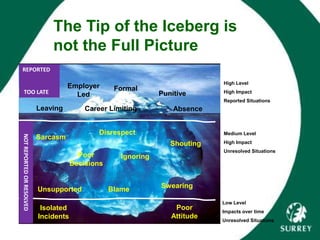
REPORTED
TOO LATE
Employer
Led
Leaving Career Limiting
Formal
Punitive
Absence
NOTREPORTEDORRESOLVED
Sarcasm
Disrespect
Shouting
Poor
Decisions
Ignoring
BlameUnsupported Swearing
Isolated
Incidents
Poor
Attitude
High Level
High Impact
Reported Situations
Medium Level
High Impact
Unresolved Situations
Low Level
Impacts over time
Unresolved Situations
The Tip of the Iceberg is
not the Full Picture
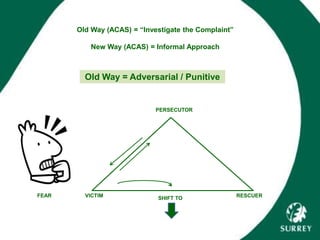
Old Way (ACAS) = “Investigate the Complaint”
New Way (ACAS) = Informal Approach
Old Way = Adversarial / Punitive
PERSECUTOR
FEAR VICTIM SHIFT TO RESCUER
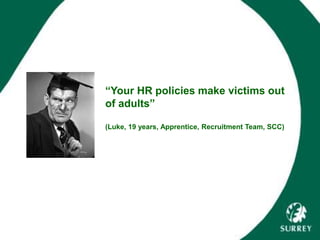
“Your HR policies make victims out
of adults”
(Luke, 19 years, Apprentice, Recruitment Team, SCC)
With an Adversarial approach
– How many times in your
experience does it all end up
with happy people in Restored
Relationships ?
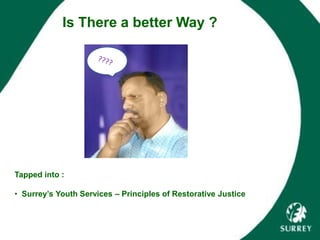
Is There a better Way ?
Tapped into :
• Surrey’s Youth Services – Principles of Restorative Justice
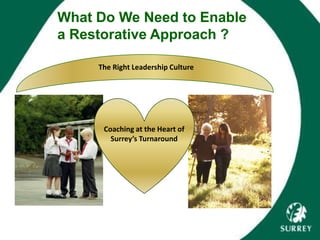
Coaching at the Heart of
Surrey’s Turnaround
The Right Leadership Culture
What Do We Need to Enable
a Restorative Approach ?
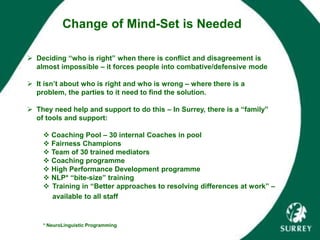
 Deciding “who is right” when there is conflict and disagreement is
almost impossible – it forces people into combative/defensive mode
 It isn’t about who is right and who is wrong – where there is a
problem, the parties to it need to find the solution.
 They need help and support to do this – In Surrey, there is a “family”
of tools and support:
 Coaching Pool – 30 internal Coaches in pool
 Fairness Champions
 Team of 30 trained mediators
 Coaching programme
 High Performance Development programme
 NLP* “bite-size” training
 Training in “Better approaches to resolving differences at work” –
available to all staff
* NeuroLinguistic Programming
Change of Mind-Set is Needed
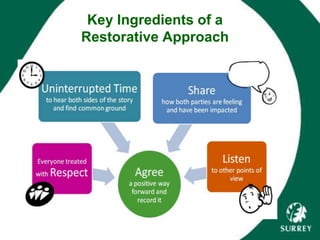
Key Ingredients of a
Restorative Approach
Doesn’t all this take up a lot of
time ?
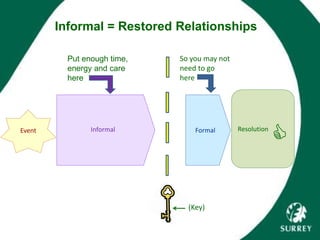
Informal = Restored Relationships
Event Informal Formal Resolution

Put enough time,
energy and care
here
So you may not
need to go
here
(Key)
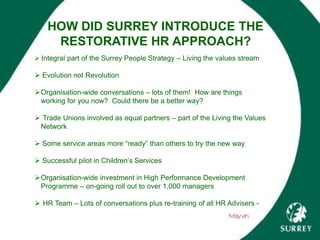
HOW DID SURREY INTRODUCE THE
RESTORATIVE HR APPROACH?
 Integral part of the Surrey People Strategy – Living the values stream
 Evolution not Revolution
Organisation-wide conversations – lots of them! How are things
working for you now? Could there be a better way?
 Trade Unions involved as equal partners – part of the Living the Values
Network
 Some service areas more “ready” than others to try the new way
 Successful pilot in Children’s Services
Organisation-wide investment in High Performance Development
Programme – on-going roll out to over 1,000 managers
 HR Team – Lots of conversations plus re-training of all HR Advisers -
Restorative HR Programme
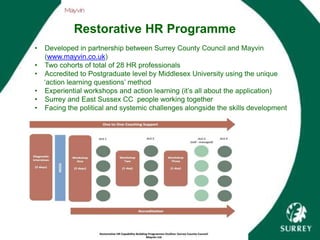
• Developed in partnership between Surrey County Council and Mayvin
(www.mayvin.co.uk)
• Two cohorts of total of 28 HR professionals
• Accredited to Postgraduate level by Middlesex University using the unique
‘action learning questions’ method
• Experiential workshops and action learning (it’s all about the application)
• Surrey and East Sussex CC people working together
• Facing the political and systemic challenges alongside the skills development
!
!
The'workshops'will'require'some'fairly'intense'work,'so'we'therefore'propose'running'it'
with'two'facilitators.'Each'learning'set'will'then'be'run'by'a'facilitator'working'with'up'to'six'
people.'These'learning'set'facilitators'will'also'offer'informal'onePtoPone'coaching'for'each'
participant'as'they'develop'their'ALQ.'
'
We'are'suggesting'a'‘straw'man’'programme'outline'below,'to'help'you'understand'the'
essence'of'our'proposal,'and'to'give'you'an'idea'of'the'minimum'input'required'to'complete'
a'satisfactory'ALQ.'
'
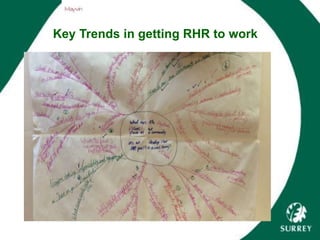
Key Trends in getting RHR to work
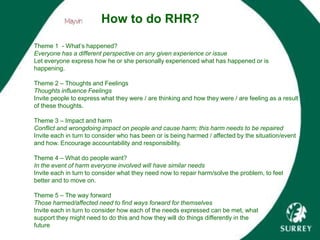
How to do RHR?
Theme 1 - What’s happened?
Everyone has a different perspective on any given experience or issue
Let everyone express how he or she personally experienced what has happened or is
happening.
Theme 2 – Thoughts and Feelings
Thoughts influence Feelings
Invite people to express what they were / are thinking and how they were / are feeling as a result
of these thoughts.
Theme 3 – Impact and harm
Conflict and wrongdoing impact on people and cause harm; this harm needs to be repaired
Invite each in turn to consider who has been or is being harmed / affected by the situation/event
and how. Encourage accountability and responsibility.
Theme 4 – What do people want?
In the event of harm everyone involved will have similar needs
Invite each in turn to consider what they need now to repair harm/solve the problem, to feel
better and to move on.
Theme 5 – The way forward
Those harmed/affected need to find ways forward for themselves
Invite each in turn to consider how each of the needs expressed can be met, what
support they might need to do this and how they will do things differently in the
future
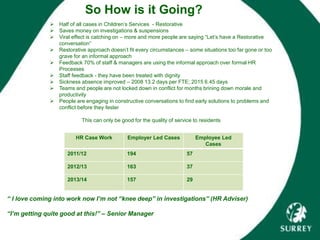
So How is it Going?
 Half of all cases in Children’s Services - Restorative
 Saves money on investigations & suspensions
 Viral effect is catching on – more and more people are saying “Let’s have a Restorative
conversation”
 Restorative approach doesn’t fit every circumstances – some situations too far gone or too
grave for an informal approach
 Feedback 70% of staff & managers are using the informal approach over formal HR
Processes
 Staff feedback - they have been treated with dignity
 Sickness absence improved – 2008 13.2 days per FTE; 2015 6.45 days
 Teams and people are not locked down in conflict for months brining down morale and
productivity
 People are engaging in constructive conversations to find early solutions to problems and
conflict before they fester
This can only be good for the quality of service to residents
“ I love coming into work now I’m not “knee deep” in investigations” (HR Adviser)
“I’m getting quite good at this!” – Senior Manager
HR Case Work Employer Led Cases Employee Led
Cases
2011/12 194 57
2012/13 163 37
2013/14 157 29
People inherently want to do the
right thing
“Human beings are happier, more cooperative and productive, and more likely to make
positive changes in their behaviour when those in positions of authority do things with them,
rather than to them or for them”
International Institute for Restorative Practices
“We underestimate people’s capacity to forgive”
RESTORED RELATIONSHIPS

Carmel Millar - Surrey CC

  • 1.
    RESTORING RELATIONSHIPS FOR HAPPIERWORKPLACES DEALING WITH THE DIFFICULT WHILST IT’S STILL EASY
  • 2.
    What happens when: •It is no longer a joy to come into work? • People in your team fall out with each other at work? •Someone has a bad day and comes into work and takes it out on someone yet on every other day they are a hard working and helpful colleague? •You feel you are being micro managed and feel diminished as a result – it’s not exactly “bullying” but you don’t feel happy to be here? •You feel you are performance managing someone and you end up being accused of bullying yourself?
  • 3.
    OUR INTERNAL RESEARCH: AS A MANAGER, FOR 85 – 95% OF THE DAY-TO-DAY, YOU DO NOT NEED AN HR POLICY FOR OR AN HR PERSON. IT IS ABOUT HAVING THE CONFIDENCE TO LEAD WITHIN THE ORGANISATION’S VALUES
  • 4.
    REPORTED TOO LATE Employer Led Leaving CareerLimiting Formal Punitive Absence NOTREPORTEDORRESOLVED Sarcasm Disrespect Shouting Poor Decisions Ignoring BlameUnsupported Swearing Isolated Incidents Poor Attitude High Level High Impact Reported Situations Medium Level High Impact Unresolved Situations Low Level Impacts over time Unresolved Situations The Tip of the Iceberg is not the Full Picture
  • 6.
    Old Way (ACAS)= “Investigate the Complaint” New Way (ACAS) = Informal Approach Old Way = Adversarial / Punitive PERSECUTOR FEAR VICTIM SHIFT TO RESCUER
  • 7.
    “Your HR policiesmake victims out of adults” (Luke, 19 years, Apprentice, Recruitment Team, SCC)
  • 8.
    With an Adversarialapproach – How many times in your experience does it all end up with happy people in Restored Relationships ?
  • 9.
    Is There abetter Way ? Tapped into : • Surrey’s Youth Services – Principles of Restorative Justice
  • 10.
    Coaching at theHeart of Surrey’s Turnaround The Right Leadership Culture What Do We Need to Enable a Restorative Approach ?
  • 11.
     Deciding “whois right” when there is conflict and disagreement is almost impossible – it forces people into combative/defensive mode  It isn’t about who is right and who is wrong – where there is a problem, the parties to it need to find the solution.  They need help and support to do this – In Surrey, there is a “family” of tools and support:  Coaching Pool – 30 internal Coaches in pool  Fairness Champions  Team of 30 trained mediators  Coaching programme  High Performance Development programme  NLP* “bite-size” training  Training in “Better approaches to resolving differences at work” – available to all staff * NeuroLinguistic Programming Change of Mind-Set is Needed
  • 12.
    Key Ingredients ofa Restorative Approach
  • 13.
    Doesn’t all thistake up a lot of time ?
  • 14.
    Informal = RestoredRelationships Event Informal Formal Resolution  Put enough time, energy and care here So you may not need to go here (Key)
  • 15.
    HOW DID SURREYINTRODUCE THE RESTORATIVE HR APPROACH?  Integral part of the Surrey People Strategy – Living the values stream  Evolution not Revolution Organisation-wide conversations – lots of them! How are things working for you now? Could there be a better way?  Trade Unions involved as equal partners – part of the Living the Values Network  Some service areas more “ready” than others to try the new way  Successful pilot in Children’s Services Organisation-wide investment in High Performance Development Programme – on-going roll out to over 1,000 managers  HR Team – Lots of conversations plus re-training of all HR Advisers -
  • 16.
    Restorative HR Programme •Developed in partnership between Surrey County Council and Mayvin (www.mayvin.co.uk) • Two cohorts of total of 28 HR professionals • Accredited to Postgraduate level by Middlesex University using the unique ‘action learning questions’ method • Experiential workshops and action learning (it’s all about the application) • Surrey and East Sussex CC people working together • Facing the political and systemic challenges alongside the skills development ! ! The'workshops'will'require'some'fairly'intense'work,'so'we'therefore'propose'running'it' with'two'facilitators.'Each'learning'set'will'then'be'run'by'a'facilitator'working'with'up'to'six' people.'These'learning'set'facilitators'will'also'offer'informal'onePtoPone'coaching'for'each' participant'as'they'develop'their'ALQ.' ' We'are'suggesting'a'‘straw'man’'programme'outline'below,'to'help'you'understand'the' essence'of'our'proposal,'and'to'give'you'an'idea'of'the'minimum'input'required'to'complete' a'satisfactory'ALQ.' '
  • 17.
    Key Trends ingetting RHR to work
  • 18.
    How to doRHR? Theme 1 - What’s happened? Everyone has a different perspective on any given experience or issue Let everyone express how he or she personally experienced what has happened or is happening. Theme 2 – Thoughts and Feelings Thoughts influence Feelings Invite people to express what they were / are thinking and how they were / are feeling as a result of these thoughts. Theme 3 – Impact and harm Conflict and wrongdoing impact on people and cause harm; this harm needs to be repaired Invite each in turn to consider who has been or is being harmed / affected by the situation/event and how. Encourage accountability and responsibility. Theme 4 – What do people want? In the event of harm everyone involved will have similar needs Invite each in turn to consider what they need now to repair harm/solve the problem, to feel better and to move on. Theme 5 – The way forward Those harmed/affected need to find ways forward for themselves Invite each in turn to consider how each of the needs expressed can be met, what support they might need to do this and how they will do things differently in the future
  • 19.
    So How isit Going?  Half of all cases in Children’s Services - Restorative  Saves money on investigations & suspensions  Viral effect is catching on – more and more people are saying “Let’s have a Restorative conversation”  Restorative approach doesn’t fit every circumstances – some situations too far gone or too grave for an informal approach  Feedback 70% of staff & managers are using the informal approach over formal HR Processes  Staff feedback - they have been treated with dignity  Sickness absence improved – 2008 13.2 days per FTE; 2015 6.45 days  Teams and people are not locked down in conflict for months brining down morale and productivity  People are engaging in constructive conversations to find early solutions to problems and conflict before they fester This can only be good for the quality of service to residents “ I love coming into work now I’m not “knee deep” in investigations” (HR Adviser) “I’m getting quite good at this!” – Senior Manager HR Case Work Employer Led Cases Employee Led Cases 2011/12 194 57 2012/13 163 37 2013/14 157 29
  • 20.
    People inherently wantto do the right thing “Human beings are happier, more cooperative and productive, and more likely to make positive changes in their behaviour when those in positions of authority do things with them, rather than to them or for them” International Institute for Restorative Practices “We underestimate people’s capacity to forgive”
  • 21.