Global Talent Management: New Challenges and Opportunities May 15, 2008
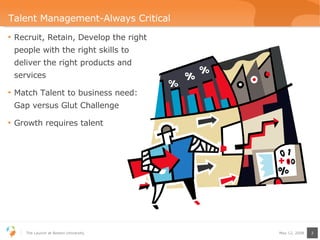
Talent Management-Always Critical Recruit, Retain, Develop the right people with the right skills to deliver the right products and services Match Talent to business need: Gap versus Glut Challenge Growth requires talent
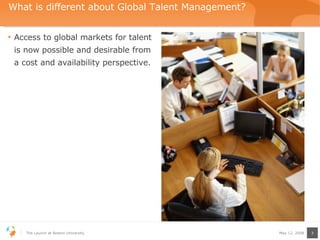
What is different about Global Talent Management? Access to global markets for talent is now possible and desirable from a cost and availability perspective.
What is global work? More than off-shoring routine jobs <Structured -- Semi-structured -- Unstructured> The New Geography of Work How to design work? When to go captive versus third-party? Where to locate? How to coordinate and synchronize work? Scope extends beyond IT and BPO sectors Nearly every sector is globalized--although the scope and impact may be different Unleashing potential of Global Talent
Changing Nature of Work and Its location Three categories of work: Transformational – from raw materials to products Transactional – structured/codified Tacit – requiring judgment, growing 3x faster than other categories McKinsey study – cited in Economist Oct 2006
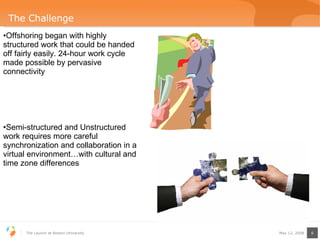
The Challenge  Offshoring began with highly structured work that could be handed off fairly easily. 24-hour work cycle made possible by pervasive connectivity Semi-structured and Unstructured work requires more careful synchronization and collaboration in a virtual environment…with cultural and time zone differences
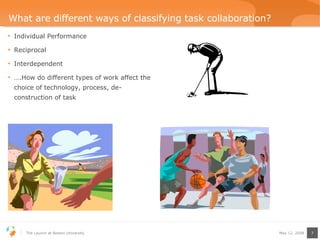
What are different ways of classifying task collaboration? Individual Performance Reciprocal Interdependent … .How do different types of work affect the choice of technology, process, de-construction of task
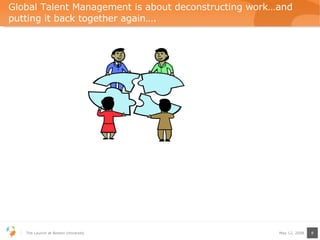
Global Talent Management is about deconstructing work…and putting it back together again….
Example Case: PTC Solutions Centers PTC sells software products that support 3-dimensional design: Pro-Engineer and Windchill that helps manage documents related to the product The Windchill product is a web based software product that supports the document management process associated with complex product development and implementation.  While PTC is primarily a product company selling software, an increasing amount of revenue (currently 25%)  is now derived from the services support activities associated with the sale and implementation of the product within client sites.
Current Support Services 65% of support service engineers come from the field organization and are used mostly on-site in various global locations 20% of support service engineers are drawn from the company’s centralized Solution Centers in Poland, India, Pennsylvania and China.  Mostly work off site to support clients 15% of support services engineers are subcontractors.
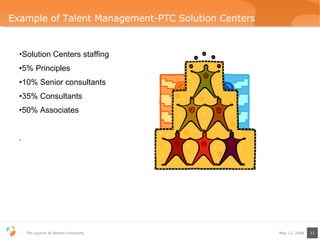
Example of Talent Management-PTC Solution Centers Solution Centers staffing 5% Principles 10% Senior consultants 35% Consultants 50% Associates .
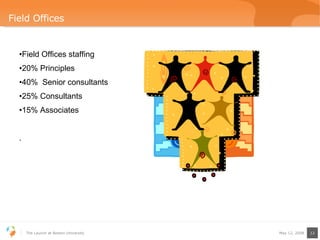
Field Offices Field Offices staffing 20% Principles 40%  Senior consultants 25% Consultants 15% Associates .
The Talent Management Challenge for Services Engineers Match the right talent to the job so that customer satisfaction remains high Minimize Cost Access best available talent pools Minimize use of subcontractors Avoid gaps and gluts of service professionals
Rethinking the problem Can we rethink the current offering of the service support work? Can it be deconstructed to make better use of solution center resources? Can service support be delivered to customers in a different and more cost effective way with e-learning resources, on-line support? Can we identify the specific tasks involved and model them in a workforce management system using constraint programming to yield better forecasting capability?
Design an Experiment #1-Using Supply Chain Theory Identify the specific tasks required to deliver the consulting support to Windchill customers De-construct the work as currently done and chunk it across lowest cost resources (within constraints) Examine the processes used to synchronize/coordinate the service support What have we learned?
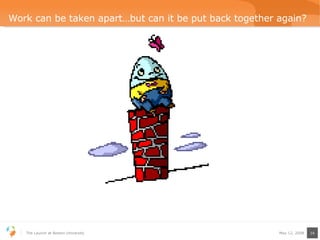
Work can be taken apart…but can it be put back together again?
Unleashing Talent in a virtual world…Challenges What are the challenges of synchronizing collaboration virtually? What about the path for Talent Development and growth? What about issues of pay scale, fairness, promotion? How do customers react?
Design an Experiment #2-Design Learning Objects for customers As in the first example, identify the specific knowledge or learning objects that must be transferred to customers to make them successful Can we design these learning objects into the application of Windchill so as to provide customers with just in time learning? What have we learned?
What are the challenges of “just in time” learning? Can some consulting support be replaced by on-line learning modules? How much can be replaced without impairing customer satisfaction? Can customer satisfaction be improved? Are there other methods of delivery and support we should be testing?
Global work is more than call centers and cost arbitrage We have just seen the tip of the iceberg when it comes to global work... It’s more than locating (and relocating) call centers to low-cost areas. It’s more than looking for cost-arbitrage. It’s about designing next generation work processes that create sustained value.
Let’s develop ways we can work together in this initiative… Discussions and Next Steps

Talent Management Preswith Ptc5 15 08

  • 1.
    Global Talent Management:New Challenges and Opportunities May 15, 2008
  • 2.
    Talent Management-Always CriticalRecruit, Retain, Develop the right people with the right skills to deliver the right products and services Match Talent to business need: Gap versus Glut Challenge Growth requires talent
  • 3.
    What is differentabout Global Talent Management? Access to global markets for talent is now possible and desirable from a cost and availability perspective.
  • 4.
    What is globalwork? More than off-shoring routine jobs <Structured -- Semi-structured -- Unstructured> The New Geography of Work How to design work? When to go captive versus third-party? Where to locate? How to coordinate and synchronize work? Scope extends beyond IT and BPO sectors Nearly every sector is globalized--although the scope and impact may be different Unleashing potential of Global Talent
  • 5.
    Changing Nature ofWork and Its location Three categories of work: Transformational – from raw materials to products Transactional – structured/codified Tacit – requiring judgment, growing 3x faster than other categories McKinsey study – cited in Economist Oct 2006
  • 6.
    The Challenge Offshoring began with highly structured work that could be handed off fairly easily. 24-hour work cycle made possible by pervasive connectivity Semi-structured and Unstructured work requires more careful synchronization and collaboration in a virtual environment…with cultural and time zone differences
  • 7.
    What are differentways of classifying task collaboration? Individual Performance Reciprocal Interdependent … .How do different types of work affect the choice of technology, process, de-construction of task
  • 8.
    Global Talent Managementis about deconstructing work…and putting it back together again….
  • 9.
    Example Case: PTCSolutions Centers PTC sells software products that support 3-dimensional design: Pro-Engineer and Windchill that helps manage documents related to the product The Windchill product is a web based software product that supports the document management process associated with complex product development and implementation. While PTC is primarily a product company selling software, an increasing amount of revenue (currently 25%) is now derived from the services support activities associated with the sale and implementation of the product within client sites.
  • 10.
    Current Support Services65% of support service engineers come from the field organization and are used mostly on-site in various global locations 20% of support service engineers are drawn from the company’s centralized Solution Centers in Poland, India, Pennsylvania and China. Mostly work off site to support clients 15% of support services engineers are subcontractors.
  • 11.
    Example of TalentManagement-PTC Solution Centers Solution Centers staffing 5% Principles 10% Senior consultants 35% Consultants 50% Associates .
  • 12.
    Field Offices FieldOffices staffing 20% Principles 40% Senior consultants 25% Consultants 15% Associates .
  • 13.
    The Talent ManagementChallenge for Services Engineers Match the right talent to the job so that customer satisfaction remains high Minimize Cost Access best available talent pools Minimize use of subcontractors Avoid gaps and gluts of service professionals
  • 14.
    Rethinking the problemCan we rethink the current offering of the service support work? Can it be deconstructed to make better use of solution center resources? Can service support be delivered to customers in a different and more cost effective way with e-learning resources, on-line support? Can we identify the specific tasks involved and model them in a workforce management system using constraint programming to yield better forecasting capability?
  • 15.
    Design an Experiment#1-Using Supply Chain Theory Identify the specific tasks required to deliver the consulting support to Windchill customers De-construct the work as currently done and chunk it across lowest cost resources (within constraints) Examine the processes used to synchronize/coordinate the service support What have we learned?
  • 16.
    Work can betaken apart…but can it be put back together again?
  • 17.
    Unleashing Talent ina virtual world…Challenges What are the challenges of synchronizing collaboration virtually? What about the path for Talent Development and growth? What about issues of pay scale, fairness, promotion? How do customers react?
  • 18.
    Design an Experiment#2-Design Learning Objects for customers As in the first example, identify the specific knowledge or learning objects that must be transferred to customers to make them successful Can we design these learning objects into the application of Windchill so as to provide customers with just in time learning? What have we learned?
  • 19.
    What are thechallenges of “just in time” learning? Can some consulting support be replaced by on-line learning modules? How much can be replaced without impairing customer satisfaction? Can customer satisfaction be improved? Are there other methods of delivery and support we should be testing?
  • 20.
    Global work ismore than call centers and cost arbitrage We have just seen the tip of the iceberg when it comes to global work... It’s more than locating (and relocating) call centers to low-cost areas. It’s more than looking for cost-arbitrage. It’s about designing next generation work processes that create sustained value.
  • 21.
    Let’s develop wayswe can work together in this initiative… Discussions and Next Steps