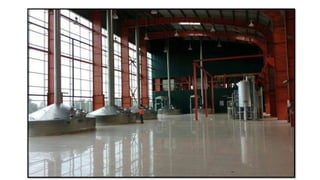
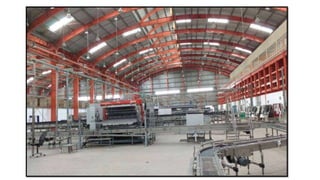
Carlsberg India Pvt. Ltd.
Aurangabad, Maharashtra
Presented By:
Kaustubh Kshetrapal 113064
Submitted to:
National Institute of Food Technology Entrepreneurship and Management, Kundli
Haryana
In partial fulfilment of the requirement of the degree
B. Tech in
Food Technology and Management.
Introduction:
• Carlsberg entered India in may 2006 by incorporating a company named South Asia
Breweries Pvt. Ltd. The name changed to Carlsberg India Pvt. Ltd. on 23rd february 2009
to reflect the company as a part of the carlsberg group.
• Carlsberg India has an impressive beer portfolio which includes a good mix of
mild and strong beer- Carlsberg (CBM), Carlsberg elephant(CBX), Tuborg mild
(TBM), Tuborg strong (TBS) and Palone 8.
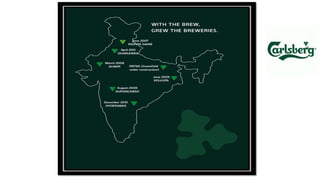
• Carlsberg’s commercial operations started in june 2007 by the commencement of
production at the Poanta Sahib Brewery, in Himachal Pradesh, with the launch of
carlsberg in the premium-beer segment and pallone in the strong-beer segment in some
markets of north india.
• Carlsberg expanded its operations by Maharashtra establishing breweries in Alwar,
Rajasthan in march 2008 and in Aurangabad, in august 2008..
Geographic Overview:
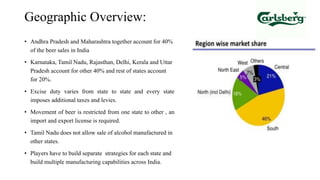
• Andhra Pradesh and Maharashtra together account for 40%
of the beer sales in India
• Karnataka, Tamil Nadu, Rajasthan, Delhi, Kerala and Uttar
Pradesh account for other 40% and rest of states account
for 20%.
• Excise duty varies from state to state and every state
imposes additional taxes and levies.
• Movement of beer is restricted from one state to other , an
import and export license is required.
• Tamil Nadu does not allow sale of alcohol manufactured in
other states.
• Players have to build separate strategies for each state and
build multiple manufacturing capabilities across India.
Market Share In India:
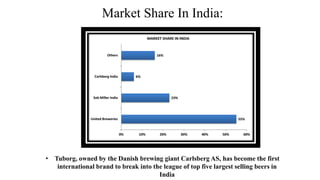
• Tuborg, owned by the Danish brewing giant Carlsberg AS, has become the first
international brand to break into the league of top five largest selling beers in
India
Tuborg strong
premium beer
Tuborg Booster
strong premium beer
Carlsberg all malt
premium beer
Carlsberg elephant
strong premium
DETAILS OF PRODUCTS MANUFACTURED
Malt grist Water Rice grist Water
Raise in temp at 480C Raise in temp at 800C
Rest for 12 min at 480C Rest for 12 min at 800C
Raise in temp at 640C
Rest for 25 min at 640C
Raise in temp at 720C
Rest for 25 min at 720C
Raise in temp at 890C
Rest for 20 min at 890C
Raise in temp at 900C
Saccrification test (starch sugar) (Iodine test)
Flow Sheet for Mashing:
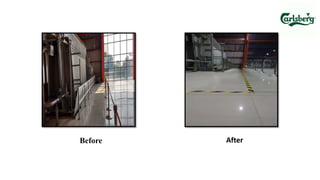
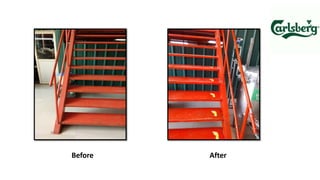
Project at Carlsberg # 1
“Implementation of 5S Methodology in the
Brewing Department”
5S Abbreviation:
The Five S’s:
Sorting – separating the needed from the not-needed
Simplifying – a place for everything and everything in its place, clean
and ready to use
Systematic Cleaning or Sweeping – cleaning for inspection
Standardizing – developing common methods for consistency
Sustaining – holding the gains and improving
OBJECTIVE OF IMPLEMENTING 5S:
• It is a way to create:
Cleaner work areas.
Safer working conditions.
Less wasted time.
Efficient work processes and practices.
More available space.
Issues and Concerns:
 Communicating across shifts
 Disposing of or moving, personal items
 Making time available
 Following agreements consistently
 Maintaining the gains
 Giving rewards and recognition
 Integrating 5S with other improvement activities
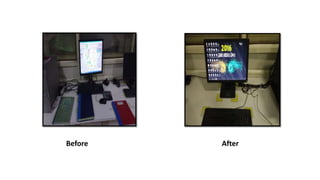
Before After
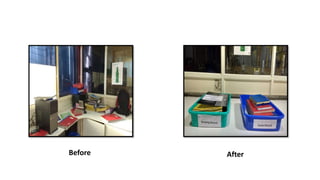
Before After
Before After
Before After
Project at Carlsberg # 2
Using used Kieselghur Powder (diatomaceous earth) used for
filtering beer as an additive in construction company for bricks
making.
Background of the filtration aid:
• To remove solid particles from the beer stream to produce a bright stable beer free of yeast and most
bacteria.
• For filtering matured beer, candle filters were used.
• For making candle filter to work, bed of Kieselghur powder are made inside. Bed porosity is maintained
by the continual dosing of a filter aid.
• After filtering beer, the used filter aid contains suspension, mainly yeast but also smaller particles.
• The used filter aid is to be discarded directly into the drains thus creating choking of drains.
My Work:
• Found some literature in which the used filter aid can be used as an additive in construction company
(bricks making).
• Contacted one construction company for this who were ready to buy after making analysis of it.
• The discarded filter aid can become profitable.
Problem faced:
• Problem regarding maintenance of filter aid.
• Cleaning and sanitation problems.
• Extensive labour work.
• Execution from top authorities.
Project at Carlsberg # 3
Designing of layout for machinery in entire
industry
Background
• During my internship one day the mash filter’s sensor broke because of operator’s
negligence due to which production was affected for the next 24 hrs.
• Thus facing difficulty in identifying which sensor and transmitter causing problem?
My work
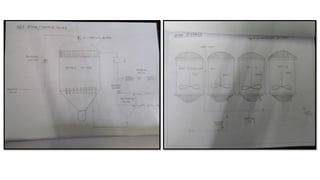
• I was given task of making layouts of each machinery in the production house as well as
in the filtration house to identify sensors in each equipment's.
• From next time it would become easy to identify sensor which is causing problem and
where it is located.
• My layouts are their on the notice board of the brewing department.
• Got appreciation from the plant head and the brewing manager for the layout diagrams.
Key Learnings:
• Introduction to fascinating area of brewing industry.
• Introduction to new, modern and industrial techniques and machinery.
• Introduction to various parameters and techniques of hygiene and sterilization.
• Knowledge of various parameters to be maintained during and after production.
• Understood working of critical machinery in production house.
• Accepted numerous tasks and challenges given by the management and completed them
appropriately.
• Learnt how to manage the whole workforce engaged in production area and solutions to
resolve typical manpower issues.
• Helped in applying theoretical knowledge
• Got to know about layout designing of equipment's.
• Did brainstorming at various levels in the industry and discussed the major problems and
their solutions.
Innovation at Carlsberg:
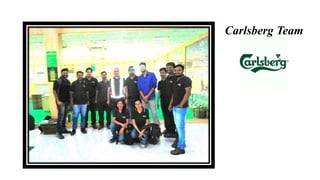
Carlsberg Team
Carlsberg india pvt

Carlsberg india pvt

  • 1.
    Carlsberg India Pvt.Ltd. Aurangabad, Maharashtra Presented By: Kaustubh Kshetrapal 113064 Submitted to: National Institute of Food Technology Entrepreneurship and Management, Kundli Haryana In partial fulfilment of the requirement of the degree B. Tech in Food Technology and Management.
  • 2.
    Introduction: • Carlsberg enteredIndia in may 2006 by incorporating a company named South Asia Breweries Pvt. Ltd. The name changed to Carlsberg India Pvt. Ltd. on 23rd february 2009 to reflect the company as a part of the carlsberg group. • Carlsberg India has an impressive beer portfolio which includes a good mix of mild and strong beer- Carlsberg (CBM), Carlsberg elephant(CBX), Tuborg mild (TBM), Tuborg strong (TBS) and Palone 8. • Carlsberg’s commercial operations started in june 2007 by the commencement of production at the Poanta Sahib Brewery, in Himachal Pradesh, with the launch of carlsberg in the premium-beer segment and pallone in the strong-beer segment in some markets of north india. • Carlsberg expanded its operations by Maharashtra establishing breweries in Alwar, Rajasthan in march 2008 and in Aurangabad, in august 2008..
  • 5.
    Geographic Overview: • AndhraPradesh and Maharashtra together account for 40% of the beer sales in India • Karnataka, Tamil Nadu, Rajasthan, Delhi, Kerala and Uttar Pradesh account for other 40% and rest of states account for 20%. • Excise duty varies from state to state and every state imposes additional taxes and levies. • Movement of beer is restricted from one state to other , an import and export license is required. • Tamil Nadu does not allow sale of alcohol manufactured in other states. • Players have to build separate strategies for each state and build multiple manufacturing capabilities across India.
  • 6.
    Market Share InIndia: • Tuborg, owned by the Danish brewing giant Carlsberg AS, has become the first international brand to break into the league of top five largest selling beers in India
  • 7.
    Tuborg strong premium beer TuborgBooster strong premium beer Carlsberg all malt premium beer Carlsberg elephant strong premium DETAILS OF PRODUCTS MANUFACTURED
  • 8.
    Malt grist WaterRice grist Water Raise in temp at 480C Raise in temp at 800C Rest for 12 min at 480C Rest for 12 min at 800C Raise in temp at 640C Rest for 25 min at 640C Raise in temp at 720C Rest for 25 min at 720C Raise in temp at 890C Rest for 20 min at 890C Raise in temp at 900C Saccrification test (starch sugar) (Iodine test) Flow Sheet for Mashing:
  • 12.
    Project at Carlsberg# 1 “Implementation of 5S Methodology in the Brewing Department”
  • 13.
  • 14.
    The Five S’s: Sorting– separating the needed from the not-needed Simplifying – a place for everything and everything in its place, clean and ready to use Systematic Cleaning or Sweeping – cleaning for inspection Standardizing – developing common methods for consistency Sustaining – holding the gains and improving
  • 15.
    OBJECTIVE OF IMPLEMENTING5S: • It is a way to create: Cleaner work areas. Safer working conditions. Less wasted time. Efficient work processes and practices. More available space.
  • 16.
    Issues and Concerns: Communicating across shifts  Disposing of or moving, personal items  Making time available  Following agreements consistently  Maintaining the gains  Giving rewards and recognition  Integrating 5S with other improvement activities
  • 17.
  • 18.
  • 19.
  • 20.
  • 21.
    Project at Carlsberg# 2 Using used Kieselghur Powder (diatomaceous earth) used for filtering beer as an additive in construction company for bricks making.
  • 22.
    Background of thefiltration aid: • To remove solid particles from the beer stream to produce a bright stable beer free of yeast and most bacteria. • For filtering matured beer, candle filters were used. • For making candle filter to work, bed of Kieselghur powder are made inside. Bed porosity is maintained by the continual dosing of a filter aid. • After filtering beer, the used filter aid contains suspension, mainly yeast but also smaller particles. • The used filter aid is to be discarded directly into the drains thus creating choking of drains. My Work: • Found some literature in which the used filter aid can be used as an additive in construction company (bricks making). • Contacted one construction company for this who were ready to buy after making analysis of it. • The discarded filter aid can become profitable. Problem faced: • Problem regarding maintenance of filter aid. • Cleaning and sanitation problems. • Extensive labour work. • Execution from top authorities.
  • 23.
    Project at Carlsberg# 3 Designing of layout for machinery in entire industry
  • 24.
    Background • During myinternship one day the mash filter’s sensor broke because of operator’s negligence due to which production was affected for the next 24 hrs. • Thus facing difficulty in identifying which sensor and transmitter causing problem? My work • I was given task of making layouts of each machinery in the production house as well as in the filtration house to identify sensors in each equipment's. • From next time it would become easy to identify sensor which is causing problem and where it is located. • My layouts are their on the notice board of the brewing department. • Got appreciation from the plant head and the brewing manager for the layout diagrams.
  • 27.
    Key Learnings: • Introductionto fascinating area of brewing industry. • Introduction to new, modern and industrial techniques and machinery. • Introduction to various parameters and techniques of hygiene and sterilization. • Knowledge of various parameters to be maintained during and after production. • Understood working of critical machinery in production house. • Accepted numerous tasks and challenges given by the management and completed them appropriately. • Learnt how to manage the whole workforce engaged in production area and solutions to resolve typical manpower issues. • Helped in applying theoretical knowledge • Got to know about layout designing of equipment's. • Did brainstorming at various levels in the industry and discussed the major problems and their solutions.
  • 28.
  • 29.