HINDUSTAN COCA COLA BEVERAGES PVT. LTD. TIRUPATI, CHITTOOR
ROLLEY SHARAFF and Rohit Mishra| SVCET COLLEGE REPORT | 29/01/201
7
PAGE 1
Table of Contents
1) Introduction
2) Objectives
3) Company profiles
4) 2000 & now coca cola now
5) Competitors analysis
6) Current market position
7) Factors affecting business
8) Products and pack sizes
9) Brand names
10) Mission
11) Leadership
12) Manufacturing process
13) SWOT analysis
14) Management style
15) Annexure
16) Objectives of the study
17) Refrences
PAGE 2
Acknowledgement
I would like to express my sincerest gratitude to the head of the organiza t io n Mr.
Uday K umar (Production Manager), Mr. Das Jagabandhu (Finance Manager)
& Mr. Venugopala Rao Sreeram (HR Manager) o f c o c a c o l a c o m p a n y .
Also I would like to thank all the staff members at the depot and plant of the company
in Tirupati for their support and for providing me with information whenever
needed. I am also grateful to my faculty guide at SVCET CO LLEGE of
T e c h n o l o g y & M a n a g e m e n t , R V S n a g a r , C h i t t o o r d i s t r i c t
i . e . M r . R o h a n s h a r m a (Director – SVCET.) and Mr…… (Faculty -..)
for their regular guidance, support and encouragement throughout my project work.
PAGE 3
INTRODUCTION
With the development of world and human being, the taste, need and the
attitude of human being also changes. India is one of the common market in the world
with a population o f mo r e t ha n o ne b ill io n. S o ft d r ink is a p o p ula r
c o mmo n p r o d uc t w hic h is ge ne r a ll y purchased by consumers for
quenching their thirst in summer and also to have cooling
r e fr e s hme nt .
A s fa r a s t he ma r k e t o f s o ft d r ink s is c o nc e r ne d , it is fa c ing
c ut t hr o a t competition from the larger number of soft drinks available in
the market. Different brand available in every segment of flavors, but
the attitudes of the consumers differ from each other due to several factors. Every
company tries to increase their market share and their sales volume. Discounting
system followed by the companies proved to be an essential factor to boost
up the purchases made by the retailers. The companies try to attract
the retailers to purchase more by providing some schemes or
incent ives or cash/card discount. If more discount or any other
incentive scheme is given to the outlets, they make purchases to avail that
offer. Therefore, it is essential for any company to have an effic ie nt
and effective discounting system. Distribution is the spine of any FMCG
company. The main function of a retailer is to bridge the gap between the
supplier and the customer. The central focus of distribution is to increase
the efficie nc y of time, place, and deliver y utilit y. For any FMCG
product it
ise s s e nt ia l t o ha ve a go o d d is t r ib ut io n ne t w o r k w hic h s ho uld
b e b e t t e r t ha n t ha t o f it s competitors.
D is t r ib u t io n is t he k e y a r e a fo r a ny F M C G b us ine s s . F o r a s m
o o t h d is t r ib u t io n network, it is essential to keep the retail outlets
satisfied which in turn mainly depend upon the profitability. Their
profitability is checked by keeping a satisfied profit margin for them. Apart
from that, the company also provides discount on purchase of different pack
sizes to some HVO s which in turn increases their profit margin.
Sometimes the company also provides incentives to the outlets which
make frequent and high purchases. To meet stiff and challenging
competitio n from some of the other brands, it is essentia l for the
company to have an effective and efficient distribution network. Therefore,
the company tries to keep the outlets satisfied by offering discounts and some other
incentive schemes from time to time.
PAGE 4
OBJECTIVES
1.1.1 Primary Objectives
. To find out any kind of misrepresentation being done by salesmen or by
distributors related to daily sales by making out their own personal benefits
from the discounting system.
. To compare the discounts given to HVOs on the basis of their sales volume.
. To make proposals to minimize the revenue leakages and this will help the
company in saving its funds.
1.1.2 Secondary Objectives
. To study the discounting policies of the company.
. To know about the different pack sizes being sold by the company.
. To find out the outlets where the company is offering high discounts.
. To analyze the discount rates offered to HVOs.
To find o ut w he t he r t he y a r e a c t ua lly ge t t in g t he p r o d uc t s a t
t he p r e - d e c id e d discounted price or not.
PAGE 5
COMPANY PROFILE
Coca-Cola (also known as Coke, a name that was trademarked by The Coca-Cola
Company after it was discovered many people called it by tha t
particular name) is a very popular cola (a carbonated soft drink) sold
in stores, restaurants and vending machine s in more than 200 countries.
It is produced by the Coca-Cola Company (NYSE: KO), which is a ls o o ft e n
r e fe r r e d t o a s s imp l y Coca-Cola or Coke. C o k e is o ne o f t he w o r ld ’ s
mo s t recognizable and widely sold commercial brands; its major rival is Pepsi. Coke
was originally intended as a patent medicine when it was invented in the
late1 9 t h c e nt ur y, C o c a - C o la w a s b o ught o ut b y b us ine s s ma n A s
a G r iggs C a nd le r , w ho s e marketing tactics led Coke to its dominance of
the world soft drink market throughout the20th century. Although faced with
critiques of its health effects and various allegations of wrongdoing by the
company, Coca-Cola has remained a popular soft drink to the present day It was initia l ly
sold as a patent medicine for five cents a glass at soda fountains, which
were popular in the United States at the time thanks to a belief that carbonated
water was good for the health. The first sales were made at Jacob's
Pharmacy in Atlanta, Georgia, on May 8,1886, and for the first eight months
only nine drinks were sold each day. Coca-Cola was sold in bottles for the first time
on March 12, 1894, and cans of Coke first appeared in 1955. By1888, three
versions of Coca-Cola - sold by three separate businesses were on the market. On
February 7, 2005, the Coca-Cola Company announced that in the second
quarter of 2005 they planned a launch of a Diet Coke product sweetened with
theartificialsweetener sucralose ("Splenda "), the same sweetener curr e
ntly used in Pepsi O ne. The company actually produces concentrate for Coca-
Cola, which is then sold to various Coca-Cola
bottlersthro ugho ut the world. The bottlers, who hold territoria l l y-
PAGE 6
exclusive contracts with thecompany, produce finished product in cans and
bottles from the concentrate in combination with filtered water and sweeteners.
The bottlers then sell, distribute and merchandise Coca-Cola in cans and
bottles to retail stores and vending machines. Such bottlers include Coca-Cola
Enterprises, which is the single largest Coca-Cola bottler in North America and Europe.
The Coca-Cola Company also sells concentrate for fountain sales to major
restaurants and food service distributors. The Coca- Cola Company has on
occasion introduced other cola drinks under the Coke brand name. The
most famous of these is Diet Coke, which has become a major diet cola but
others exist, such as Cherry Coke, Coke Zero, and Vanilla Coke. The Coca-
Cola Company owns and markets other soft drinks that do not carry the Coca-
Cola branding, such as Sprite, Fanta, and others. The actual production and
distribution of Coca-Cola follows a
Hindustan Coca-Cola Beverages Private Limited is an Indian subsidiary of the
US based Coca-Cola Company. The company-
owned Bottling arm of the Indian Operations, Hindustan Coca-Cola Beverages Private
Limited is responsible for the manufacture, sale and distribution
of beverages across the country. Coca Cola India is among the country’s top international
investors, having invested more than US$ 1 billion in India within a decade of its
presence and further pledged another US$ 100 million in 2003 for its operations. It is
the world’s largest selling soft drink since 1886. The Coca-Cola Company returned to
India in1993 after a gap of 16 years giving new Thumps up to the Indian Soft Drink
Market and took over the ownership of the nation's top soft-drink brands and bottling
network. The vast Indian operations comprises 25 wholly company
owned bottling operations and another 24franchisee owned bottling operations and a
network of 21 contract packers also manufactures range of products for the Company.
PAGE 7
2000 and Now Coca cola now
In 1886, Coca-Cola® brought refreshment to patrons of a small Atlanta pharmacy.
Now well into its second century, the Company's goal is to provide magic every
time someone drinks one of its more than 400 brands. Coca-Cola has fans from
Boston to Budapest to Bahrain, drinking brands such as Ambos, Vegitabeta and
Frescolita. In the remotest comers of the globe, you can still find Coca-Cola. Coca-
Cola is committed to local markets, paying attention to what people from different
cultures and backgrounds like to drink, and where and how they want to drink it.
With its bottling partners, the Company reaches out to the local communities it
serves, believing that Coca-Cola exists to benefit and refresh everyone it touches.
From the early beginnings when just nine drinks a day were served, Coca-Cola has
grown to the world’s most ubiquitous brand, with more than 1.4 billion beverage
servings sold each day. When people choose to reach for one of The Coca-Cola
Company brands, the Company wants that choice to be exciting and satisfying,
every single time.
PAGE 8
COMPETITOR ANALYSIS
Indian soft drinks market is predominantly controlled by two major multinationals
namely Coca- Cola and Pepsi, which have carefully stifled out the local
competition here in India. Penetrating tough Indian psychology and making their
products feel accepted was the toughest challenge in front of them.
A brief overview of the soft drinks giant biggest competitor will help in gaining a
better insight of the soft drinks market in totality.
PAGE 9
CURRENT MARKET POSITION
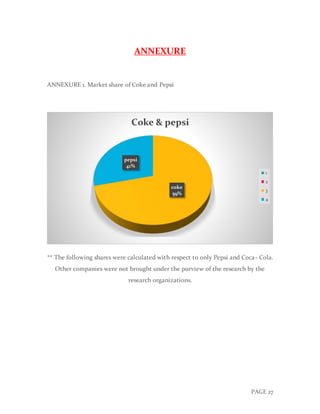
There has been much controversy and debate on the market share standings
between the two companies in the Indian subcontinent and a substantial and
a consolidated figure has been unavailable for reference. This is mainly because
both companies had approached different market research companies for making
a study about the market share standings. Pepsi Co had approached IMRB while
Coca- Cola had entrusted this responsibility on ORG. According to the survey
done by IMRB Pepsi’s market share was found to have increased from 47% to 49%
while according to the study conducted by ORG Coca- Cola’s market share was
claimed to be 59%.
PAGE 10
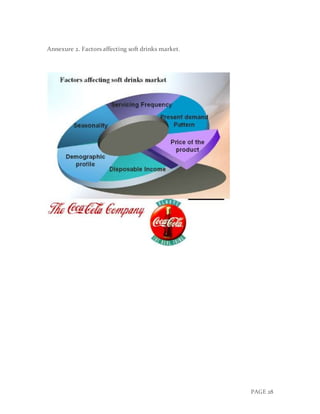
FACTORS AFFECTING BUSINESS
Seasonality: Seasonality is one of the most important factors that affect the soft
drink business. Seasonality is primarily influenced either by the weather, or by
holidays and religious festivals. Within the Group, soft drink business has different
seasonal cycles throughout the year.
Service frequency: This is another factor that affects the business. Service
frequency is the time gap between visiting a particular outlet again. Service
frequency directly affects the rotation time which in turn affects the value of
business.
Demand pattern for the market: Every product has a different demand pattern
and affects the business.
Price of the product: Price of the soft drinks also affects the business. Due to
perfect competition in soft drink market, price of a product plays a major role in
business.
Disposable Income: Disposable Income of the consumers also affects the
business of the soft drink players. A high disposable income of the
consumers ensures a high demand for the products in the market.
PAGE 11
PRODUCTS AND PACK SIZES:
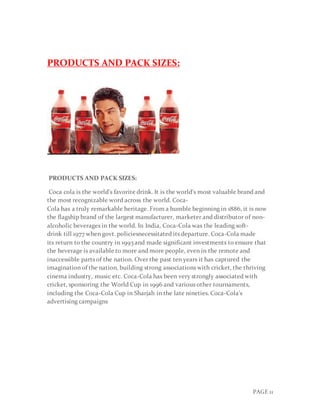
Coca cola is the world's favorite drink. It is the world's most valuable brand and
the most recognizable word across the world. Coca-
Cola has a truly remarkable heritage. From a humble beginning in 1886, it is now
the flagship brand of the largest manufacturer, marketer and distributor of non-
alcoholic beverages in the world. In India, Coca-Cola was the leading soft-
drink till 1977 when govt. policiesnecessitated its departure. Coca-Cola made
its return to the country in 1993 and made significant investments to ensure that
the beverage is available to more and more people, even in the remote and
inaccessible parts of the nation. Over the past ten years it has captured the
imagination of the nation, building strong associations with cricket, the thriving
cinema industry, music etc. Coca-Cola has been very strongly associated with
cricket, sponsoring the World Cup in 1996 and various other tournaments,
including the Coca-Cola Cup in Sharjah in the late nineties. Coca-Cola's
advertising campaigns
PAGE 12
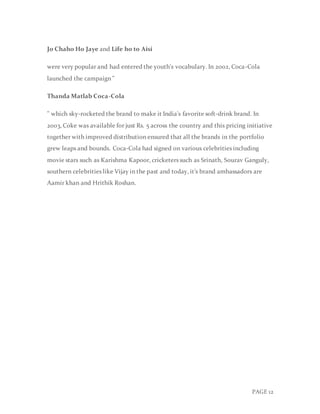
Jo Chaho Ho Jaye and Life ho to Aisi
were very popular and had entered the youth's vocabulary. In 2002, Coca-Cola
launched the campaign "
Thanda Matlab Coca-Cola
" which sky-rocketed the brand to make it India's favorite soft-drink brand. In
2003, Coke was available for just Rs. 5 across the country and this pricing initiative
together with improved distribution ensured that all the brands in the portfolio
grew leaps and bounds. Coca-Cola had signed on various celebrities including
movie stars such as Karishma Kapoor, cricketers such as Srinath, Sourav Ganguly,
southern celebrities like Vijay in the past and today, it’s brand ambassadors are
Aamir khan and Hrithik Roshan.
PAGE 13
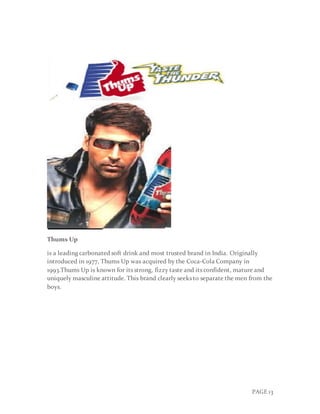
Thums Up
is a leading carbonated soft drink and most trusted brand in India. Originally
introduced in 1977, Thums Up was acquired by the Coca-Cola Company in
1993.Thums Up is known for its strong, fizzy taste and its confident, mature and
uniquely masculine attitude. This brand clearly seeks to separate the men from the
boys.
PAGE 14
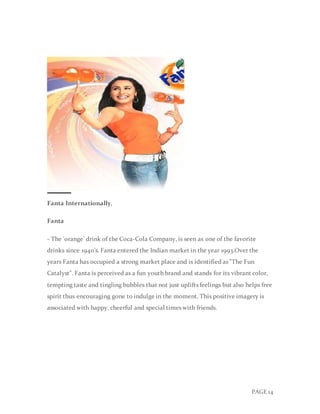
Fanta Internationally,
Fanta
- The 'orange' drink of the Coca-Cola Company, is seen as one of the favorite
drinks since 1940's. Fanta entered the Indian market in the year 1993.Over the
years Fanta has occupied a strong market place and is identified as "The Fun
Catalyst". Fanta is perceived as a fun youth brand and stands for its vibrant color,
tempting taste and tingling bubbles that not just uplifts feelings but also helps free
spirit thus encouraging gone to indulge in the moment. This positive imagery is
associated with happy, cheerful and special times with friends.
PAGE 15
BRAND NAME GLASSTETRA PACKPET CAN
FOUNTAIN
Coca- cola
200 ml and300ml-600 ml, 1.25land 2l330 ml Various sizes
Thums up
200 ml and300ml-350 ml, 600 ml,1.25L and 2L330 ml Various sizes
Fanta
200 ml and300ml-600 ml, 1.25Land 2L330 ml Various sizes
Limca
200 ml and300 ml-600 ml, 1.25Land 2L330 ml Various sizes
Sprite
200 ml and300 ml-350 ml, 600 ml,1.25L and 2L330 ml
PAGE 16
MISSION
Our mission is to refresh the world in mind, body & spirit and to inspire moment
of optimism through our brand and our action. Create consumer products,
services & communications, customer service and bottling system strategies,
processes and tools in order to create competitive advantage & deliver
superior value to:
Consumers as a superior beverage experience.
Consumers as an opportunity to grow profits through the use of finished drink.
Bottlers as an opportunity to grow profit and volume.
TCCC as a trade mark enhancement & positive economic value added.
Suppliers as an opportunity to make reasonable profits when creating real value
added in an environment of system-wide teamwork, flexible business system &
continuous improvement.
CCI Associates as superior career opportunity.
Indian society in the form of a contribution to economic and socio development.
LEADERSHIP
“There’s never been a better time to be the part of The Coca-Cola Company. Our
people are dedicated to strengthening relationship with stake holders and
communities everywhere’’.
PAGE 17
MANUFACTURING PROCESS
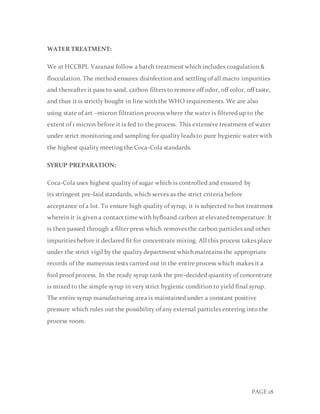
We at Coca-Cola are committed to manufacture our products with utmost care
and with quality at top priority which makes it the world leader in the soft drink
industry. Following is the overview of the stringent Processes adopted in
manufacturing before our quality product reaches finally to our proud consumers.
PAGE 18
WATER TREATMENT:
We at HCCBPL Varanasi follow a batch treatment which includes coagulation &
flocculation. The method ensures disinfection and settling of all macro impurities
and thereafter it pass to sand, carbon filters to remove off odor, off color, off taste,
and thus it is strictly bought in line with the WHO requirements. We are also
using state of art –micron filtration process where the water is filtered up to the
extent of 1 micron before it is fed to the process. This extensive treatment of water
under strict monitoring and sampling for quality leads to pure hygienic water with
the highest quality meeting the Coca-Cola standards.
SYRUP PREPARATION:
Coca-Cola uses highest quality of sugar which is controlled and ensured by
its stringent pre-laid standards, which serves as the strict criteria before
acceptance of a lot. To ensure high quality of syrup, it is subjected to hot treatment
wherein it is given a contact time with hyfloand carbon at elevated temperature. It
is then passed through a filter press which removes the carbon particles and other
impurities before it declared fit for concentrate mixing. All this process takes place
under the strict vigil by the quality department which maintains the appropriate
records of the numerous tests carried out in the entire process which makes it a
fool proof process. In the ready syrup tank the pre-decided quantity of concentrate
is mixed to the simple syrup in very strict hygienic condition to yield final syrup.
The entire syrup manufacturing area is maintained under a constant positive
pressure which rules out the possibility of any external particles entering into the
process room.
PAGE 19
CONTAINER WASHING:
Container has been identified as one of the major critical control point in the entir
emanufacturing process & that’s the reason that company has laid some of the very
stringentand foolproof systems which ensures Coca-Cola product to be of the
highest quality and reflects our commitment towards delivering the best in class
product to the consumers. The bottles received from the market are loaded on the
conveyor by the uncasing machine and the arrays of the unwashed bottles passes
through the four pre-wash inspections stations which ensures removal of rusty
neck bottles, excessively dirty bottles, bottles carrying foreign matter, foreign
bottles. And thus the good bottles pass into the bottle washing machine which
uses intensive mechanical and chemical processes to clean and disinfect
the bottles thoroughly and ensures the bottles to be ready for filling. However as
an additional safety, there is again a post wash inspection station comprising of 4
sub-stations, which ensures removal of the chip necked bottles and suspected
bottles from the lot. Thus the bottles are subjected to series of stringent
inspections before it is fed to the filler for filling.
MIXING, PROPORTIONING:
Proportioning is basically a process where ready syrup is diluted in a
predetermined fixed proportion with water and carbonated concentrate in to
beverage conforming strictly to company’s norms and specifications. It is carried
out by an Italian Machine-MOJONNIER.
PAGE 20
FILLING & CROWNING:
The chilled carbonated beverage fed by the MOJONNIER is filled into the bottles
through a rotator machine named FILLER. The bottles are immediately crowned
by crowner (adjacentto the filler) and thereafter bottles passes through the date
coding machine which enable the consumer to be 100 percent sure of consuming a
perfectly safe and fresh product.
FINAL INSPECTION: After date coding, there is once again a final inspection
station where light inspectors all lower high filled bottles and permit only the
saleable product to pass through for casing to the caser machine.
MANAGING THE WASTE WATER:
Production lines maintain the waste water from the bottle washers, Syrup and
Filler rooms. Entire waste water generated is treated at Waste Water Treatment
Plant and discharged through 800 meters long pipeline specially laid to discharge
the treated waste water away from inhabited areas. Part of this water is being used
for gardening purpose within the plant premises.
PAGE 21
MARKET & CUSTOMERS:
Once the finished product is ready, it is transported to the distribution centers and
then to retail outlets by way of route trucks. The consumer buys the soft drink
from the retailer outlets. The empty bottles are simultaneously collected by the
distribution channels at the time of dispensing the finished products.
SUPPLIERS AND OTHER BUSINESS PARTNER: Other than water and
concentrate, bottling operation require sugar, CO2, bottles, crates and other
miscellaneous materials. The Coca-Cola India division has a Supplier
authorization program where suppliers are authorized based on a defined criterion
. Environmental considerations are amongst the critical of these criterions.
EMPLOYEES, PLANTS & MACHINERY:
The no of total unit employees is approximately 113 & in summer season, which is a
peak season for sale of soft drinks, the plant works for three shift operation round
the clock. The overall education level of the employees is good and they obviously
have a good expertise in water treatment and purification processes. Extensive in-
house training program conducted to maintain the competency of the manpower
in respective areas. The plant and machinery consists of state of art bottling
machinery and test equipment to get consistent quality product at the optimum
usage of raw materials. The plant also has an extensive quality test laboratory with
equipment like spectrophotometer, density meter, micro lab etc. to conduct on the
spot tests at various stages of production. A typical bottling line will consist of un
caser- pre wash inspection station –conveyers-bottle washer-post wash bottle
inspection station—filler-final light inspection station-conveyor-and caser.
PAGE 22
SWOT ANALYSIS
Coca-Cola Company is one of the leading MNC in the world.
It has made a remarkable growth since it origin and it has got a good potential in
spite of various hurdles coming its ways. By going through its SWOT analysis we
can know much more about the company.
STRENGTH
The company has got various strengths, which leads the company be a
market leader. Some of the strengths listed below:
A) Strong product line:
The company has got various fast moving products which are going great job in
the market. These soft drinks not only quench thirst but also refresh everyone it
touches. One of the strong brands of the company is Thumps Up, which specially
doing well in the Indian market. It has captured one of the major shares of the soft
drink market.
B) Advertising:
Advertising plays a major in promoting sales of the product. The company has got
one of the best advertising strategies. Appointing film actors, as the brand
ambassadors, makes a great impact on the mind of the customers. The company
should try to launch more and more advertising and sales campaigns to promote
sales to the maximum.
PAGE 23
WEAKNESS:
As no man in this world is a complete man and so are the companies. Every
company has got weakness so as Coca-Cola Company too. Some of the
weaknesses which the company should overcome are as follow:
A) Distribution network:
The company has got an average distribution network this is one of the reason why
the company fails to fulfill the demand of the customer at time of peak seasons. It
must go for some more bottling plants and should opt for better distribution
channels to increase the sales in the best possible manner.
B) Pricing strategy:
The company has got a pricing strategy as there is no certainty of rising or fall of
price during the peak season. This also hamper the sales of the company as the
retailers and distributor get dilemma whether to place the next order or not as
increase or decrease in price may hamper their profit margin and blockage of the
goods.
PAGE 24
OPPORTUNITIES:
Instead of weakness and threats the company has got various opportunities
to which it has to go for. The opportunities for the company are as follows:
A) Large Market:
As India is said to be one of the biggest market in the world, thus the company
survive for long and can expands to its length and width. Still there are thousand
of villages which have not been covered by soft drink companies. If the company
targets the rural market it can easily make large profits and thus can also satisfy its
aim to benefit and refresh the whole nation.
B) Launch of other brands:
Coca- Cola Company has got more than 300 brands which is running successfully
over the world. Thus it can launch some more brands in the country, after
studying the demand and desire of the people and can deep its roots by winning
their minds and hearts.
PAGE 25
THREATS:
Some of the threats which the can face:
A) Competitors:
One of the strong competitors of the company is Pepsi Co. thus it has to formulate
such strategies which make it to remain one step ahead and give a strong
competition to the competitors. Some of the other competitor in the path of
growth to the company is the local soft drinks manufacturers who play an active
part at the time of peak season. The other local refreshers like Nimbu Pani, lassi,
fruit juice etc. which hampers the sales of the company
.
B) Govt. Policies:
The policies of the government also play a major role for the company. The
company cannot perform well or in its own way by violating the rules of the
government. Thus if the government formulates some policies which creates
hindrances in the working of the company it will prove to be one of the major
threats.
PAGE 26
MANAGEMENT STYLE
DONT
The company discourages such conduct and habits which are likely to undermine
the way of life in the organization.
If it is mandatory for the company to adopt both the accounting standards i.e.
UGAAP &IGAAP, then the company should make sure there should not be
violation of any of the accounting standards in UGAAP as well as in IGAAP at any
cost.
DOES
The company should make aware and impart knowledge to the employees
regarding clear cut bifurcation of standards used UGAAP & IGAAP.
The company should take necessary steps so that paper work should be as less
as possible, but this should not be at the cost of effectiveness in work.
NOTE:
1.UGAAP-
UNITED STATES STANDARDS – GENERALLY ACCEPTEDACCOUNTING
PRINCIPLES.
2.IGAAP –
INDIAN GENERALLY ACCEPTED ACCOUNTINGPRINCIPLES.
PAGE 27
ANNEXURE
ANNEXURE 1. Market share of Coke and Pepsi
** The following shares were calculated with respect to only Pepsi and Coca- Cola.
Other companies were not brought under the purview of the research by the
research organizations.
coke
59%
pepsi
41%
Coke & pepsi
1
2
3
4
PAGE 28
Annexure 2. Factors affecting soft drinks market.
PAGE 29
OBJECTIVES OF THE STUDY
A) To study How the Finance Department of “Hindustan Coca-ColaMarketing
Company works.
B) To have a broad view of the company’s financial policies.
C) To learn what points are considered while processing claims of the discount
schemes or general bills.
D) To ensure that processes are within policies and procedures of the
company.
E) To ensure that the payment of the bills is made within the specified amount
of time.
F) To study what formalities that have to be fulfilled while makingpurchases
and while making payments.
G) To ensure the transactions that occur are properly recorded and are
recorded with the specified procedures.
H) To study the work process of direct route & indirect route.
PAGE 30
MANAGEMENT STYLE
Every study has some limitations in terms of time, cost or human error
etc…I have tried my best at my level to make it an original and a genuine
one. Due to shortage of time it may be that the expectations wouldn’t have
been met, still an attempt has been made in order to represent one of the
best reports.
This project report aims at describing the processes that are followed
while making payments to the vendors, receiving payments from the
distributors. I have tried to explain the actual process but the meaning that
it has is not what it actually is.
Some human errors would have been resulted while preparing this project
reports.
PAGE 31
REFRENCES:
www.coca-colaindia.com.
www.wikipedia.com.
www.google.co.in.
Actual processes in which training was received have been defined.
With the help of the senior executives of the company an attempt has been made
in order to define the processes and procedures followed.
PAGE 32

Hindustan coca cola beverages pvt

  • 1.
    HINDUSTAN COCA COLABEVERAGES PVT. LTD. TIRUPATI, CHITTOOR ROLLEY SHARAFF and Rohit Mishra| SVCET COLLEGE REPORT | 29/01/201 7
  • 2.
    PAGE 1 Table ofContents 1) Introduction 2) Objectives 3) Company profiles 4) 2000 & now coca cola now 5) Competitors analysis 6) Current market position 7) Factors affecting business 8) Products and pack sizes 9) Brand names 10) Mission 11) Leadership 12) Manufacturing process 13) SWOT analysis 14) Management style 15) Annexure 16) Objectives of the study 17) Refrences
  • 3.
    PAGE 2 Acknowledgement I wouldlike to express my sincerest gratitude to the head of the organiza t io n Mr. Uday K umar (Production Manager), Mr. Das Jagabandhu (Finance Manager) & Mr. Venugopala Rao Sreeram (HR Manager) o f c o c a c o l a c o m p a n y . Also I would like to thank all the staff members at the depot and plant of the company in Tirupati for their support and for providing me with information whenever needed. I am also grateful to my faculty guide at SVCET CO LLEGE of T e c h n o l o g y & M a n a g e m e n t , R V S n a g a r , C h i t t o o r d i s t r i c t i . e . M r . R o h a n s h a r m a (Director – SVCET.) and Mr…… (Faculty -..) for their regular guidance, support and encouragement throughout my project work.
  • 4.
    PAGE 3 INTRODUCTION With thedevelopment of world and human being, the taste, need and the attitude of human being also changes. India is one of the common market in the world with a population o f mo r e t ha n o ne b ill io n. S o ft d r ink is a p o p ula r c o mmo n p r o d uc t w hic h is ge ne r a ll y purchased by consumers for quenching their thirst in summer and also to have cooling r e fr e s hme nt . A s fa r a s t he ma r k e t o f s o ft d r ink s is c o nc e r ne d , it is fa c ing c ut t hr o a t competition from the larger number of soft drinks available in the market. Different brand available in every segment of flavors, but the attitudes of the consumers differ from each other due to several factors. Every company tries to increase their market share and their sales volume. Discounting system followed by the companies proved to be an essential factor to boost up the purchases made by the retailers. The companies try to attract the retailers to purchase more by providing some schemes or incent ives or cash/card discount. If more discount or any other incentive scheme is given to the outlets, they make purchases to avail that offer. Therefore, it is essential for any company to have an effic ie nt and effective discounting system. Distribution is the spine of any FMCG company. The main function of a retailer is to bridge the gap between the supplier and the customer. The central focus of distribution is to increase the efficie nc y of time, place, and deliver y utilit y. For any FMCG product it ise s s e nt ia l t o ha ve a go o d d is t r ib ut io n ne t w o r k w hic h s ho uld b e b e t t e r t ha n t ha t o f it s competitors. D is t r ib u t io n is t he k e y a r e a fo r a ny F M C G b us ine s s . F o r a s m o o t h d is t r ib u t io n network, it is essential to keep the retail outlets satisfied which in turn mainly depend upon the profitability. Their profitability is checked by keeping a satisfied profit margin for them. Apart from that, the company also provides discount on purchase of different pack sizes to some HVO s which in turn increases their profit margin. Sometimes the company also provides incentives to the outlets which make frequent and high purchases. To meet stiff and challenging competitio n from some of the other brands, it is essentia l for the company to have an effective and efficient distribution network. Therefore, the company tries to keep the outlets satisfied by offering discounts and some other incentive schemes from time to time.
  • 5.
    PAGE 4 OBJECTIVES 1.1.1 PrimaryObjectives . To find out any kind of misrepresentation being done by salesmen or by distributors related to daily sales by making out their own personal benefits from the discounting system. . To compare the discounts given to HVOs on the basis of their sales volume. . To make proposals to minimize the revenue leakages and this will help the company in saving its funds. 1.1.2 Secondary Objectives . To study the discounting policies of the company. . To know about the different pack sizes being sold by the company. . To find out the outlets where the company is offering high discounts. . To analyze the discount rates offered to HVOs. To find o ut w he t he r t he y a r e a c t ua lly ge t t in g t he p r o d uc t s a t t he p r e - d e c id e d discounted price or not.
  • 6.
    PAGE 5 COMPANY PROFILE Coca-Cola(also known as Coke, a name that was trademarked by The Coca-Cola Company after it was discovered many people called it by tha t particular name) is a very popular cola (a carbonated soft drink) sold in stores, restaurants and vending machine s in more than 200 countries. It is produced by the Coca-Cola Company (NYSE: KO), which is a ls o o ft e n r e fe r r e d t o a s s imp l y Coca-Cola or Coke. C o k e is o ne o f t he w o r ld ’ s mo s t recognizable and widely sold commercial brands; its major rival is Pepsi. Coke was originally intended as a patent medicine when it was invented in the late1 9 t h c e nt ur y, C o c a - C o la w a s b o ught o ut b y b us ine s s ma n A s a G r iggs C a nd le r , w ho s e marketing tactics led Coke to its dominance of the world soft drink market throughout the20th century. Although faced with critiques of its health effects and various allegations of wrongdoing by the company, Coca-Cola has remained a popular soft drink to the present day It was initia l ly sold as a patent medicine for five cents a glass at soda fountains, which were popular in the United States at the time thanks to a belief that carbonated water was good for the health. The first sales were made at Jacob's Pharmacy in Atlanta, Georgia, on May 8,1886, and for the first eight months only nine drinks were sold each day. Coca-Cola was sold in bottles for the first time on March 12, 1894, and cans of Coke first appeared in 1955. By1888, three versions of Coca-Cola - sold by three separate businesses were on the market. On February 7, 2005, the Coca-Cola Company announced that in the second quarter of 2005 they planned a launch of a Diet Coke product sweetened with theartificialsweetener sucralose ("Splenda "), the same sweetener curr e ntly used in Pepsi O ne. The company actually produces concentrate for Coca- Cola, which is then sold to various Coca-Cola bottlersthro ugho ut the world. The bottlers, who hold territoria l l y-
  • 7.
    PAGE 6 exclusive contractswith thecompany, produce finished product in cans and bottles from the concentrate in combination with filtered water and sweeteners. The bottlers then sell, distribute and merchandise Coca-Cola in cans and bottles to retail stores and vending machines. Such bottlers include Coca-Cola Enterprises, which is the single largest Coca-Cola bottler in North America and Europe. The Coca-Cola Company also sells concentrate for fountain sales to major restaurants and food service distributors. The Coca- Cola Company has on occasion introduced other cola drinks under the Coke brand name. The most famous of these is Diet Coke, which has become a major diet cola but others exist, such as Cherry Coke, Coke Zero, and Vanilla Coke. The Coca- Cola Company owns and markets other soft drinks that do not carry the Coca- Cola branding, such as Sprite, Fanta, and others. The actual production and distribution of Coca-Cola follows a Hindustan Coca-Cola Beverages Private Limited is an Indian subsidiary of the US based Coca-Cola Company. The company- owned Bottling arm of the Indian Operations, Hindustan Coca-Cola Beverages Private Limited is responsible for the manufacture, sale and distribution of beverages across the country. Coca Cola India is among the country’s top international investors, having invested more than US$ 1 billion in India within a decade of its presence and further pledged another US$ 100 million in 2003 for its operations. It is the world’s largest selling soft drink since 1886. The Coca-Cola Company returned to India in1993 after a gap of 16 years giving new Thumps up to the Indian Soft Drink Market and took over the ownership of the nation's top soft-drink brands and bottling network. The vast Indian operations comprises 25 wholly company owned bottling operations and another 24franchisee owned bottling operations and a network of 21 contract packers also manufactures range of products for the Company.
  • 8.
    PAGE 7 2000 andNow Coca cola now In 1886, Coca-Cola® brought refreshment to patrons of a small Atlanta pharmacy. Now well into its second century, the Company's goal is to provide magic every time someone drinks one of its more than 400 brands. Coca-Cola has fans from Boston to Budapest to Bahrain, drinking brands such as Ambos, Vegitabeta and Frescolita. In the remotest comers of the globe, you can still find Coca-Cola. Coca- Cola is committed to local markets, paying attention to what people from different cultures and backgrounds like to drink, and where and how they want to drink it. With its bottling partners, the Company reaches out to the local communities it serves, believing that Coca-Cola exists to benefit and refresh everyone it touches. From the early beginnings when just nine drinks a day were served, Coca-Cola has grown to the world’s most ubiquitous brand, with more than 1.4 billion beverage servings sold each day. When people choose to reach for one of The Coca-Cola Company brands, the Company wants that choice to be exciting and satisfying, every single time.
  • 9.
    PAGE 8 COMPETITOR ANALYSIS Indiansoft drinks market is predominantly controlled by two major multinationals namely Coca- Cola and Pepsi, which have carefully stifled out the local competition here in India. Penetrating tough Indian psychology and making their products feel accepted was the toughest challenge in front of them. A brief overview of the soft drinks giant biggest competitor will help in gaining a better insight of the soft drinks market in totality.
  • 10.
    PAGE 9 CURRENT MARKETPOSITION There has been much controversy and debate on the market share standings between the two companies in the Indian subcontinent and a substantial and a consolidated figure has been unavailable for reference. This is mainly because both companies had approached different market research companies for making a study about the market share standings. Pepsi Co had approached IMRB while Coca- Cola had entrusted this responsibility on ORG. According to the survey done by IMRB Pepsi’s market share was found to have increased from 47% to 49% while according to the study conducted by ORG Coca- Cola’s market share was claimed to be 59%.
  • 11.
    PAGE 10 FACTORS AFFECTINGBUSINESS Seasonality: Seasonality is one of the most important factors that affect the soft drink business. Seasonality is primarily influenced either by the weather, or by holidays and religious festivals. Within the Group, soft drink business has different seasonal cycles throughout the year. Service frequency: This is another factor that affects the business. Service frequency is the time gap between visiting a particular outlet again. Service frequency directly affects the rotation time which in turn affects the value of business. Demand pattern for the market: Every product has a different demand pattern and affects the business. Price of the product: Price of the soft drinks also affects the business. Due to perfect competition in soft drink market, price of a product plays a major role in business. Disposable Income: Disposable Income of the consumers also affects the business of the soft drink players. A high disposable income of the consumers ensures a high demand for the products in the market.
  • 12.
    PAGE 11 PRODUCTS ANDPACK SIZES: PRODUCTS AND PACK SIZES: Coca cola is the world's favorite drink. It is the world's most valuable brand and the most recognizable word across the world. Coca- Cola has a truly remarkable heritage. From a humble beginning in 1886, it is now the flagship brand of the largest manufacturer, marketer and distributor of non- alcoholic beverages in the world. In India, Coca-Cola was the leading soft- drink till 1977 when govt. policiesnecessitated its departure. Coca-Cola made its return to the country in 1993 and made significant investments to ensure that the beverage is available to more and more people, even in the remote and inaccessible parts of the nation. Over the past ten years it has captured the imagination of the nation, building strong associations with cricket, the thriving cinema industry, music etc. Coca-Cola has been very strongly associated with cricket, sponsoring the World Cup in 1996 and various other tournaments, including the Coca-Cola Cup in Sharjah in the late nineties. Coca-Cola's advertising campaigns
  • 13.
    PAGE 12 Jo ChahoHo Jaye and Life ho to Aisi were very popular and had entered the youth's vocabulary. In 2002, Coca-Cola launched the campaign " Thanda Matlab Coca-Cola " which sky-rocketed the brand to make it India's favorite soft-drink brand. In 2003, Coke was available for just Rs. 5 across the country and this pricing initiative together with improved distribution ensured that all the brands in the portfolio grew leaps and bounds. Coca-Cola had signed on various celebrities including movie stars such as Karishma Kapoor, cricketers such as Srinath, Sourav Ganguly, southern celebrities like Vijay in the past and today, it’s brand ambassadors are Aamir khan and Hrithik Roshan.
  • 14.
    PAGE 13 Thums Up isa leading carbonated soft drink and most trusted brand in India. Originally introduced in 1977, Thums Up was acquired by the Coca-Cola Company in 1993.Thums Up is known for its strong, fizzy taste and its confident, mature and uniquely masculine attitude. This brand clearly seeks to separate the men from the boys.
  • 15.
    PAGE 14 Fanta Internationally, Fanta -The 'orange' drink of the Coca-Cola Company, is seen as one of the favorite drinks since 1940's. Fanta entered the Indian market in the year 1993.Over the years Fanta has occupied a strong market place and is identified as "The Fun Catalyst". Fanta is perceived as a fun youth brand and stands for its vibrant color, tempting taste and tingling bubbles that not just uplifts feelings but also helps free spirit thus encouraging gone to indulge in the moment. This positive imagery is associated with happy, cheerful and special times with friends.
  • 16.
    PAGE 15 BRAND NAMEGLASSTETRA PACKPET CAN FOUNTAIN Coca- cola 200 ml and300ml-600 ml, 1.25land 2l330 ml Various sizes Thums up 200 ml and300ml-350 ml, 600 ml,1.25L and 2L330 ml Various sizes Fanta 200 ml and300ml-600 ml, 1.25Land 2L330 ml Various sizes Limca 200 ml and300 ml-600 ml, 1.25Land 2L330 ml Various sizes Sprite 200 ml and300 ml-350 ml, 600 ml,1.25L and 2L330 ml
  • 17.
    PAGE 16 MISSION Our missionis to refresh the world in mind, body & spirit and to inspire moment of optimism through our brand and our action. Create consumer products, services & communications, customer service and bottling system strategies, processes and tools in order to create competitive advantage & deliver superior value to: Consumers as a superior beverage experience. Consumers as an opportunity to grow profits through the use of finished drink. Bottlers as an opportunity to grow profit and volume. TCCC as a trade mark enhancement & positive economic value added. Suppliers as an opportunity to make reasonable profits when creating real value added in an environment of system-wide teamwork, flexible business system & continuous improvement. CCI Associates as superior career opportunity. Indian society in the form of a contribution to economic and socio development. LEADERSHIP “There’s never been a better time to be the part of The Coca-Cola Company. Our people are dedicated to strengthening relationship with stake holders and communities everywhere’’.
  • 18.
    PAGE 17 MANUFACTURING PROCESS Weat Coca-Cola are committed to manufacture our products with utmost care and with quality at top priority which makes it the world leader in the soft drink industry. Following is the overview of the stringent Processes adopted in manufacturing before our quality product reaches finally to our proud consumers.
  • 19.
    PAGE 18 WATER TREATMENT: Weat HCCBPL Varanasi follow a batch treatment which includes coagulation & flocculation. The method ensures disinfection and settling of all macro impurities and thereafter it pass to sand, carbon filters to remove off odor, off color, off taste, and thus it is strictly bought in line with the WHO requirements. We are also using state of art –micron filtration process where the water is filtered up to the extent of 1 micron before it is fed to the process. This extensive treatment of water under strict monitoring and sampling for quality leads to pure hygienic water with the highest quality meeting the Coca-Cola standards. SYRUP PREPARATION: Coca-Cola uses highest quality of sugar which is controlled and ensured by its stringent pre-laid standards, which serves as the strict criteria before acceptance of a lot. To ensure high quality of syrup, it is subjected to hot treatment wherein it is given a contact time with hyfloand carbon at elevated temperature. It is then passed through a filter press which removes the carbon particles and other impurities before it declared fit for concentrate mixing. All this process takes place under the strict vigil by the quality department which maintains the appropriate records of the numerous tests carried out in the entire process which makes it a fool proof process. In the ready syrup tank the pre-decided quantity of concentrate is mixed to the simple syrup in very strict hygienic condition to yield final syrup. The entire syrup manufacturing area is maintained under a constant positive pressure which rules out the possibility of any external particles entering into the process room.
  • 20.
    PAGE 19 CONTAINER WASHING: Containerhas been identified as one of the major critical control point in the entir emanufacturing process & that’s the reason that company has laid some of the very stringentand foolproof systems which ensures Coca-Cola product to be of the highest quality and reflects our commitment towards delivering the best in class product to the consumers. The bottles received from the market are loaded on the conveyor by the uncasing machine and the arrays of the unwashed bottles passes through the four pre-wash inspections stations which ensures removal of rusty neck bottles, excessively dirty bottles, bottles carrying foreign matter, foreign bottles. And thus the good bottles pass into the bottle washing machine which uses intensive mechanical and chemical processes to clean and disinfect the bottles thoroughly and ensures the bottles to be ready for filling. However as an additional safety, there is again a post wash inspection station comprising of 4 sub-stations, which ensures removal of the chip necked bottles and suspected bottles from the lot. Thus the bottles are subjected to series of stringent inspections before it is fed to the filler for filling. MIXING, PROPORTIONING: Proportioning is basically a process where ready syrup is diluted in a predetermined fixed proportion with water and carbonated concentrate in to beverage conforming strictly to company’s norms and specifications. It is carried out by an Italian Machine-MOJONNIER.
  • 21.
    PAGE 20 FILLING &CROWNING: The chilled carbonated beverage fed by the MOJONNIER is filled into the bottles through a rotator machine named FILLER. The bottles are immediately crowned by crowner (adjacentto the filler) and thereafter bottles passes through the date coding machine which enable the consumer to be 100 percent sure of consuming a perfectly safe and fresh product. FINAL INSPECTION: After date coding, there is once again a final inspection station where light inspectors all lower high filled bottles and permit only the saleable product to pass through for casing to the caser machine. MANAGING THE WASTE WATER: Production lines maintain the waste water from the bottle washers, Syrup and Filler rooms. Entire waste water generated is treated at Waste Water Treatment Plant and discharged through 800 meters long pipeline specially laid to discharge the treated waste water away from inhabited areas. Part of this water is being used for gardening purpose within the plant premises.
  • 22.
    PAGE 21 MARKET &CUSTOMERS: Once the finished product is ready, it is transported to the distribution centers and then to retail outlets by way of route trucks. The consumer buys the soft drink from the retailer outlets. The empty bottles are simultaneously collected by the distribution channels at the time of dispensing the finished products. SUPPLIERS AND OTHER BUSINESS PARTNER: Other than water and concentrate, bottling operation require sugar, CO2, bottles, crates and other miscellaneous materials. The Coca-Cola India division has a Supplier authorization program where suppliers are authorized based on a defined criterion . Environmental considerations are amongst the critical of these criterions. EMPLOYEES, PLANTS & MACHINERY: The no of total unit employees is approximately 113 & in summer season, which is a peak season for sale of soft drinks, the plant works for three shift operation round the clock. The overall education level of the employees is good and they obviously have a good expertise in water treatment and purification processes. Extensive in- house training program conducted to maintain the competency of the manpower in respective areas. The plant and machinery consists of state of art bottling machinery and test equipment to get consistent quality product at the optimum usage of raw materials. The plant also has an extensive quality test laboratory with equipment like spectrophotometer, density meter, micro lab etc. to conduct on the spot tests at various stages of production. A typical bottling line will consist of un caser- pre wash inspection station –conveyers-bottle washer-post wash bottle inspection station—filler-final light inspection station-conveyor-and caser.
  • 23.
    PAGE 22 SWOT ANALYSIS Coca-ColaCompany is one of the leading MNC in the world. It has made a remarkable growth since it origin and it has got a good potential in spite of various hurdles coming its ways. By going through its SWOT analysis we can know much more about the company. STRENGTH The company has got various strengths, which leads the company be a market leader. Some of the strengths listed below: A) Strong product line: The company has got various fast moving products which are going great job in the market. These soft drinks not only quench thirst but also refresh everyone it touches. One of the strong brands of the company is Thumps Up, which specially doing well in the Indian market. It has captured one of the major shares of the soft drink market. B) Advertising: Advertising plays a major in promoting sales of the product. The company has got one of the best advertising strategies. Appointing film actors, as the brand ambassadors, makes a great impact on the mind of the customers. The company should try to launch more and more advertising and sales campaigns to promote sales to the maximum.
  • 24.
    PAGE 23 WEAKNESS: As noman in this world is a complete man and so are the companies. Every company has got weakness so as Coca-Cola Company too. Some of the weaknesses which the company should overcome are as follow: A) Distribution network: The company has got an average distribution network this is one of the reason why the company fails to fulfill the demand of the customer at time of peak seasons. It must go for some more bottling plants and should opt for better distribution channels to increase the sales in the best possible manner. B) Pricing strategy: The company has got a pricing strategy as there is no certainty of rising or fall of price during the peak season. This also hamper the sales of the company as the retailers and distributor get dilemma whether to place the next order or not as increase or decrease in price may hamper their profit margin and blockage of the goods.
  • 25.
    PAGE 24 OPPORTUNITIES: Instead ofweakness and threats the company has got various opportunities to which it has to go for. The opportunities for the company are as follows: A) Large Market: As India is said to be one of the biggest market in the world, thus the company survive for long and can expands to its length and width. Still there are thousand of villages which have not been covered by soft drink companies. If the company targets the rural market it can easily make large profits and thus can also satisfy its aim to benefit and refresh the whole nation. B) Launch of other brands: Coca- Cola Company has got more than 300 brands which is running successfully over the world. Thus it can launch some more brands in the country, after studying the demand and desire of the people and can deep its roots by winning their minds and hearts.
  • 26.
    PAGE 25 THREATS: Some ofthe threats which the can face: A) Competitors: One of the strong competitors of the company is Pepsi Co. thus it has to formulate such strategies which make it to remain one step ahead and give a strong competition to the competitors. Some of the other competitor in the path of growth to the company is the local soft drinks manufacturers who play an active part at the time of peak season. The other local refreshers like Nimbu Pani, lassi, fruit juice etc. which hampers the sales of the company . B) Govt. Policies: The policies of the government also play a major role for the company. The company cannot perform well or in its own way by violating the rules of the government. Thus if the government formulates some policies which creates hindrances in the working of the company it will prove to be one of the major threats.
  • 27.
    PAGE 26 MANAGEMENT STYLE DONT Thecompany discourages such conduct and habits which are likely to undermine the way of life in the organization. If it is mandatory for the company to adopt both the accounting standards i.e. UGAAP &IGAAP, then the company should make sure there should not be violation of any of the accounting standards in UGAAP as well as in IGAAP at any cost. DOES The company should make aware and impart knowledge to the employees regarding clear cut bifurcation of standards used UGAAP & IGAAP. The company should take necessary steps so that paper work should be as less as possible, but this should not be at the cost of effectiveness in work. NOTE: 1.UGAAP- UNITED STATES STANDARDS – GENERALLY ACCEPTEDACCOUNTING PRINCIPLES. 2.IGAAP – INDIAN GENERALLY ACCEPTED ACCOUNTINGPRINCIPLES.
  • 28.
    PAGE 27 ANNEXURE ANNEXURE 1.Market share of Coke and Pepsi ** The following shares were calculated with respect to only Pepsi and Coca- Cola. Other companies were not brought under the purview of the research by the research organizations. coke 59% pepsi 41% Coke & pepsi 1 2 3 4
  • 29.
    PAGE 28 Annexure 2.Factors affecting soft drinks market.
  • 30.
    PAGE 29 OBJECTIVES OFTHE STUDY A) To study How the Finance Department of “Hindustan Coca-ColaMarketing Company works. B) To have a broad view of the company’s financial policies. C) To learn what points are considered while processing claims of the discount schemes or general bills. D) To ensure that processes are within policies and procedures of the company. E) To ensure that the payment of the bills is made within the specified amount of time. F) To study what formalities that have to be fulfilled while makingpurchases and while making payments. G) To ensure the transactions that occur are properly recorded and are recorded with the specified procedures. H) To study the work process of direct route & indirect route.
  • 31.
    PAGE 30 MANAGEMENT STYLE Everystudy has some limitations in terms of time, cost or human error etc…I have tried my best at my level to make it an original and a genuine one. Due to shortage of time it may be that the expectations wouldn’t have been met, still an attempt has been made in order to represent one of the best reports. This project report aims at describing the processes that are followed while making payments to the vendors, receiving payments from the distributors. I have tried to explain the actual process but the meaning that it has is not what it actually is. Some human errors would have been resulted while preparing this project reports.
  • 32.
    PAGE 31 REFRENCES: www.coca-colaindia.com. www.wikipedia.com. www.google.co.in. Actual processesin which training was received have been defined. With the help of the senior executives of the company an attempt has been made in order to define the processes and procedures followed.
  • 33.