Seismic Waves
   An introduction

 Walter D. Mooney,
USGS Menlo Park, CA.
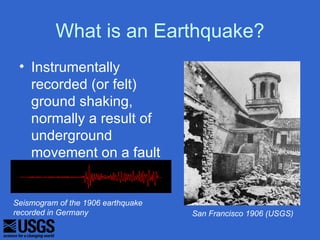
What is an Earthquake?
 • Instrumentally
   recorded (or felt)
   ground shaking,
   normally a result of
   underground
   movement on a fault


Seismogram of the 1906 earthquake
recorded in Germany                 San Francisco 1906 (USGS)
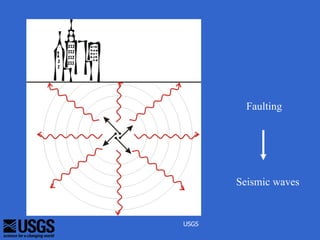
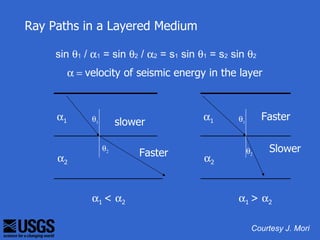
Faulting


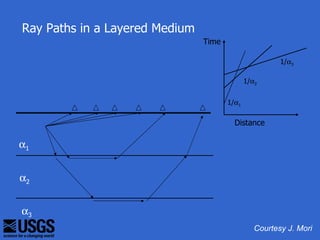
       Seismic waves


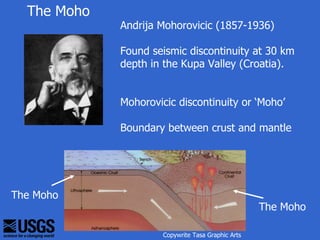
USGS
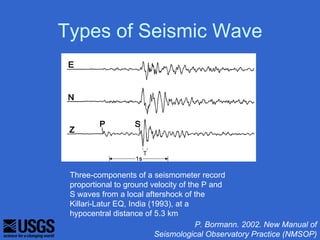
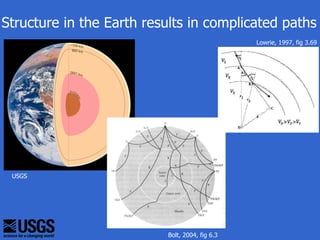
Types of Seismic Wave


 Three-components of a seismometer record
 proportional to ground velocity of the P and
 S waves from a local aftershock of the
 Killari-Latur EQ, India (1993), at a
 hypocentral distance of 5.3 km
                                      P. Bormann. 2002. New Manual of
                           Seismological Observatory Practice (NMSOP)
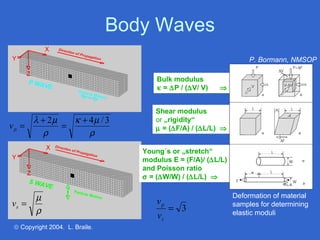
Body Waves
                                                                    P. Bormann, NMSOP

                                       Bulk modulus
                                       κ = ∆P / (∆V/ V)   ⇒


                                      Shear modulus
       λ + 2µ   κ + 4µ / 3            or „rigidity“
vp =          =                       µ = (∆F/A) / (∆L/L) ⇒
          ρ         ρ
                                   Young´s or „stretch“
                                   modulus E = (F/A)/ (∆L/L)
                                   and Poisson ratio
                                   σ = (∆W/W) / (∆L/L) ⇒


     µ                                 vp
                                                               Deformation of material
vs =                                                           samples for determining
     ρ                                      = 3                elastic moduli
                                       vs
 © Copyright 2004. L. Braile.
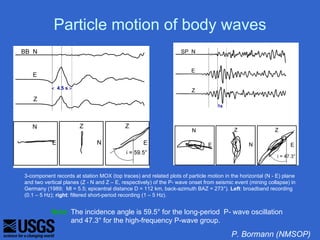
Particle motion of body waves


           < 4.5 s >


                                                                                  1s


3-component records at station MOX (top traces) and related plots of particle motion in the horizontal (N - E) plane
and two vertical planes (Z - N and Z – E, respectively) of the P- wave onset from seismic event (mining collapse) in
Germany (1989; Ml = 5.5; epicentral distance D = 112 km, back-azimuth BAZ = 273°). Left: broadband recording
(0.1 – 5 Hz); right: filtered short-period recording (1 – 5 Hz).


           Note: The incidence angle is 59.5° for the long-period P- wave oscillation
                 and 47.3° for the high-frequency P-wave group.
                                                                                        P. Bormann (NMSOP)
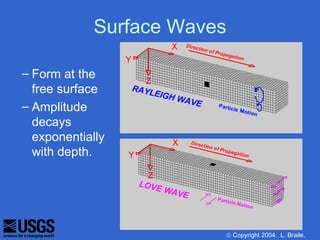
Surface Waves

– Form at the
  free surface
– Amplitude
  decays
  exponentially
  with depth.


                         © Copyright 2004. L. Braile.
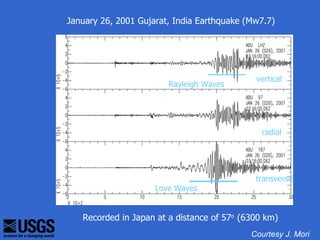
January 26, 2001 Gujarat, India Earthquake (Mw7.7)


                                             vertical
                        Rayleigh Waves


                                               radial


                                             transverse
                     Love Waves


   Recorded in Japan at a distance of 57o (6300 km)
                                            Courtesy J. Mori
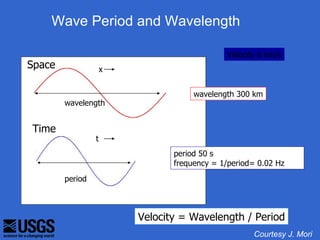
Wave Period and Wavelength  

                                              Velocity 6 km/s
Space                x


                                     wavelength 300 km
        wavelength
          

Time
                 t
                                period 50 s
                                frequency = 1/period= 0.02 Hz
        period


                         Velocity = Wavelength / Period
                                                     Courtesy J. Mori
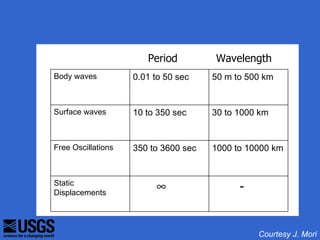
Period         Wavelength
Body waves          0.01 to 50 sec    50 m to 500 km


Surface waves       10 to 350 sec     30 to 1000 km


Free Oscillations   350 to 3600 sec   1000 to 10000 km


Static
Displacements
                         ∞                  -


                                                Courtesy J. Mori
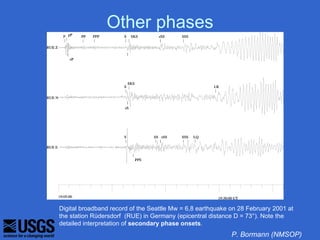
Other phases


Digital broadband record of the Seattle Mw = 6,8 earthquake on 28 February 2001 at
the station Rüdersdorf (RUE) in Germany (epicentral distance D = 73°). Note the
detailed interpretation of secondary phase onsets.
                                                            P. Bormann (NMSOP)
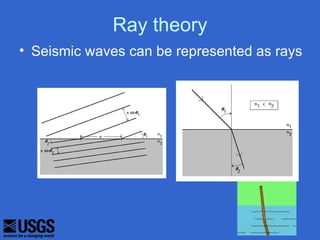
Ray theory
• Seismic waves can be represented as rays
Ray Paths in a Layered Medium

     sin θ1 / α1 = sin θ2 / α2 = s1 sin θ1 = s2 sin θ2
          α = velocity of seismic energy in the layer


     α1        θ1        slower          α1      θ1        Faster

                    θ2
                             Faster                   θ2    Slower
     α2                                  α2


               α1 < α2                           α1 > α2

                                                       Courtesy J. Mori
Ray Paths in a Layered Medium
                                Time

                                                        1/α3

                                              1/α2


                                       1/α1

                                         Distance

α1


α2


α3
                                                 Courtesy J. Mori
The Moho
             Andrija Mohorovicic (1857-1936)

             Found seismic discontinuity at 30 km
             depth in the Kupa Valley (Croatia).


             Mohorovicic discontinuity or ‘Moho’  

             Boundary between crust and mantle


The Moho
                                                   The Moho

                     Copywrite Tasa Graphic Arts
Structure in the Earth results in complicated paths
                                                Lowrie, 1997, fig 3.69


 USGS


                          Bolt, 2004, fig 6.3
Propagation of Seismic Waves In
    the Earth; M. Wysession
Courtesy R. Mereu


Courtesy J. Mori
Courtesy J. Mori
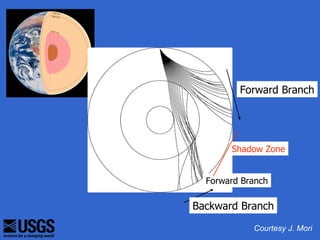
Forward Branch


Backward Branch

           Courtesy J. Mori
Forward Branch


       Shadow Zone


  Forward Branch

Backward Branch

            Courtesy J. Mori
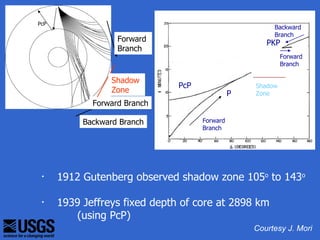
PcP
                                                    Backward
                                                    Branch
                Forward                           PKP
                Branch
                                                        Forward
                                                        Branch

               Shadow
                           PcP                 Shadow
               Zone                        P   Zone
          Forward Branch

        Backward Branch          Forward
                                 Branch


・ 1912 Gutenberg observed shadow zone 105o to 143o

・ 1939 Jeffreys fixed depth of core at 2898 km
     (using PcP)
                                               Courtesy J. Mori
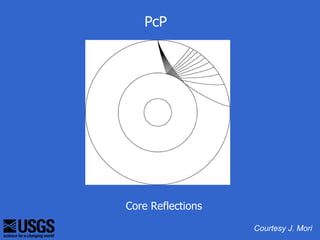
PcP


Core Reflections

                   Courtesy J. Mori
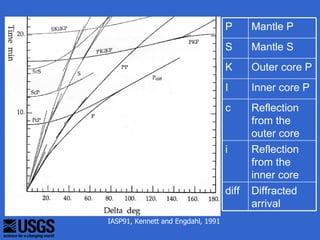
P      Mantle P
                                    S      Mantle S
                                    K      Outer core P
                                    I      Inner core P
                                    c      Reflection
                                           from the
                                           outer core
                                    i      Reflection
                                           from the
                                           inner core
                                    diff   Diffracted
                                           arrival
IASP91, Kennett and Engdahl, 1991
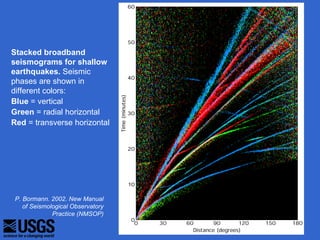
Stacked broadband
seismograms for shallow
earthquakes. Seismic
phases are shown in
different colors:
Blue = vertical
Green = radial horizontal
Red = transverse horizontal


 P. Bormann. 2002. New Manual
    of Seismological Observatory
              Practice (NMSOP)
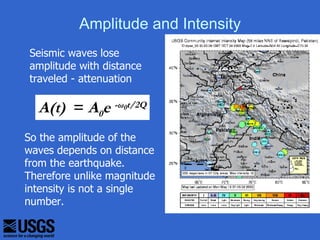
Amplitude and Intensity
 Seismic waves lose
 amplitude with distance
 traveled - attenuation

  A(t) = A0e -ω0t/2Q
So the amplitude of the
waves depends on distance
from the earthquake.
Therefore unlike magnitude
intensity is not a single
number.
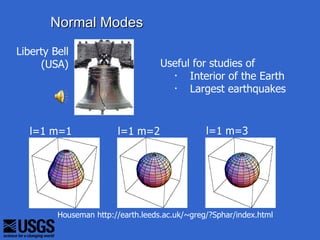
Normal Modes
Liberty Bell
     (USA)                          Useful for studies of
                                      ・ Interior of the Earth
                                      ・ Largest earthquakes


   l=1 m=1              l=1 m=2                 l=1 m=3


         Houseman http://earth.leeds.ac.uk/~greg/?Sphar/index.html
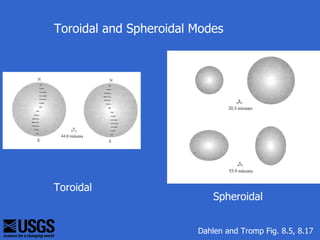
Toroidal and Spheroidal Modes


Toroidal
                            Spheroidal


                        Dahlen and Tromp Fig. 8.5, 8.17
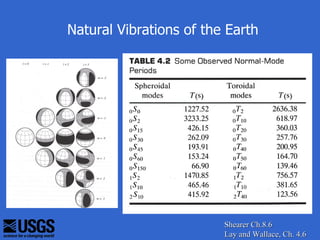
Natural Vibrations of the Earth


                         Shearer Ch.8.6
                         Lay and Wallace, Ch. 4.6

Caribbean3

  • 1.
    Seismic Waves An introduction Walter D. Mooney, USGS Menlo Park, CA.
  • 2.
    What is anEarthquake? • Instrumentally recorded (or felt) ground shaking, normally a result of underground movement on a fault Seismogram of the 1906 earthquake recorded in Germany San Francisco 1906 (USGS)
  • 3.
    Faulting Seismic waves USGS
  • 4.
    Types of SeismicWave Three-components of a seismometer record proportional to ground velocity of the P and S waves from a local aftershock of the Killari-Latur EQ, India (1993), at a hypocentral distance of 5.3 km P. Bormann. 2002. New Manual of Seismological Observatory Practice (NMSOP)
  • 5.
    Body Waves P. Bormann, NMSOP Bulk modulus κ = ∆P / (∆V/ V) ⇒ Shear modulus λ + 2µ κ + 4µ / 3 or „rigidity“ vp = = µ = (∆F/A) / (∆L/L) ⇒ ρ ρ Young´s or „stretch“ modulus E = (F/A)/ (∆L/L) and Poisson ratio σ = (∆W/W) / (∆L/L) ⇒ µ vp Deformation of material vs = samples for determining ρ = 3 elastic moduli vs © Copyright 2004. L. Braile.
  • 6.
    Particle motion ofbody waves < 4.5 s > 1s 3-component records at station MOX (top traces) and related plots of particle motion in the horizontal (N - E) plane and two vertical planes (Z - N and Z – E, respectively) of the P- wave onset from seismic event (mining collapse) in Germany (1989; Ml = 5.5; epicentral distance D = 112 km, back-azimuth BAZ = 273°). Left: broadband recording (0.1 – 5 Hz); right: filtered short-period recording (1 – 5 Hz). Note: The incidence angle is 59.5° for the long-period P- wave oscillation and 47.3° for the high-frequency P-wave group. P. Bormann (NMSOP)
  • 7.
    Surface Waves – Format the free surface – Amplitude decays exponentially with depth. © Copyright 2004. L. Braile.
  • 8.
    January 26, 2001Gujarat, India Earthquake (Mw7.7) vertical Rayleigh Waves radial transverse Love Waves Recorded in Japan at a distance of 57o (6300 km) Courtesy J. Mori
  • 9.
    Wave Period andWavelength   Velocity 6 km/s Space x wavelength 300 km wavelength    Time t period 50 s frequency = 1/period= 0.02 Hz period Velocity = Wavelength / Period Courtesy J. Mori
  • 10.
    Period Wavelength Body waves 0.01 to 50 sec 50 m to 500 km Surface waves 10 to 350 sec 30 to 1000 km Free Oscillations 350 to 3600 sec 1000 to 10000 km Static Displacements ∞ - Courtesy J. Mori
  • 11.
    Other phases Digital broadbandrecord of the Seattle Mw = 6,8 earthquake on 28 February 2001 at the station Rüdersdorf (RUE) in Germany (epicentral distance D = 73°). Note the detailed interpretation of secondary phase onsets. P. Bormann (NMSOP)
  • 12.
    Ray theory • Seismicwaves can be represented as rays
  • 13.
    Ray Paths ina Layered Medium sin θ1 / α1 = sin θ2 / α2 = s1 sin θ1 = s2 sin θ2 α = velocity of seismic energy in the layer α1 θ1 slower α1 θ1 Faster θ2 Faster θ2 Slower α2 α2 α1 < α2 α1 > α2 Courtesy J. Mori
  • 14.
    Ray Paths ina Layered Medium Time 1/α3 1/α2 1/α1 Distance α1 α2 α3 Courtesy J. Mori
  • 15.
    The Moho Andrija Mohorovicic (1857-1936) Found seismic discontinuity at 30 km depth in the Kupa Valley (Croatia). Mohorovicic discontinuity or ‘Moho’   Boundary between crust and mantle The Moho The Moho Copywrite Tasa Graphic Arts
  • 16.
    Structure in theEarth results in complicated paths Lowrie, 1997, fig 3.69 USGS Bolt, 2004, fig 6.3
  • 17.
    Propagation of SeismicWaves In the Earth; M. Wysession
  • 18.
  • 19.
  • 20.
  • 21.
    Forward Branch Shadow Zone Forward Branch Backward Branch Courtesy J. Mori
  • 22.
    PcP Backward Branch Forward PKP Branch Forward Branch Shadow PcP Shadow Zone P Zone Forward Branch Backward Branch Forward Branch ・ 1912 Gutenberg observed shadow zone 105o to 143o ・ 1939 Jeffreys fixed depth of core at 2898 km (using PcP) Courtesy J. Mori
  • 23.
    PcP Core Reflections Courtesy J. Mori
  • 24.
    P Mantle P S Mantle S K Outer core P I Inner core P c Reflection from the outer core i Reflection from the inner core diff Diffracted arrival IASP91, Kennett and Engdahl, 1991
  • 25.
    Stacked broadband seismograms forshallow earthquakes. Seismic phases are shown in different colors: Blue = vertical Green = radial horizontal Red = transverse horizontal P. Bormann. 2002. New Manual of Seismological Observatory Practice (NMSOP)
  • 26.
    Amplitude and Intensity Seismic waves lose amplitude with distance traveled - attenuation A(t) = A0e -ω0t/2Q So the amplitude of the waves depends on distance from the earthquake. Therefore unlike magnitude intensity is not a single number.
  • 27.
    Normal Modes Liberty Bell (USA) Useful for studies of ・ Interior of the Earth ・ Largest earthquakes l=1 m=1 l=1 m=2 l=1 m=3 Houseman http://earth.leeds.ac.uk/~greg/?Sphar/index.html
  • 28.
    Toroidal and SpheroidalModes Toroidal Spheroidal Dahlen and Tromp Fig. 8.5, 8.17
  • 29.
    Natural Vibrations ofthe Earth Shearer Ch.8.6 Lay and Wallace, Ch. 4.6

Editor's Notes

  • #3 An earthquake is caused by sudden movement on a sub-surface fault. The energy which is released (which was stored as strain in the rock) is converted to seismic waves which radiate from the earthquake focus. These seismic waves cause ground shaking and can be measured using seismometers.
  • #4 This session focuses on the seismic waves that result from an earthquake.
  • #5 Two categories of seismic wave exist – body waves (which travel through the entire volume of the Earth) and surface waves (which are restricted to the near-surface). Each category consists of several types of seismic wave which all propagate through the earth with different velocity, amplitude, and particle motion.
  • #6 Body waves are those which travel through the entire volume of the Earth. There are two types: P-waves (Primary, or first arriving) are the quickest and have a compressional particle motion parallel to the direction of travel. S-waves (Shear) are quicker than surface waves, and have a shearing particle motion perpendicular to the direction of travel. The velocity of a P or S wave is related to the bulk or shear moduli (respectively) of the material through which they travel.
  • #7 Different arrivals in a seismic wave-train can usually be identified by considering the particle motion of each seismic wave.
  • #8 Surface waves are those which are restricted to propagation close to the free surface. There are two main types: Love waves have a shearing particle motion but only in the horizontal plane (parallel to the ground surface). Rayleigh waves have a reverse retrograde ellipse particle motion parallel to the direction of propagation.
  • #9 On a 3-component seismometer we can separate out the Love and Rayleigh waves as a result of their different particle motion. The Love waves arrive earlier. A seismometer records the ground motion caused by the different seismic waves as they arrive and pass by. Different records are made in 3 orthogonal directions – N, E, and Z. Depending on the distance to the source, different ‘phases’ (the recorded waveforms corresponding to different seismic arrivals) could appear close together in a complicated wave-train (if the earthquake was close), or separated out into distinct arrivals depending on the propagation velocity of each seismic wave. If the earthquake was very far away (Teleseismic) then surface waves will not be recorded.
  • #10 In the spatial domain, one wavelength describes the distance for one complete cycle of the seismic wave (e.g. peak to peak, or trough to trough). In the time domain, the period describes the time taken for one whole cycle to pass a certain point/ The velocity of the wave is related to both the wavelength and the period.
  • #11 The different phases have different wavelengths and periods, this is important when we try to use the seismic waves to investigate the earthquake source – see earthquake sources lecture.
  • #12 Depending on the geometry of the ray path of a particular seismic wave as it hits a seismic discontinuity (boundary over which the velocity differs) it could be refracted or reflected, or even converted from a P- to an S-wave (or vice versa). As a result, many different seismic phases can be recorded which have taken different paths through the earth to get from the source to the seismometer, and have different travel-times.
  • #13 Seismic waves travel through the Earth according to the laws of optics. Snell’s law, as illustrated here, describes the refraction of a seismic ray as it crosses a velocity contrast
  • #14 When velocity increases with depth within the Earth the rays a refracted back towards the Earth’s surface (left hand example), when the velocity decreases within the earth the rays are refracted away from the surface (right hand example).
  • #15 With several layers of increasing velocity this effect is repeated. The time taken for the ray to travel from the source to the receiver is the sum of the distance traveled in each layer multiplied by the velocity of that layer. If we have a number of recording stations in a simple patch of ground and we plot the time of arrival against the distance from the source we create a plot like the one on the right. In a constant velocity layer the time taken is proportional to the distance traveled and the graph is a straight line (giving the velocity of the layer). We investigate the structure of the earth using this – by recording the arrival times at many locations we can create a plot similar to the one on the right (but more complicated) and use this to try and calculate the velocity structure of the earth.
  • #16 The Moho is a good example of a seismic discontinuity across which seismic velocity is different. Andrija Mohorovicic found a very sharp change in velocity within the earth in Croatia, which was later shown to occur everywhere at varying depths (average of about 40 km under the continents and ~7 km below the seabed under the oceans). The velocity change is interpreted to happen at the boundary between crustal material and mantle material, and is known as the Moho after Mohorovicic.
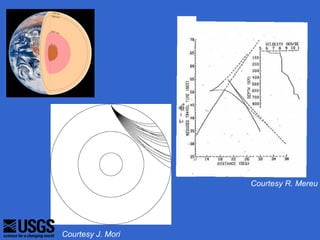
  • #17 The Earth has a complicated structure. The changes in velocity with depth result in refraction and reflection of the seismic energy. So the ray paths through the Earth are complicated.
  • #19 Ray paths through the mantle are relatively simple. There are a few changes associated with the 410 and 660 km discontinuities, but nothing compared to the deeper earth.
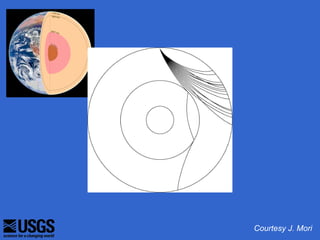
  • #20 Because the outer core is a liquid, S waves do not propagate through it (this is because a liquid cannot support shearing) and P waves are slower. So the ray that enters the inner core bends away from the surface, deeper into the earth.
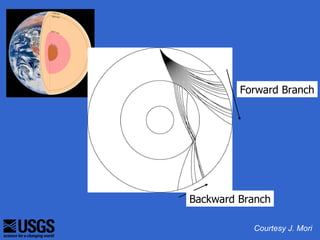
  • #21 Steeper incident rays are less affected and so we end up with deeper ray paths arriving nearer the source.
  • #22 We then have another short forward branch. However, no direct P energy arrives in a zone ~105-~143 degrees from the source – the shadow zone because of the refractive properties of the mantle-core boundary.
  • #23 A time-distance plot through the mantle shows this complexity.
  • #24 PcP is an example of a P phase which has reflected off the core-mantle boundary because it’s angle of incidence at the boundary is greater than the critical angle.
  • #25 There are many possible ray paths within the earth, all of which have been observed. Phases are named according to their path through the Earth. For instance a P wave which travels directly through the centre of the Earth is called the PKIKP phase
  • #26 Collation of recorded phase data. Blue represents the vertical component.
  • #27 The intensity of earthquake shaking is directly related to the amplitude of the seismic waves. The above relationship describes the decay of amplitude with distance.
  • #28 Normal modes are the free oscillations of the Earth that happen following a large earthquake – they are similar to the ringing of a bell. They have much longer periods and wavelengths than other seismic waves so they are very useful for studying the largest earthquakes. Like a bell there are initially many different frequencies, but the higher modes attenuate (lose amplitude) more rapidly than the lower modes, so with time the ringing simplifies.
  • #29 Some of the more simple and longer period ways the earth can oscillate. The top figure on the right is known as the “breathing mode” as the Earth expands and contracts. The lower figure is the “football mode” . Note that these waves have periods of many 10’s of minutes , far longer than P, S and surface waves.
  • #30 More ways the earth can oscillate.