Mental Health Needs of Family Caregivers:
Identifying, Engaging and Assisting
Today’s Talk
• Who are caregivers and what do they do?
• Impact of caregiving on health and mental
health
• Key factors for caregiver strain vs. resilience
• Effective interventions for caregivers
Fundamentals—caregiving is
increasingly common
• 52 million informal and family caregivers
provide care to someone aged 20+ who is ill
or disabled
• 34 million adults involved in caregiving to
persons aged 50 or over
• 8.9 million informal caregivers provide care
for someone aged 50+ with dementia
Fundamentals of caregiving
• Most family caregivers are women; spouses
and daughters; “informal” (unpaid)
• AD caregiving, 60 hours per week at home; 9
hours even after NHP; 5-10 year “career”
• Hospice lung cancer caregivers, over 100
hours per week
• Differences with other conditions and
disabilities (DD, stroke, SCI, MCI)
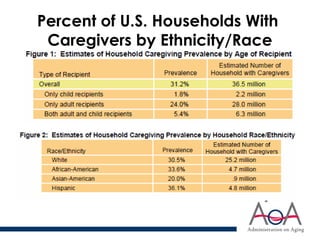
Percent of U.S. Households With
Caregivers by Ethnicity/Race
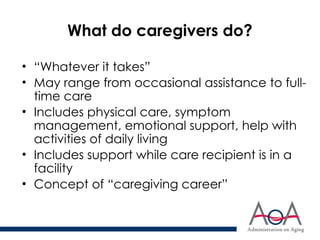
What do caregivers do?
• “Whatever it takes”
• May range from occasional assistance to full-
time care
• Includes physical care, symptom
management, emotional support, help with
activities of daily living
• Includes support while care recipient is in a
facility
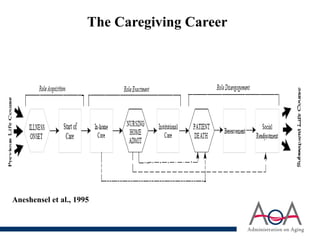
• Concept of “caregiving career”
Aneshensel et al., 1995
The Caregiving Career
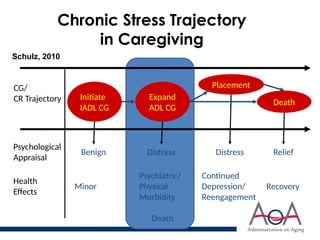
Continued
Depression/
Reengagement
Distress
Recovery
Relief
Psychological
Appraisal
Health
Effects
Initiate
IADL CG
Expand
ADL CG
Placement
CG/
CR Trajectory
Minor
Benign
Psychiatric/
Physical
Morbidity
Distress
Death
Chronic Stress Trajectory
in Caregiving
Death
Schulz, 2010
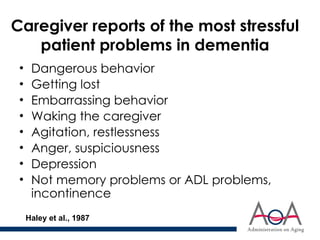
Caregiver reports of the most stressful
patient problems in dementia
• Dangerous behavior
• Getting lost
• Embarrassing behavior
• Waking the caregiver
• Agitation, restlessness
• Anger, suspiciousness
• Depression
• Not memory problems or ADL problems,
incontinence
Haley et al., 1987
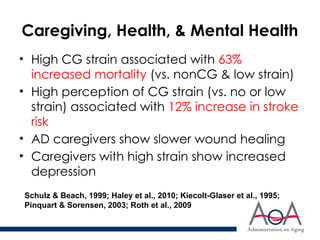
Caregiving, Health, & Mental Health
• High CG strain associated with 63%
increased mortality (vs. nonCG & low strain)
• High perception of CG strain (vs. no or low
strain) associated with 12% increase in stroke
risk
• AD caregivers show slower wound healing
• Caregivers with high strain show increased
depression
Schulz & Beach, 1999; Haley et al., 2010; Kiecolt-Glaser et al., 1995;
Pinquart & Sorensen, 2003; Roth et al., 2009
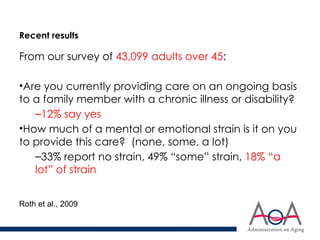
Recent results
From our survey of 43,099 adults over 45:
•Are you currently providing care on an ongoing basis
to a family member with a chronic illness or disability?
–12% say yes
•How much of a mental or emotional strain is it on you
to provide this care? (none, some, a lot)
–33% report no strain, 49% “some” strain, 18% “a
lot” of strain
Roth et al., 2009
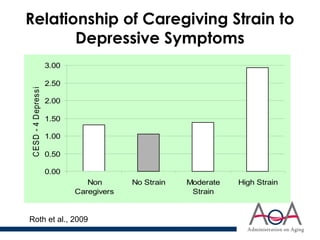
Relationship of Caregiving Strain to
Depressive Symptoms
0.00
0.50
1.00
1.50
2.00
2.50
3.00
Non
Caregivers
No Strain Moderate
Strain
High Strain
C
ESD
-
4
D
epression
Roth et al., 2009
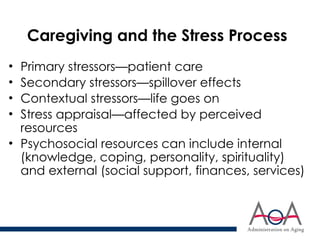
Caregiving and the Stress Process
• Primary stressors—patient care
• Secondary stressors—spillover effects
• Contextual stressors—life goes on
• Stress appraisal—affected by perceived
resources
• Psychosocial resources can include internal
(knowledge, coping, personality, spirituality)
and external (social support, finances, services)
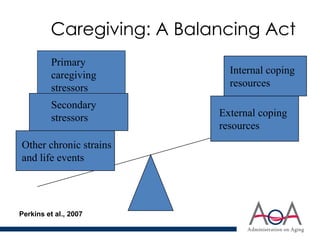
Caregiving: A Balancing Act
Other chronic strains
and life events
Internal coping
resources
External coping
resources
Secondary
stressors
Primary
caregiving
stressors
Perkins et al., 2007
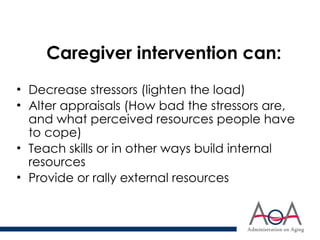
Caregiver intervention can:
• Decrease stressors (lighten the load)
• Alter appraisals (How bad the stressors are,
and what perceived resources people have
to cope)
• Teach skills or in other ways build internal
resources
• Provide or rally external resources
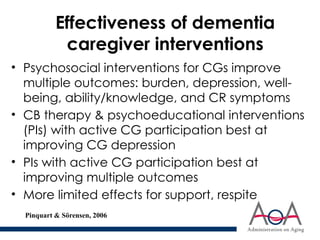
Effectiveness of dementia
caregiver interventions
• Psychosocial interventions for CGs improve
multiple outcomes: burden, depression, well-
being, ability/knowledge, and CR symptoms
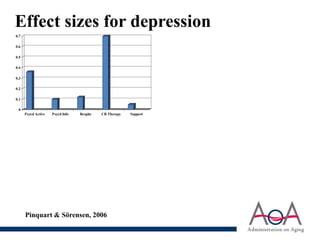
• CB therapy & psychoeducational interventions
(PIs) with active CG participation best at
improving CG depression
• PIs with active CG participation best at
improving multiple outcomes
• More limited effects for support, respite
Pinquart & Sörensen, 2006
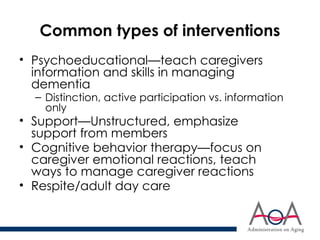
Common types of interventions
• Psychoeducational—teach caregivers
information and skills in managing
dementia
– Distinction, active participation vs. information
only
• Support—Unstructured, emphasize
support from members
• Cognitive behavior therapy—focus on
caregiver emotional reactions, teach
ways to manage caregiver reactions
• Respite/adult day care
0
0.1
0.2
0.3
0.4
0.5
0.6
0.7
Psyed Active Psyed Info Respite CB Therapy Support
Effect sizes for depression
Pinquart & Sörensen, 2006
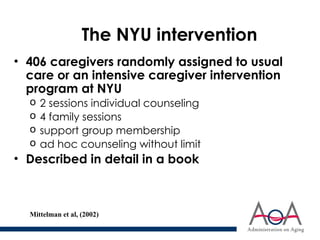
The NYU intervention
• 406 caregivers randomly assigned to usual
care or an intensive caregiver intervention
program at NYU
o 2 sessions individual counseling
o 4 family sessions
o support group membership
o ad hoc counseling without limit
• Described in detail in a book
Mittelman et al, (2002)
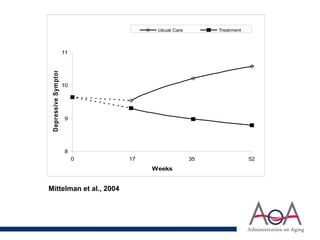
8
9
10
11
0 17 35 52
Weeks
Depressive
Symptoms
Usual Care Treatment
Mittelman et al., 2004
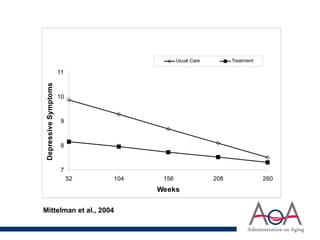
7
8
9
10
11
52 104 156 208 260
Weeks
Depressive
Symptoms
Usual Care Treatment
Mittelman et al., 2004
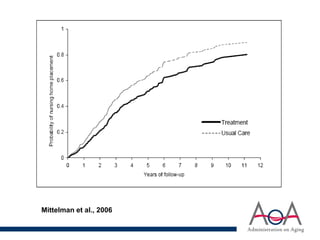
Results--effects on NHP
• Our analyses show that, with longer
duration of follow up, the delay in nursing
home placement in the treatment group
is 557 days, compared with previously
reported delay of 329 delays
• Median cost of NH care in Florida is
currently over $75,000 per year
Mittelman et al., 2006
Beyond “efficacy”, to
“effectiveness” studies
• Current trials translating evidence based
interventions into community using REACH,
NYU, & STAR-C protocols
• STAR-C protocol (trains caregivers in
behavioral management)
• Used community practitioners to train
caregivers
• Random assignment to STAR-C versus usual
care
Burgio et al., 2009; Teri et al., 2005
Results
• Community consultants were able to learn and
adhere to the behavioral treatment protocol.
Caregivers receiving STAR-C training showed
significant improvements at 6 month follow up in:
– Depression
– Burden
– Reactivity to behavior problems in the care recipient.
– Care recipients also showed benefits, including:
• Decreased frequency and severity of behavior problems
• improved care recipient quality of life.
Teri et al., 2005
Conclusion
• High strain caregivers at increased risk for
depression and health problems
• Intervention for caregivers has the potential
to produce long lasting, life changing,
benefits for caregivers
• Potential to save costs and to minimize the
long term damage to caregivers’ lives
• Important to build CG resources and do
more to increase caregivers’ access to
effective intervention
Today’s Talk
• How to get them in the door – overcoming
barriers to providing support services to
family caregivers
• How to get them to help themselves –
overcoming reluctance to reach out for and
accept support
• When to refer to a mental health specialist
“I’m an anxious wreck at work”
• Don, 46-year-old, African-American man
seeking psychotherapy for anxiety and
“career burnout”
• Has worked for 15 years in high-volume, high-
pressure job as bank administrator
• But thinks constantly about his mother with
COPD, disabled and alone in her home
• Calls her 5 times during the course of each
day and then visits her after work
Barriers to Receiving Caregiver
Support
• Has never heard of an Area Agency on
Aging or family caregiver support program
• Not sure what family caregiving is
• Doesn’t think of himself as a family caregiver
• Mother wants no services because she
doesn’t like strangers in her home
• Family doesn’t take “handouts”
Challenge of Outreach
• Don won’t be looking for family caregiver
support group
• If I refer him to a family caregiver support
group (especially early on in his treatment
with me), he won’t go
• How do we engage him in the process of
seeking support for himself and his mother
Outreach (cont.)
• To reach sons like Don, we have to go beyond
advertising caregiver services. Two ideas:
1. Community events that define and normalize
being a stressed-out caregiver without being
explicitly “caregiver” or “support” events.
Educational sessions on taking care of an aging
parent (Caregiver Month); on disease specifics
(e.g., dementia) that covers family impact
Outreach (cont.)
2. Make greater use of primary care portal “Making
the Link” – a National Association of Area
Agencies on Aging (n4a) program – some success
but not lasting
Other models – Northern California Care Network
for Dementia 0 faxed referrals from physician
offices – worked well
NYUCI in Primary Care – caregiver counselor in
Vermont primary care offices – good data
Encouraging Self-Care
• Caregivers are notorious for neglecting their
own needs
• Don would never have sought services if his
physician hadn’t twisted his arm and if he
wasn’t at risk of losing his job
• Telling caregivers that taking care of
themselves will better enable them to care
for their loved ones is of limited effectiveness
Self-Care (cont.)
• Three Ideas: Marathon Metaphor; Honoring
the Mission; Receiving with Grace
• Caregiving as a marathon:
• Have to train to learn to pace oneself
• Have to learn the up-hills and down-hills of
the lay of the land (disease)
• Have to learn to replenish along the way
• All are essential – or don’t finish the race
Honoring the Mission
• Solicit the story of giving care
• Avoid premature advice-giving
• Inquire about meaning of caregiving in
caregiver’s life
• Identify and honor the caregiver’s sense of
mission
• Raise issue of sustainability
• Inquire about sources of sustenance
Receiving with Grace
• Assumption: Most of us would rather give
than receive
• But running best race means taking in
sustenance, utilizing support
• Spiritual traditions of seeing giving in
receiving – offering others the blessing of
doing good
Mental Health Referral
• Majority of caregivers will never need formal
mental health services
• Who does? Those who are so depressed,
anxious, angry (abusive), guilty that it is
affecting their capacity to function
effectively and to provide adequate care
• Issue of severity
Referral (cont.)
• “Caregiver burnout”: dread, tension,
irritability, anger, fatigue, sadness, disturbed
sleep, difficulty thinking clearly and making
decisions
• Often a precursor to Major Depressive
Disorder (MDD)
• Don is anxious, distracted and jumpy all day
long; fragmented sleep at night
Referral (cont.)
• MDD – sadness, lack of enjoyment, sleep
and appetite disturbances, excessive guilt,
low self-esteem, fatigue, difficulty making
decisions, thoughts about dying; also
anxiety, social withdrawal
• Often disabling
• Psychotherapy and drug treatments
Referral (cont.)
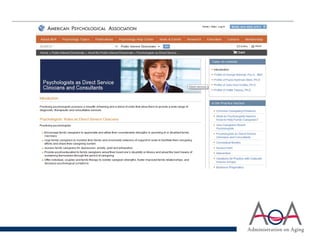
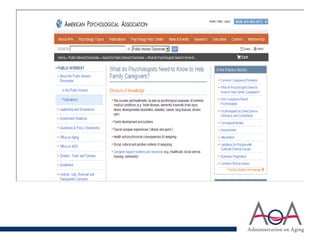
• If possible, refer to a caregiver-savvy, medically
knowledgeable therapist (e.g., APA’s
Psychologist Locator http://locator.apa.org/)
• If caregiver is reluctant to go to a mental
health provider, urge visit to primary care
doctor
• Broach mental health treatment as another
strategy to strengthen caregiving capacity –
run the best race
Mental Health Needs of Family Caregivers:
Identifying, Engaging and Assisting
Questions?
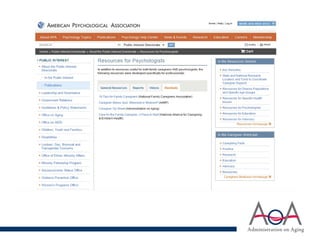
APA Family Caregivers
Briefcase
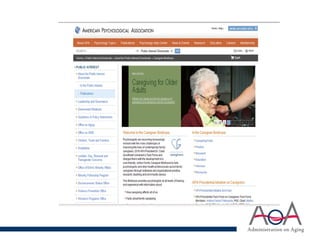
• 2010 APA President Carol Goodheart, EdD selected Family
Caregivers as one of her Presidential Initiatives based on the
belief that APA can help others to anticipate, recognize, and
reduce the stresses on family caregivers across the life span.
• APA Presidential Task Force on Family Caregivers members are:
Andrea Farkas Patenaude, PhD, Martha Crowther, PhD, MPH,
Timothy Elliott, PhD, ABPP, William E. Haley, PhD, Barry J. Jacobs,
Psy.D, and Sara Honn Qualls, PhD. I was APA Staff Liaison.
• It is anticipated that the Briefcase will be useful for years to come,
with small changes as the field produces new approaches, new
research findings, and new tools and resources.
• The Briefcase is dedicated to the millions of family members who
carry a magnificent load of responsibility and care on a daily
basis.
Mental Health Needs of Family Caregivers:
Identifying, Engaging and Assisting
Questions?

mental-health- training session for students

  • 1.
    Mental Health Needsof Family Caregivers: Identifying, Engaging and Assisting
  • 2.
    Today’s Talk • Whoare caregivers and what do they do? • Impact of caregiving on health and mental health • Key factors for caregiver strain vs. resilience • Effective interventions for caregivers
  • 3.
    Fundamentals—caregiving is increasingly common •52 million informal and family caregivers provide care to someone aged 20+ who is ill or disabled • 34 million adults involved in caregiving to persons aged 50 or over • 8.9 million informal caregivers provide care for someone aged 50+ with dementia
  • 4.
    Fundamentals of caregiving •Most family caregivers are women; spouses and daughters; “informal” (unpaid) • AD caregiving, 60 hours per week at home; 9 hours even after NHP; 5-10 year “career” • Hospice lung cancer caregivers, over 100 hours per week • Differences with other conditions and disabilities (DD, stroke, SCI, MCI)
  • 5.
    Percent of U.S.Households With Caregivers by Ethnicity/Race
  • 6.
    What do caregiversdo? • “Whatever it takes” • May range from occasional assistance to full- time care • Includes physical care, symptom management, emotional support, help with activities of daily living • Includes support while care recipient is in a facility • Concept of “caregiving career”
  • 7.
    Aneshensel et al.,1995 The Caregiving Career
  • 8.
    Continued Depression/ Reengagement Distress Recovery Relief Psychological Appraisal Health Effects Initiate IADL CG Expand ADL CG Placement CG/ CRTrajectory Minor Benign Psychiatric/ Physical Morbidity Distress Death Chronic Stress Trajectory in Caregiving Death Schulz, 2010
  • 9.
    Caregiver reports ofthe most stressful patient problems in dementia • Dangerous behavior • Getting lost • Embarrassing behavior • Waking the caregiver • Agitation, restlessness • Anger, suspiciousness • Depression • Not memory problems or ADL problems, incontinence Haley et al., 1987
  • 10.
    Caregiving, Health, &Mental Health • High CG strain associated with 63% increased mortality (vs. nonCG & low strain) • High perception of CG strain (vs. no or low strain) associated with 12% increase in stroke risk • AD caregivers show slower wound healing • Caregivers with high strain show increased depression Schulz & Beach, 1999; Haley et al., 2010; Kiecolt-Glaser et al., 1995; Pinquart & Sorensen, 2003; Roth et al., 2009
  • 11.
    Recent results From oursurvey of 43,099 adults over 45: •Are you currently providing care on an ongoing basis to a family member with a chronic illness or disability? –12% say yes •How much of a mental or emotional strain is it on you to provide this care? (none, some, a lot) –33% report no strain, 49% “some” strain, 18% “a lot” of strain Roth et al., 2009
  • 12.
    Relationship of CaregivingStrain to Depressive Symptoms 0.00 0.50 1.00 1.50 2.00 2.50 3.00 Non Caregivers No Strain Moderate Strain High Strain C ESD - 4 D epression Roth et al., 2009
  • 13.
    Caregiving and theStress Process • Primary stressors—patient care • Secondary stressors—spillover effects • Contextual stressors—life goes on • Stress appraisal—affected by perceived resources • Psychosocial resources can include internal (knowledge, coping, personality, spirituality) and external (social support, finances, services)
  • 14.
    Caregiving: A BalancingAct Other chronic strains and life events Internal coping resources External coping resources Secondary stressors Primary caregiving stressors Perkins et al., 2007
  • 16.
    Caregiver intervention can: •Decrease stressors (lighten the load) • Alter appraisals (How bad the stressors are, and what perceived resources people have to cope) • Teach skills or in other ways build internal resources • Provide or rally external resources
  • 18.
    Effectiveness of dementia caregiverinterventions • Psychosocial interventions for CGs improve multiple outcomes: burden, depression, well- being, ability/knowledge, and CR symptoms • CB therapy & psychoeducational interventions (PIs) with active CG participation best at improving CG depression • PIs with active CG participation best at improving multiple outcomes • More limited effects for support, respite Pinquart & Sörensen, 2006
  • 19.
    Common types ofinterventions • Psychoeducational—teach caregivers information and skills in managing dementia – Distinction, active participation vs. information only • Support—Unstructured, emphasize support from members • Cognitive behavior therapy—focus on caregiver emotional reactions, teach ways to manage caregiver reactions • Respite/adult day care
  • 20.
    0 0.1 0.2 0.3 0.4 0.5 0.6 0.7 Psyed Active PsyedInfo Respite CB Therapy Support Effect sizes for depression Pinquart & Sörensen, 2006
  • 21.
    The NYU intervention •406 caregivers randomly assigned to usual care or an intensive caregiver intervention program at NYU o 2 sessions individual counseling o 4 family sessions o support group membership o ad hoc counseling without limit • Described in detail in a book Mittelman et al, (2002)
  • 22.
    8 9 10 11 0 17 3552 Weeks Depressive Symptoms Usual Care Treatment Mittelman et al., 2004
  • 23.
    7 8 9 10 11 52 104 156208 260 Weeks Depressive Symptoms Usual Care Treatment Mittelman et al., 2004
  • 24.
    Results--effects on NHP •Our analyses show that, with longer duration of follow up, the delay in nursing home placement in the treatment group is 557 days, compared with previously reported delay of 329 delays • Median cost of NH care in Florida is currently over $75,000 per year Mittelman et al., 2006
  • 25.
  • 26.
    Beyond “efficacy”, to “effectiveness”studies • Current trials translating evidence based interventions into community using REACH, NYU, & STAR-C protocols • STAR-C protocol (trains caregivers in behavioral management) • Used community practitioners to train caregivers • Random assignment to STAR-C versus usual care Burgio et al., 2009; Teri et al., 2005
  • 27.
    Results • Community consultantswere able to learn and adhere to the behavioral treatment protocol. Caregivers receiving STAR-C training showed significant improvements at 6 month follow up in: – Depression – Burden – Reactivity to behavior problems in the care recipient. – Care recipients also showed benefits, including: • Decreased frequency and severity of behavior problems • improved care recipient quality of life. Teri et al., 2005
  • 28.
    Conclusion • High straincaregivers at increased risk for depression and health problems • Intervention for caregivers has the potential to produce long lasting, life changing, benefits for caregivers • Potential to save costs and to minimize the long term damage to caregivers’ lives • Important to build CG resources and do more to increase caregivers’ access to effective intervention
  • 29.
    Today’s Talk • Howto get them in the door – overcoming barriers to providing support services to family caregivers • How to get them to help themselves – overcoming reluctance to reach out for and accept support • When to refer to a mental health specialist
  • 30.
    “I’m an anxiouswreck at work” • Don, 46-year-old, African-American man seeking psychotherapy for anxiety and “career burnout” • Has worked for 15 years in high-volume, high- pressure job as bank administrator • But thinks constantly about his mother with COPD, disabled and alone in her home • Calls her 5 times during the course of each day and then visits her after work
  • 31.
    Barriers to ReceivingCaregiver Support • Has never heard of an Area Agency on Aging or family caregiver support program • Not sure what family caregiving is • Doesn’t think of himself as a family caregiver • Mother wants no services because she doesn’t like strangers in her home • Family doesn’t take “handouts”
  • 32.
    Challenge of Outreach •Don won’t be looking for family caregiver support group • If I refer him to a family caregiver support group (especially early on in his treatment with me), he won’t go • How do we engage him in the process of seeking support for himself and his mother
  • 34.
    Outreach (cont.) • Toreach sons like Don, we have to go beyond advertising caregiver services. Two ideas: 1. Community events that define and normalize being a stressed-out caregiver without being explicitly “caregiver” or “support” events. Educational sessions on taking care of an aging parent (Caregiver Month); on disease specifics (e.g., dementia) that covers family impact
  • 35.
    Outreach (cont.) 2. Makegreater use of primary care portal “Making the Link” – a National Association of Area Agencies on Aging (n4a) program – some success but not lasting Other models – Northern California Care Network for Dementia 0 faxed referrals from physician offices – worked well NYUCI in Primary Care – caregiver counselor in Vermont primary care offices – good data
  • 36.
    Encouraging Self-Care • Caregiversare notorious for neglecting their own needs • Don would never have sought services if his physician hadn’t twisted his arm and if he wasn’t at risk of losing his job • Telling caregivers that taking care of themselves will better enable them to care for their loved ones is of limited effectiveness
  • 37.
    Self-Care (cont.) • ThreeIdeas: Marathon Metaphor; Honoring the Mission; Receiving with Grace • Caregiving as a marathon: • Have to train to learn to pace oneself • Have to learn the up-hills and down-hills of the lay of the land (disease) • Have to learn to replenish along the way • All are essential – or don’t finish the race
  • 38.
    Honoring the Mission •Solicit the story of giving care • Avoid premature advice-giving • Inquire about meaning of caregiving in caregiver’s life • Identify and honor the caregiver’s sense of mission • Raise issue of sustainability • Inquire about sources of sustenance
  • 39.
    Receiving with Grace •Assumption: Most of us would rather give than receive • But running best race means taking in sustenance, utilizing support • Spiritual traditions of seeing giving in receiving – offering others the blessing of doing good
  • 40.
    Mental Health Referral •Majority of caregivers will never need formal mental health services • Who does? Those who are so depressed, anxious, angry (abusive), guilty that it is affecting their capacity to function effectively and to provide adequate care • Issue of severity
  • 41.
    Referral (cont.) • “Caregiverburnout”: dread, tension, irritability, anger, fatigue, sadness, disturbed sleep, difficulty thinking clearly and making decisions • Often a precursor to Major Depressive Disorder (MDD) • Don is anxious, distracted and jumpy all day long; fragmented sleep at night
  • 42.
    Referral (cont.) • MDD– sadness, lack of enjoyment, sleep and appetite disturbances, excessive guilt, low self-esteem, fatigue, difficulty making decisions, thoughts about dying; also anxiety, social withdrawal • Often disabling • Psychotherapy and drug treatments
  • 45.
    Referral (cont.) • Ifpossible, refer to a caregiver-savvy, medically knowledgeable therapist (e.g., APA’s Psychologist Locator http://locator.apa.org/) • If caregiver is reluctant to go to a mental health provider, urge visit to primary care doctor • Broach mental health treatment as another strategy to strengthen caregiving capacity – run the best race
  • 46.
    Mental Health Needsof Family Caregivers: Identifying, Engaging and Assisting Questions?
  • 47.
    APA Family Caregivers Briefcase •2010 APA President Carol Goodheart, EdD selected Family Caregivers as one of her Presidential Initiatives based on the belief that APA can help others to anticipate, recognize, and reduce the stresses on family caregivers across the life span. • APA Presidential Task Force on Family Caregivers members are: Andrea Farkas Patenaude, PhD, Martha Crowther, PhD, MPH, Timothy Elliott, PhD, ABPP, William E. Haley, PhD, Barry J. Jacobs, Psy.D, and Sara Honn Qualls, PhD. I was APA Staff Liaison. • It is anticipated that the Briefcase will be useful for years to come, with small changes as the field produces new approaches, new research findings, and new tools and resources. • The Briefcase is dedicated to the millions of family members who carry a magnificent load of responsibility and care on a daily basis.
  • 63.
    Mental Health Needsof Family Caregivers: Identifying, Engaging and Assisting Questions?