S.Lakshmanan,
Psychologist, and
Ex. Project Officer, NYK,
Puducherry.
Hobby
• anactivityorinterestpursuedforpleasureor
relaxationandnotasamainoccupation.
• anactivitydoneregularlyinone'sleisuretimefor
pleasure.
• Ahobbyisanactivitythatyoudoinyoursparetime
forfun....Inthe13thcenturythe
wordhobbyreferredtoasmallhorseorapony.It
latercametodescribeatoyhorse—ahobbyhorse.
It'sfromthehobbyhorsethattheword'smodern
senseof“favoritepastime”evolved.
Hobby
• Having a hobby that we
enjoy brings us joy and
enriches our lives. It gives
us something fun to do
during our leisure time and
affords us the opportunity
to learn new skills. We are
very fortunate to have so
many different options out
there today.
Cultivating a new Hobby
• The best way to cultivate a new hobby is to try something
new. The world is full of wonderful, exciting activities that
we can explore and adopt as our own. Of course, all of us
are unique and, therefore, our interests and hobbies vary.
But once we find a hobby that we truly enjoy and are
passionate about, we become hooked. It becomes part of
our lives and captivates us in a very personal way.
Advantage of Hobby
There are many reasons why all of us should
have at least one hobby, but here are the main
advantages:
1. It makes you more interesting. People who
have hobbies have experiences and stories
that they can share with others. They also
have specialized knowledge that they can
teach to anyone who also has an interest in
the same topics as they do.
2. It helps to relieve stress by keeping you
engaged in something you enjoy. Hobbies give
you a way to take your mind off the stresses of
everyday life. They let you relax and seek
pleasure in activities that aren’t associated
with work, chores or other responsibilities.
Advantage of Hobby
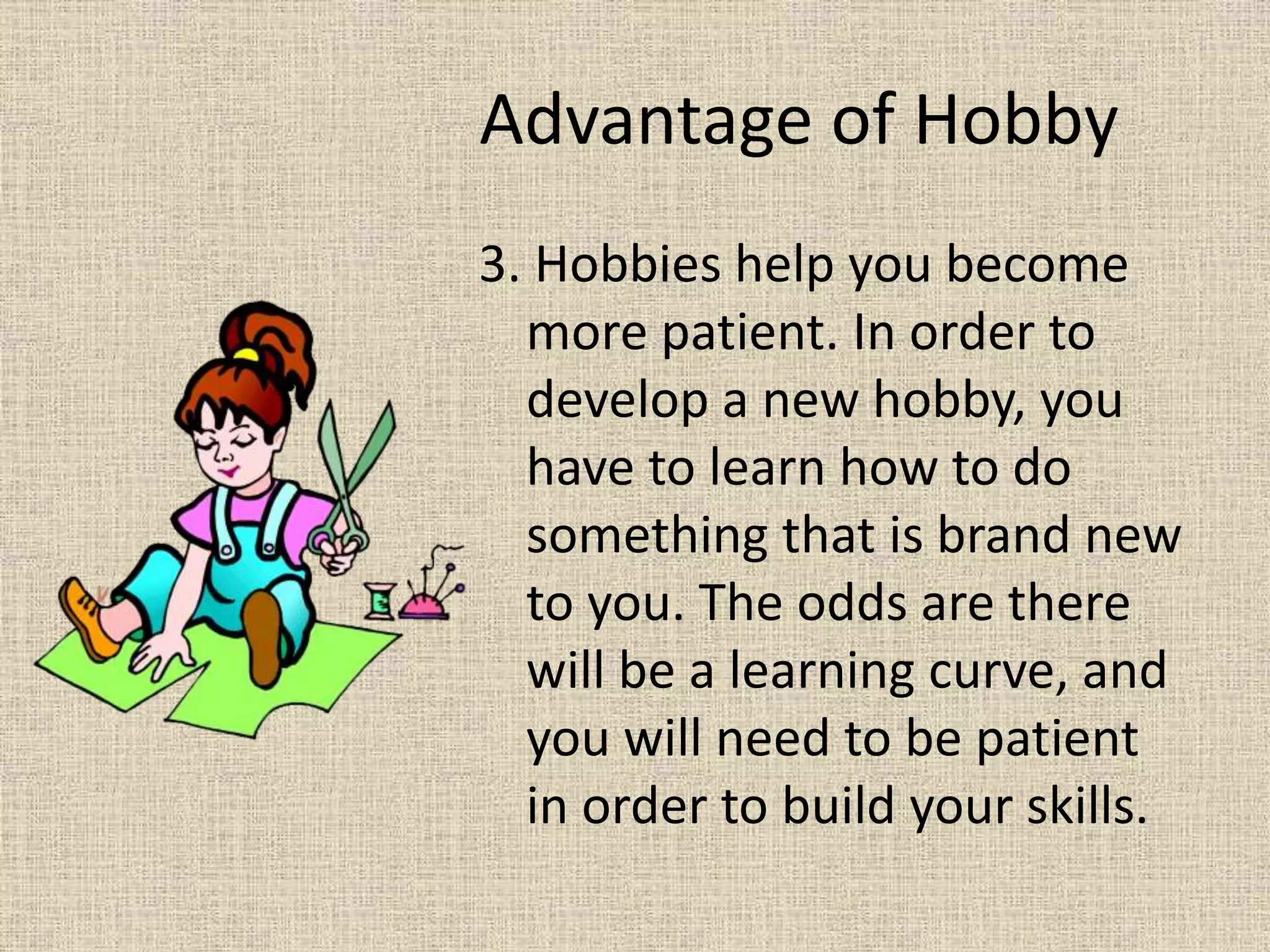
3. Hobbies help you become
more patient. In order to
develop a new hobby, you
have to learn how to do
something that is brand new
to you. The odds are there
will be a learning curve, and
you will need to be patient
in order to build your skills.
Advantage of Hobby
4. Having a hobby can help your
social life and create a bond with
others. A hobby is something
that you can frequently enjoy
with other people. Whether you
join a club, play in a league, or
just gift others with the fruits of
your labor, a hobby is a great
way to meet and get closer to
people who have the same
interests as you do.
Advantage of Hobby
5. It increases your confidence
and self-esteem. The odds
are that if you really enjoy
an activity, you are usually
pretty good at it. Any
activity that you can excel in
is an opportunity for you to
build your confidence and
develop pride in your
accomplishments.
Advantage of Hobby
6. Hobbies help reduce or
eradicate boredom. They give
you something to do when you
find yourself with nothing to fill
your time. They also give you an
activity that you can look
forward to and get excited
about.
Advantage of Hobby
7. It helps you develop new skills. A hobby that
you really dedicate your time to will lead you
to build new skills. As you spend more time at
your hobby you will become better and better
at it.
Advantage of Hobby
8. It increases your knowledge. Along with
building new skills, you will also gain new
knowledge through the development of your
hobby.
Advantage of Hobby
9. It enriches your life and gives you a different
perspective on things. No matter what type of
hobby you choose, you will definitely be
exposed to new ideas. Hobbies help you grow
in various ways, including exposing you to new
opinions and to new ways to look at life
Advantage of Hobby
10. It challenges you. When you pick a new
hobby, you will be involved in activities that
are novel and challenging. If you don’t find
your hobby challenging, then you also won’t
find it engaging, and it will be less enjoyable.
That means you need to find a better hobby.
Advantage of Hobby
11. It helps prevent bad habits and
wasting time. There is an old saying
that “idle hands are the devil’s
workshop.” If you have good hobbies
to fill up your free time, then you will
be less likely to spend that time on
wasteful or negative activities.
Advantage of Hobby
Hobbies reduce Stress
• Hobbies bring a sense of fun and freedom
to life that can help to minimize the
impact of chronic stress.
• Those who feel overwhelmed at a job, for
example, can benefit
from hobbies because they provide an
outlet for stress and something to look
forward to after a hard day (or week) at
a stressful job.
Health Benefits of Hobbies
• One study found that those who engage in physical
leisure activities for at least 20 minutes once a week are
less susceptible to fatigue.
• Other research found that enjoyable activities
performed during leisure time were associated with
lower blood pressure, total cortisol, waist
circumference, and body mass index, and perceptions
of better physical function. Such activities were also
correlated with higher levels of positive psychosocial
states and lower levels of depression and negative
effect.
• Ultimately, the benefits of hobbies, both psychologically
and physically, are worth exploring. Find something you
enjoy engaging in and you create time for yourself and
your health!
Health Benefits of Hobbies
Taking a Break
• Hobbies provide a slice of work-free and responsibility-free
time in your schedule. This can be especially welcome for
people who feel overwhelmed by all that they have to do and
need to recharge their batteries by doing something they
enjoy.
• For those who feel overwhelmed by responsibility, it may be
difficult to find the time or give themselves permission to take
a break from a busy schedule and just sit and relax.
• Either way, hobbies provide a nice break during a busy week.
Health Benefits of Hobbies
Experiencing Eustress
• For those who aren’t overly stressed and may
actually be under-stimulated, hobbies provide a nice
source of eustress, the healthy kind of stress that we
all need to remain feeling excited about life.
• If the rest of your life is somewhat dull or
uninspiring, hobbies can provide meaning
and fun and can break up a boring schedule without
feeling like work. In other words, hobbies can
provide just the right amount of challenge.
Health Benefits of Hobbies
Having a Social Outlet
• Many hobbies lend themselves to
group activities: golfing rotations,
knitting circles, and creative writing
groups are good examples.
• Hobbies that connect you with
others can bring the added benefit
of social support, which can
bring stress relief and meaning to
life in a fun way.
• The friends you have fun with can
become some of your best friends,
so hobbies that bring you closer to
others are well worth your time.
Health Benefits of Hobbies
Enjoying Positive Pleasures
• Positive psychology, a relatively new branch of
psychology that studies what makes life worthwhile,
has discovered that pleasures—activities that bring
fun to life—can be wonderful for relaxation and
enjoyment of the moment.
• Pleasures can bring a lift to your mood. Since
hobbies generally incorporate pleasures into your
life, maintaining hobbies can be good for your overall
sense of joy.
Health Benefits of Hobbies
Receiving Gratifications
• Also from positive psychology, satisfactions are important
activities that bring meaning and fun to life. Gratifications
present the kind of challenge that requires us to use some of
our best personal skills and engages us in a sense of flow,
which can put us in a near-meditative state where we lose
track of time and feel removed from the stressors of life, and
fully engage in what we are doing.
• Gratifications can lead to a reduction in stress and a sense of
well-being, and hobbies are usually experienced as
gratifications. If you want more happiness and fewer stress
experiences in your life, hobbies provide a direct route to
gratifications that can lead to this.
Health Benefits of Hobbies
• Staving Off Burnout
• Hobbies bring a sense of fun and freedom to life that can help to
minimize the impact of chronic stress. Those who feel
overwhelmed at a job, for example, can benefit from hobbies
because they provide an outlet for stress and something to look
forward to after a hard day (or week) at a stressful job.
• Some research shows that those who are in stressful jobs that
normally contribute to burnout (low-control, high-demand jobs, for
example) feel less of a need to "recover" from their day at bedtime
if they have more physical or social leisure activities that aren’t
work-related—or in other words, more hobbies.
• In this study, those who had a need to "recover" at bedtime were
more likely to suffer from negative health and wellness outcomes
like psychosomatic complaints and fatigue.
• In other words, hobbies
can help buffer the effects
of a stressful job and
mitigate factors that
contribute to burnout.
Health Benefits of Hobbies
List of Hobbies
• Aquarium making
• Arts and crafts
• Cooking/baking
• Auto repairing
• Carpentry
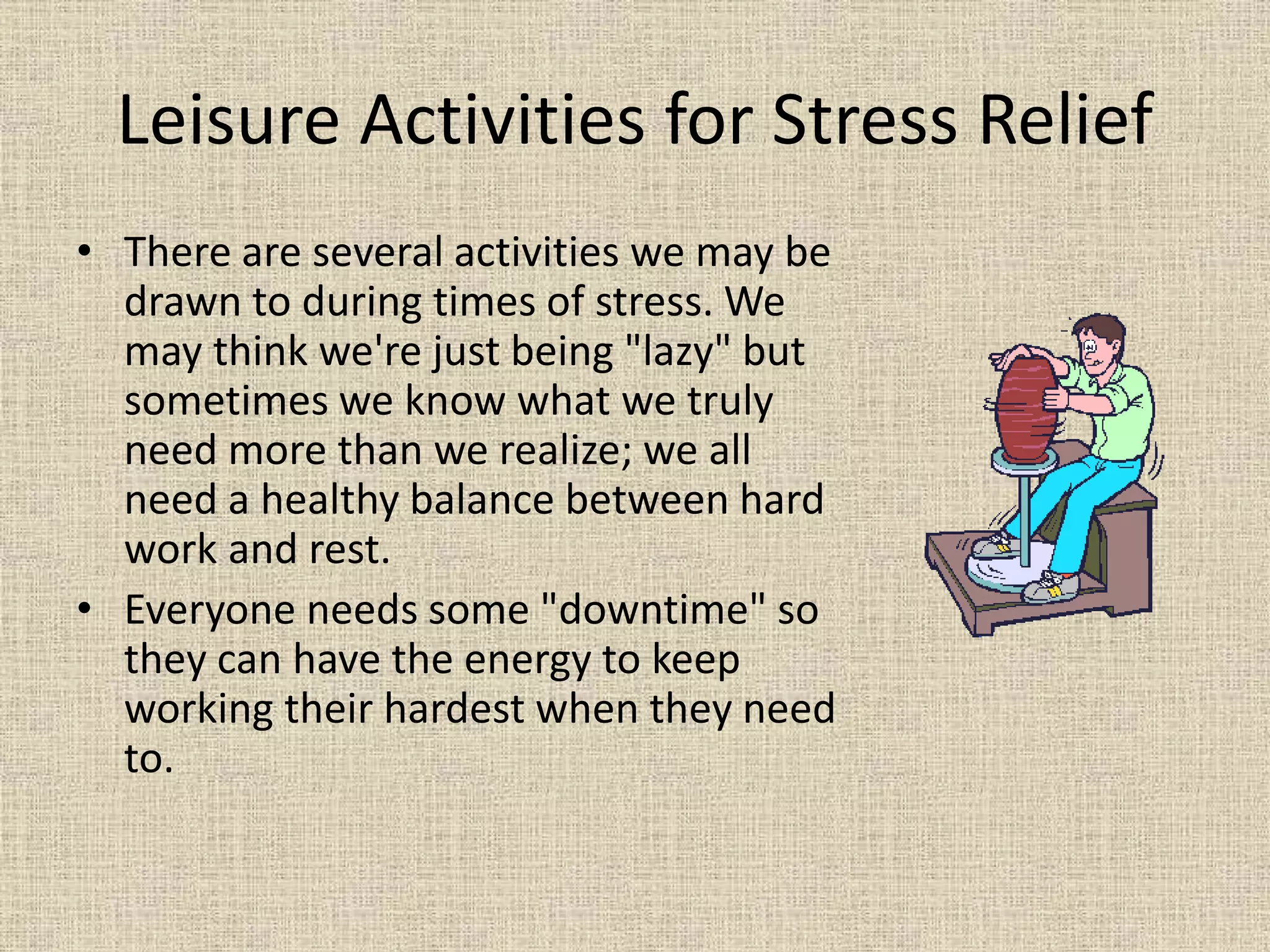
• Ceramics/pottery
• Coaching Little League
• Computers
• Gardening
• Home decorating
• Hunting
• Model building
• Photography
• Playing music
• Sewing
• Singing
• Stained glass making
• Volunteering
• Flower arranging
• Woodworking
Difference Among Hobby and Leisure
Activity
• A hobby would be a passion or interest
you invest time, effort and often money
into a regular constructive activity in
deliberate way
• Leisure time would be your free time
outside of work, other responsibilities
including your hobby that you engaged in
other recreational or leisure type
activities.
Leisure Activity
• An activity chosen for pleasure, relaxation,
or other emotional satisfaction, typically aft
er work and other responsibilities are done.
• Leisure time allows you to step back —
physically but most important, mentally —
from stress. ... During leisure activities, you
will be disconnected from the outside
world. You will be empowering yourself to
deal with situations in a less stressful way.
Leisure activities
• Health is a complex phenomenon,
analogous to which leisure can also be
considered as holistic: It affects our
physical, mental and emotional well-
being (health), promotes social
integration, socialises, educates, exercises
an effect on balancing sexual energies, it
can be the means of expressing our
identity, and its performance is
connected to our natural and built
environment.
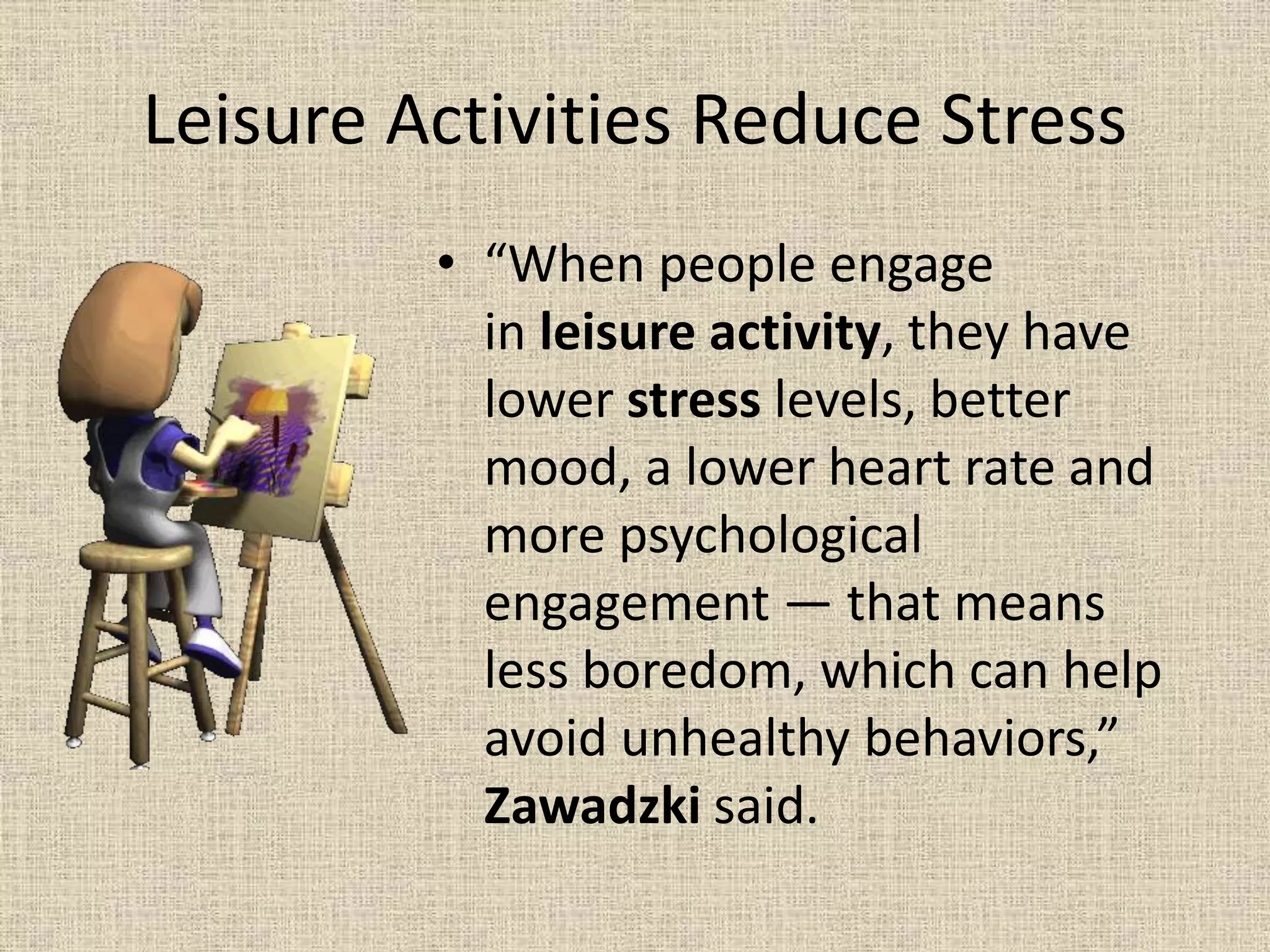
Leisure Activities Reduce Stress
• “When people engage
in leisure activity, they have
lower stress levels, better
mood, a lower heart rate and
more psychological
engagement — that means
less boredom, which can help
avoid unhealthy behaviors,”
Zawadzki said.
Use Leisure Time to Cope With Stress
• Being busy people, most of us have at least some ambivalence about
"doing nothing." Most people carry a heavy load of responsibilities for
work and family and need to remain productive. Our time is valuable, and
we don't want to waste it. (Even when on vacation, many people not only
structure their schedules and over-plan activities but bring work along
with them as well!) Unstructured time, leisure time may feel like wasted
time to many.
• Interestingly, sometimes we need to spend some idle time relaxing so that
we can remain productive.
• Because too much of the wrong kind of unmanaged stress can lead to
decreased motivation and even burnout, it's important to find
effective coping strategies for this stress and taking a break to do what
feels like nothing can be a key to managing this stress. Leisure time helps
us to cope with stressful days.
Leisure Activities for Stress Relief
• There are several activities we may be
drawn to during times of stress. We
may think we're just being "lazy" but
sometimes we know what we truly
need more than we realize; we all
need a healthy balance between hard
work and rest.
• Everyone needs some "downtime" so
they can have the energy to keep
working their hardest when they need
to.
Walking
• Getting your body going can help you reduce
stress. If you find yourself overwhelmed,
consider upping the amount of physical
activity you do.
• Although no one is considered an athlete for
walking often, it doesn’t mean that it is devoid
of benefits. Walking offers a simple way of
getting your body going without being too
taxing.
• If you’re intimidated by other physical
activities, start by getting into the habit of
walking for 30 minutes every once in a while.
Hiking
• If you find yourself getting sick from all the stress in
your life, you need to get yourself into nature.
Hiking can get you to beautiful places, which may
help boost your mood.
• A study has shown that immersing yourself in
nature, even for 20 minutes, can help reduce your
stress hormone levels.
Making Art
• The simple act of creating something
from scratch can be relaxing. At the
same time, it’s something within your
control.
• You might want to consider leisure
activities like painting, sketching, and
the like to help reduce your stress.
Not only is art a great way of calming
yourself, but it is also a great form of
self-expression.
Knitting
• Speaking of creating something
from scratch, you might want to
start getting into knitting.
• Not only is knitting a great hobby
that allows you to create
something, but it is also quite
meditative. There is such a thing
called mindful knitting, which
makes people focus less on
what’s going on in the outside
world and more into their
knitting.
Dancing
• Moving your body, in
whatever way you can, helps
you be more focused on what
your body is doing. You’re
letting loose.
• You don’t even have to dance
well to benefit from the
freeing feeling of dancing.
Simply dancing alone in your
room and letting yourself
drown in the movement of
your body is already releasing
stress.
Listening Music
• Leisure activities don’t have to be complex to
provide stress-reducing benefits. Listening to
music you love can already help reduce stress
levels.
• There’s even a study on how music can reduce
stress and anxiety in people with coronary
heart disease.
Watching Movie
• Even if you’re watching a sad movie,
it can still help boost your endorphin
levels.
• Endorphins Definition: These are
hormones that relieve pain and
boost feelings of pleasure.
• Do you have a list of movies on your
to-watch list that you haven’t gotten
around to yet? Then, maybe it’s time
that you get back to it and start
knocking them out one-by-one.
Reading a Book
• Leisure activities like reading a book are great for
relaxation. The great thing about books is you can
carry them anywhere so you can always whip them
out when you want.
• You can read while on your commute, laying on your
couch, or even when you’re soaking in the tub. If
you’ve been hoarding books and feeling stressed,
then crack one open.
• If you haven’t been into reading, then perhaps now is
the time to start. It’s a great hobby to develop that
helps you live a stress-free life.
Watching Aquariums
• Watching fish may sound like watching paint dry,
but studies have shown that there are wellness
benefits to looking at current events in the
aquarium.
• It goes to show that even the most mundane
activities can help you develop a more stable
mental well-being. So, if you’re looking for a
destination to unwind in, then why not go to your
nearest aquarium that practice safe animal care?
• After all, there must be a reason a lot of dentist
offices have aquariums, right?
Playing with Pet
• Playing with Your Pet
• The reason why cat videos are
popular on the Internet may be
because of their stress-reducing
effect. There are many studies that
associate stress relief with owning
pets so if you’ve got a furry (or not-
furry) friend with you, then consider
spending more time with them.
• Why not hit two birds with one stone
by going on a walk with them?
Choice an activity is Yours
• There are many leisure activities that have a stress-
relieving effect on people. From physical activities to
simply taking a break, stress management doesn’t
have to be a complicated affair.
• As long as you take the time to disconnect from your
stresses, then you should be able to deal with
whatever’s on your plate.
Hobbies, Leisure Activities reduce Stress and improve personality by S.Lakshmanan, Psychologist

Hobbies, Leisure Activities reduce Stress and improve personality by S.Lakshmanan, Psychologist

  • 1.
  • 2.
    Hobby • anactivityorinterestpursuedforpleasureor relaxationandnotasamainoccupation. • anactivitydoneregularlyinone'sleisuretimefor pleasure. •Ahobbyisanactivitythatyoudoinyoursparetime forfun....Inthe13thcenturythe wordhobbyreferredtoasmallhorseorapony.It latercametodescribeatoyhorse—ahobbyhorse. It'sfromthehobbyhorsethattheword'smodern senseof“favoritepastime”evolved.
  • 3.
    Hobby • Having ahobby that we enjoy brings us joy and enriches our lives. It gives us something fun to do during our leisure time and affords us the opportunity to learn new skills. We are very fortunate to have so many different options out there today.
  • 4.
    Cultivating a newHobby • The best way to cultivate a new hobby is to try something new. The world is full of wonderful, exciting activities that we can explore and adopt as our own. Of course, all of us are unique and, therefore, our interests and hobbies vary. But once we find a hobby that we truly enjoy and are passionate about, we become hooked. It becomes part of our lives and captivates us in a very personal way.
  • 5.
    Advantage of Hobby Thereare many reasons why all of us should have at least one hobby, but here are the main advantages: 1. It makes you more interesting. People who have hobbies have experiences and stories that they can share with others. They also have specialized knowledge that they can teach to anyone who also has an interest in the same topics as they do.
  • 6.
    2. It helpsto relieve stress by keeping you engaged in something you enjoy. Hobbies give you a way to take your mind off the stresses of everyday life. They let you relax and seek pleasure in activities that aren’t associated with work, chores or other responsibilities. Advantage of Hobby
  • 7.
    3. Hobbies helpyou become more patient. In order to develop a new hobby, you have to learn how to do something that is brand new to you. The odds are there will be a learning curve, and you will need to be patient in order to build your skills. Advantage of Hobby
  • 8.
    4. Having ahobby can help your social life and create a bond with others. A hobby is something that you can frequently enjoy with other people. Whether you join a club, play in a league, or just gift others with the fruits of your labor, a hobby is a great way to meet and get closer to people who have the same interests as you do. Advantage of Hobby
  • 9.
    5. It increasesyour confidence and self-esteem. The odds are that if you really enjoy an activity, you are usually pretty good at it. Any activity that you can excel in is an opportunity for you to build your confidence and develop pride in your accomplishments. Advantage of Hobby
  • 10.
    6. Hobbies helpreduce or eradicate boredom. They give you something to do when you find yourself with nothing to fill your time. They also give you an activity that you can look forward to and get excited about. Advantage of Hobby
  • 11.
    7. It helpsyou develop new skills. A hobby that you really dedicate your time to will lead you to build new skills. As you spend more time at your hobby you will become better and better at it. Advantage of Hobby
  • 12.
    8. It increasesyour knowledge. Along with building new skills, you will also gain new knowledge through the development of your hobby. Advantage of Hobby
  • 13.
    9. It enrichesyour life and gives you a different perspective on things. No matter what type of hobby you choose, you will definitely be exposed to new ideas. Hobbies help you grow in various ways, including exposing you to new opinions and to new ways to look at life Advantage of Hobby
  • 14.
    10. It challengesyou. When you pick a new hobby, you will be involved in activities that are novel and challenging. If you don’t find your hobby challenging, then you also won’t find it engaging, and it will be less enjoyable. That means you need to find a better hobby. Advantage of Hobby
  • 15.
    11. It helpsprevent bad habits and wasting time. There is an old saying that “idle hands are the devil’s workshop.” If you have good hobbies to fill up your free time, then you will be less likely to spend that time on wasteful or negative activities. Advantage of Hobby
  • 16.
    Hobbies reduce Stress •Hobbies bring a sense of fun and freedom to life that can help to minimize the impact of chronic stress. • Those who feel overwhelmed at a job, for example, can benefit from hobbies because they provide an outlet for stress and something to look forward to after a hard day (or week) at a stressful job.
  • 17.
    Health Benefits ofHobbies • One study found that those who engage in physical leisure activities for at least 20 minutes once a week are less susceptible to fatigue. • Other research found that enjoyable activities performed during leisure time were associated with lower blood pressure, total cortisol, waist circumference, and body mass index, and perceptions of better physical function. Such activities were also correlated with higher levels of positive psychosocial states and lower levels of depression and negative effect. • Ultimately, the benefits of hobbies, both psychologically and physically, are worth exploring. Find something you enjoy engaging in and you create time for yourself and your health!
  • 18.
    Health Benefits ofHobbies Taking a Break • Hobbies provide a slice of work-free and responsibility-free time in your schedule. This can be especially welcome for people who feel overwhelmed by all that they have to do and need to recharge their batteries by doing something they enjoy. • For those who feel overwhelmed by responsibility, it may be difficult to find the time or give themselves permission to take a break from a busy schedule and just sit and relax. • Either way, hobbies provide a nice break during a busy week.
  • 19.
    Health Benefits ofHobbies Experiencing Eustress • For those who aren’t overly stressed and may actually be under-stimulated, hobbies provide a nice source of eustress, the healthy kind of stress that we all need to remain feeling excited about life. • If the rest of your life is somewhat dull or uninspiring, hobbies can provide meaning and fun and can break up a boring schedule without feeling like work. In other words, hobbies can provide just the right amount of challenge.
  • 20.
    Health Benefits ofHobbies Having a Social Outlet • Many hobbies lend themselves to group activities: golfing rotations, knitting circles, and creative writing groups are good examples. • Hobbies that connect you with others can bring the added benefit of social support, which can bring stress relief and meaning to life in a fun way. • The friends you have fun with can become some of your best friends, so hobbies that bring you closer to others are well worth your time.
  • 21.
    Health Benefits ofHobbies Enjoying Positive Pleasures • Positive psychology, a relatively new branch of psychology that studies what makes life worthwhile, has discovered that pleasures—activities that bring fun to life—can be wonderful for relaxation and enjoyment of the moment. • Pleasures can bring a lift to your mood. Since hobbies generally incorporate pleasures into your life, maintaining hobbies can be good for your overall sense of joy.
  • 22.
    Health Benefits ofHobbies Receiving Gratifications • Also from positive psychology, satisfactions are important activities that bring meaning and fun to life. Gratifications present the kind of challenge that requires us to use some of our best personal skills and engages us in a sense of flow, which can put us in a near-meditative state where we lose track of time and feel removed from the stressors of life, and fully engage in what we are doing. • Gratifications can lead to a reduction in stress and a sense of well-being, and hobbies are usually experienced as gratifications. If you want more happiness and fewer stress experiences in your life, hobbies provide a direct route to gratifications that can lead to this.
  • 23.
    Health Benefits ofHobbies • Staving Off Burnout • Hobbies bring a sense of fun and freedom to life that can help to minimize the impact of chronic stress. Those who feel overwhelmed at a job, for example, can benefit from hobbies because they provide an outlet for stress and something to look forward to after a hard day (or week) at a stressful job. • Some research shows that those who are in stressful jobs that normally contribute to burnout (low-control, high-demand jobs, for example) feel less of a need to "recover" from their day at bedtime if they have more physical or social leisure activities that aren’t work-related—or in other words, more hobbies. • In this study, those who had a need to "recover" at bedtime were more likely to suffer from negative health and wellness outcomes like psychosomatic complaints and fatigue.
  • 24.
    • In otherwords, hobbies can help buffer the effects of a stressful job and mitigate factors that contribute to burnout. Health Benefits of Hobbies
  • 25.
    List of Hobbies •Aquarium making • Arts and crafts • Cooking/baking • Auto repairing • Carpentry • Ceramics/pottery • Coaching Little League • Computers • Gardening • Home decorating • Hunting • Model building • Photography • Playing music • Sewing • Singing • Stained glass making • Volunteering • Flower arranging • Woodworking
  • 26.
    Difference Among Hobbyand Leisure Activity • A hobby would be a passion or interest you invest time, effort and often money into a regular constructive activity in deliberate way • Leisure time would be your free time outside of work, other responsibilities including your hobby that you engaged in other recreational or leisure type activities.
  • 27.
    Leisure Activity • Anactivity chosen for pleasure, relaxation, or other emotional satisfaction, typically aft er work and other responsibilities are done. • Leisure time allows you to step back — physically but most important, mentally — from stress. ... During leisure activities, you will be disconnected from the outside world. You will be empowering yourself to deal with situations in a less stressful way.
  • 28.
    Leisure activities • Healthis a complex phenomenon, analogous to which leisure can also be considered as holistic: It affects our physical, mental and emotional well- being (health), promotes social integration, socialises, educates, exercises an effect on balancing sexual energies, it can be the means of expressing our identity, and its performance is connected to our natural and built environment.
  • 29.
    Leisure Activities ReduceStress • “When people engage in leisure activity, they have lower stress levels, better mood, a lower heart rate and more psychological engagement — that means less boredom, which can help avoid unhealthy behaviors,” Zawadzki said.
  • 30.
    Use Leisure Timeto Cope With Stress • Being busy people, most of us have at least some ambivalence about "doing nothing." Most people carry a heavy load of responsibilities for work and family and need to remain productive. Our time is valuable, and we don't want to waste it. (Even when on vacation, many people not only structure their schedules and over-plan activities but bring work along with them as well!) Unstructured time, leisure time may feel like wasted time to many. • Interestingly, sometimes we need to spend some idle time relaxing so that we can remain productive. • Because too much of the wrong kind of unmanaged stress can lead to decreased motivation and even burnout, it's important to find effective coping strategies for this stress and taking a break to do what feels like nothing can be a key to managing this stress. Leisure time helps us to cope with stressful days.
  • 31.
    Leisure Activities forStress Relief • There are several activities we may be drawn to during times of stress. We may think we're just being "lazy" but sometimes we know what we truly need more than we realize; we all need a healthy balance between hard work and rest. • Everyone needs some "downtime" so they can have the energy to keep working their hardest when they need to.
  • 32.
    Walking • Getting yourbody going can help you reduce stress. If you find yourself overwhelmed, consider upping the amount of physical activity you do. • Although no one is considered an athlete for walking often, it doesn’t mean that it is devoid of benefits. Walking offers a simple way of getting your body going without being too taxing. • If you’re intimidated by other physical activities, start by getting into the habit of walking for 30 minutes every once in a while.
  • 33.
    Hiking • If youfind yourself getting sick from all the stress in your life, you need to get yourself into nature. Hiking can get you to beautiful places, which may help boost your mood. • A study has shown that immersing yourself in nature, even for 20 minutes, can help reduce your stress hormone levels.
  • 34.
    Making Art • Thesimple act of creating something from scratch can be relaxing. At the same time, it’s something within your control. • You might want to consider leisure activities like painting, sketching, and the like to help reduce your stress. Not only is art a great way of calming yourself, but it is also a great form of self-expression.
  • 35.
    Knitting • Speaking ofcreating something from scratch, you might want to start getting into knitting. • Not only is knitting a great hobby that allows you to create something, but it is also quite meditative. There is such a thing called mindful knitting, which makes people focus less on what’s going on in the outside world and more into their knitting.
  • 36.
    Dancing • Moving yourbody, in whatever way you can, helps you be more focused on what your body is doing. You’re letting loose. • You don’t even have to dance well to benefit from the freeing feeling of dancing. Simply dancing alone in your room and letting yourself drown in the movement of your body is already releasing stress.
  • 37.
    Listening Music • Leisureactivities don’t have to be complex to provide stress-reducing benefits. Listening to music you love can already help reduce stress levels. • There’s even a study on how music can reduce stress and anxiety in people with coronary heart disease.
  • 38.
    Watching Movie • Evenif you’re watching a sad movie, it can still help boost your endorphin levels. • Endorphins Definition: These are hormones that relieve pain and boost feelings of pleasure. • Do you have a list of movies on your to-watch list that you haven’t gotten around to yet? Then, maybe it’s time that you get back to it and start knocking them out one-by-one.
  • 39.
    Reading a Book •Leisure activities like reading a book are great for relaxation. The great thing about books is you can carry them anywhere so you can always whip them out when you want. • You can read while on your commute, laying on your couch, or even when you’re soaking in the tub. If you’ve been hoarding books and feeling stressed, then crack one open. • If you haven’t been into reading, then perhaps now is the time to start. It’s a great hobby to develop that helps you live a stress-free life.
  • 40.
    Watching Aquariums • Watchingfish may sound like watching paint dry, but studies have shown that there are wellness benefits to looking at current events in the aquarium. • It goes to show that even the most mundane activities can help you develop a more stable mental well-being. So, if you’re looking for a destination to unwind in, then why not go to your nearest aquarium that practice safe animal care? • After all, there must be a reason a lot of dentist offices have aquariums, right?
  • 41.
    Playing with Pet •Playing with Your Pet • The reason why cat videos are popular on the Internet may be because of their stress-reducing effect. There are many studies that associate stress relief with owning pets so if you’ve got a furry (or not- furry) friend with you, then consider spending more time with them. • Why not hit two birds with one stone by going on a walk with them?
  • 42.
    Choice an activityis Yours • There are many leisure activities that have a stress- relieving effect on people. From physical activities to simply taking a break, stress management doesn’t have to be a complicated affair. • As long as you take the time to disconnect from your stresses, then you should be able to deal with whatever’s on your plate.