Career Development Programmes
for Digital Health Practitioners
Programme Information
Brian Ng
1#ISSLearningFest
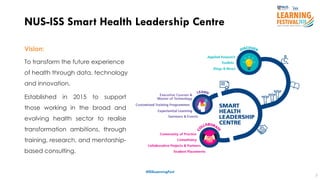
NUS-ISS Smart Health Leadership Centre
2
Vision:
To transform the future experience
of health through data, technology
and innovation.
Established in 2015 to support
those working in the broad and
evolving health sector to realise
transformation ambitions, through
training, research, and mentorship-
based consulting.
#ISSLearningFest
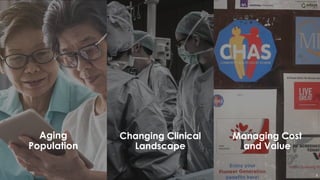
Aging
Population
3
Changing Clinical
Landscape
Managing Cost
and Value
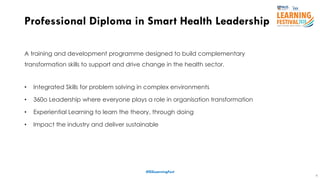
Professional Diploma in Smart Health Leadership
A training and development programme designed to build complementary
transformation skills to support and drive change in the health sector.
• Integrated Skills for problem solving in complex environments
• 360o Leadership where everyone plays a role in organisation transformation
• Experiential Learning to learn the theory, through doing
• Impact the industry and deliver sustainable
4
#ISSLearningFest
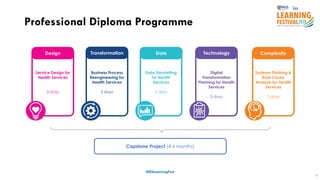
Professional Diploma Programme
5
#ISSLearningFest
Systems Thinking &
Root Cause
Analysis for Health
Services
2 days
ComplexityDesign
Service Design for
Health Services
3 days
Data
Data Storytelling
for Health
Services
3 days
Technology
Digital
Transformation
Planning for Health
Services
3 days
Transformation
Business Process
Reengineering for
Health Services
3 days
Capstone Project (4-6 months)
6
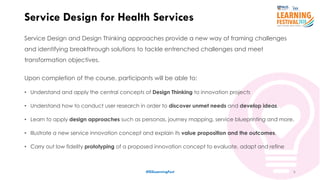
Service Design and Design Thinking approaches provide a new way of framing challenges
and identifying breakthrough solutions to tackle entrenched challenges and meet
transformation objectives.
Upon completion of the course, participants will be able to:
• Understand and apply the central concepts of Design Thinking to innovation projects
• Understand how to conduct user research in order to discover unmet needs and develop ideas.
• Learn to apply design approaches such as personas, journey mapping, service blueprinting and more.
• Illustrate a new service innovation concept and explain its value proposition and the outcomes.
• Carry out low fidelity prototyping of a proposed innovation concept to evaluate, adapt and refine
Service Design for Health Services
#ISSLearningFest
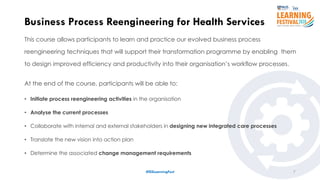
This course allows participants to learn and practice our evolved business process
reengineering techniques that will support their transformation programme by enabling them
to design improved efficiency and productivity into their organisation’s workflow processes.
At the end of the course, participants will be able to:
• Initiate process reengineering activities in the organisation
• Analyse the current processes
• Collaborate with internal and external stakeholders in designing new integrated care processes
• Translate the new vision into action plan
• Determine the associated change management requirements
7
Business Process Reengineering for Health Services
#ISSLearningFest
8
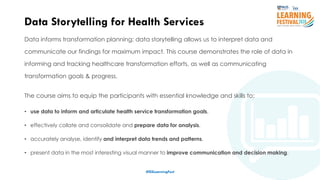
Data informs transformation planning; data storytelling allows us to interpret data and
communicate our findings for maximum impact. This course demonstrates the role of data in
informing and tracking healthcare transformation efforts, as well as communicating
transformation goals & progress.
The course aims to equip the participants with essential knowledge and skills to:
• use data to inform and articulate health service transformation goals,
• effectively collate and consolidate and prepare data for analysis,
• accurately analyse, identify and interpret data trends and patterns,
• present data in the most interesting visual manner to improve communication and decision making.
Data Storytelling for Health Services
#ISSLearningFest
9
In a rapidly evolving technology landscape it can be challenging to determine the most
appropriate technologies to invest in to support healthcare organizations' transformation
goals. This course is designed to help participants understand how to identify emerging
technology trends, and to assess their potential role and impact in achieving the
organization's objectives.
At the end of this course, participants will be able to:
• Understand the organisational model and transformation goals
• Analyse the internal and external factors impacting the organisation
• Identify and prioritize digital opportunities in relation to the transformation and organisation objectives
• Create a digital transformation plan to support informed dialogue between the transformation team
and the IT team
Digital Transformation Planning for Health Services
#ISSLearningFest
10
The course is designed to assist participants in appreciating the wider impacts and
opportunities associated with their decision making and solutioning processes. Participants
will learn to apply complexity and systems thinking models in the health or social care sector.
Upon completion of the course, participants will be able to:
• Understand the importance and key principles of systems thinking
• Devise appropriate solutions based on systems thinking research, analysis, and sense making
• Understand the importance and opportunities for stakeholder engagement through the systems
thinking process
• Determine when and how to apply a variety of systems thinking tools, templates, frameworks
Systems Thinking & Root Cause Analysis
for Health Services
#ISSLearningFest
11
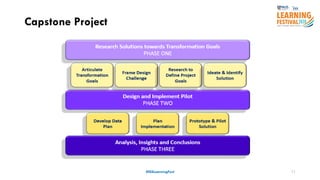
Capstone Project
#ISSLearningFest
12
Project topic and scope will be defined by the sponsoring company. Company
sponsoring the project will appoint a project sponsor and a project supervisor;
Project Sponsor:
• define direction and scope of the project from the organization’s point of view,
• ensure that resources are in place, help to remove obstacles, and promote the project.
• determine if the project was a success from the organizations perspective.
• Usually someone in a senior position (e.g. head of division/department, senior management).
Project Supervisor:
• work closely with the project team to grant access to information and/or facilitate connections
necessary for the project to take place.
• point of contact from the sponsoring company (e.g. team lead, manager).
Industry Projects
#ISSLearningFest
13
Team Composition
• The project may be delivered by an individual or by a project team of up to 5 members.
The size of the team must correlate with the scale of the project.
• Each member of the team must be responsible for undertaking a specific set of tasks
towards achieving the final outcomes and to enable assessment of individual abilities.
NUS ISS Project Advisor
• Each project team will be assigned an NUS-ISS advisor. The advisor will help to reinforce the
participant’s application of the skills and knowledge during the mentoring, and review of
the deliverables.
Project Team and Support
#ISSLearningFest
Past Capstone Projects
14
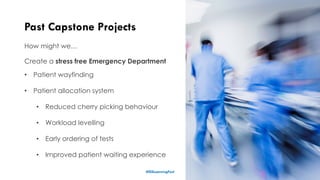
How might we…
Create a stress free Emergency Department
• Patient wayfinding
• Patient allocation system
• Reduced cherry picking behaviour
• Workload levelling
• Early ordering of tests
• Improved patient waiting experience
#ISSLearningFest
Past Capstone Projects
15
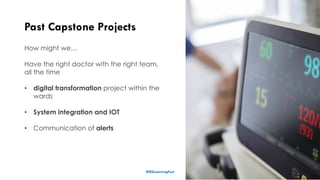
How might we…
Have the right doctor with the right team,
all the time
• digital transformation project within the
wards
• System integration and IOT
• Communication of alerts
#ISSLearningFest
Past Capstone Projects
16
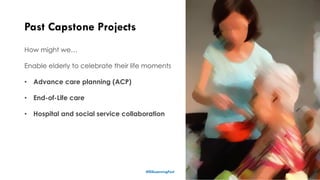
How might we…
Enable elderly to celebrate their life moments
• Advance care planning (ACP)
• End-of-Life care
• Hospital and social service collaboration
#ISSLearningFest
17
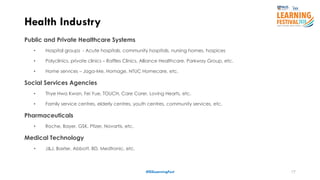
Health Industry
Public and Private Healthcare Systems
• Hospital groups - Acute hospitals, community hospitals, nursing homes, hospices
• Polyclinics, private clinics – Raffles Clinics, Alliance Healthcare, Parkway Group, etc.
• Home services – Jaga-Me, Homage, NTUC Homecare, etc.
Social Services Agencies
• Thye Hwa Kwan, Fei Yue, TOUCH, Care Corer, Loving Hearts, etc.
• Family service centres, elderly centres, youth centres, community services, etc.
Pharmaceuticals
• Roche, Bayer, GSK, Pfizer, Novartis, etc.
Medical Technology
• J&J, Baxter, Abbott, BD, Medtronic, etc.
#ISSLearningFest
18
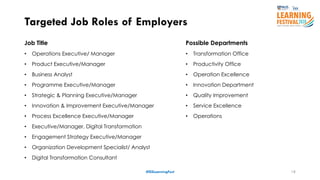
Targeted Job Roles of Employers
Job Title
• Operations Executive/ Manager
• Product Executive/Manager
• Business Analyst
• Programme Executive/Manager
• Strategic & Planning Executive/Manager
• Innovation & Improvement Executive/Manager
• Process Excellence Executive/Manager
• Executive/Manager, Digital Transformation
• Engagement Strategy Executive/Manager
• Organization Development Specialist/ Analyst
• Digital Transformation Consultant
Possible Departments
• Transformation Office
• Productivity Office
• Operation Excellence
• Innovation Department
• Quality Improvement
• Service Excellence
• Operations
#ISSLearningFest
19
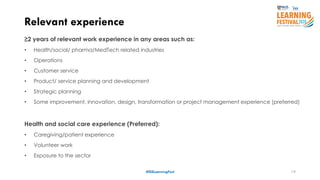
Relevant experience
≥2 years of relevant work experience in any areas such as:
• Health/social/ pharma/MedTech related industries
• Operations
• Customer service
• Product/ service planning and development
• Strategic planning
• Some improvement, innovation, design, transformation or project management experience (preferred)
Health and social care experience (Preferred):
• Caregiving/patient experience
• Volunteer work
• Exposure to the sector
#ISSLearningFest
Professional Conversion Programme (PCP)
#ISSLearningFest
21
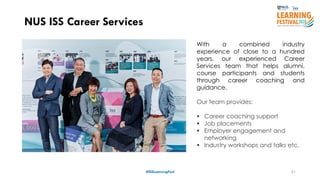
NUS ISS Career Services
#ISSLearningFest
With a combined industry
experience of close to a hundred
years, our experienced Career
Services team that helps alumni,
course participants and students
through career coaching and
guidance.
Our team provides:
 Career coaching support
 Job placements
 Employer engagement and
networking
 Industry workshops and talks etc.
22
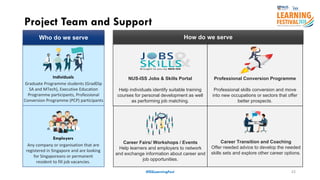
Project Team and Support
#ISSLearningFest
Individuals
Graduate Programme students (GradDip
SA and MTech), Executive Education
Programme participants, Professional
Conversion Programme (PCP) participants
Who do we serve
Employers
Any company or organisation that are
registered in Singapore and are looking
for Singaporeans or permanent
resident to fill job vacancies.
NUS-ISS Jobs & Skills Portal
Help individuals identify suitable training
courses for personal development as well
as performing job matching.
Professional Conversion Programme
Professional skills conversion and move
into new occupations or sectors that offer
better prospects.
How do we serve
Career Fairs/ Workshops / Events
Help learners and employers to network
and exchange information about career and
job opportunities.
Career Transition and Coaching
Offer needed advice to develop the needed
skills sets and explore other career options.
23
Professional Conversion Programme (PCP)
#ISSLearningFest
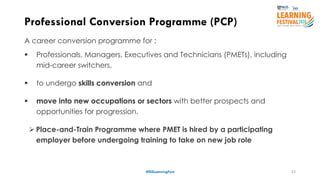
A career conversion programme for :
 Professionals, Managers, Executives and Technicians (PMETs), including
mid-career switchers,
 to undergo skills conversion and
 move into new occupations or sectors with better prospects and
opportunities for progression.
 Place-and-Train Programme where PMET is hired by a participating
employer before undergoing training to take on new job role
24
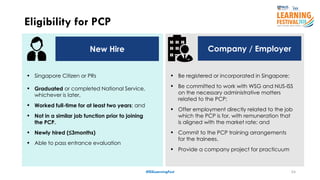
Eligibility for PCP
#ISSLearningFest
New Hire Company / Employer
 Be registered or incorporated in Singapore;
 Be committed to work with WSG and NUS-ISS
on the necessary administrative matters
related to the PCP;
 Offer employment directly related to the job
which the PCP is for, with remuneration that
is aligned with the market rate; and
 Commit to the PCP training arrangements
for the trainees.
 Provide a company project for practicuum
 Singapore Citizen or PRs
 Graduated or completed National Service,
whichever is later,
 Worked full-time for at least two years; and
 Not in a similar job function prior to joining
the PCP.
 Newly hired (≤3months)
 Able to pass entrance evaluation
25
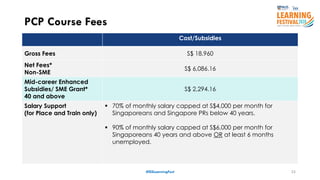
PCP Course Fees
#ISSLearningFest
Cost/Subsidies
Gross Fees S$ 18,960
Net Fees*
Non-SME
S$ 6,086.16
Mid-career Enhanced
Subsidies/ SME Grant*
40 and above
S$ 2,294.16
Salary Support
(for Place and Train only)
 70% of monthly salary capped at S$4,000 per month for
Singaporeans and Singapore PRs below 40 years.
 90% of monthly salary capped at S$6,000 per month for
Singaporeans 40 years and above OR at least 6 months
unemployed.
26
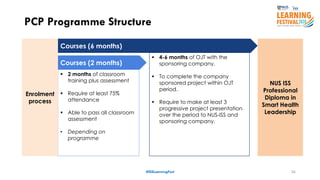
PCP Programme Structure
#ISSLearningFest
Courses (2 months)
Courses (6 months)
 2 months of classroom
training plus assessment
 Require at least 75%
attendance
 Able to pass all classroom
assessment
• Depending on
programme
 4-6 months of OJT with the
sponsoring company.
 To complete the company
sponsored project within OJT
period.
 Require to make at least 3
progressive project presentation
over the period to NUS-ISS and
sponsoring company.
NUS ISS
Professional
Diploma in
Smart Health
Leadership
Enrolment
process
27
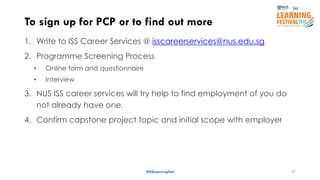
To sign up for PCP or to find out more
#ISSLearningFest
1. Write to ISS Career Services @ isscareerservices@nus.edu.sg
2. Programme Screening Process
• Online form and questionnaire
• Interview
3. NUS ISS career services will try help to find employment of you do
not already have one.
4. Confirm capstone project topic and initial scope with employer
28
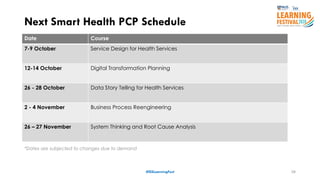
Next Smart Health PCP Schedule
#ISSLearningFest
Date Course
7-9 October Service Design for Health Services
12-14 October Digital Transformation Planning
26 - 28 October Data Story Telling for Health Services
2 - 4 November Business Process Reengineering
26 – 27 November System Thinking and Root Cause Analysis
*Dates are subjected to changes due to demand
Thank you!
brian.ng@nus.edu.sg
isscareerservices@nus.edu.sg
#ISSLearningFest
Give Us Your Feedback
#ISSLearningFest
Day 4 Programme
31© National University of Singapore. All Rights Reserved
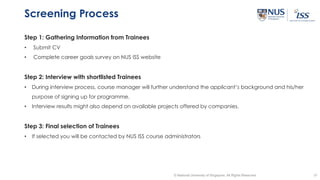
Screening Process
Step 1: Gathering Information from Trainees
• Submit CV
• Complete career goals survey on NUS ISS website
Step 2: Interview with shortlisted Trainees
• During interview process, course manager will further understand the applicant’s background and his/her
purpose of signing up for programme.
• Interview results might also depend on available projects offered by companies.
Step 3: Final selection of Trainees
• If selected you will be contacted by NUS ISS course administrators
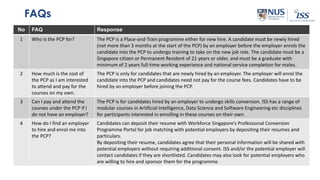
FAQs
No FAQ Response
1 Who is the PCP for? The PCP is a Place-and-Train programme either for new hire. A candidate must be newly hired
(not more than 3 months at the start of the PCP) by an employer before the employer enrols the
candidate into the PCP to undergo training to take on the new job role. The candidate must be a
Singapore citizen or Permanent Resident of 21 years or older, and must be a graduate with
minimum of 2 years full-time working experience and national service completion for males.
2 How much is the cost of
the PCP as I am interested
to attend and pay for the
courses on my own.
The PCP is only for candidates that are newly hired by an employer. The employer will enrol the
candidate into the PCP and candidates need not pay for the course fees. Candidates have to be
hired by an employer before joining the PCP.
3 Can I pay and attend the
courses under the PCP if I
do not have an employer?
The PCP is for candidates hired by an employer to undergo skills conversion. ISS has a range of
modular courses in Artificial Intelligence, Data Science and Software Engineering etc disciplines
for participants interested in enrolling in these courses on their own.
4 How do I find an employer
to hire and enrol me into
the PCP?
Candidates can deposit their resume with Workforce Singapore’s Professional Conversion
Programme Portal for job matching with potential employers by depositing their resumes and
particulars.
By depositing their resume, candidates agree that their personal information will be shared with
potential employers without requiring additional consent. ISS and/or the potential employer will
contact candidates if they are shortlisted. Candidates may also look for potential employers who
are willing to hire and sponsor them for the programme.
FAQs
No FAQ Response
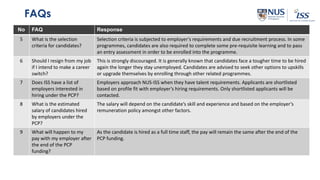
5 What is the selection
criteria for candidates?
Selection criteria is subjected to employer’s requirements and due recruitment process. In some
programmes, candidates are also required to complete some pre-requisite learning and to pass
an entry assessment in order to be enrolled into the programme.
6 Should I resign from my job
if I intend to make a career
switch?
This is strongly discouraged. It is generally known that candidates face a tougher time to be hired
again the longer they stay unemployed. Candidates are advised to seek other options to upskills
or upgrade themselves by enrolling through other related programmes.
7 Does ISS have a list of
employers interested in
hiring under the PCP?
Employers approach NUS-ISS when they have talent requirements. Applicants are shortlisted
based on profile fit with employer’s hiring requirements. Only shortlisted applicants will be
contacted.
8 What is the estimated
salary of candidates hired
by employers under the
PCP?
The salary will depend on the candidate’s skill and experience and based on the employer’s
remuneration policy amongst other factors.
9 What will happen to my
pay with my employer after
the end of the PCP
funding?
As the candidate is hired as a full time staff, the pay will remain the same after the end of the
PCP funding.
FAQs
No FAQ Response
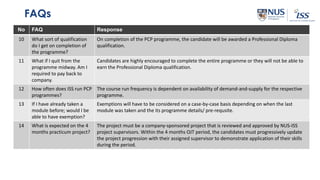
10 What sort of qualification
do I get on completion of
the programme?
On completion of the PCP programme, the candidate will be awarded a Professional Diploma
qualification.
11 What if I quit from the
programme midway. Am I
required to pay back to
company.
Candidates are highly encouraged to complete the entire programme or they will not be able to
earn the Professional Diploma qualification.
12 How often does ISS run PCP
programmes?
The course run frequency is dependent on availability of demand-and-supply for the respective
programme.
13 If I have already taken a
module before; would I be
able to have exemption?
Exemptions will have to be considered on a case-by-case basis depending on when the last
module was taken and the its programme details/ pre-requsite.
14 What is expected on the 4
months practicum project?
The project must be a company-sponsored project that is reviewed and approved by NUS-ISS
project supervisors. Within the 4 months OJT period, the candidates must progressively update
the project progression with their assigned supervisor to demonstrate application of their skills
during the period.
35© National University of Singapore. All Rights Reserved
Sample Project Topic 1
Creating a Stress-Free Emergency Department
The Emergency Department (ED) is often the starting point for patients who have to visit a hospital for
unscheduled urgent care. It is an intense environment for both patients and healthcare providers due
to the high patient volume and urgency of medical attention required.
ED is separated into 3 different sections (P1 – P3) based on patients’ acuity. P3 acuity level tackle
cases with descending criticality. Although P3 has the highest ED patient load, it often has the least
resources as doctors and nurses from P3 may be deployed to assist patients that require more
immediate medical attention.
For P3 patients, the typical wait time of 1.0 to 3.5 hours before seeing a doctor. In total, they spend 3 to
7 hours at the ED. Due to the long wait time for patients, high work volume and the need to make
quick decisions under pressure in often unpredictable situation, staff at ED P3 work in a highly stressful
environment. This stress leads to poor physical and psychological health, lower productivity and staff
burn-out.
As part of our capstone project, we wanted to create a stress-free ED which would benefit both the
patients and staff of our hospital. Taking into consideration the time constraint of three months to
complete our project, we decided to define our problem statement as “Improving staff and patient
satisfaction and reducing anxiety and stress in ED P3”.
36© National University of Singapore. All Rights Reserved
Sample Project Topic 1
Creating a Stress Free Emergency Department – Solutions Designed, prototyped and tested
• Improved way finding experience for patients inside ED facility
• New patient allocation system for P3 patients that
• Prevents cherry picking behaviour
• Improved workload distribution
• Ownership and accountability
• Enabled pre-ordering of medication, test and scans improving efficiency
• Clearer directions and reduced unnecessary travel time of patients
*Imbued an innovation culture in the Emergency Department.
37© National University of Singapore. All Rights Reserved
Sample Project Topic 2
Right Doctor with the Right Team at the Right Time, all the time, with Technology as Enabler
A clinical Improvement project done in a hospital in Singapore has shown that only X% of patients’ alerts in
Red Zone(names and data omitted for privacy reasons) are escalated to a doctor, of which the majority of
alerts go to the junior doctors like house or medical officer, instead of the required registrar or above. It, in
turn, leads to delays in treatment by the right doctor at the right time. As a result of such escalation failures,
there are a number of documented serious reportable events (SRE), some of which have led to even
patients’ deaths.
There have also been cases of missed sepsis diagnosis in patients leading to a delay in administration of
antibiotics and other relevant treatment, causing harm to the patients. Even if the nurse, wants to call the
right doctor based on patient condition, it requires her to leave patient on his or her own, find a computer
followed by finding right doctor in the system. It requires minimum 3- 5 minutes for each incident.
Rapid Response Systems (RRS) have been implemented internationally as a patient safety initiative to
improve the recognition and management of patient deterioration in hospital (Institute for Healthcare
Improvement, 2006; National Patient Safety Agency (NPSA), 2007). This team explored the use of RRS to
activate the right doctor with the right team at the right time in the inpatient wards.
38© National University of Singapore. All Rights Reserved
Sample Project Topic 2
Right Doctor with the Right Team at the Right Time, all the time, with Technology as Enabler
To implement a Rapid Response Systems (RRS) would involve multiple teams and vendors.
The project undertaken by our participants is the first phase of the project involved the proof of concept
that helped to determine;
• How much work would be generated for the parties involved
• Identify the volume of false positive messages generated per day across all the wards
• Determine the volume of alerts and if doctors will be overburdened with alter messages
• Explore restructuring of alert escalation processes with the implementation of technology
• Recommendation plans for future roll out of RRS in inpatient wards for sepsis
39© National University of Singapore. All Rights Reserved
Sample Project Topic 3
Normalizing Advance Care Planning (ACP) in the Community
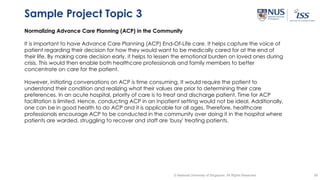
It is important to have Advance Care Planning (ACP) End-Of-Life care. It helps capture the voice of
patient regarding their decision for how they would want to be medically cared for at the end of
their life. By making care decision early, it helps to lessen the emotional burden on loved ones during
crisis. This would then enable both healthcare professionals and family members to better
concentrate on care for the patient.
However, initiating conversations on ACP is time consuming. It would require the patient to
understand their condition and realizing what their values are prior to determining their care
preferences. In an acute hospital, priority of care is to treat and discharge patient. Time for ACP
facilitation is limited. Hence, conducting ACP in an inpatient setting would not be ideal. Additionally,
one can be in good health to do ACP and it is applicable for all ages. Therefore, healthcare
professionals encourage ACP to be conducted in the community over doing it in the hospital where
patients are warded, struggling to recover and staff are 'busy' treating patients.
40© National University of Singapore. All Rights Reserved
Sample Project Topic 3
Normalizing Advance Care Planning (ACP) in the Community - Solutions
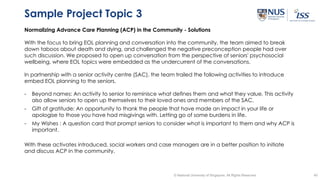
With the focus to bring EOL planning and conversation into the community, the team aimed to break
down taboos about death and dying, and challenged the negative preconception people had over
such discussion. We proposed to open up conversation from the perspective of seniors' psychosocial
wellbeing, where EOL topics were embedded as the undercurrent of the conversations.
In partnership with a senior activity centre (SAC), the team trailed the following activities to introduce
embed EOL planning to the seniors.
- Beyond names: An activity to senior to reminisce what defines them and what they value. This activity
also allow seniors to open up themselves to their loved ones and members of the SAC.
- Gift of gratitude: An opportunity to thank the people that have made an impact in your life or
apologise to those you have had misgivings with. Letting go of some burdens in life.
- My Wishes : A question card that prompt seniors to consider what is important to them and why ACP is
important.
With these activates introduced, social workers and case managers are in a better position to initiate
and discuss ACP in the community.

Career Development Programmes for Digital Health Practitioners (For Individuals)

  • 1.
    Career Development Programmes forDigital Health Practitioners Programme Information Brian Ng 1#ISSLearningFest
  • 2.
    NUS-ISS Smart HealthLeadership Centre 2 Vision: To transform the future experience of health through data, technology and innovation. Established in 2015 to support those working in the broad and evolving health sector to realise transformation ambitions, through training, research, and mentorship- based consulting. #ISSLearningFest
  • 3.
  • 4.
    Professional Diploma inSmart Health Leadership A training and development programme designed to build complementary transformation skills to support and drive change in the health sector. • Integrated Skills for problem solving in complex environments • 360o Leadership where everyone plays a role in organisation transformation • Experiential Learning to learn the theory, through doing • Impact the industry and deliver sustainable 4 #ISSLearningFest
  • 5.
    Professional Diploma Programme 5 #ISSLearningFest SystemsThinking & Root Cause Analysis for Health Services 2 days ComplexityDesign Service Design for Health Services 3 days Data Data Storytelling for Health Services 3 days Technology Digital Transformation Planning for Health Services 3 days Transformation Business Process Reengineering for Health Services 3 days Capstone Project (4-6 months)
  • 6.
    6 Service Design andDesign Thinking approaches provide a new way of framing challenges and identifying breakthrough solutions to tackle entrenched challenges and meet transformation objectives. Upon completion of the course, participants will be able to: • Understand and apply the central concepts of Design Thinking to innovation projects • Understand how to conduct user research in order to discover unmet needs and develop ideas. • Learn to apply design approaches such as personas, journey mapping, service blueprinting and more. • Illustrate a new service innovation concept and explain its value proposition and the outcomes. • Carry out low fidelity prototyping of a proposed innovation concept to evaluate, adapt and refine Service Design for Health Services #ISSLearningFest
  • 7.
    This course allowsparticipants to learn and practice our evolved business process reengineering techniques that will support their transformation programme by enabling them to design improved efficiency and productivity into their organisation’s workflow processes. At the end of the course, participants will be able to: • Initiate process reengineering activities in the organisation • Analyse the current processes • Collaborate with internal and external stakeholders in designing new integrated care processes • Translate the new vision into action plan • Determine the associated change management requirements 7 Business Process Reengineering for Health Services #ISSLearningFest
  • 8.
    8 Data informs transformationplanning; data storytelling allows us to interpret data and communicate our findings for maximum impact. This course demonstrates the role of data in informing and tracking healthcare transformation efforts, as well as communicating transformation goals & progress. The course aims to equip the participants with essential knowledge and skills to: • use data to inform and articulate health service transformation goals, • effectively collate and consolidate and prepare data for analysis, • accurately analyse, identify and interpret data trends and patterns, • present data in the most interesting visual manner to improve communication and decision making. Data Storytelling for Health Services #ISSLearningFest
  • 9.
    9 In a rapidlyevolving technology landscape it can be challenging to determine the most appropriate technologies to invest in to support healthcare organizations' transformation goals. This course is designed to help participants understand how to identify emerging technology trends, and to assess their potential role and impact in achieving the organization's objectives. At the end of this course, participants will be able to: • Understand the organisational model and transformation goals • Analyse the internal and external factors impacting the organisation • Identify and prioritize digital opportunities in relation to the transformation and organisation objectives • Create a digital transformation plan to support informed dialogue between the transformation team and the IT team Digital Transformation Planning for Health Services #ISSLearningFest
  • 10.
    10 The course isdesigned to assist participants in appreciating the wider impacts and opportunities associated with their decision making and solutioning processes. Participants will learn to apply complexity and systems thinking models in the health or social care sector. Upon completion of the course, participants will be able to: • Understand the importance and key principles of systems thinking • Devise appropriate solutions based on systems thinking research, analysis, and sense making • Understand the importance and opportunities for stakeholder engagement through the systems thinking process • Determine when and how to apply a variety of systems thinking tools, templates, frameworks Systems Thinking & Root Cause Analysis for Health Services #ISSLearningFest
  • 11.
  • 12.
    12 Project topic andscope will be defined by the sponsoring company. Company sponsoring the project will appoint a project sponsor and a project supervisor; Project Sponsor: • define direction and scope of the project from the organization’s point of view, • ensure that resources are in place, help to remove obstacles, and promote the project. • determine if the project was a success from the organizations perspective. • Usually someone in a senior position (e.g. head of division/department, senior management). Project Supervisor: • work closely with the project team to grant access to information and/or facilitate connections necessary for the project to take place. • point of contact from the sponsoring company (e.g. team lead, manager). Industry Projects #ISSLearningFest
  • 13.
    13 Team Composition • Theproject may be delivered by an individual or by a project team of up to 5 members. The size of the team must correlate with the scale of the project. • Each member of the team must be responsible for undertaking a specific set of tasks towards achieving the final outcomes and to enable assessment of individual abilities. NUS ISS Project Advisor • Each project team will be assigned an NUS-ISS advisor. The advisor will help to reinforce the participant’s application of the skills and knowledge during the mentoring, and review of the deliverables. Project Team and Support #ISSLearningFest
  • 14.
    Past Capstone Projects 14 Howmight we… Create a stress free Emergency Department • Patient wayfinding • Patient allocation system • Reduced cherry picking behaviour • Workload levelling • Early ordering of tests • Improved patient waiting experience #ISSLearningFest
  • 15.
    Past Capstone Projects 15 Howmight we… Have the right doctor with the right team, all the time • digital transformation project within the wards • System integration and IOT • Communication of alerts #ISSLearningFest
  • 16.
    Past Capstone Projects 16 Howmight we… Enable elderly to celebrate their life moments • Advance care planning (ACP) • End-of-Life care • Hospital and social service collaboration #ISSLearningFest
  • 17.
    17 Health Industry Public andPrivate Healthcare Systems • Hospital groups - Acute hospitals, community hospitals, nursing homes, hospices • Polyclinics, private clinics – Raffles Clinics, Alliance Healthcare, Parkway Group, etc. • Home services – Jaga-Me, Homage, NTUC Homecare, etc. Social Services Agencies • Thye Hwa Kwan, Fei Yue, TOUCH, Care Corer, Loving Hearts, etc. • Family service centres, elderly centres, youth centres, community services, etc. Pharmaceuticals • Roche, Bayer, GSK, Pfizer, Novartis, etc. Medical Technology • J&J, Baxter, Abbott, BD, Medtronic, etc. #ISSLearningFest
  • 18.
    18 Targeted Job Rolesof Employers Job Title • Operations Executive/ Manager • Product Executive/Manager • Business Analyst • Programme Executive/Manager • Strategic & Planning Executive/Manager • Innovation & Improvement Executive/Manager • Process Excellence Executive/Manager • Executive/Manager, Digital Transformation • Engagement Strategy Executive/Manager • Organization Development Specialist/ Analyst • Digital Transformation Consultant Possible Departments • Transformation Office • Productivity Office • Operation Excellence • Innovation Department • Quality Improvement • Service Excellence • Operations #ISSLearningFest
  • 19.
    19 Relevant experience ≥2 yearsof relevant work experience in any areas such as: • Health/social/ pharma/MedTech related industries • Operations • Customer service • Product/ service planning and development • Strategic planning • Some improvement, innovation, design, transformation or project management experience (preferred) Health and social care experience (Preferred): • Caregiving/patient experience • Volunteer work • Exposure to the sector #ISSLearningFest
  • 20.
    Professional Conversion Programme(PCP) #ISSLearningFest
  • 21.
    21 NUS ISS CareerServices #ISSLearningFest With a combined industry experience of close to a hundred years, our experienced Career Services team that helps alumni, course participants and students through career coaching and guidance. Our team provides:  Career coaching support  Job placements  Employer engagement and networking  Industry workshops and talks etc.
  • 22.
    22 Project Team andSupport #ISSLearningFest Individuals Graduate Programme students (GradDip SA and MTech), Executive Education Programme participants, Professional Conversion Programme (PCP) participants Who do we serve Employers Any company or organisation that are registered in Singapore and are looking for Singaporeans or permanent resident to fill job vacancies. NUS-ISS Jobs & Skills Portal Help individuals identify suitable training courses for personal development as well as performing job matching. Professional Conversion Programme Professional skills conversion and move into new occupations or sectors that offer better prospects. How do we serve Career Fairs/ Workshops / Events Help learners and employers to network and exchange information about career and job opportunities. Career Transition and Coaching Offer needed advice to develop the needed skills sets and explore other career options.
  • 23.
    23 Professional Conversion Programme(PCP) #ISSLearningFest A career conversion programme for :  Professionals, Managers, Executives and Technicians (PMETs), including mid-career switchers,  to undergo skills conversion and  move into new occupations or sectors with better prospects and opportunities for progression.  Place-and-Train Programme where PMET is hired by a participating employer before undergoing training to take on new job role
  • 24.
    24 Eligibility for PCP #ISSLearningFest NewHire Company / Employer  Be registered or incorporated in Singapore;  Be committed to work with WSG and NUS-ISS on the necessary administrative matters related to the PCP;  Offer employment directly related to the job which the PCP is for, with remuneration that is aligned with the market rate; and  Commit to the PCP training arrangements for the trainees.  Provide a company project for practicuum  Singapore Citizen or PRs  Graduated or completed National Service, whichever is later,  Worked full-time for at least two years; and  Not in a similar job function prior to joining the PCP.  Newly hired (≤3months)  Able to pass entrance evaluation
  • 25.
    25 PCP Course Fees #ISSLearningFest Cost/Subsidies GrossFees S$ 18,960 Net Fees* Non-SME S$ 6,086.16 Mid-career Enhanced Subsidies/ SME Grant* 40 and above S$ 2,294.16 Salary Support (for Place and Train only)  70% of monthly salary capped at S$4,000 per month for Singaporeans and Singapore PRs below 40 years.  90% of monthly salary capped at S$6,000 per month for Singaporeans 40 years and above OR at least 6 months unemployed.
  • 26.
    26 PCP Programme Structure #ISSLearningFest Courses(2 months) Courses (6 months)  2 months of classroom training plus assessment  Require at least 75% attendance  Able to pass all classroom assessment • Depending on programme  4-6 months of OJT with the sponsoring company.  To complete the company sponsored project within OJT period.  Require to make at least 3 progressive project presentation over the period to NUS-ISS and sponsoring company. NUS ISS Professional Diploma in Smart Health Leadership Enrolment process
  • 27.
    27 To sign upfor PCP or to find out more #ISSLearningFest 1. Write to ISS Career Services @ isscareerservices@nus.edu.sg 2. Programme Screening Process • Online form and questionnaire • Interview 3. NUS ISS career services will try help to find employment of you do not already have one. 4. Confirm capstone project topic and initial scope with employer
  • 28.
    28 Next Smart HealthPCP Schedule #ISSLearningFest Date Course 7-9 October Service Design for Health Services 12-14 October Digital Transformation Planning 26 - 28 October Data Story Telling for Health Services 2 - 4 November Business Process Reengineering 26 – 27 November System Thinking and Root Cause Analysis *Dates are subjected to changes due to demand
  • 29.
  • 30.
    Give Us YourFeedback #ISSLearningFest Day 4 Programme
  • 31.
    31© National Universityof Singapore. All Rights Reserved Screening Process Step 1: Gathering Information from Trainees • Submit CV • Complete career goals survey on NUS ISS website Step 2: Interview with shortlisted Trainees • During interview process, course manager will further understand the applicant’s background and his/her purpose of signing up for programme. • Interview results might also depend on available projects offered by companies. Step 3: Final selection of Trainees • If selected you will be contacted by NUS ISS course administrators
  • 32.
    FAQs No FAQ Response 1Who is the PCP for? The PCP is a Place-and-Train programme either for new hire. A candidate must be newly hired (not more than 3 months at the start of the PCP) by an employer before the employer enrols the candidate into the PCP to undergo training to take on the new job role. The candidate must be a Singapore citizen or Permanent Resident of 21 years or older, and must be a graduate with minimum of 2 years full-time working experience and national service completion for males. 2 How much is the cost of the PCP as I am interested to attend and pay for the courses on my own. The PCP is only for candidates that are newly hired by an employer. The employer will enrol the candidate into the PCP and candidates need not pay for the course fees. Candidates have to be hired by an employer before joining the PCP. 3 Can I pay and attend the courses under the PCP if I do not have an employer? The PCP is for candidates hired by an employer to undergo skills conversion. ISS has a range of modular courses in Artificial Intelligence, Data Science and Software Engineering etc disciplines for participants interested in enrolling in these courses on their own. 4 How do I find an employer to hire and enrol me into the PCP? Candidates can deposit their resume with Workforce Singapore’s Professional Conversion Programme Portal for job matching with potential employers by depositing their resumes and particulars. By depositing their resume, candidates agree that their personal information will be shared with potential employers without requiring additional consent. ISS and/or the potential employer will contact candidates if they are shortlisted. Candidates may also look for potential employers who are willing to hire and sponsor them for the programme.
  • 33.
    FAQs No FAQ Response 5What is the selection criteria for candidates? Selection criteria is subjected to employer’s requirements and due recruitment process. In some programmes, candidates are also required to complete some pre-requisite learning and to pass an entry assessment in order to be enrolled into the programme. 6 Should I resign from my job if I intend to make a career switch? This is strongly discouraged. It is generally known that candidates face a tougher time to be hired again the longer they stay unemployed. Candidates are advised to seek other options to upskills or upgrade themselves by enrolling through other related programmes. 7 Does ISS have a list of employers interested in hiring under the PCP? Employers approach NUS-ISS when they have talent requirements. Applicants are shortlisted based on profile fit with employer’s hiring requirements. Only shortlisted applicants will be contacted. 8 What is the estimated salary of candidates hired by employers under the PCP? The salary will depend on the candidate’s skill and experience and based on the employer’s remuneration policy amongst other factors. 9 What will happen to my pay with my employer after the end of the PCP funding? As the candidate is hired as a full time staff, the pay will remain the same after the end of the PCP funding.
  • 34.
    FAQs No FAQ Response 10What sort of qualification do I get on completion of the programme? On completion of the PCP programme, the candidate will be awarded a Professional Diploma qualification. 11 What if I quit from the programme midway. Am I required to pay back to company. Candidates are highly encouraged to complete the entire programme or they will not be able to earn the Professional Diploma qualification. 12 How often does ISS run PCP programmes? The course run frequency is dependent on availability of demand-and-supply for the respective programme. 13 If I have already taken a module before; would I be able to have exemption? Exemptions will have to be considered on a case-by-case basis depending on when the last module was taken and the its programme details/ pre-requsite. 14 What is expected on the 4 months practicum project? The project must be a company-sponsored project that is reviewed and approved by NUS-ISS project supervisors. Within the 4 months OJT period, the candidates must progressively update the project progression with their assigned supervisor to demonstrate application of their skills during the period.
  • 35.
    35© National Universityof Singapore. All Rights Reserved Sample Project Topic 1 Creating a Stress-Free Emergency Department The Emergency Department (ED) is often the starting point for patients who have to visit a hospital for unscheduled urgent care. It is an intense environment for both patients and healthcare providers due to the high patient volume and urgency of medical attention required. ED is separated into 3 different sections (P1 – P3) based on patients’ acuity. P3 acuity level tackle cases with descending criticality. Although P3 has the highest ED patient load, it often has the least resources as doctors and nurses from P3 may be deployed to assist patients that require more immediate medical attention. For P3 patients, the typical wait time of 1.0 to 3.5 hours before seeing a doctor. In total, they spend 3 to 7 hours at the ED. Due to the long wait time for patients, high work volume and the need to make quick decisions under pressure in often unpredictable situation, staff at ED P3 work in a highly stressful environment. This stress leads to poor physical and psychological health, lower productivity and staff burn-out. As part of our capstone project, we wanted to create a stress-free ED which would benefit both the patients and staff of our hospital. Taking into consideration the time constraint of three months to complete our project, we decided to define our problem statement as “Improving staff and patient satisfaction and reducing anxiety and stress in ED P3”.
  • 36.
    36© National Universityof Singapore. All Rights Reserved Sample Project Topic 1 Creating a Stress Free Emergency Department – Solutions Designed, prototyped and tested • Improved way finding experience for patients inside ED facility • New patient allocation system for P3 patients that • Prevents cherry picking behaviour • Improved workload distribution • Ownership and accountability • Enabled pre-ordering of medication, test and scans improving efficiency • Clearer directions and reduced unnecessary travel time of patients *Imbued an innovation culture in the Emergency Department.
  • 37.
    37© National Universityof Singapore. All Rights Reserved Sample Project Topic 2 Right Doctor with the Right Team at the Right Time, all the time, with Technology as Enabler A clinical Improvement project done in a hospital in Singapore has shown that only X% of patients’ alerts in Red Zone(names and data omitted for privacy reasons) are escalated to a doctor, of which the majority of alerts go to the junior doctors like house or medical officer, instead of the required registrar or above. It, in turn, leads to delays in treatment by the right doctor at the right time. As a result of such escalation failures, there are a number of documented serious reportable events (SRE), some of which have led to even patients’ deaths. There have also been cases of missed sepsis diagnosis in patients leading to a delay in administration of antibiotics and other relevant treatment, causing harm to the patients. Even if the nurse, wants to call the right doctor based on patient condition, it requires her to leave patient on his or her own, find a computer followed by finding right doctor in the system. It requires minimum 3- 5 minutes for each incident. Rapid Response Systems (RRS) have been implemented internationally as a patient safety initiative to improve the recognition and management of patient deterioration in hospital (Institute for Healthcare Improvement, 2006; National Patient Safety Agency (NPSA), 2007). This team explored the use of RRS to activate the right doctor with the right team at the right time in the inpatient wards.
  • 38.
    38© National Universityof Singapore. All Rights Reserved Sample Project Topic 2 Right Doctor with the Right Team at the Right Time, all the time, with Technology as Enabler To implement a Rapid Response Systems (RRS) would involve multiple teams and vendors. The project undertaken by our participants is the first phase of the project involved the proof of concept that helped to determine; • How much work would be generated for the parties involved • Identify the volume of false positive messages generated per day across all the wards • Determine the volume of alerts and if doctors will be overburdened with alter messages • Explore restructuring of alert escalation processes with the implementation of technology • Recommendation plans for future roll out of RRS in inpatient wards for sepsis
  • 39.
    39© National Universityof Singapore. All Rights Reserved Sample Project Topic 3 Normalizing Advance Care Planning (ACP) in the Community It is important to have Advance Care Planning (ACP) End-Of-Life care. It helps capture the voice of patient regarding their decision for how they would want to be medically cared for at the end of their life. By making care decision early, it helps to lessen the emotional burden on loved ones during crisis. This would then enable both healthcare professionals and family members to better concentrate on care for the patient. However, initiating conversations on ACP is time consuming. It would require the patient to understand their condition and realizing what their values are prior to determining their care preferences. In an acute hospital, priority of care is to treat and discharge patient. Time for ACP facilitation is limited. Hence, conducting ACP in an inpatient setting would not be ideal. Additionally, one can be in good health to do ACP and it is applicable for all ages. Therefore, healthcare professionals encourage ACP to be conducted in the community over doing it in the hospital where patients are warded, struggling to recover and staff are 'busy' treating patients.
  • 40.
    40© National Universityof Singapore. All Rights Reserved Sample Project Topic 3 Normalizing Advance Care Planning (ACP) in the Community - Solutions With the focus to bring EOL planning and conversation into the community, the team aimed to break down taboos about death and dying, and challenged the negative preconception people had over such discussion. We proposed to open up conversation from the perspective of seniors' psychosocial wellbeing, where EOL topics were embedded as the undercurrent of the conversations. In partnership with a senior activity centre (SAC), the team trailed the following activities to introduce embed EOL planning to the seniors. - Beyond names: An activity to senior to reminisce what defines them and what they value. This activity also allow seniors to open up themselves to their loved ones and members of the SAC. - Gift of gratitude: An opportunity to thank the people that have made an impact in your life or apologise to those you have had misgivings with. Letting go of some burdens in life. - My Wishes : A question card that prompt seniors to consider what is important to them and why ACP is important. With these activates introduced, social workers and case managers are in a better position to initiate and discuss ACP in the community.