CARE PLANS What are “care plans?” By C Spain
Care plans are: Care plans are made up of four different parts or stages. They are --- Assessment Planning Implementation Evaluation Remember ….A.P.I.E.
Assessment.   This is the part of the process where the individual client’s needs are assessed  From this assessment we can get a fuller picture of their individual needs The assessment should involve all people who have had input into the clients care, this would include—
Assessment. Nurses  Relatives Medical staff Social services Speech and language To name just a few This type of assessment is referred to as a “multi-disciplinary assessment” By using all the information that we can we should be able to understand our client better and in a more  “holistic ” way.
Assessment It is during this stage that we can identify where the client has difficulty and where their problem areas are. So it not only helps us to identify their individual problems and needs,  But it also gives us a full picture of them helping us to understand their life, desires and expectations.
Assessment Most importantly you should talk to the client helping to understand their particular individual problems and needs. Trying to.. “look at the world through their eyes.” This phase should also start the client carer relationship, which should be based on trust, understanding and empathy.
Planning. The next stage of this process is the planning stage. It is during this stage that we can try to understand the client’s problem and with them look at a way of reducing it. The plan must involve all those people who will be using it  It must involve the client.
Planning It is always best to look at ways in which we can assist the client to manage themselves as best as they are able to. This is called giving them “active support” And all staff assisting the client should be aware of the plan. But don’t forget that all plans should be:
Assessment It must be  attainable It must be  safe  It must have  an end goal It must be  measurable And they must be  realistic.
Implementation. This quite simply means putting the plan into progress. All that you have discovered about a clients particular problem can now help you to reduce it or relieve it completely. Using all the resources that you need for example,  Outside help, Using any aids required, for example special knives and forks, Plate guards or hoists.
Implementation. BUT NO MATTER HOW GOOD A PLAN IS, WITH ARE DEALING WITH UNPREDICTABLE PEOPLE, AND THEIR NEEDS WILL CHANGE. So the next phase is very important.
Evaluation This is the phase when we should re-look at the plans and see if they are having the desired effect for example: Problem-- is mobility Plan is-- refer to client for walking aid. Implementation—Zimmer frame received, /No reply
Evaluation. Evaluation. May mean re-try as possibly in above scenario or to move on to the next plan for that problem (“ Chaining ”) For Example---Teaching the client how to use a Zimmer frame, at first with assistance.
What do we assess? We assess looking back to our activities of daily living, and more that is: (Group to look again at the ADLs) What are they?
What do we assess? Communication Personal hygiene Dressing Sleeping Motivation Mobility Elimination
What do we assess?  Risk Eating and drinking Breathing Memory Orientation Behaviour
What do we assess?  Loss and change Sexuality Social relationships Personal and spiritual fulfilment Cognition And more
Overview. When a new client come in, they should be Assessed for any problems relating to the above. If they have problems in these areas then a care plan should be drawn up to guide them to a goal in order to either: Resolve the problem  Or To find a way of managing with it, without the problem interfering with their daily lives.
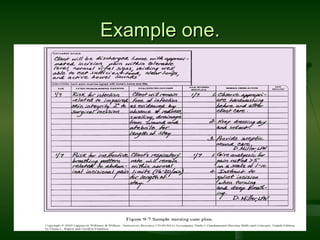
Example one.
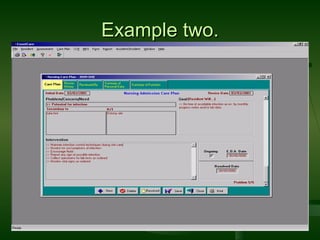
Example two.
Thank you Mr C Spain.

Care Plans

  • 1.
    CARE PLANS Whatare “care plans?” By C Spain
  • 2.
    Care plans are:Care plans are made up of four different parts or stages. They are --- Assessment Planning Implementation Evaluation Remember ….A.P.I.E.
  • 3.
    Assessment. This is the part of the process where the individual client’s needs are assessed From this assessment we can get a fuller picture of their individual needs The assessment should involve all people who have had input into the clients care, this would include—
  • 4.
    Assessment. Nurses Relatives Medical staff Social services Speech and language To name just a few This type of assessment is referred to as a “multi-disciplinary assessment” By using all the information that we can we should be able to understand our client better and in a more “holistic ” way.
  • 5.
    Assessment It isduring this stage that we can identify where the client has difficulty and where their problem areas are. So it not only helps us to identify their individual problems and needs, But it also gives us a full picture of them helping us to understand their life, desires and expectations.
  • 6.
    Assessment Most importantlyyou should talk to the client helping to understand their particular individual problems and needs. Trying to.. “look at the world through their eyes.” This phase should also start the client carer relationship, which should be based on trust, understanding and empathy.
  • 7.
    Planning. The nextstage of this process is the planning stage. It is during this stage that we can try to understand the client’s problem and with them look at a way of reducing it. The plan must involve all those people who will be using it It must involve the client.
  • 8.
    Planning It isalways best to look at ways in which we can assist the client to manage themselves as best as they are able to. This is called giving them “active support” And all staff assisting the client should be aware of the plan. But don’t forget that all plans should be:
  • 9.
    Assessment It mustbe attainable It must be safe It must have an end goal It must be measurable And they must be realistic.
  • 10.
    Implementation. This quitesimply means putting the plan into progress. All that you have discovered about a clients particular problem can now help you to reduce it or relieve it completely. Using all the resources that you need for example, Outside help, Using any aids required, for example special knives and forks, Plate guards or hoists.
  • 11.
    Implementation. BUT NOMATTER HOW GOOD A PLAN IS, WITH ARE DEALING WITH UNPREDICTABLE PEOPLE, AND THEIR NEEDS WILL CHANGE. So the next phase is very important.
  • 12.
    Evaluation This isthe phase when we should re-look at the plans and see if they are having the desired effect for example: Problem-- is mobility Plan is-- refer to client for walking aid. Implementation—Zimmer frame received, /No reply
  • 13.
    Evaluation. Evaluation. Maymean re-try as possibly in above scenario or to move on to the next plan for that problem (“ Chaining ”) For Example---Teaching the client how to use a Zimmer frame, at first with assistance.
  • 14.
    What do weassess? We assess looking back to our activities of daily living, and more that is: (Group to look again at the ADLs) What are they?
  • 15.
    What do weassess? Communication Personal hygiene Dressing Sleeping Motivation Mobility Elimination
  • 16.
    What do weassess? Risk Eating and drinking Breathing Memory Orientation Behaviour
  • 17.
    What do weassess? Loss and change Sexuality Social relationships Personal and spiritual fulfilment Cognition And more
  • 18.
    Overview. When anew client come in, they should be Assessed for any problems relating to the above. If they have problems in these areas then a care plan should be drawn up to guide them to a goal in order to either: Resolve the problem Or To find a way of managing with it, without the problem interfering with their daily lives.
  • 19.
  • 20.
  • 21.
    Thank you MrC Spain.