Karnataka Institute of
Medical Sciences, Hubli
Guide:Presenter:
Sandeep M Pujar
CONTENTS
INTRODUCTION
PROBLEM STATEMENT
WORLD
INDIA
RISK FACTORS
MODIFIABLE
NON-MODIFIABLE
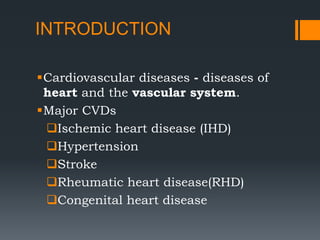
INTRODUCTION
Cardiovascular diseases - diseases of
heart and the vascular system.
Major CVDs
Ischemic heart disease (IHD)
Hypertension
Stroke
Rheumatic heart disease(RHD)
Congenital heart disease
PROBLEM STATEMENT
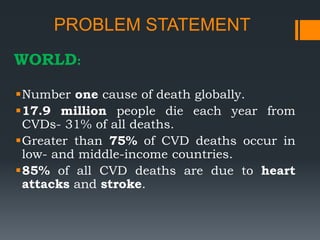
WORLD:
Number one cause of death globally.
17.9 million people die each year from
CVDs- 31% of all deaths.
Greater than 75% of CVD deaths occur in
low- and middle-income countries.
85% of all CVD deaths are due to heart
attacks and stroke.
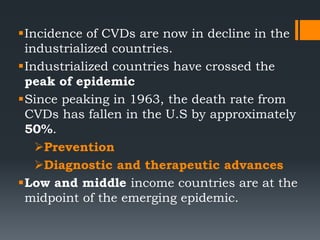
Incidence of CVDs are now in decline in the
industrialized countries.
Industrialized countries have crossed the
peak of epidemic
Since peaking in 1963, the death rate from
CVDs has fallen in the U.S by approximately
50%.
Prevention
Diagnostic and therapeutic advances
Low and middle income countries are at the
midpoint of the emerging epidemic.
INDIA:
2.59 million people died of CVD in
India in 2016
Prevalence of CVD is 2-3 times more in
urban than in rural areas.
IHD is found to be prevalent in 9.67%
of the population in urban and 2.71%
in rural areas
India faces maximum loss of potentially
productive years due to deaths from
CVD in the age group 35-64 years
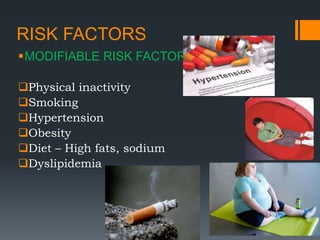
RISK FACTORS
MODIFIABLE RISK FACTORS
Physical inactivity
Smoking
Hypertension
Obesity
Diet – High fats, sodium
Dyslipidemia
NON-MODIFIABLE RISK FACTORS
Age
Gender
Family history
 PHYSICAL INACTIVITY
 Approximately 3.2 million deaths
each year are attributable to
insufficient physical activity
 Leads to the development of Diabetes,
Obesity, Hypertension, which are all
independent risk factors for CVD
 SMOKING
Tobacco smoking kills more than 8 million
people each year.
More than 7 million of those deaths are the
result of direct tobacco use
1.2 million are the result of non-smokers being
exposed to second-hand smoke
Three constituents of cigarette smoke are
potential contributors to CVD:
Nicotine
Carbon monoxide (CO)
Oxidant gases
 HYPERTENSION
Defined as a systolic blood pressure of 140
mm Hg or more, or a diastolic blood
pressure of 90 mm Hg or more.
Major risk factor for atherosclerosis,
congestive heart failure
Increases the risk of Ischemic heart disease
by approximately 60% versus normotensive
populations.
Elevated pressures induce myocyte
hypertrophy and interstitial fibrosis that
increases wall thickness and myocardial
stiffness
 OBESITY
Excessive fat accumulation that presents a
risk to health
Measured in body mass index (BMI), which
is a person’s weight (in kilograms) divided by
the square of his or her height (in meters)
A person with a BMI of 30 or more is
generally considered obese
Obesity increases blood LDL and Triglyceride
levels and decreases HDL levels
 DIET FACTORS
Diet high in Saturated fats, Trans
fats increases the risk of heart disease and
stroke
Unsaturated, polyunsaturated and mono-
unsaturated fats are beneficial for heart
health.
Diet high in sodium increases the risk of
hypertension, which in turn is a major risk
factor for CVD
REFERENCES:
Park’s Textbook of Preventive and Social
Medicine, K.Park; 25th Ed
Robbins and Cotran Pathologic Basis of
Disease, Kumar,Abbas,Aster; 9th Ed
World Heart Federation:
https://www.world-heart-federation.org/

''Cardiovascular diseases''-Epidemiology

  • 1.
    Karnataka Institute of MedicalSciences, Hubli Guide:Presenter: Sandeep M Pujar
  • 2.
  • 3.
    INTRODUCTION Cardiovascular diseases -diseases of heart and the vascular system. Major CVDs Ischemic heart disease (IHD) Hypertension Stroke Rheumatic heart disease(RHD) Congenital heart disease
  • 4.
    PROBLEM STATEMENT WORLD: Number onecause of death globally. 17.9 million people die each year from CVDs- 31% of all deaths. Greater than 75% of CVD deaths occur in low- and middle-income countries. 85% of all CVD deaths are due to heart attacks and stroke.
  • 5.
    Incidence of CVDsare now in decline in the industrialized countries. Industrialized countries have crossed the peak of epidemic Since peaking in 1963, the death rate from CVDs has fallen in the U.S by approximately 50%. Prevention Diagnostic and therapeutic advances Low and middle income countries are at the midpoint of the emerging epidemic.
  • 6.
    INDIA: 2.59 million peopledied of CVD in India in 2016 Prevalence of CVD is 2-3 times more in urban than in rural areas. IHD is found to be prevalent in 9.67% of the population in urban and 2.71% in rural areas India faces maximum loss of potentially productive years due to deaths from CVD in the age group 35-64 years
  • 7.
    RISK FACTORS MODIFIABLE RISKFACTORS Physical inactivity Smoking Hypertension Obesity Diet – High fats, sodium Dyslipidemia
  • 8.
  • 9.
     PHYSICAL INACTIVITY Approximately 3.2 million deaths each year are attributable to insufficient physical activity  Leads to the development of Diabetes, Obesity, Hypertension, which are all independent risk factors for CVD
  • 10.
     SMOKING Tobacco smokingkills more than 8 million people each year. More than 7 million of those deaths are the result of direct tobacco use 1.2 million are the result of non-smokers being exposed to second-hand smoke Three constituents of cigarette smoke are potential contributors to CVD: Nicotine Carbon monoxide (CO) Oxidant gases
  • 11.
     HYPERTENSION Defined asa systolic blood pressure of 140 mm Hg or more, or a diastolic blood pressure of 90 mm Hg or more. Major risk factor for atherosclerosis, congestive heart failure Increases the risk of Ischemic heart disease by approximately 60% versus normotensive populations. Elevated pressures induce myocyte hypertrophy and interstitial fibrosis that increases wall thickness and myocardial stiffness
  • 12.
     OBESITY Excessive fataccumulation that presents a risk to health Measured in body mass index (BMI), which is a person’s weight (in kilograms) divided by the square of his or her height (in meters) A person with a BMI of 30 or more is generally considered obese Obesity increases blood LDL and Triglyceride levels and decreases HDL levels
  • 13.
     DIET FACTORS Diethigh in Saturated fats, Trans fats increases the risk of heart disease and stroke Unsaturated, polyunsaturated and mono- unsaturated fats are beneficial for heart health. Diet high in sodium increases the risk of hypertension, which in turn is a major risk factor for CVD
  • 14.
    REFERENCES: Park’s Textbook ofPreventive and Social Medicine, K.Park; 25th Ed Robbins and Cotran Pathologic Basis of Disease, Kumar,Abbas,Aster; 9th Ed World Heart Federation: https://www.world-heart-federation.org/