Chapter 9: Cardiac Muscle; The Heart
As A Pump and Function of the Heart Valves
AFSHAN ARZOO
LECTURER, RCCT
Guyton and Hall, Textbook of Medical Physiology, 12th edition
Physiology of Cardiac Muscle
• Physiologic Anatomy
a. Muscle fibers arranged in a latticework
b. Striated and Involuntary
c. Actin and myosin, typical myofibrils
d. Sliding filament mechanism
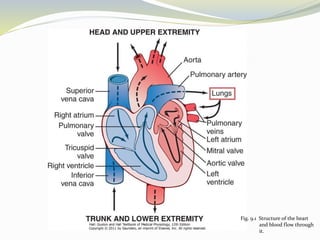
Fig. 9.1 Structure of the heart
and blood flow through
it.
Physiology (cont.)
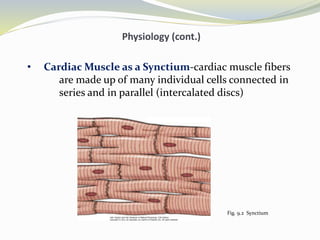
• Cardiac Muscle as a Synctium-cardiac muscle fibers
are made up of many individual cells connected in
series and in parallel (intercalated discs)
Fig. 9.2 Synctium
Physiology (cont.)
a. Composed of two synctiums: atrial and ventricular
b. Disks allow the action potential to travel easily from
cell to cell
• Action Potentials in Cardiac Muscle
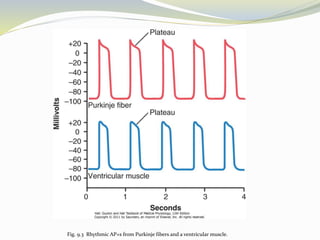
a. What causes the long action potential and plateau?
b. The AP is caused by the opening of two channel types
1. The same fast Na+ channels as in skeletal muscle
2. Slow Ca++ channels (slower to open and close)
3. Longer period of depolarization leads to plateau
Fig. 9.3 Rhythmic AP+s from Purkinje fibers and a ventricular muscle.
Physiology (cont.)
c. Permeability for K+ decreases about 5-fold
d. Prevents an early return to depolarized state
• Velocity of Signal Conduction
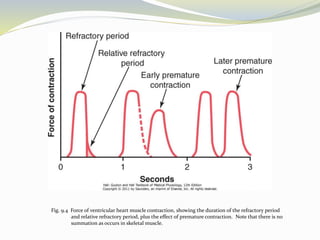
• Refractory Period of Cardiac Muscle
a. Refractory to restimulation during the AP
b. Ventricle; 0.25-0.30 sec. which is the duration
of the plateau
c. There is an additional relative refractory period
Fig. 9.4 Force of ventricular heart muscle contraction, showing the duration of the refractory period
and relative refractory period, plus the effect of premature contraction. Note that there is no
summation as occurs in skeletal muscle.
9
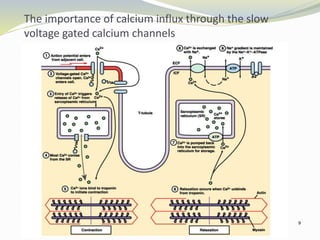
The importance of calcium influx through the slow
voltage gated calcium channels
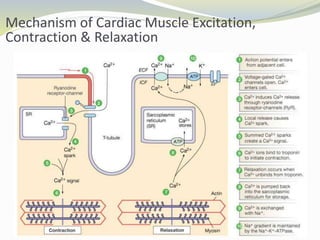
Mechanism of Cardiac Muscle Excitation,
Contraction & Relaxation
Physiology (cont.)
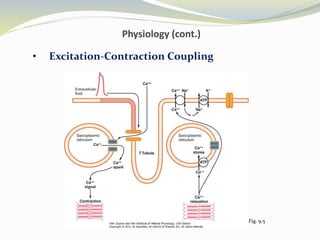
• Excitation-Contraction Coupling
Fig. 9.5
• Excitation-Contraction Coupling (cont.)
a. Calcium enters from extracellular fluid
b. Triggers calcium release from SR
c. At the end of the plateau, calcium flow stops and
calcium is reabsorbed by the SR

cardiac muscle.ppt

  • 1.
    Chapter 9: CardiacMuscle; The Heart As A Pump and Function of the Heart Valves AFSHAN ARZOO LECTURER, RCCT Guyton and Hall, Textbook of Medical Physiology, 12th edition
  • 2.
    Physiology of CardiacMuscle • Physiologic Anatomy a. Muscle fibers arranged in a latticework b. Striated and Involuntary c. Actin and myosin, typical myofibrils d. Sliding filament mechanism
  • 3.
    Fig. 9.1 Structureof the heart and blood flow through it.
  • 4.
    Physiology (cont.) • CardiacMuscle as a Synctium-cardiac muscle fibers are made up of many individual cells connected in series and in parallel (intercalated discs) Fig. 9.2 Synctium
  • 5.
    Physiology (cont.) a. Composedof two synctiums: atrial and ventricular b. Disks allow the action potential to travel easily from cell to cell • Action Potentials in Cardiac Muscle a. What causes the long action potential and plateau? b. The AP is caused by the opening of two channel types 1. The same fast Na+ channels as in skeletal muscle 2. Slow Ca++ channels (slower to open and close) 3. Longer period of depolarization leads to plateau
  • 6.
    Fig. 9.3 RhythmicAP+s from Purkinje fibers and a ventricular muscle.
  • 7.
    Physiology (cont.) c. Permeabilityfor K+ decreases about 5-fold d. Prevents an early return to depolarized state • Velocity of Signal Conduction • Refractory Period of Cardiac Muscle a. Refractory to restimulation during the AP b. Ventricle; 0.25-0.30 sec. which is the duration of the plateau c. There is an additional relative refractory period
  • 8.
    Fig. 9.4 Forceof ventricular heart muscle contraction, showing the duration of the refractory period and relative refractory period, plus the effect of premature contraction. Note that there is no summation as occurs in skeletal muscle.
  • 9.
    9 The importance ofcalcium influx through the slow voltage gated calcium channels
  • 10.
    Mechanism of CardiacMuscle Excitation, Contraction & Relaxation
  • 11.
  • 12.
    • Excitation-Contraction Coupling(cont.) a. Calcium enters from extracellular fluid b. Triggers calcium release from SR c. At the end of the plateau, calcium flow stops and calcium is reabsorbed by the SR