CARBON NANO TUBE
(CNT)
By,
SURAJ BISWAS
MECHANICAL ENGINEERING
OUTLINE
• Introduction
• What is carbon nanotube
• Discovery of carbon nanotube
• Types of carbon nanotube
Single walled
Multi layered
• Properties of carbon nanotube
BY SURAJ BISWAS 2
INTRODUCTION
• Carbon nanotubes (CNT) are a class of nanomaterials
that consist of a two-dimensional hexagonal lattice
of carbon atoms, bent and joined in one direction, so
as to form a hollow cylinder. Carbon nanotubes are
one of the allotropes of carbon, specifically a class of
fullerenes, intermediate between the buckyballs
(closed shells) and graphene (flat sheets).
BY SURAJ BISWAS 3
WHAT IS CNT?
• A Carbon Nanotube is a tube-shaped material, made
of carbon, having a diameter measuring on the
nanometer scale.
• Carbon Nanotubes are formed from essentially the
graphite sheet and the graphite layer appears
somewhat like a rolled-up continuous unbroken
hexagonal mesh and carbon molecules at the apexes
of the hexagons.
• Nanotubes are members of the fullerene structural
family.
• Their name is derived from their long, hollowBY SURAJ BISWAS 4
HISTORY OF CNT
• CNT was discovery of carbon nanotubes (CNTs) in
1991 by Iijima, a whole new discipline in materials
science has developed, Nanoscience. Hundreds of
millions of dollars have been invested trying to
unlock the secrets of these revolutionary materials.
• These functional nanoscale materials have a variety
of unique, fascinating, and never seen before
properties. In fact, a 4th state of matter was recently
discovered as water trapped inside a carbon
nanotube doesn’t act as a solid, liquid, or gas.
BY SURAJ BISWAS 5
DISCOVERY OF CNT
• 1952 Radushkevich and Lukyanovich publish a paper
in the Soviet Journal of Physical Chemistry showing
hollow graphitic carbon fibers that are 50
nanometers in diameter.
• 1979 John Abrahamson presented evidence of
carbon nanotubes at the 14th Biennial Conference of
Carbon at Pennsylvania State University.
• 1981 A group of Soviet scientists published the
results of chemical and structural characterization of
carbon nanoparticles produced by a
thermocatalytical disproportionation of carbon
monoxide. BY SURAJ BISWAS 6
TYPES OF CNT?
• Classified mainly in two types:
1. SINGLE WALLED NANOTUBES
2. MULTI WALLED NANOTUBES
BY SURAJ BISWAS 7
SINGLE WALLED NANOTUBES
• Single-walled nanotubes (SWNT) have a diameter of
close to 1 nanometer, with a tube length that can be
many millions of times longer. The structure of a
SWNT can be conceptualized by wrapping a one-
atom-thick layer of graphite called graphene into a
seamless cylinder.
• Single-walled nanotubes are an important variety of
carbon nanotube because they exhibit electric
properties that are not shared by the multi-walled
carbon nanotube (MWNT) variants
BY SURAJ BISWAS 8
SINGLE WALLED NANOTUBES
BY SURAJ BISWAS 9
MULTI WALLED NANOTUBES
• Multi-walled carbon nanotubes (MWCNTs) are a
special form of carbon nanotubes in which multiple
single-walled carbon nanotubes are nested inside
one another.
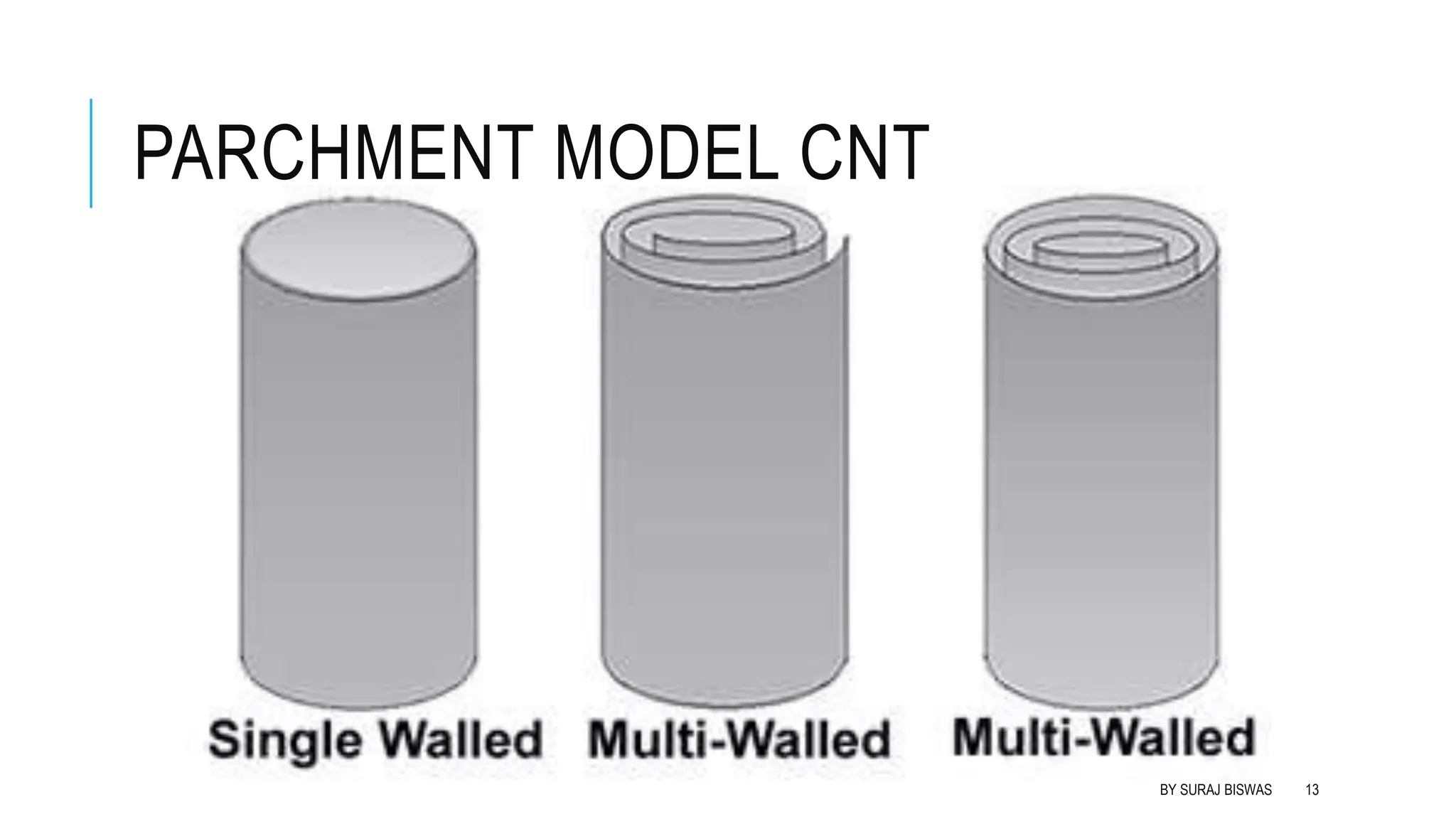
• Multi-walled nanotubes (MWNTs) consist of multiple
rolled layers (concentric tubes) of graphene. There
are two models that can be used to describe the
structures of multi-walled nanotubes.
• Double-walled carbon nanotubes (DWNTs) form a
special class of nanotubes because their morphology
and properties are similar to those of SWNTs but
[
BY SURAJ BISWAS 10
RUSSIAN DOLL MODEL CNT
BY SURAJ BISWAS 11
BY SURAJ BISWAS 12
PARCHMENT MODEL CNT
BY SURAJ BISWAS 13
BY SURAJ BISWAS 14
BY SURAJ BISWAS 15
SURAJ BISWAS
4th YEAR MECHANICAL ENGINEERING
sjbiswas2050@gmail.com
THANK
YOU BY SURAJ BISWAS 16

Carbon Nano Tube (CNT)

  • 1.
    CARBON NANO TUBE (CNT) By, SURAJBISWAS MECHANICAL ENGINEERING
  • 2.
    OUTLINE • Introduction • Whatis carbon nanotube • Discovery of carbon nanotube • Types of carbon nanotube Single walled Multi layered • Properties of carbon nanotube BY SURAJ BISWAS 2
  • 3.
    INTRODUCTION • Carbon nanotubes(CNT) are a class of nanomaterials that consist of a two-dimensional hexagonal lattice of carbon atoms, bent and joined in one direction, so as to form a hollow cylinder. Carbon nanotubes are one of the allotropes of carbon, specifically a class of fullerenes, intermediate between the buckyballs (closed shells) and graphene (flat sheets). BY SURAJ BISWAS 3
  • 4.
    WHAT IS CNT? •A Carbon Nanotube is a tube-shaped material, made of carbon, having a diameter measuring on the nanometer scale. • Carbon Nanotubes are formed from essentially the graphite sheet and the graphite layer appears somewhat like a rolled-up continuous unbroken hexagonal mesh and carbon molecules at the apexes of the hexagons. • Nanotubes are members of the fullerene structural family. • Their name is derived from their long, hollowBY SURAJ BISWAS 4
  • 5.
    HISTORY OF CNT •CNT was discovery of carbon nanotubes (CNTs) in 1991 by Iijima, a whole new discipline in materials science has developed, Nanoscience. Hundreds of millions of dollars have been invested trying to unlock the secrets of these revolutionary materials. • These functional nanoscale materials have a variety of unique, fascinating, and never seen before properties. In fact, a 4th state of matter was recently discovered as water trapped inside a carbon nanotube doesn’t act as a solid, liquid, or gas. BY SURAJ BISWAS 5
  • 6.
    DISCOVERY OF CNT •1952 Radushkevich and Lukyanovich publish a paper in the Soviet Journal of Physical Chemistry showing hollow graphitic carbon fibers that are 50 nanometers in diameter. • 1979 John Abrahamson presented evidence of carbon nanotubes at the 14th Biennial Conference of Carbon at Pennsylvania State University. • 1981 A group of Soviet scientists published the results of chemical and structural characterization of carbon nanoparticles produced by a thermocatalytical disproportionation of carbon monoxide. BY SURAJ BISWAS 6
  • 7.
    TYPES OF CNT? •Classified mainly in two types: 1. SINGLE WALLED NANOTUBES 2. MULTI WALLED NANOTUBES BY SURAJ BISWAS 7
  • 8.
    SINGLE WALLED NANOTUBES •Single-walled nanotubes (SWNT) have a diameter of close to 1 nanometer, with a tube length that can be many millions of times longer. The structure of a SWNT can be conceptualized by wrapping a one- atom-thick layer of graphite called graphene into a seamless cylinder. • Single-walled nanotubes are an important variety of carbon nanotube because they exhibit electric properties that are not shared by the multi-walled carbon nanotube (MWNT) variants BY SURAJ BISWAS 8
  • 9.
  • 10.
    MULTI WALLED NANOTUBES •Multi-walled carbon nanotubes (MWCNTs) are a special form of carbon nanotubes in which multiple single-walled carbon nanotubes are nested inside one another. • Multi-walled nanotubes (MWNTs) consist of multiple rolled layers (concentric tubes) of graphene. There are two models that can be used to describe the structures of multi-walled nanotubes. • Double-walled carbon nanotubes (DWNTs) form a special class of nanotubes because their morphology and properties are similar to those of SWNTs but [ BY SURAJ BISWAS 10
  • 11.
    RUSSIAN DOLL MODELCNT BY SURAJ BISWAS 11
  • 12.
  • 13.
    PARCHMENT MODEL CNT BYSURAJ BISWAS 13
  • 14.
  • 15.
  • 16.
    SURAJ BISWAS 4th YEARMECHANICAL ENGINEERING sjbiswas2050@gmail.com THANK YOU BY SURAJ BISWAS 16