‫إقرأ‬
`
CARBON FOOTPRINT
 A Definition of ‘Carbon footprint’ (JAN 2008)
Thomas weidmann
Jan minx
RESEARCH PAPER:
Addition Support…
 Carbon Footprints Project Report (2011)
of the Pakistan Tobacco Company
Mr. Majid Hussain
Slide:1/18
 Introduction
 Aims & Objectives
 Literature Review
 Methodology
 Conclusion
 References
OUTLINE
Slide:2/18
 What is carbon footprint?
 Why we need it?
 How it is calculated?
INTRODUCTION
Slide:3/18
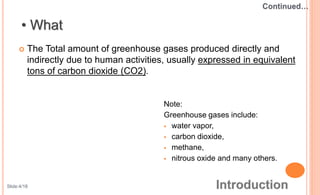
 The Total amount of greenhouse gases produced directly and
indirectly due to human activities, usually expressed in equivalent
tons of carbon dioxide (CO2).
Note:
Greenhouse gases include:
 water vapor,
 carbon dioxide,
 methane,
 nitrous oxide and many others.
Slide:4/18
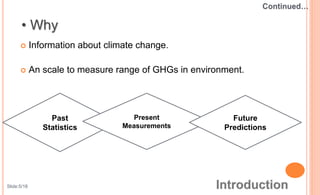
 Information about climate change.
 An scale to measure range of GHGs in environment.
Past
Statistics
Present
Measurements
Future
Predictions
Slide:5/18
 This accounting approach compares,
how much people demand compared to what the planet can
renew.
 This allows to assess the number of "earths" that would be
required if everyone on the planet consumed resources at the
same level as the person calculating their ecological footprint.
Slide:6/18
 The carbon footprint calculation procedure is based on life cycle
thinking and the life cycle assessment (LCA) method.
What is LCA?
Inputs and outputs of material and energy
And the environmental impacts
through out life of a product.
Slide:7/18
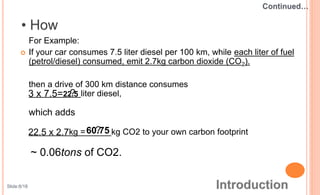
For Example:
 If your car consumes 7.5 liter diesel per 100 km, while each liter of fuel
(petrol/diesel) consumed, emit 2.7kg carbon dioxide (CO2).
then a drive of 300 km distance consumes
liter diesel,
which adds
kg = kg CO2 to your own carbon footprint
22.53 x 7.5= ?
22.5 x 2.7 ?60.75
~ 0.06tons of CO2.
Slide:8/18
 The aim of the research is specifically to study concept of carbon
footprint, its need and usage.
 To address back controversies such as methodological question,
completeness, units and environmental impacts of carbon
footprints.
 To suggests a scientific definition based on commonly accepted
accounting principles and modeling approaches.
AIMS & OBJECTIVES
Slide:9/18
 The carbon footprint concept is related to and grew out of the
older idea of ecological footprint.
 Invented in the early 1990s.
 By Canadian ecologist William Rees and
Swiss-born regional planner Mathis Wackernagel
at the University of British Columbia.
LITERATURE REVIEW
Slide:10/18
LITERATURE REVIEW
 Part of the ecological footprint
 Popularized by a large campaign of BP in 2005.
 In 2007, carbon footprint was used as a measure of carbon
emissions to develop the energy plan for City of Lynnwood,
Washington.
 Produced from two types of sources:
Direct & Indirect Sources
 Most of the carbon footprint come from the
"indirect" sources,
e.g. fuel burned to produce goods far away from the final
consumer.
 Direct sources
i.e. One's car emission or stove, commonly referred to as
consumer's carbon footprint.
Slide:11/18
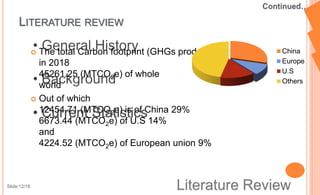
 The total Carbon footprint (GHGs produced)
in 2018
45261.25 (MTCO2e) of whole
world
 Out of which
12454.71 (MTCO2e) is of China 29%
6673.44 (MTCO2e) of U.S 14%
and
4224.52 (MTCO2e) of European union 9%
LITERATURE REVIEW
China
Europe
U.S
Others
Slide:12/18
 There are several approaches in order to estimate the carbon
footprint of a system, however these are four specific general
steps:
• a) selection of the greenhouse gases
• b) setting the boundaries of the study
• c) collection of the necessary data
• d) translation of data into carbon footprint
METHODOLOGY
Slide:13/18
 The Life Cycle Assessment (LCA)
is followed by the
[Steps (a) (b) and (c)]
• Selection Setting and Collection
• Translation/Conversion
 As the majority of the carbon footprint product is
carbon dioxide, methane and nitrous oxide.
 Then How other greenhouse gases (GHGs) rather than CO2, are
calculated though: [Step (d)]
Slide:14/18
• Translation/Conversion
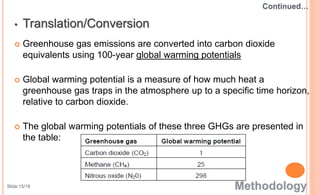
 Greenhouse gas emissions are converted into carbon dioxide
equivalents using 100-year global warming potentials
 Global warming potential is a measure of how much heat a
greenhouse gas traps in the atmosphere up to a specific time horizon,
relative to carbon dioxide.
 The global warming potentials of these three GHGs are presented in
the table:
Slide:15/18
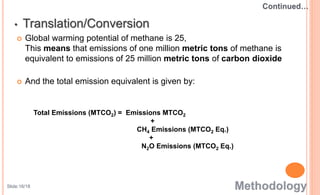
 Global warming potential of methane is 25,
This means that emissions of one million metric tons of methane is
equivalent to emissions of 25 million metric tons of carbon dioxide
 And the total emission equivalent is given by:
Total Emissions (MTCO2) = Emissions MTCO2
+
CH4 Emissions (MTCO2 Eq.)
+
N2O Emissions (MTCO2 Eq.)
• Translation/Conversion
Slide:16/18
 Carbon footprint has emerged as a strong mode of GHG expression.
 Carbon footprinting must be harnessed as a strong tool to promote
GHG emission reductions.
 Evolution of CO2 emissions illustrates the necessity for every country to
plan more sustainable energy future.
 Any action to reduce GHG emissions must be welcomed and should be
applied as soon as possible.
 It should be included as indicator of sustainable development also
among businesses, events, and civil society.
CONCLUSION
Slide:17/18
 A Definition of ‘Carbon footprint’ (2008)
Thomas weidmann
Jan minx
 Carbon footprint: current methods of estimation (2010)
Divya Pandey Madhoolika Agrawal
Jai Shanker Pandey
 Carbon Footprints Project Report of the Pakistan Tobacco Company
Mr. Majid Hussain (2011)
Department of Environmental Science
Quaid e azam University Islamabad
REFERENCES
Slide:18/18
THANK YOU

Carbon footprints

  • 1.
  • 3.
  • 4.
     A Definitionof ‘Carbon footprint’ (JAN 2008) Thomas weidmann Jan minx RESEARCH PAPER: Addition Support…  Carbon Footprints Project Report (2011) of the Pakistan Tobacco Company Mr. Majid Hussain Slide:1/18
  • 5.
     Introduction  Aims& Objectives  Literature Review  Methodology  Conclusion  References OUTLINE Slide:2/18
  • 6.
     What iscarbon footprint?  Why we need it?  How it is calculated? INTRODUCTION Slide:3/18
  • 7.
     The Totalamount of greenhouse gases produced directly and indirectly due to human activities, usually expressed in equivalent tons of carbon dioxide (CO2). Note: Greenhouse gases include:  water vapor,  carbon dioxide,  methane,  nitrous oxide and many others. Slide:4/18
  • 8.
     Information aboutclimate change.  An scale to measure range of GHGs in environment. Past Statistics Present Measurements Future Predictions Slide:5/18
  • 9.
     This accountingapproach compares, how much people demand compared to what the planet can renew.  This allows to assess the number of "earths" that would be required if everyone on the planet consumed resources at the same level as the person calculating their ecological footprint. Slide:6/18
  • 10.
     The carbonfootprint calculation procedure is based on life cycle thinking and the life cycle assessment (LCA) method. What is LCA? Inputs and outputs of material and energy And the environmental impacts through out life of a product. Slide:7/18
  • 11.
    For Example:  Ifyour car consumes 7.5 liter diesel per 100 km, while each liter of fuel (petrol/diesel) consumed, emit 2.7kg carbon dioxide (CO2). then a drive of 300 km distance consumes liter diesel, which adds kg = kg CO2 to your own carbon footprint 22.53 x 7.5= ? 22.5 x 2.7 ?60.75 ~ 0.06tons of CO2. Slide:8/18
  • 12.
     The aimof the research is specifically to study concept of carbon footprint, its need and usage.  To address back controversies such as methodological question, completeness, units and environmental impacts of carbon footprints.  To suggests a scientific definition based on commonly accepted accounting principles and modeling approaches. AIMS & OBJECTIVES Slide:9/18
  • 13.
     The carbonfootprint concept is related to and grew out of the older idea of ecological footprint.  Invented in the early 1990s.  By Canadian ecologist William Rees and Swiss-born regional planner Mathis Wackernagel at the University of British Columbia. LITERATURE REVIEW Slide:10/18
  • 14.
    LITERATURE REVIEW  Partof the ecological footprint  Popularized by a large campaign of BP in 2005.  In 2007, carbon footprint was used as a measure of carbon emissions to develop the energy plan for City of Lynnwood, Washington.  Produced from two types of sources: Direct & Indirect Sources  Most of the carbon footprint come from the "indirect" sources, e.g. fuel burned to produce goods far away from the final consumer.  Direct sources i.e. One's car emission or stove, commonly referred to as consumer's carbon footprint. Slide:11/18
  • 15.
     The totalCarbon footprint (GHGs produced) in 2018 45261.25 (MTCO2e) of whole world  Out of which 12454.71 (MTCO2e) is of China 29% 6673.44 (MTCO2e) of U.S 14% and 4224.52 (MTCO2e) of European union 9% LITERATURE REVIEW China Europe U.S Others Slide:12/18
  • 16.
     There areseveral approaches in order to estimate the carbon footprint of a system, however these are four specific general steps: • a) selection of the greenhouse gases • b) setting the boundaries of the study • c) collection of the necessary data • d) translation of data into carbon footprint METHODOLOGY Slide:13/18
  • 17.
     The LifeCycle Assessment (LCA) is followed by the [Steps (a) (b) and (c)] • Selection Setting and Collection • Translation/Conversion  As the majority of the carbon footprint product is carbon dioxide, methane and nitrous oxide.  Then How other greenhouse gases (GHGs) rather than CO2, are calculated though: [Step (d)] Slide:14/18
  • 18.
    • Translation/Conversion  Greenhousegas emissions are converted into carbon dioxide equivalents using 100-year global warming potentials  Global warming potential is a measure of how much heat a greenhouse gas traps in the atmosphere up to a specific time horizon, relative to carbon dioxide.  The global warming potentials of these three GHGs are presented in the table: Slide:15/18
  • 19.
     Global warmingpotential of methane is 25, This means that emissions of one million metric tons of methane is equivalent to emissions of 25 million metric tons of carbon dioxide  And the total emission equivalent is given by: Total Emissions (MTCO2) = Emissions MTCO2 + CH4 Emissions (MTCO2 Eq.) + N2O Emissions (MTCO2 Eq.) • Translation/Conversion Slide:16/18
  • 20.
     Carbon footprinthas emerged as a strong mode of GHG expression.  Carbon footprinting must be harnessed as a strong tool to promote GHG emission reductions.  Evolution of CO2 emissions illustrates the necessity for every country to plan more sustainable energy future.  Any action to reduce GHG emissions must be welcomed and should be applied as soon as possible.  It should be included as indicator of sustainable development also among businesses, events, and civil society. CONCLUSION Slide:17/18
  • 21.
     A Definitionof ‘Carbon footprint’ (2008) Thomas weidmann Jan minx  Carbon footprint: current methods of estimation (2010) Divya Pandey Madhoolika Agrawal Jai Shanker Pandey  Carbon Footprints Project Report of the Pakistan Tobacco Company Mr. Majid Hussain (2011) Department of Environmental Science Quaid e azam University Islamabad REFERENCES Slide:18/18
  • 22.

Editor's Notes

  • #10 Green house gases
  • #12 view of the production and consumption of a product or service and assesses its impacts on the environment through the entire life cycle