Carbohydrate for Exercise
Introduction
• Organic compounds containing
Carbon
Oxygen
Hydrogen
CH2O
• Formed naturally in nature
• It can also be synthesized by the body from other sources via metabolism.
• ~4 kcal/gram
Classification of dietary CHO
Simple CHO
• Monosaccharides
• Glucose (dextrose, grape sugar)
• Fructose (levulose, fruit sugar)
• Galactose (milk sugar)
• Disaccharide
• Maltose (malt sugar, glucose & glucose)
• Lactose (milk sugar, glucose & galactose)
• Sucrose (cane or table sugar, glucose & fructose)
COMPLEX CHO
• 3 or more glucose molecules
• Polysaccharide (>2 molecules)
 Plant starches (amylose and amylopectin)
 Animal starch (glycogen)
• glucose polymer (10-20 molecules: Maltodextrin and polyose)
• Fiber
Major hormones involved in regulation of blood glucose levels
Hormone Gland Stimulus Action
Insulin Pancreas Increase in blood glucose Helps transport glucose into cells;
decreases blood glucose levels.
Glucagon Pancreas Decrease in blood
glucose; Exercise stress
Promotes gluconeogenesis in liver;
helps increase blood glucose levels.
Epinephrine Adrenal Exercise stress; decrease
in blood glucose
Promotes glycogen breakdown and
glucose release from the liver; helps
increase blood glucose levels
Cortisol Adrenal Exercise stress; decrease
in blood glucose
Promotes breakdown of protein and
resultant gluconeogenesis; helps
increase blood glucose levels
CHO and Exercise
 During exercise, carbohydrates comes in two forms:
• Simple sugar:
• Stored form of sugar (glucose): Glycogen; it is stored in muscles and liver.
• The amount of carbohydrate requires depends on the
 Frequency of exercise
 Intensity of exercise
 Duration of exercise
 Types of training (aerobic/ anaerobic)
 Environmental conditions.
As fuel source
Carbohydrates are used during exercise which comes from the following sources:
1. Gluconeogenesis: endogenous production of glucose by the liver.
2. Blood glucose
3. Muscle and liver glycogen stores.
4. Carbohydrate consumed during exercise (exogenous CHO)
Compared to fat and protein, the body’s CHO reserves are very limited of about 800-2000kcal.
Effect of the exercise intensity on fuel use
Glycemic response
• Classify food as producing a high, moderate and low glycemic response.
• Foods that produce a large and rapid rise in blood glucose and insulin is high
glycemic foods.
• It can increase more muscle glycogen than low GI foods.
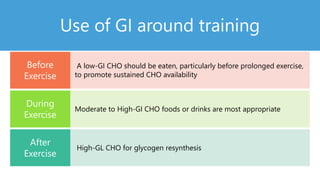
Use of GI around training
A low-GI CHO should be eaten, particularly before prolonged exercise,
to promote sustained CHO availability
Before
Exercise
Moderate to High-GI CHO foods or drinks are most appropriate
During
Exercise
High-GL CHO for glycogen resynthesis
After
Exercise
Carbohydrate loading
• Carbohydrate loading is meant to store extra glycogen that the muscles can tap into once the
normal stores are used up.
• During prolonged exercise, muscle completely depletes the glycogen after about 90 minutes.
(marathon, triathlons, etc.).
• Combination of reduced training prior to the event and increased intake of carbohydrate.
Importance of carbohydrate in exercise
• Carbohydrates are the primary source of energy fuel during exercise (moderate to intense
exercise).
• Essential for adequate exercise recovery.
• Prevents fatigue during exercise.
• Prevents cumulative depletion of muscle glycogen from successive training sessions.
• Muscle protein sparing action.
• It is also fueling the central nervous system (CNS) and brain.
Daily CHO Requirements
• Minimum of 100 g/day for nervous system.
• Moderate duration/low intensity training of 1-3 hours – 5-7 g/kg.
• Moderate to heavy endurance training of 1-2 hours – 7-12 g/kg.
• Extreme exercise of 4-6 hours – 10-12 g/kg.
Before exercise
• Consumption 3-4 hours before Exercise
• Up to 2-3 g/kg of CHO (200-300 gm)
• Low to mid glycemic index CHO
• Minimal fat and protein
• Increases muscle and liver glycogen
• Complex carbohydrates, pastas, starches and breads are some few examples.
During exercise
• Maximal use of exogenous CHO is ~ 70 grams per hour
• Timing of feedings seem unimportant
• 5-10% solution of 15-20 grams every 15-20 min
8 oz of Gatorade contains approx. 15 grams of CHO
High Fructose may cause stomach upset
• Multiple CHO types may increase use
• Always test feeding prior to competition
• Sport drink, gel packet with water
After exercise
• Glycogen resynthesis rate is about 5-7% per hour.
• 2hour window following exercise for maximal rate of resynthesis.
• High glycemic foods.
• 1.2 - 1.5g/kg
• Combination of carbohydrate and protein is best in a 3:1 ratio of carbohydrate to protein.
However, if total carbohydrate intake is sufficient, protein doesn’t matter.
• Sports drinks, bagels, fruits.
CHO recommendation for different type of training
Carbohydrate recommendation based on grams of CHO/kg BW versus % of total energy
• Works better in low kcal situations.
• Recreational athletes: 5-7gCHO/kg BW
• Competitive athletes: 10g CHO/Kg BW
Most athletes consume diets that contain 55-65% of energy from CHO.

Carbohydrate for exercise

  • 1.
  • 2.
    Introduction • Organic compoundscontaining Carbon Oxygen Hydrogen CH2O • Formed naturally in nature • It can also be synthesized by the body from other sources via metabolism. • ~4 kcal/gram
  • 3.
    Classification of dietaryCHO Simple CHO • Monosaccharides • Glucose (dextrose, grape sugar) • Fructose (levulose, fruit sugar) • Galactose (milk sugar) • Disaccharide • Maltose (malt sugar, glucose & glucose) • Lactose (milk sugar, glucose & galactose) • Sucrose (cane or table sugar, glucose & fructose)
  • 4.
    COMPLEX CHO • 3or more glucose molecules • Polysaccharide (>2 molecules)  Plant starches (amylose and amylopectin)  Animal starch (glycogen) • glucose polymer (10-20 molecules: Maltodextrin and polyose) • Fiber
  • 5.
    Major hormones involvedin regulation of blood glucose levels Hormone Gland Stimulus Action Insulin Pancreas Increase in blood glucose Helps transport glucose into cells; decreases blood glucose levels. Glucagon Pancreas Decrease in blood glucose; Exercise stress Promotes gluconeogenesis in liver; helps increase blood glucose levels. Epinephrine Adrenal Exercise stress; decrease in blood glucose Promotes glycogen breakdown and glucose release from the liver; helps increase blood glucose levels Cortisol Adrenal Exercise stress; decrease in blood glucose Promotes breakdown of protein and resultant gluconeogenesis; helps increase blood glucose levels
  • 6.
    CHO and Exercise During exercise, carbohydrates comes in two forms: • Simple sugar: • Stored form of sugar (glucose): Glycogen; it is stored in muscles and liver. • The amount of carbohydrate requires depends on the  Frequency of exercise  Intensity of exercise  Duration of exercise  Types of training (aerobic/ anaerobic)  Environmental conditions.
  • 7.
    As fuel source Carbohydratesare used during exercise which comes from the following sources: 1. Gluconeogenesis: endogenous production of glucose by the liver. 2. Blood glucose 3. Muscle and liver glycogen stores. 4. Carbohydrate consumed during exercise (exogenous CHO) Compared to fat and protein, the body’s CHO reserves are very limited of about 800-2000kcal.
  • 8.
    Effect of theexercise intensity on fuel use
  • 9.
    Glycemic response • Classifyfood as producing a high, moderate and low glycemic response. • Foods that produce a large and rapid rise in blood glucose and insulin is high glycemic foods. • It can increase more muscle glycogen than low GI foods.
  • 10.
    Use of GIaround training A low-GI CHO should be eaten, particularly before prolonged exercise, to promote sustained CHO availability Before Exercise Moderate to High-GI CHO foods or drinks are most appropriate During Exercise High-GL CHO for glycogen resynthesis After Exercise
  • 11.
    Carbohydrate loading • Carbohydrateloading is meant to store extra glycogen that the muscles can tap into once the normal stores are used up. • During prolonged exercise, muscle completely depletes the glycogen after about 90 minutes. (marathon, triathlons, etc.). • Combination of reduced training prior to the event and increased intake of carbohydrate.
  • 12.
    Importance of carbohydratein exercise • Carbohydrates are the primary source of energy fuel during exercise (moderate to intense exercise). • Essential for adequate exercise recovery. • Prevents fatigue during exercise. • Prevents cumulative depletion of muscle glycogen from successive training sessions. • Muscle protein sparing action. • It is also fueling the central nervous system (CNS) and brain.
  • 13.
    Daily CHO Requirements •Minimum of 100 g/day for nervous system. • Moderate duration/low intensity training of 1-3 hours – 5-7 g/kg. • Moderate to heavy endurance training of 1-2 hours – 7-12 g/kg. • Extreme exercise of 4-6 hours – 10-12 g/kg.
  • 14.
    Before exercise • Consumption3-4 hours before Exercise • Up to 2-3 g/kg of CHO (200-300 gm) • Low to mid glycemic index CHO • Minimal fat and protein • Increases muscle and liver glycogen • Complex carbohydrates, pastas, starches and breads are some few examples.
  • 15.
    During exercise • Maximaluse of exogenous CHO is ~ 70 grams per hour • Timing of feedings seem unimportant • 5-10% solution of 15-20 grams every 15-20 min 8 oz of Gatorade contains approx. 15 grams of CHO High Fructose may cause stomach upset • Multiple CHO types may increase use • Always test feeding prior to competition • Sport drink, gel packet with water
  • 16.
    After exercise • Glycogenresynthesis rate is about 5-7% per hour. • 2hour window following exercise for maximal rate of resynthesis. • High glycemic foods. • 1.2 - 1.5g/kg • Combination of carbohydrate and protein is best in a 3:1 ratio of carbohydrate to protein. However, if total carbohydrate intake is sufficient, protein doesn’t matter. • Sports drinks, bagels, fruits.
  • 17.
    CHO recommendation fordifferent type of training Carbohydrate recommendation based on grams of CHO/kg BW versus % of total energy • Works better in low kcal situations. • Recreational athletes: 5-7gCHO/kg BW • Competitive athletes: 10g CHO/Kg BW Most athletes consume diets that contain 55-65% of energy from CHO.