The Importance of Carbohydrates in Performance
Iñigo San Millán, PhD
Assistant Professor, Department of Physical Medicine and Rehabilitation
University of Colorado School of Medicine
Director, Sports Performance
CU Sports Medicine and Performance Center
Inigo.sanmillan@ucdenver.edu
@doctorinigo
Iñigo San Millán, PhD
Director of Sports Performance
CU Sports Medicine and Performance Center
Assistant Professor, University of Colorado School of Medicine
Inigo.sanmillan@ucdenver.edu
@doctorinigo
Today’s Main Topics
Performance Glycogen
Muscle ContractionOvertraining
Muscle Damage
Carbohydrates Public Enemy #1??
Are they really that bad for you??
Embedded PowerPoint VideoBy PresenterMedia.com
Humphrey et al. Earliest evidence for caries and exploitation of starchy plant foods in Pleistocene hunter-
gatherers from Morocco. Proceedings of the National Academy of Sciences. 2014
94% of the 50 sets of teeth found in a Paleolithic cave in Morocco
had Caies and Tooth Decay as a result of starchy foods
Hardy et al. Dental calculus reveals potential respiratory irritants and
ingestion of essential plant-based nutrients at Lower Palaeolithic Qesem
Cave Israel. Quaternary International 2015.
Starch granules found in teeth show evidence of plants and starchy foods
in Paleolithic diets.
In fact….Paleo diet was rich in Starchy foods!
We have seen amazing advances in the
science of the sport
These Advances are based on
Scientific Evidence………
When it comes to Carbohydrates We
need to keep applying the scientific
approach and evidence
Endurance Coaching Summit | 2015
What Does Science Say?
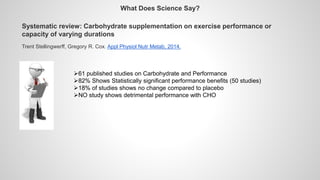
Systematic review: Carbohydrate supplementation on exercise performance or
capacity of varying durations
Trent Stellingwerff, Gregory R. Cox. Appl Physiol Nutr Metab, 2014.
61 published studies on Carbohydrate and Performance
82% Shows Statistically significant performance benefits (50 studies)
18% of studies shows no change compared to placebo
NO study shows detrimental performance with CHO
What Does Science Say?
67:00:00
60:47:00
56:07:00
Placebo
Glucose (90g/h)
Glucose + Fructose
(90g/h)
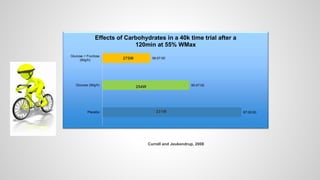
Effects of Carbohydrates in a 40k time trial after a
120min at 55% WMax
275W
254W
231W
Currell and Jeukendrup, 2008
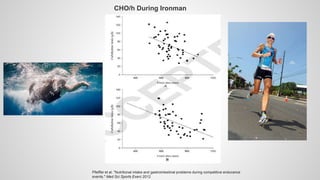
CHO/h During Ironman
Pfeiffer et al. "Nutritional intake and gastrointestinal problems during competitive endurance
events." Med Sci Sports Exerc 2012
Kenyan runners have dominated for decades and are the
skinniest athletes in the world
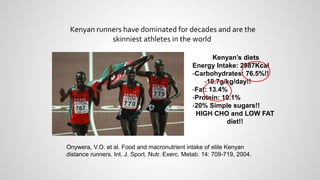
Kenyan runners have dominated for decades and are the
skinniest athletes in the world
Kenyan’s diets
Energy Intake: 2987Kcal
-Carbohydrates: 76.5%!!
-10.7g/kg/day!!
-Fat: 13.4%
-Protein: 10.1%
-20% Simple sugars!!
HIGH CHO and LOW FAT
diet!!
Onywera, V.O. et al. Food and macronutrient intake of elite Kenyan
distance runners. Int. J. Sport. Nutr. Exerc. Metab. 14: 709-719, 2004.
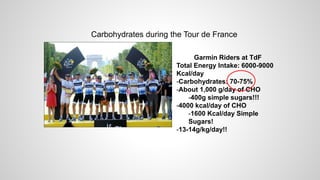
Carbohydrates during the Tour de France
Garmin Riders at TdF
Total Energy Intake: 6000-9000
Kcal/day
-Carbohydrates: 70-75%
-About 1,000 g/day of CHO
-400g simple sugars!!!
-4000 kcal/day of CHO
-1600 Kcal/day Simple
Sugars!
-13-14g/kg/day!!
Low CHO Diets and Performance??
Can low CHO Diets (Therefore High Fat or High Protein) increase Fat utilization?
Yes…HOWEVER, no improvements in performance (normally detrimental).
NO Scientific Study has shown improvements in performance.
In fact, overall, studies show to be detrimental for performance
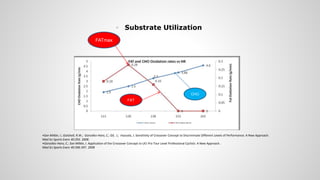
 Substrate Utilization
CHO
FAT
FATmax
•San Millán, I.; Gotshall, R.W.; González-Haro, C.; Gil, J.; Irazusta, J. Sensitivity of Crossover Concept to Discriminate Different Levels of Performance: A New Approach.
Med Sci Sports Exerc 40:293. 2008.
•González-Haro, C.; San Millán, I. Application of the Crossover Concept to UCI Pro Tour Level Professional Cyclists: A New Approach.
Med Sci Sports Exerc 40:396-397. 2008
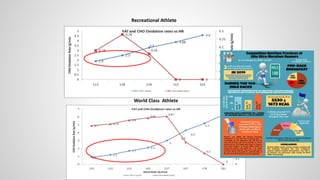
Recreational Athlete
World Class Athlete
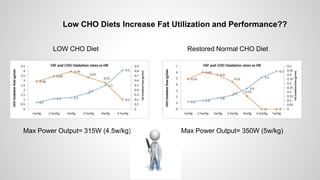
Low CHO Diets Increase Fat Utilization and Performance??
LOW CHO Diet Restored Normal CHO Diet
Max Power Output= 315W (4.5w/kg) Max Power Output= 350W (5w/kg)
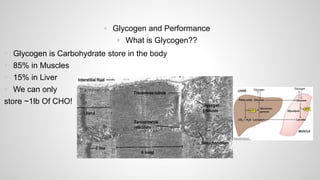
 Glycogen and Performance
 What is Glycogen??
 Glycogen is Carbohydrate store in the body
 85% in Muscles
 15% in Liver
 We can only
store ~1lb Of CHO!
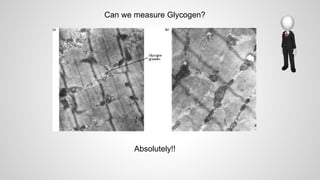
Can we measure Glycogen?
Absolutely!!
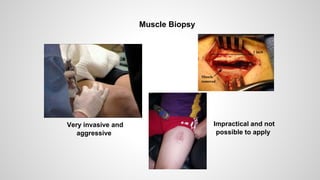
Muscle Biopsy
Very invasive and
aggressive
Impractical and not
possible to apply
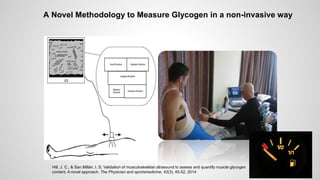
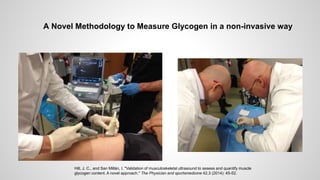
A Novel Methodology to Measure Glycogen in a non-invasive way
Hill, J. C., & San Millán, I. S. Validation of musculoskeletal ultrasound to assess and quantify muscle glycogen
content. A novel approach. The Physician and sportsmedicine, 42(3), 45-52, 2014
A Novel Methodology to Measure Glycogen in a non-invasive way
Hill, J. C., and San Millán, I. "Validation of musculoskeletal ultrasound to assess and quantify muscle
glycogen content. A novel approach." The Physician and sportsmedicine 42.3 (2014): 45-52.
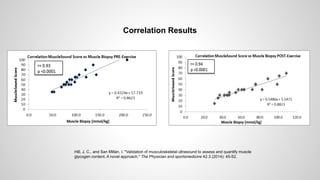
Correlation Results
Hill, J. C., and San Millán, I. "Validation of musculoskeletal ultrasound to assess and quantify muscle
glycogen content. A novel approach." The Physician and sportsmedicine 42.3 (2014): 45-52.
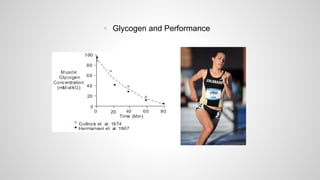
 Glycogen and Performance
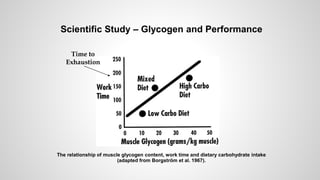
The relationship of muscle glycogen content, work time and dietary carbohydrate intake
(adapted from Borgström et al. 1967).
Scientific Study – Glycogen and Performance
Time to
Exhaustion
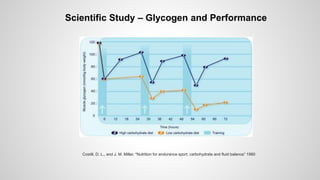
Scientific Study – Glycogen and Performance
Costill, D. L., and J. M. Miller. "Nutrition for endurance sport: carbohydrate and fluid balance” 1980
Want More on Glycogen?
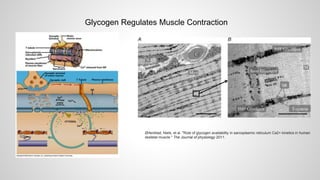
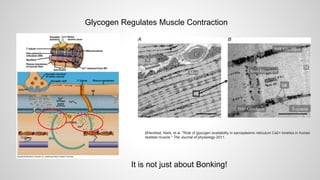
Glycogen Regulates Muscle Contraction
Ørtenblad, Niels, et al. "Role of glycogen availability in sarcoplasmic reticulum Ca2+ kinetics in human
skeletal muscle." The Journal of physiology 2011.
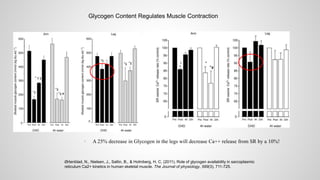
Glycogen Regulates Muscle Contraction
Ørtenblad, Niels, et al. "Role of glycogen availability in sarcoplasmic reticulum Ca2+ kinetics in human
skeletal muscle." The Journal of physiology 2011.
It is not just about Bonking!
 A 25% decrease in Glycogen in the legs will decrease Ca++ release from SR by a 10%!
Ørtenblad, N., Nielsen, J., Saltin, B., & Holmberg, H. C. (2011). Role of glycogen availability in sarcoplasmic
reticulum Ca2+ kinetics in human skeletal muscle. The Journal of physiology, 589(3), 711-725.
Glycogen Content Regulates Muscle Contraction
80
45
0
10
20
30
40
50
60
70
80
90
Pre Race Post Race
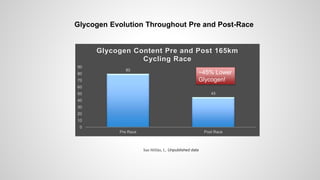
Glycogen Content Pre and Post 165km
Cycling Race
~45% Lower
Glycogen!
San Millán, I., Unpublished data
Glycogen Evolution Throughout Pre and Post-Race
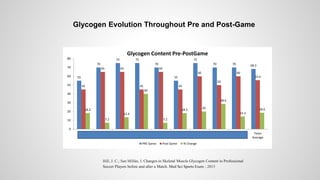
Glycogen Evolution Throughout Pre and Post-Game
55
70
75 75
70
55
75
70 70 68.3
45
65 65
45
65
45
60
50
60
55.6
18.2
7.2
13.4
40
7.2
18.2 20
28.6
14.3
18.6
0
10
20
30
40
50
60
70
80
Torres Brown Burch Klute Labrocca Sanchez Watts Wynne Jose M Team
Average
Glycogen Content Pre-PostGame
PRE Game Post Game % Change
Hill, J. C.; San Millán, I. Changes in Skeletal Muscle Glycogen Content in Professional
Soccer Players before and after a Match. Med Sci Sports Exerc ; 2015
INDIRECT ASSESSMENT OF GLYCOGEN STATUS IN COMPETITIVE ATHLETES
I. San Millán1, C. González-Haro2, J. Hill, FACSM1,
1School of Medicine, University of Colorado Denver, Denver, CO.; 2Department of Pharmacology and Physiology, School of
Medicine, University of Zaragoza, Spain
CONCLUSION: The measurement of [La-]b max and CHOox max in competitive athletes could be a good and practical approach to indirectly evaluate glycogen status as well as to identify
suboptimal glycogen storages that can ultimately affect athletic performance.
RESULTS: The results of the present study sowed that 30% for men and 24% for women showed suboptimal [La-]b max (GS). The correlation
between [La-]b max and CHOox max was high in men (r=0.771, p<0.05) and low in women (r=0.373). In men, [La-]b max, CHOox max, and
RER max were significantly higher in GO vs. GS, whereas FATox max was significantly lower in GO vs. GS. In women, there were not found
significant differences neither in CHOox max nor in FATox max. Nevertheless [La-]b max, and RER max were significantly higher in GO vs. GS.
METHODS: 82 competitive men (28 professionals and 54 non-professionals) and 17 competitive carried out a bycicle ergometer test, starting at 2 W·kg-1 with
increments of 0.5 W·kg-1 until exhaustion, the duration of three first steps was 5 min, and then 10 min. Oxygen uptake (VO2) and carbon dioxide (VCO2) were
measured (ParvoMedics TrueOne 2400, Sandy, UT) throughout the test and blood lactate concentration ([La-]b) (YSI 1500, Yellow Springs Instruments, Ohio) at the
end of each step. [La-]b max was considered the value at the end of last step of exercise. Fat and carbohydrate oxidation rates (FATox and CHOox) were estimated
by means of Frayn’s equations. A cutoff of 1 SD respect to the ([La-]b max) was suggested in order to classify the subjects in two groups: GO (Optimal [La-]b max)
and GS (Suboptimal maximal [La-]b max) with [La-]b max of <5.27 mM in men and <4.00 mM in women respectively as the cutoff. A Student t-test for independent
data was used to compare groups, the determination of the Pearson correlation coefficient was used to verify the existence of relationships between variables, level
of statistical significance was set at p<0.05.
ACKNOWLEDGEMENTS: The authors would like to express their gratitude to all subjects for their cooperation in this study.
INTRODUCTION: Proper glycogen storage is of great importance for athletic performance. Multiple studies show the positive correlation between glycogen storage and performance. Nevertheless, glycogen
assessment is difficult to determine due to the invasive and impractical nature of muscle biopsies. Therefore, it is difficult to identify suboptimal glycogen levels in athletes. Throughout the measurements of maximal
blood lactate levels ([La-]b max) and maximal carbohydrate oxidation rates (CHOox max) it could be possible to indirectly estimate muscle glycogen status in competitive athletes and identify suboptimal glycogen
levels. The purpose of this study was to assess indirectly muscle glycogen status through measurement of [La-]b max and CHOox max.
Figure 1. [La-]b max, CHOox max, FATox max and RER max comparisons between both groups of men. *p<0.05,
***p<0.001.
Figure 2. [La-]b max, CHOox max, FATox max and RER max comparisons between both groups of women. *p<0.05, **p<0.01.
0
1
2
3
4
5
6
7
8
9
10
[La-]b max CHOox max
[La-]bmax(mM)&CHOoxmax(g·min-1)
Women GO
GS
**
0.0
0.5
1.0
1.5
2.0
2.5
3.0
FATox max RER max
FAToxmax(g·min-1)&RERmax
Women GO
GS
*
0
1
2
3
4
5
6
7
8
9
10
[La-]b max CHOox max
[La-]bmax(mM)&CHOoxmax(g·min-1)
Men GO
GS
***
***
0.0
0.5
1.0
1.5
2.0
2.5
3.0
FATox max RER max
FAToxmax(g·min-1)&RERmax
Men GO
GS
*
***
INDIRECT ASSESSMENT OF GLYCOGEN STATUS IN COMPETITIVE ATHLETES
I. San Millán1, C. González-Haro2, J. Hill, FACSM1,
1School of Medicine, University of Colorado Denver, Denver, CO.; 2Department of Pharmacology and Physiology, School of
Medicine, University of Zaragoza, Spain
CONCLUSION: The measurement of [La-]b max and CHOox max in competitive athletes could be a good and practical approach to indirectly evaluate glycogen status as well as to identify
suboptimal glycogen storages that can ultimately affect athletic performance.
RESULTS: The results of the present study sowed that 30% for men and 24% for women showed suboptimal [La-]b max (GS). The correlation
between [La-]b max and CHOox max was high in men (r=0.771, p<0.05) and low in women (r=0.373). In men, [La-]b max, CHOox max, and
RER max were significantly higher in GO vs. GS, whereas FATox max was significantly lower in GO vs. GS. In women, there were not found
significant differences neither in CHOox max nor in FATox max. Nevertheless [La-]b max, and RER max were significantly higher in GO vs. GS.
METHODS: 82 competitive men (28 professionals and 54 non-professionals) and 17 competitive carried out a bycicle ergometer test, starting at 2 W·kg-1 with
increments of 0.5 W·kg-1 until exhaustion, the duration of three first steps was 5 min, and then 10 min. Oxygen uptake (VO2) and carbon dioxide (VCO2) were
measured (ParvoMedics TrueOne 2400, Sandy, UT) throughout the test and blood lactate concentration ([La-]b) (YSI 1500, Yellow Springs Instruments, Ohio) at the
end of each step. [La-]b max was considered the value at the end of last step of exercise. Fat and carbohydrate oxidation rates (FATox and CHOox) were estimated
by means of Frayn’s equations. A cutoff of 1 SD respect to the ([La-]b max) was suggested in order to classify the subjects in two groups: GO (Optimal [La-]b max)
and GS (Suboptimal maximal [La-]b max) with [La-]b max of <5.27 mM in men and <4.00 mM in women respectively as the cutoff. A Student t-test for independent
data was used to compare groups, the determination of the Pearson correlation coefficient was used to verify the existence of relationships between variables, level
of statistical significance was set at p<0.05.
ACKNOWLEDGEMENTS: The authors would like to express their gratitude to all subjects for their cooperation in this study.
INTRODUCTION: Proper glycogen storage is of great importance for athletic performance. Multiple studies show the positive correlation between glycogen storage and performance. Nevertheless, glycogen
assessment is difficult to determine due to the invasive and impractical nature of muscle biopsies. Therefore, it is difficult to identify suboptimal glycogen levels in athletes. Throughout the measurements of maximal
blood lactate levels ([La-]b max) and maximal carbohydrate oxidation rates (CHOox max) it could be possible to indirectly estimate muscle glycogen status in competitive athletes and identify suboptimal glycogen
levels. The purpose of this study was to assess indirectly muscle glycogen status through measurement of [La-]b max and CHOox max.
Figure 1. [La-]b max, CHOox max, FATox max and RER max comparisons between both groups of men. *p<0.05,
***p<0.001.
Figure 2. [La-]b max, CHOox max, FATox max and RER max comparisons between both groups of women. *p<0.05, **p<0.01.
0
1
2
3
4
5
6
7
8
9
10
[La-]b max CHOox max
[La-]bmax(mM)&CHOoxmax(g·min-1)
Women GO
GS
**
0.0
0.5
1.0
1.5
2.0
2.5
3.0
FATox max RER max
FAToxmax(g·min-1)&RERmax
Women GO
GS
*
0
1
2
3
4
5
6
7
8
9
10
[La-]b max CHOox max
[La-]bmax(mM)&CHOoxmax(g·min-1)
Men GO
GS
***
***
0.0
0.5
1.0
1.5
2.0
2.5
3.0
FATox max RER max
FAToxmax(g·min-1)&RERmax
Men GO
GS
*
***
Still Have Doubts?
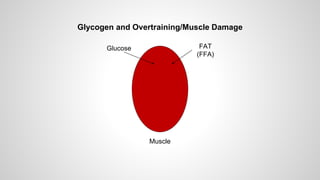
Glycogen and Overtraining/Muscle Damage
FAT
(FFA)
Muscle
Glucose
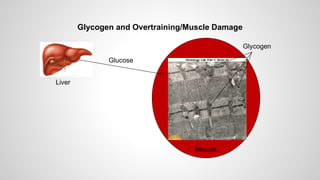
Glycogen
Muscle
Glucose
Liver
Glycogen and Overtraining/Muscle Damage
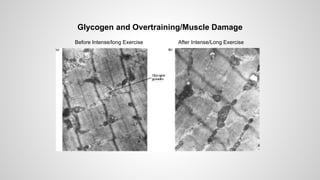
Before Intense/long Exercise After Intense/Long Exercise
Glycogen and Overtraining/Muscle Damage
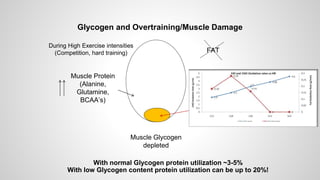
Muscle Glycogen
depleted
FAT
glycogen
Muscle Protein
(Alanine,
Glutamine,
BCAA’s)
During High Exercise intensities
(Competition, hard training)
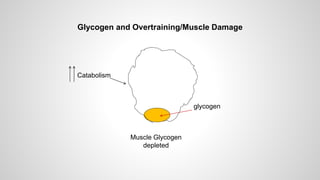
Glycogen and Overtraining/Muscle Damage
With normal Glycogen protein utilization ~3-5%
With low Glycogen content protein utilization can be up to 20%!
Muscle Glycogen
depleted
glycogen
Catabolism
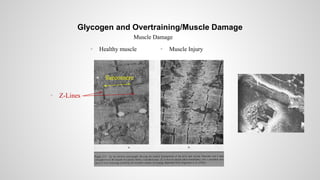
Glycogen and Overtraining/Muscle Damage
 Healthy muscle  Muscle Injury
 Z-Lines
 Sarcomere
Muscle Damage
Glycogen and Overtraining/Muscle Damage
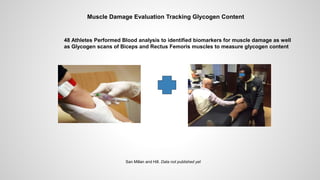
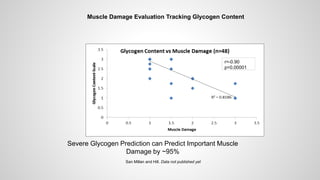
Muscle Damage Evaluation Tracking Glycogen Content
48 Athletes Performed Blood analysis to identified biomarkers for muscle damage as well
as Glycogen scans of Biceps and Rectus Femoris muscles to measure glycogen content
San Millan and Hill. Data not published yet
Severe Glycogen Prediction can Predict Important Muscle
Damage by ~95%
San Millan and Hill. Data not published yet
r=-0.90
p<0.00001
Muscle Damage Evaluation Tracking Glycogen Content
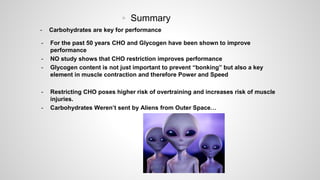
- Carbohydrates are key for performance
- For the past 50 years CHO and Glycogen have been shown to improve
performance
- NO study shows that CHO restriction improves performance
- Glycogen content is not just important to prevent “bonking” but also a key
element in muscle contraction and therefore Power and Speed
- Restricting CHO poses higher risk of overtraining and increases risk of muscle
injuries.
- Carbohydrates Weren’t sent by Aliens from Outer Space…
 Summary
Iñigo San Millán, PhD
Director of Sports Performance
CU Sports Medicine and Performance Center
Assistant Professor, University of Colorado School of Medicine
Inigo.sanmillan@ucdenver.edu
@doctorinigo
Questions??
Iñigo San Millán, PhD
Director of Sports Performance
CU Sports Medicine and Performance Center
Assistant Professor, University of Colorado School of Medicine
Inigo.sanmillan@ucdenver.edu
@doctorinigo

Dr. Inigo San Millan Presentation

  • 1.
    The Importance ofCarbohydrates in Performance Iñigo San Millán, PhD Assistant Professor, Department of Physical Medicine and Rehabilitation University of Colorado School of Medicine Director, Sports Performance CU Sports Medicine and Performance Center Inigo.sanmillan@ucdenver.edu @doctorinigo
  • 2.
    Iñigo San Millán,PhD Director of Sports Performance CU Sports Medicine and Performance Center Assistant Professor, University of Colorado School of Medicine Inigo.sanmillan@ucdenver.edu @doctorinigo
  • 3.
    Today’s Main Topics PerformanceGlycogen Muscle ContractionOvertraining Muscle Damage
  • 4.
    Carbohydrates Public Enemy#1?? Are they really that bad for you??
  • 5.
    Embedded PowerPoint VideoByPresenterMedia.com
  • 6.
    Humphrey et al.Earliest evidence for caries and exploitation of starchy plant foods in Pleistocene hunter- gatherers from Morocco. Proceedings of the National Academy of Sciences. 2014 94% of the 50 sets of teeth found in a Paleolithic cave in Morocco had Caies and Tooth Decay as a result of starchy foods Hardy et al. Dental calculus reveals potential respiratory irritants and ingestion of essential plant-based nutrients at Lower Palaeolithic Qesem Cave Israel. Quaternary International 2015. Starch granules found in teeth show evidence of plants and starchy foods in Paleolithic diets. In fact….Paleo diet was rich in Starchy foods!
  • 7.
    We have seenamazing advances in the science of the sport These Advances are based on Scientific Evidence……… When it comes to Carbohydrates We need to keep applying the scientific approach and evidence
  • 8.
    Endurance Coaching Summit| 2015 What Does Science Say?
  • 9.
    Systematic review: Carbohydratesupplementation on exercise performance or capacity of varying durations Trent Stellingwerff, Gregory R. Cox. Appl Physiol Nutr Metab, 2014. 61 published studies on Carbohydrate and Performance 82% Shows Statistically significant performance benefits (50 studies) 18% of studies shows no change compared to placebo NO study shows detrimental performance with CHO What Does Science Say?
  • 10.
    67:00:00 60:47:00 56:07:00 Placebo Glucose (90g/h) Glucose +Fructose (90g/h) Effects of Carbohydrates in a 40k time trial after a 120min at 55% WMax 275W 254W 231W Currell and Jeukendrup, 2008
  • 12.
    CHO/h During Ironman Pfeifferet al. "Nutritional intake and gastrointestinal problems during competitive endurance events." Med Sci Sports Exerc 2012
  • 13.
    Kenyan runners havedominated for decades and are the skinniest athletes in the world
  • 14.
    Kenyan runners havedominated for decades and are the skinniest athletes in the world Kenyan’s diets Energy Intake: 2987Kcal -Carbohydrates: 76.5%!! -10.7g/kg/day!! -Fat: 13.4% -Protein: 10.1% -20% Simple sugars!! HIGH CHO and LOW FAT diet!! Onywera, V.O. et al. Food and macronutrient intake of elite Kenyan distance runners. Int. J. Sport. Nutr. Exerc. Metab. 14: 709-719, 2004.
  • 15.
    Carbohydrates during theTour de France Garmin Riders at TdF Total Energy Intake: 6000-9000 Kcal/day -Carbohydrates: 70-75% -About 1,000 g/day of CHO -400g simple sugars!!! -4000 kcal/day of CHO -1600 Kcal/day Simple Sugars! -13-14g/kg/day!!
  • 16.
    Low CHO Dietsand Performance?? Can low CHO Diets (Therefore High Fat or High Protein) increase Fat utilization? Yes…HOWEVER, no improvements in performance (normally detrimental). NO Scientific Study has shown improvements in performance. In fact, overall, studies show to be detrimental for performance
  • 17.
     Substrate Utilization CHO FAT FATmax •SanMillán, I.; Gotshall, R.W.; González-Haro, C.; Gil, J.; Irazusta, J. Sensitivity of Crossover Concept to Discriminate Different Levels of Performance: A New Approach. Med Sci Sports Exerc 40:293. 2008. •González-Haro, C.; San Millán, I. Application of the Crossover Concept to UCI Pro Tour Level Professional Cyclists: A New Approach. Med Sci Sports Exerc 40:396-397. 2008
  • 18.
  • 19.
    Low CHO DietsIncrease Fat Utilization and Performance?? LOW CHO Diet Restored Normal CHO Diet Max Power Output= 315W (4.5w/kg) Max Power Output= 350W (5w/kg)
  • 20.
     Glycogen andPerformance  What is Glycogen??  Glycogen is Carbohydrate store in the body  85% in Muscles  15% in Liver  We can only store ~1lb Of CHO!
  • 21.
    Can we measureGlycogen? Absolutely!!
  • 22.
    Muscle Biopsy Very invasiveand aggressive Impractical and not possible to apply
  • 23.
    A Novel Methodologyto Measure Glycogen in a non-invasive way Hill, J. C., & San Millán, I. S. Validation of musculoskeletal ultrasound to assess and quantify muscle glycogen content. A novel approach. The Physician and sportsmedicine, 42(3), 45-52, 2014
  • 24.
    A Novel Methodologyto Measure Glycogen in a non-invasive way Hill, J. C., and San Millán, I. "Validation of musculoskeletal ultrasound to assess and quantify muscle glycogen content. A novel approach." The Physician and sportsmedicine 42.3 (2014): 45-52.
  • 25.
    Correlation Results Hill, J.C., and San Millán, I. "Validation of musculoskeletal ultrasound to assess and quantify muscle glycogen content. A novel approach." The Physician and sportsmedicine 42.3 (2014): 45-52.
  • 26.
     Glycogen andPerformance
  • 27.
    The relationship ofmuscle glycogen content, work time and dietary carbohydrate intake (adapted from Borgström et al. 1967). Scientific Study – Glycogen and Performance Time to Exhaustion
  • 28.
    Scientific Study –Glycogen and Performance Costill, D. L., and J. M. Miller. "Nutrition for endurance sport: carbohydrate and fluid balance” 1980
  • 29.
    Want More onGlycogen?
  • 30.
    Glycogen Regulates MuscleContraction Ørtenblad, Niels, et al. "Role of glycogen availability in sarcoplasmic reticulum Ca2+ kinetics in human skeletal muscle." The Journal of physiology 2011.
  • 31.
    Glycogen Regulates MuscleContraction Ørtenblad, Niels, et al. "Role of glycogen availability in sarcoplasmic reticulum Ca2+ kinetics in human skeletal muscle." The Journal of physiology 2011. It is not just about Bonking!
  • 32.
     A 25%decrease in Glycogen in the legs will decrease Ca++ release from SR by a 10%! Ørtenblad, N., Nielsen, J., Saltin, B., & Holmberg, H. C. (2011). Role of glycogen availability in sarcoplasmic reticulum Ca2+ kinetics in human skeletal muscle. The Journal of physiology, 589(3), 711-725. Glycogen Content Regulates Muscle Contraction
  • 33.
    80 45 0 10 20 30 40 50 60 70 80 90 Pre Race PostRace Glycogen Content Pre and Post 165km Cycling Race ~45% Lower Glycogen! San Millán, I., Unpublished data Glycogen Evolution Throughout Pre and Post-Race
  • 34.
    Glycogen Evolution ThroughoutPre and Post-Game 55 70 75 75 70 55 75 70 70 68.3 45 65 65 45 65 45 60 50 60 55.6 18.2 7.2 13.4 40 7.2 18.2 20 28.6 14.3 18.6 0 10 20 30 40 50 60 70 80 Torres Brown Burch Klute Labrocca Sanchez Watts Wynne Jose M Team Average Glycogen Content Pre-PostGame PRE Game Post Game % Change Hill, J. C.; San Millán, I. Changes in Skeletal Muscle Glycogen Content in Professional Soccer Players before and after a Match. Med Sci Sports Exerc ; 2015
  • 35.
    INDIRECT ASSESSMENT OFGLYCOGEN STATUS IN COMPETITIVE ATHLETES I. San Millán1, C. González-Haro2, J. Hill, FACSM1, 1School of Medicine, University of Colorado Denver, Denver, CO.; 2Department of Pharmacology and Physiology, School of Medicine, University of Zaragoza, Spain CONCLUSION: The measurement of [La-]b max and CHOox max in competitive athletes could be a good and practical approach to indirectly evaluate glycogen status as well as to identify suboptimal glycogen storages that can ultimately affect athletic performance. RESULTS: The results of the present study sowed that 30% for men and 24% for women showed suboptimal [La-]b max (GS). The correlation between [La-]b max and CHOox max was high in men (r=0.771, p<0.05) and low in women (r=0.373). In men, [La-]b max, CHOox max, and RER max were significantly higher in GO vs. GS, whereas FATox max was significantly lower in GO vs. GS. In women, there were not found significant differences neither in CHOox max nor in FATox max. Nevertheless [La-]b max, and RER max were significantly higher in GO vs. GS. METHODS: 82 competitive men (28 professionals and 54 non-professionals) and 17 competitive carried out a bycicle ergometer test, starting at 2 W·kg-1 with increments of 0.5 W·kg-1 until exhaustion, the duration of three first steps was 5 min, and then 10 min. Oxygen uptake (VO2) and carbon dioxide (VCO2) were measured (ParvoMedics TrueOne 2400, Sandy, UT) throughout the test and blood lactate concentration ([La-]b) (YSI 1500, Yellow Springs Instruments, Ohio) at the end of each step. [La-]b max was considered the value at the end of last step of exercise. Fat and carbohydrate oxidation rates (FATox and CHOox) were estimated by means of Frayn’s equations. A cutoff of 1 SD respect to the ([La-]b max) was suggested in order to classify the subjects in two groups: GO (Optimal [La-]b max) and GS (Suboptimal maximal [La-]b max) with [La-]b max of <5.27 mM in men and <4.00 mM in women respectively as the cutoff. A Student t-test for independent data was used to compare groups, the determination of the Pearson correlation coefficient was used to verify the existence of relationships between variables, level of statistical significance was set at p<0.05. ACKNOWLEDGEMENTS: The authors would like to express their gratitude to all subjects for their cooperation in this study. INTRODUCTION: Proper glycogen storage is of great importance for athletic performance. Multiple studies show the positive correlation between glycogen storage and performance. Nevertheless, glycogen assessment is difficult to determine due to the invasive and impractical nature of muscle biopsies. Therefore, it is difficult to identify suboptimal glycogen levels in athletes. Throughout the measurements of maximal blood lactate levels ([La-]b max) and maximal carbohydrate oxidation rates (CHOox max) it could be possible to indirectly estimate muscle glycogen status in competitive athletes and identify suboptimal glycogen levels. The purpose of this study was to assess indirectly muscle glycogen status through measurement of [La-]b max and CHOox max. Figure 1. [La-]b max, CHOox max, FATox max and RER max comparisons between both groups of men. *p<0.05, ***p<0.001. Figure 2. [La-]b max, CHOox max, FATox max and RER max comparisons between both groups of women. *p<0.05, **p<0.01. 0 1 2 3 4 5 6 7 8 9 10 [La-]b max CHOox max [La-]bmax(mM)&CHOoxmax(g·min-1) Women GO GS ** 0.0 0.5 1.0 1.5 2.0 2.5 3.0 FATox max RER max FAToxmax(g·min-1)&RERmax Women GO GS * 0 1 2 3 4 5 6 7 8 9 10 [La-]b max CHOox max [La-]bmax(mM)&CHOoxmax(g·min-1) Men GO GS *** *** 0.0 0.5 1.0 1.5 2.0 2.5 3.0 FATox max RER max FAToxmax(g·min-1)&RERmax Men GO GS * ***
  • 36.
    INDIRECT ASSESSMENT OFGLYCOGEN STATUS IN COMPETITIVE ATHLETES I. San Millán1, C. González-Haro2, J. Hill, FACSM1, 1School of Medicine, University of Colorado Denver, Denver, CO.; 2Department of Pharmacology and Physiology, School of Medicine, University of Zaragoza, Spain CONCLUSION: The measurement of [La-]b max and CHOox max in competitive athletes could be a good and practical approach to indirectly evaluate glycogen status as well as to identify suboptimal glycogen storages that can ultimately affect athletic performance. RESULTS: The results of the present study sowed that 30% for men and 24% for women showed suboptimal [La-]b max (GS). The correlation between [La-]b max and CHOox max was high in men (r=0.771, p<0.05) and low in women (r=0.373). In men, [La-]b max, CHOox max, and RER max were significantly higher in GO vs. GS, whereas FATox max was significantly lower in GO vs. GS. In women, there were not found significant differences neither in CHOox max nor in FATox max. Nevertheless [La-]b max, and RER max were significantly higher in GO vs. GS. METHODS: 82 competitive men (28 professionals and 54 non-professionals) and 17 competitive carried out a bycicle ergometer test, starting at 2 W·kg-1 with increments of 0.5 W·kg-1 until exhaustion, the duration of three first steps was 5 min, and then 10 min. Oxygen uptake (VO2) and carbon dioxide (VCO2) were measured (ParvoMedics TrueOne 2400, Sandy, UT) throughout the test and blood lactate concentration ([La-]b) (YSI 1500, Yellow Springs Instruments, Ohio) at the end of each step. [La-]b max was considered the value at the end of last step of exercise. Fat and carbohydrate oxidation rates (FATox and CHOox) were estimated by means of Frayn’s equations. A cutoff of 1 SD respect to the ([La-]b max) was suggested in order to classify the subjects in two groups: GO (Optimal [La-]b max) and GS (Suboptimal maximal [La-]b max) with [La-]b max of <5.27 mM in men and <4.00 mM in women respectively as the cutoff. A Student t-test for independent data was used to compare groups, the determination of the Pearson correlation coefficient was used to verify the existence of relationships between variables, level of statistical significance was set at p<0.05. ACKNOWLEDGEMENTS: The authors would like to express their gratitude to all subjects for their cooperation in this study. INTRODUCTION: Proper glycogen storage is of great importance for athletic performance. Multiple studies show the positive correlation between glycogen storage and performance. Nevertheless, glycogen assessment is difficult to determine due to the invasive and impractical nature of muscle biopsies. Therefore, it is difficult to identify suboptimal glycogen levels in athletes. Throughout the measurements of maximal blood lactate levels ([La-]b max) and maximal carbohydrate oxidation rates (CHOox max) it could be possible to indirectly estimate muscle glycogen status in competitive athletes and identify suboptimal glycogen levels. The purpose of this study was to assess indirectly muscle glycogen status through measurement of [La-]b max and CHOox max. Figure 1. [La-]b max, CHOox max, FATox max and RER max comparisons between both groups of men. *p<0.05, ***p<0.001. Figure 2. [La-]b max, CHOox max, FATox max and RER max comparisons between both groups of women. *p<0.05, **p<0.01. 0 1 2 3 4 5 6 7 8 9 10 [La-]b max CHOox max [La-]bmax(mM)&CHOoxmax(g·min-1) Women GO GS ** 0.0 0.5 1.0 1.5 2.0 2.5 3.0 FATox max RER max FAToxmax(g·min-1)&RERmax Women GO GS * 0 1 2 3 4 5 6 7 8 9 10 [La-]b max CHOox max [La-]bmax(mM)&CHOoxmax(g·min-1) Men GO GS *** *** 0.0 0.5 1.0 1.5 2.0 2.5 3.0 FATox max RER max FAToxmax(g·min-1)&RERmax Men GO GS * ***
  • 37.
  • 38.
  • 39.
    Glycogen and Overtraining/MuscleDamage FAT (FFA) Muscle Glucose
  • 40.
  • 41.
    Before Intense/long ExerciseAfter Intense/Long Exercise Glycogen and Overtraining/Muscle Damage
  • 42.
    Muscle Glycogen depleted FAT glycogen Muscle Protein (Alanine, Glutamine, BCAA’s) DuringHigh Exercise intensities (Competition, hard training) Glycogen and Overtraining/Muscle Damage With normal Glycogen protein utilization ~3-5% With low Glycogen content protein utilization can be up to 20%!
  • 43.
  • 44.
     Healthy muscle Muscle Injury  Z-Lines  Sarcomere Muscle Damage Glycogen and Overtraining/Muscle Damage
  • 45.
    Muscle Damage EvaluationTracking Glycogen Content 48 Athletes Performed Blood analysis to identified biomarkers for muscle damage as well as Glycogen scans of Biceps and Rectus Femoris muscles to measure glycogen content San Millan and Hill. Data not published yet
  • 46.
    Severe Glycogen Predictioncan Predict Important Muscle Damage by ~95% San Millan and Hill. Data not published yet r=-0.90 p<0.00001 Muscle Damage Evaluation Tracking Glycogen Content
  • 47.
    - Carbohydrates arekey for performance - For the past 50 years CHO and Glycogen have been shown to improve performance - NO study shows that CHO restriction improves performance - Glycogen content is not just important to prevent “bonking” but also a key element in muscle contraction and therefore Power and Speed - Restricting CHO poses higher risk of overtraining and increases risk of muscle injuries. - Carbohydrates Weren’t sent by Aliens from Outer Space…  Summary
  • 48.
    Iñigo San Millán,PhD Director of Sports Performance CU Sports Medicine and Performance Center Assistant Professor, University of Colorado School of Medicine Inigo.sanmillan@ucdenver.edu @doctorinigo
  • 49.
    Questions?? Iñigo San Millán,PhD Director of Sports Performance CU Sports Medicine and Performance Center Assistant Professor, University of Colorado School of Medicine Inigo.sanmillan@ucdenver.edu @doctorinigo