calculation | consulting
capsule networks
(TM)
c|c
(TM)
charles@calculationconsulting.com
calculation|consulting
capsule networks
(TM)
charles@calculationconsulting.com
c|c
(TM)
(TM)
3
calculation | consulting capsule networks
Capsule networks by Hinton
c|c
(TM)
(TM)
4
calculation | consulting capsule networks
Capsule networks by Hinton
c|c
(TM)
(TM)
5
calculation | consulting capsule networks
Where ConvNets come from: LeNet 5
Y. LeCun, L. Bottou, Y. Bengio, and P. Haffner,
Gradient-based learning applied to document recognition,
Proc. IEEE 86(11): 2278–2324, 1998.
c|c
(TM)
(TM)
6
calculation | consulting capsule networks
Convolutions usually w/ max pooling
we get gross spatial invariance by ignoring
exactly where a feature occurs
“A vision system needs to use the same
knowledge at all locations in the image” Hinton
ConvNet: share weights + max pooling
c|c
(TM)
(TM)
7
calculation | consulting capsule networks
Hierarchical model of the visual system
HMax model, Riesenhuber and Poggio (1999)
dotted line selects max pooled features from lower layer
c|c
(TM)
(TM)
8
calculation | consulting capsule networks
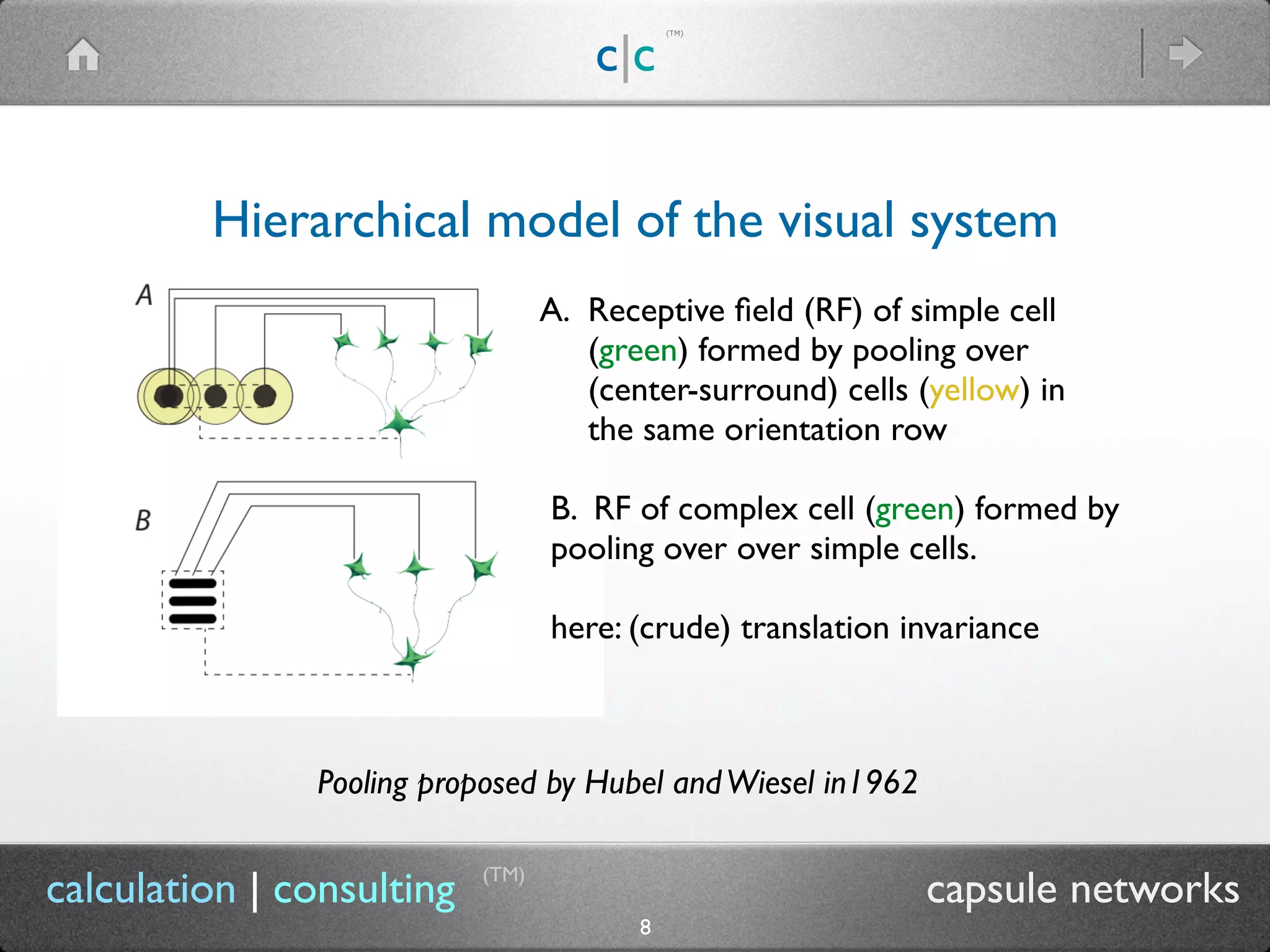
Hierarchical model of the visual system
Pooling proposed by Hubel andWiesel in1962
A. Receptive field (RF) of simple cell
(green) formed by pooling over
(center-surround) cells (yellow) in
the same orientation row
B. RF of complex cell (green) formed by
pooling over over simple cells.
here: (crude) translation invariance
c|c
(TM)
(TM)
9
calculation | consulting capsule networks
Hierarchical model of the visual system
ConvNets resemble hierarchical models (but notice the hyper-column)
HMax model, Riesenhuber and Poggio (1999)
c|c
(TM)
(TM)
10
calculation | consulting capsule networks
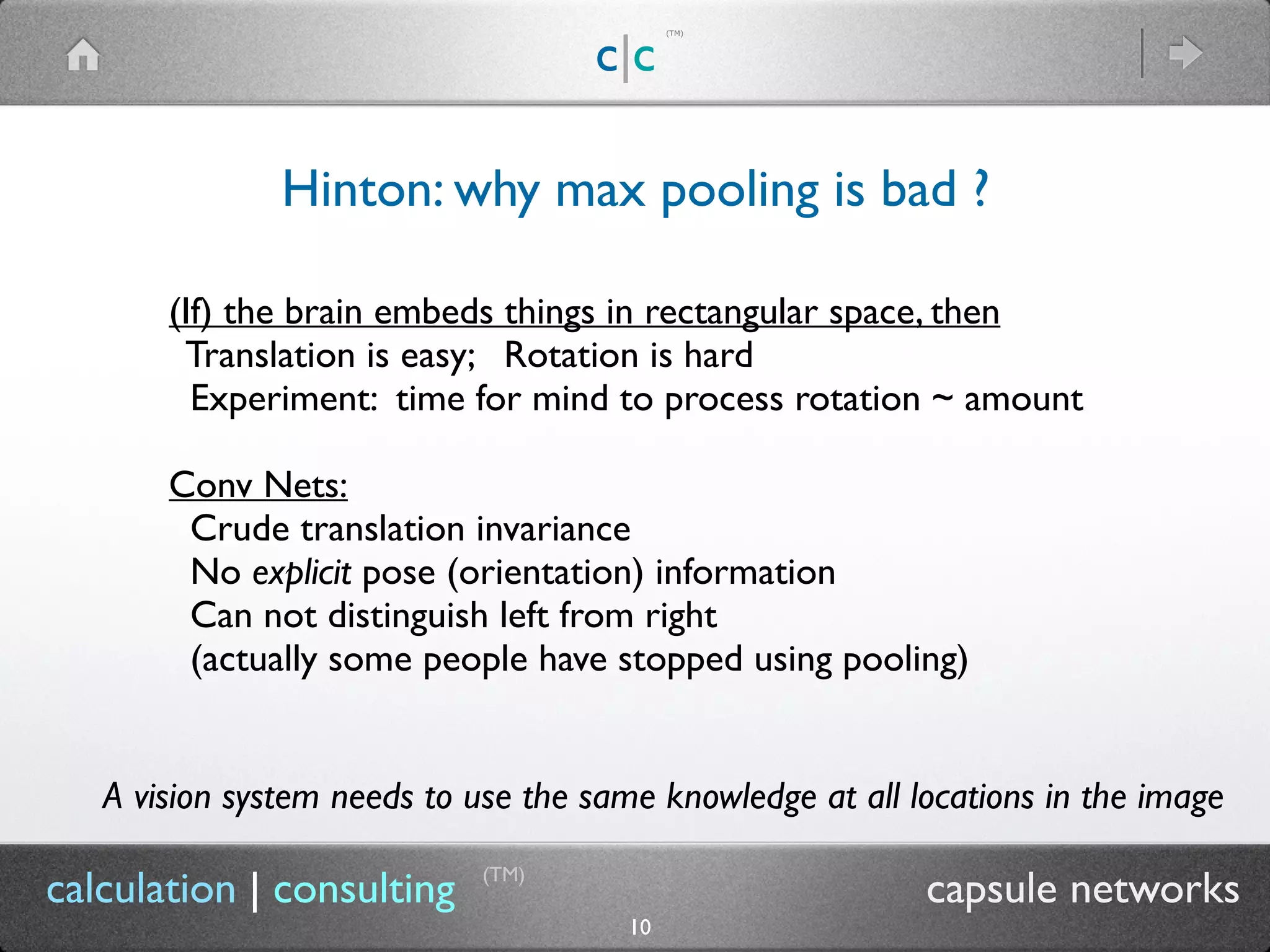
Hinton: why max pooling is bad ?
(If) the brain embeds things in rectangular space, then
Translation is easy; Rotation is hard
Experiment: time for mind to process rotation ~ amount
Conv Nets:
Crude translation invariance
No explicit pose (orientation) information
Can not distinguish left from right
(actually some people have stopped using pooling)
A vision system needs to use the same knowledge at all locations in the image
c|c
(TM)
(TM)
11
calculation | consulting capsule networks
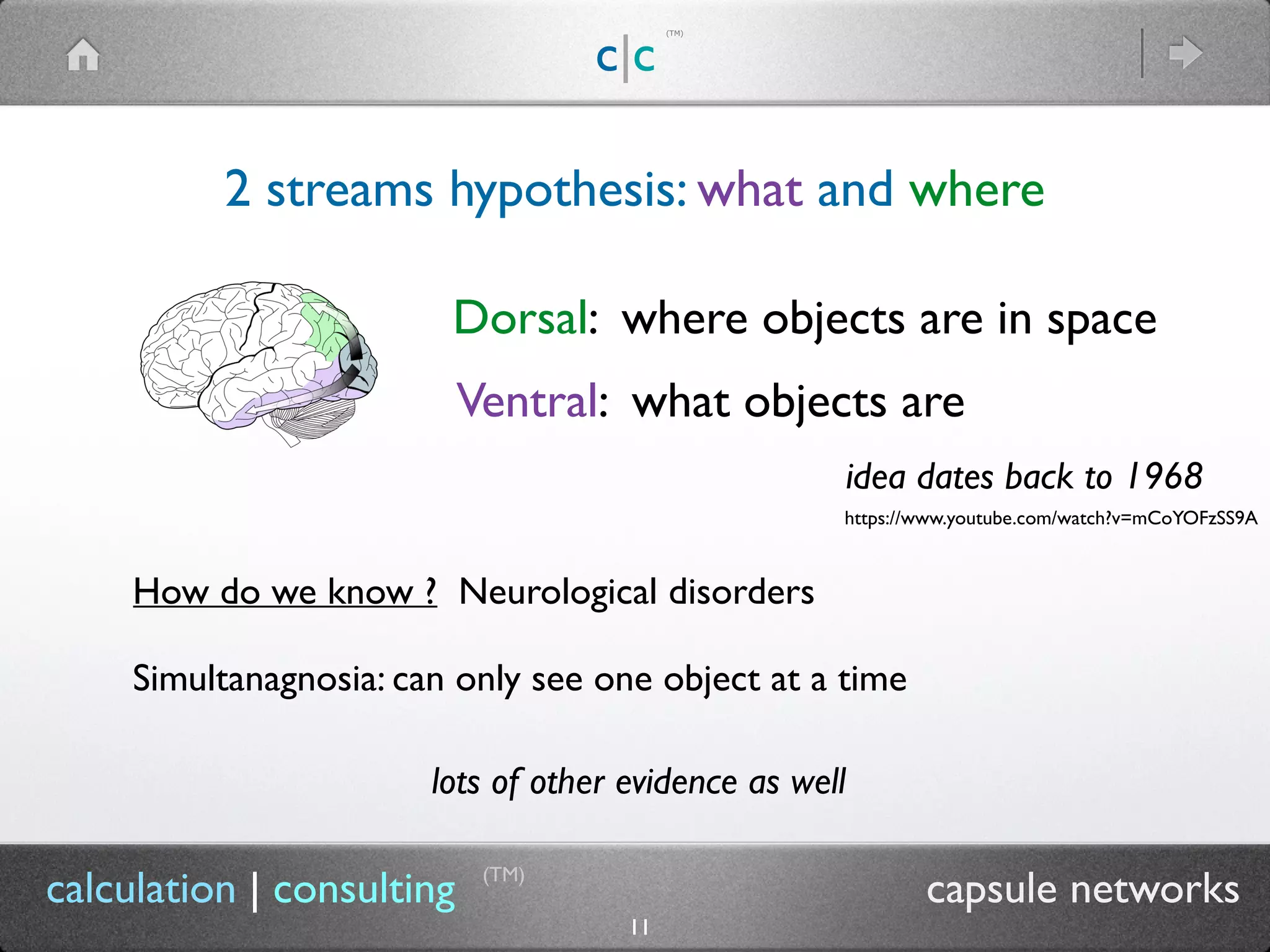
2 streams hypothesis: what and where
Ventral: what objects are
Dorsal: where objects are in space
How do we know ? Neurological disorders
Simultanagnosia: can only see one object at a time
idea dates back to 1968
lots of other evidence as well
https://www.youtube.com/watch?v=mCoYOFzSS9A
c|c
(TM)
(TM)
12
calculation | consulting capsule networks
Cortical Microcolumns
Capsules may encode
orientation scale
velocity color …
Column through cortical layers of the brain
80-120 neurons (2X long inV1)
share the same receptive field
part of Hubel andWiesel, Nobel Prize 1981
also see recent review: https://www.sciencedirect.com/science/article/pii/S0166223615001484
c|c
(TM)
(TM)
13
calculation | consulting capsule networks
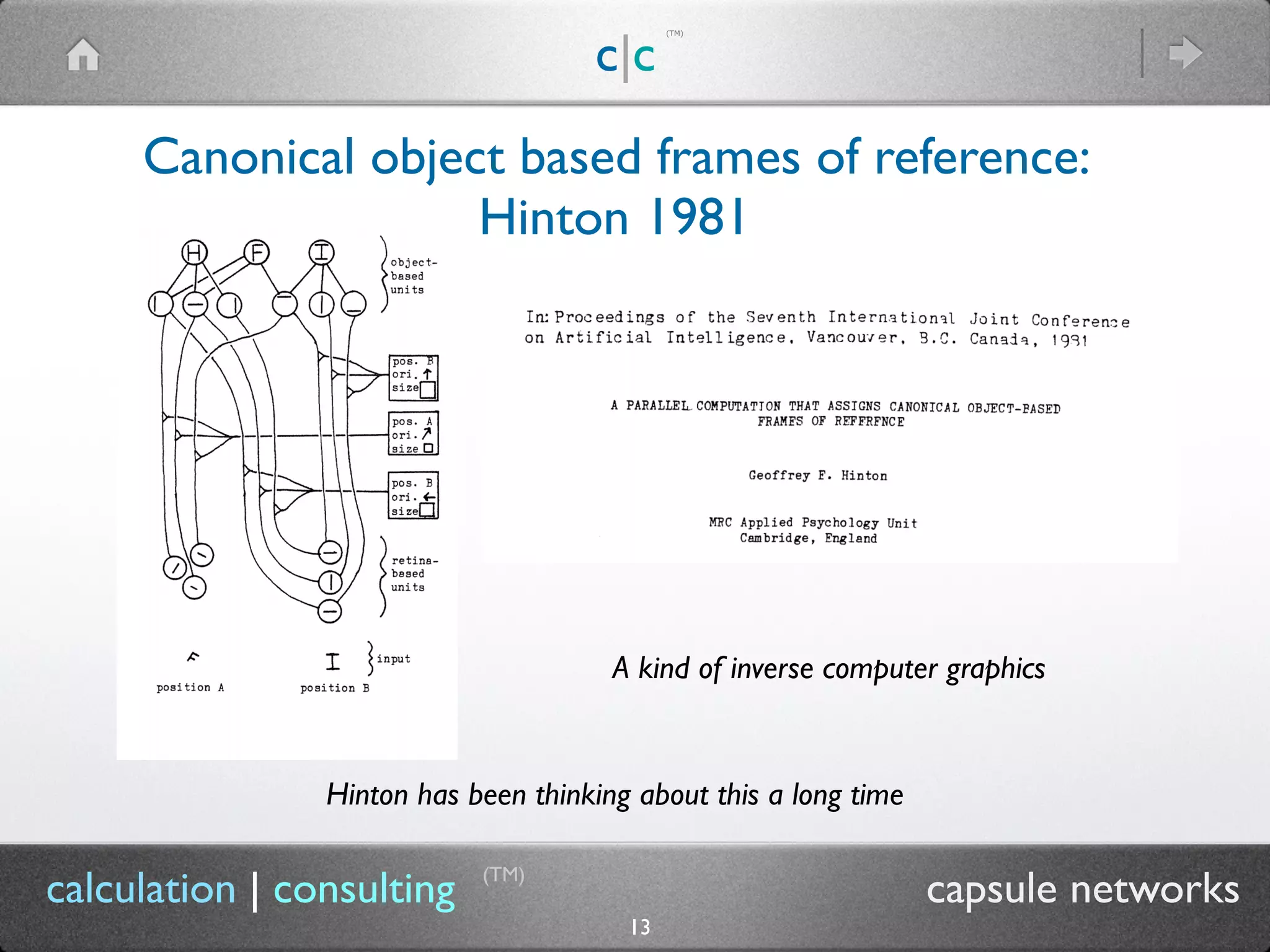
Canonical object based frames of reference:
Hinton 1981
Hinton has been thinking about this a long time
A kind of inverse computer graphics
c|c
(TM)
(TM)
14
calculation | consulting capsule networks
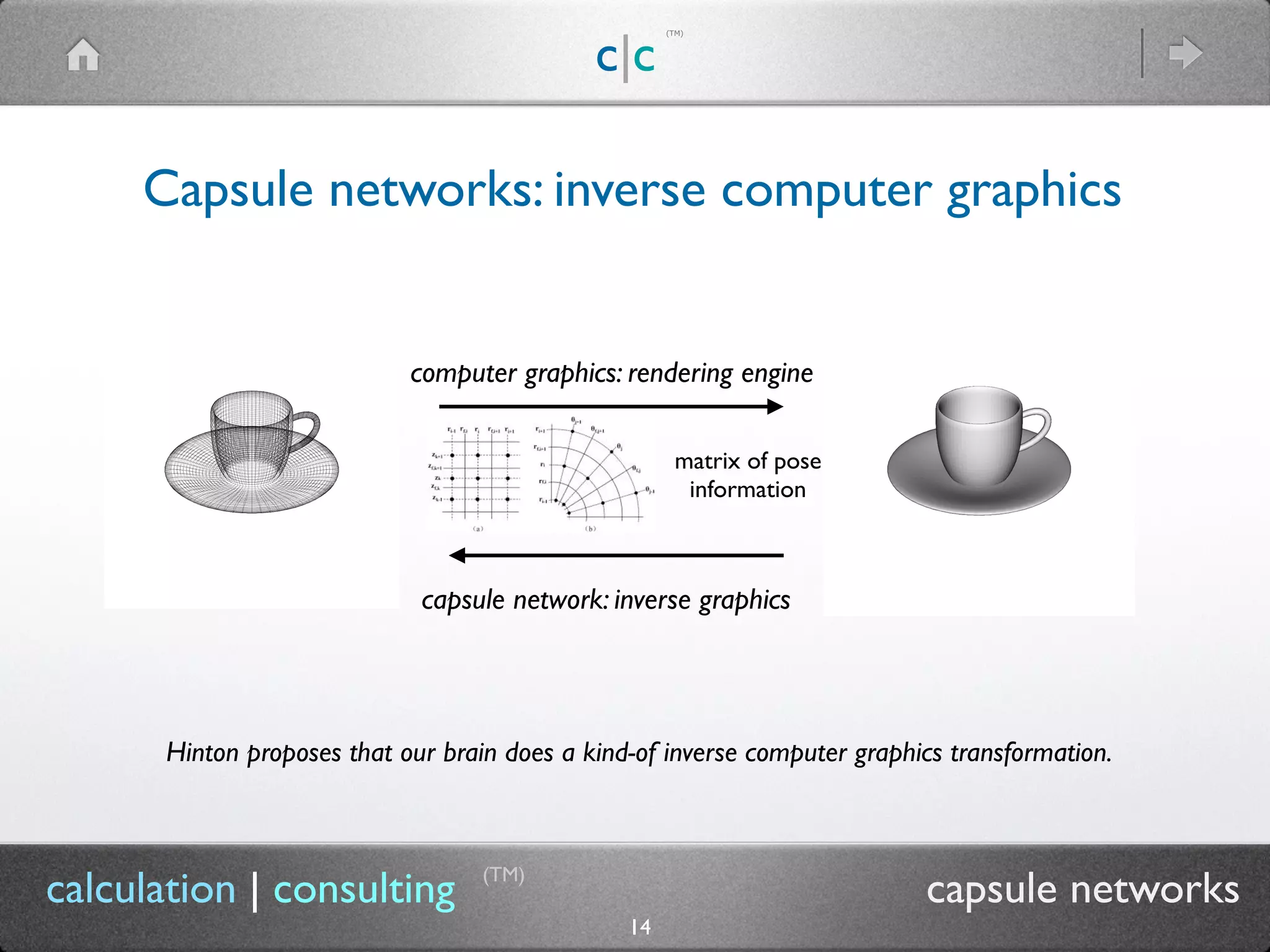
Capsule networks: inverse computer graphics
computer graphics: rendering engine
capsule network: inverse graphics
matrix of pose
information
Hinton proposes that our brain does a kind-of inverse computer graphics transformation.
c|c
(TM)
(TM)
15
calculation | consulting capsule networks
Invariance vs Equivariance
Max pooling provides spatial Invariance, but Hinton argues we need spatial Equivariance.
so use vectors and Affine transformations
Invariance: similar results if
image is shifted or rotated
Equivariance: invariance
under a Symmetry Transformations (S,A,…)
Group homomorphism: f(g*x)=g*f(x)=f(x)*g-1
Geometric: i.e. triangle
centers invariant under Similarity (S)
centroid invariant under Affine (A)
Statistics:
mean: invariant under change of units
median: more generally invariant; a better statistic
c|c
(TM)
(TM)
16
calculation | consulting capsule networks
Segmenting highly overlapping objects
Explaining away: Even if two hidden causes are independent, they can become
dependent when we observe an effect that they can both influence. Hinton
c|c
(TM)
(TM)
17
calculation | consulting capsule networks
Capsule networks: architecture
+ unsupervised | reconstruction loss
supervised | max norm loss
Hinton et. al. Dynamic Routing Between Capsules (2017)
c|c
(TM)
(TM)
18
calculation | consulting capsule networks
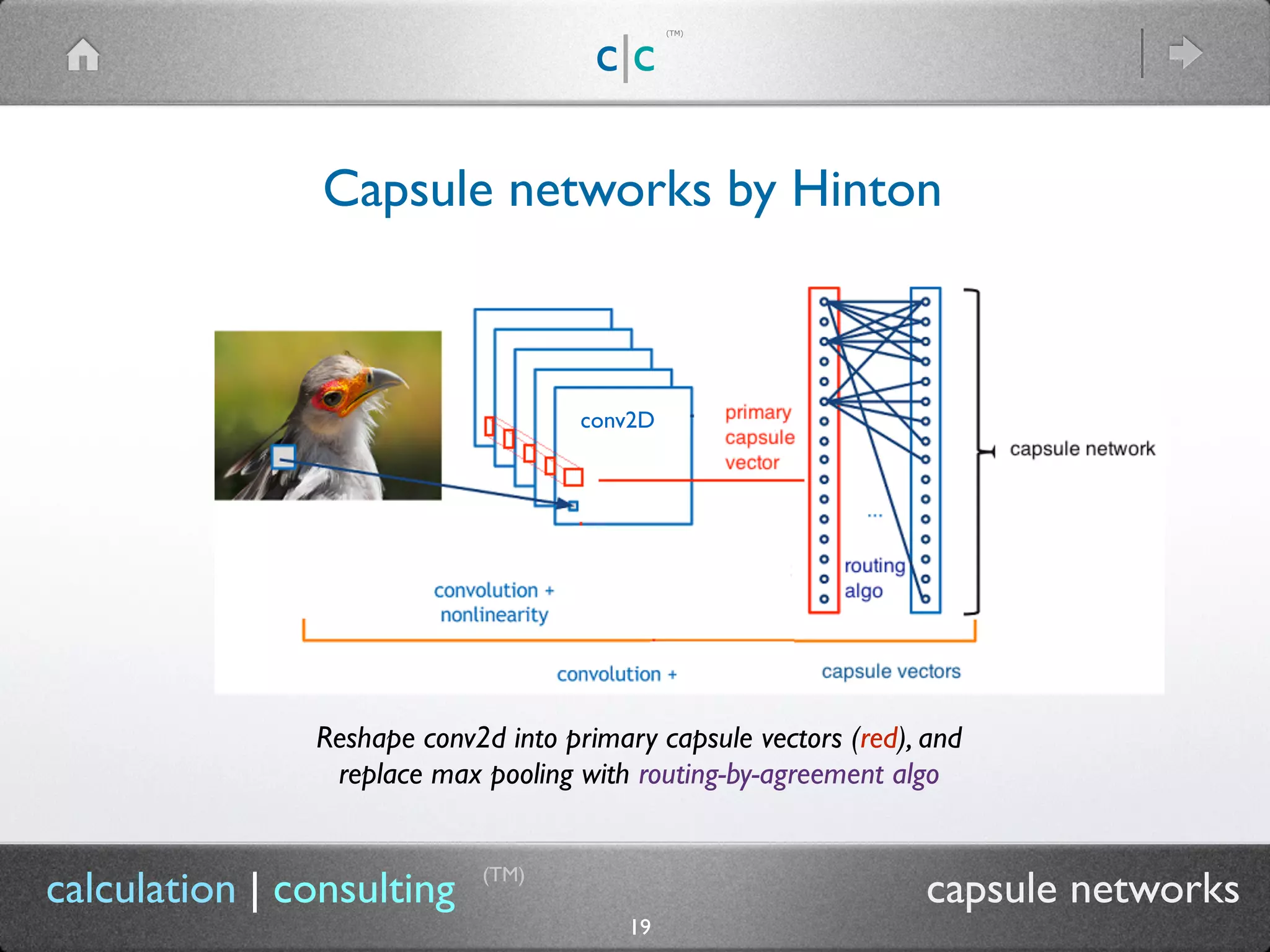
Capsule networks by Hinton
conv2D
Keep first convolutional layer, but replace max pooling with …
c|c
(TM)
(TM)
19
calculation | consulting capsule networks
Capsule networks by Hinton
conv2D
Reshape conv2d into primary capsule vectors (red), and
replace max pooling with routing-by-agreement algo
c|c
(TM)
(TM)
20
calculation | consulting capsule networks
Capsule networks by Hinton
“Active capsules at one level (red) make predictions, via transformation matrices,
for the instantiation parameters of higher-level capsules (blue).
When multiple predictions agree, a higher level capsule (blue) becomes active”
conv2D
c|c
(TM)
(TM)
21
calculation | consulting capsule networks
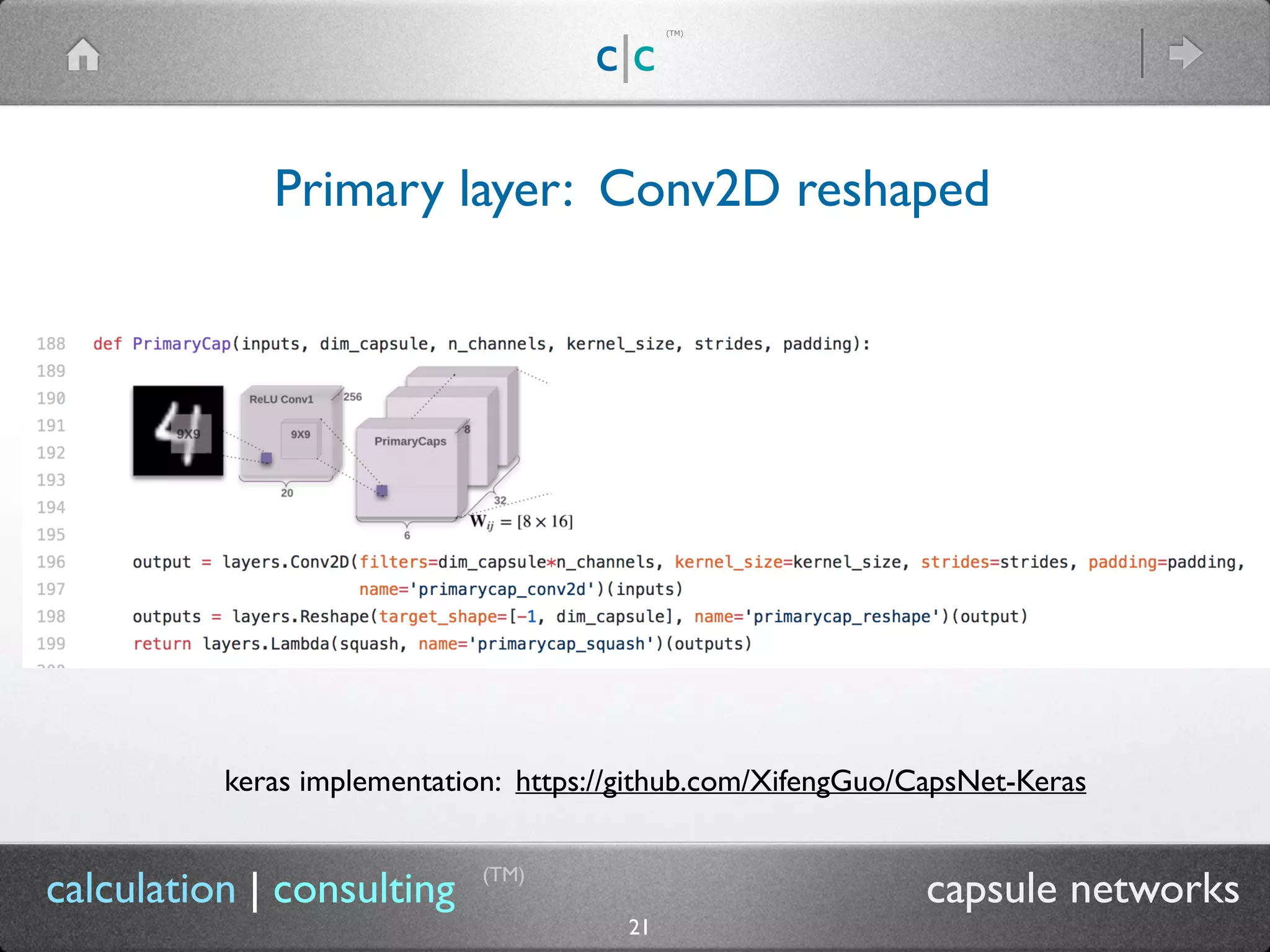
Primary layer: Conv2D reshaped
keras implementation: https://github.com/XifengGuo/CapsNet-Keras
c|c
(TM)
(TM)
22
calculation | consulting capsule networks
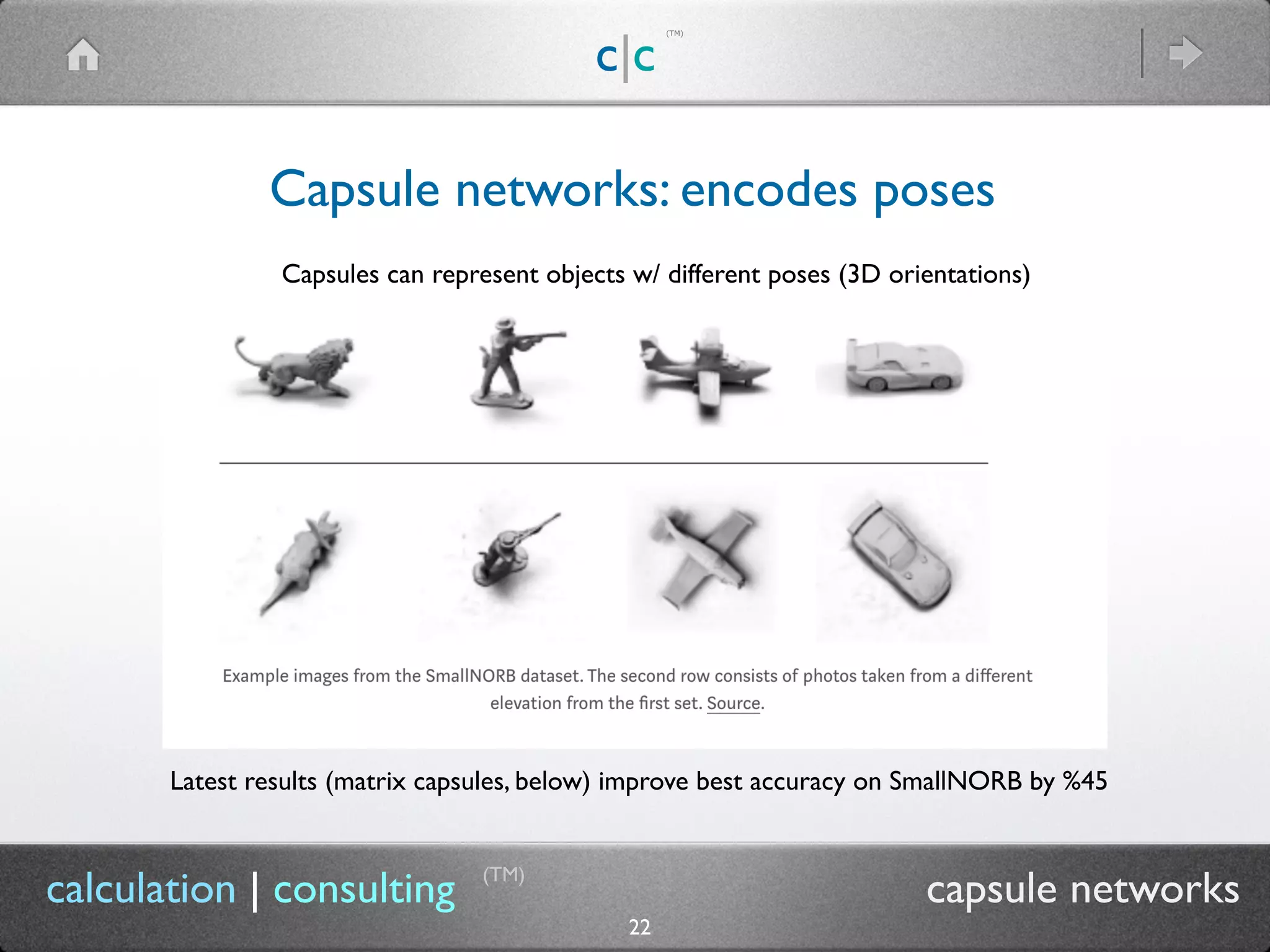
Capsule networks: encodes poses
Capsules can represent objects w/ different poses (3D orientations)
Latest results (matrix capsules, below) improve best accuracy on SmallNORB by %45
c|c
(TM)
(TM)
23
calculation | consulting capsule networks
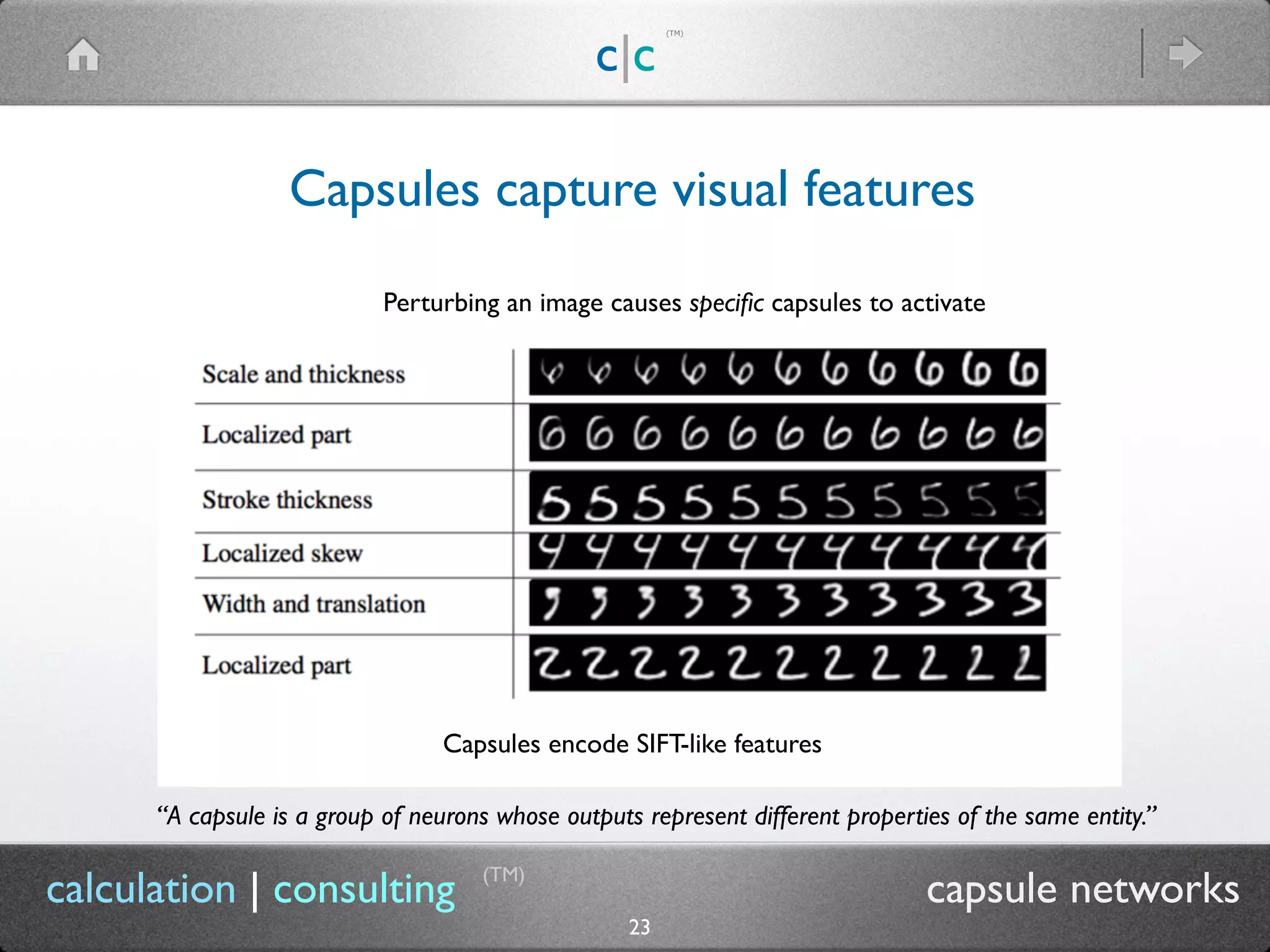
Capsules capture visual features
“A capsule is a group of neurons whose outputs represent different properties of the same entity.”
Capsules encode SIFT-like features
Perturbing an image causes specific capsules to activate
c|c
(TM)
(TM)
24
calculation | consulting capsule networks
Place-coding vs Rate-coding
Place-coding:
convNet w/out pooling
low level features for
small receptive fields
when a part moves, it may
gets a new capsule
position maps to active
capsules (u) in primary layer
Rate-coding:
traditional neurological way of coding (1926)
stimulus info encoded in rate of firing
(as opposed to magnitude, population, timing, …)
when a part rotates or moves,
the capsule values change
maps to real-values of capsule output vectors (v)
rates
encoded
in
vector
values
aside: are ReLUs a kind of rate coding ?
c|c
(TM)
(TM)
25
calculation | consulting capsule networks
Hierarchy of parts: coupled layers
A higher level entity is present if the lower / primary layer capsules
agree on their predictions for its pose.
c|c
(TM)
(TM)
26
calculation | consulting capsule networks
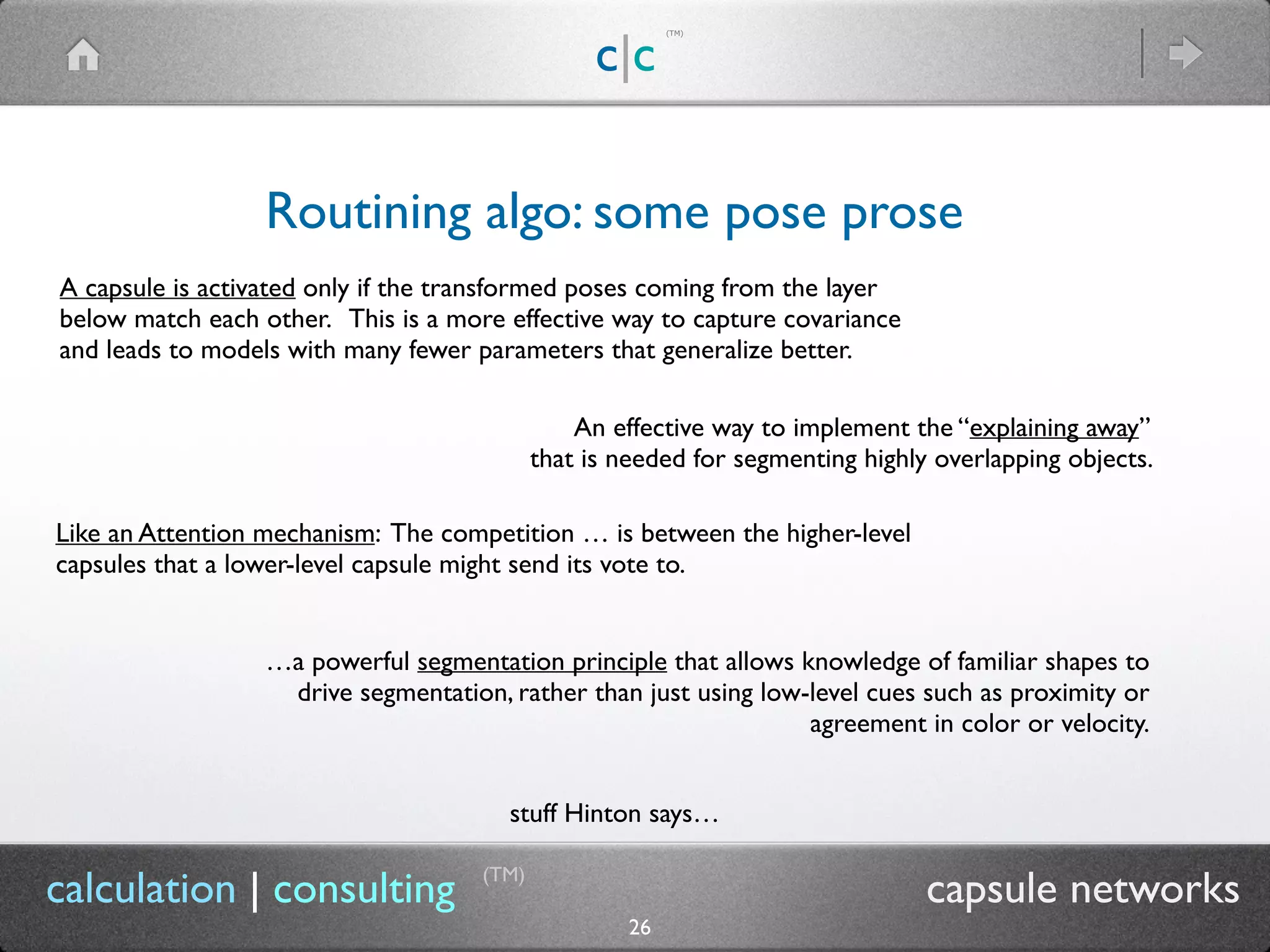
Routining algo: some pose prose
An effective way to implement the “explaining away”
that is needed for segmenting highly overlapping objects.
Like an Attention mechanism: The competition … is between the higher-level
capsules that a lower-level capsule might send its vote to.
stuff Hinton says…
A capsule is activated only if the transformed poses coming from the layer
below match each other. This is a more effective way to capture covariance
and leads to models with many fewer parameters that generalize better.
…a powerful segmentation principle that allows knowledge of familiar shapes to
drive segmentation, rather than just using low-level cues such as proximity or
agreement in color or velocity.
c|c
(TM)
(TM)
27
calculation | consulting capsule networks
Data-specific dynamic routes
squash
softmax
“c are determined by an iterative dynamic routing process”ij
weighted sum weighted mean prediction
c|c
(TM)
(TM)
28
calculation | consulting capsule networks
Capsule vs traditional neuron
https://github.com/naturomics/CapsNet-Tensorflow
c|c
(TM)
(TM)
29
calculation | consulting capsule networks
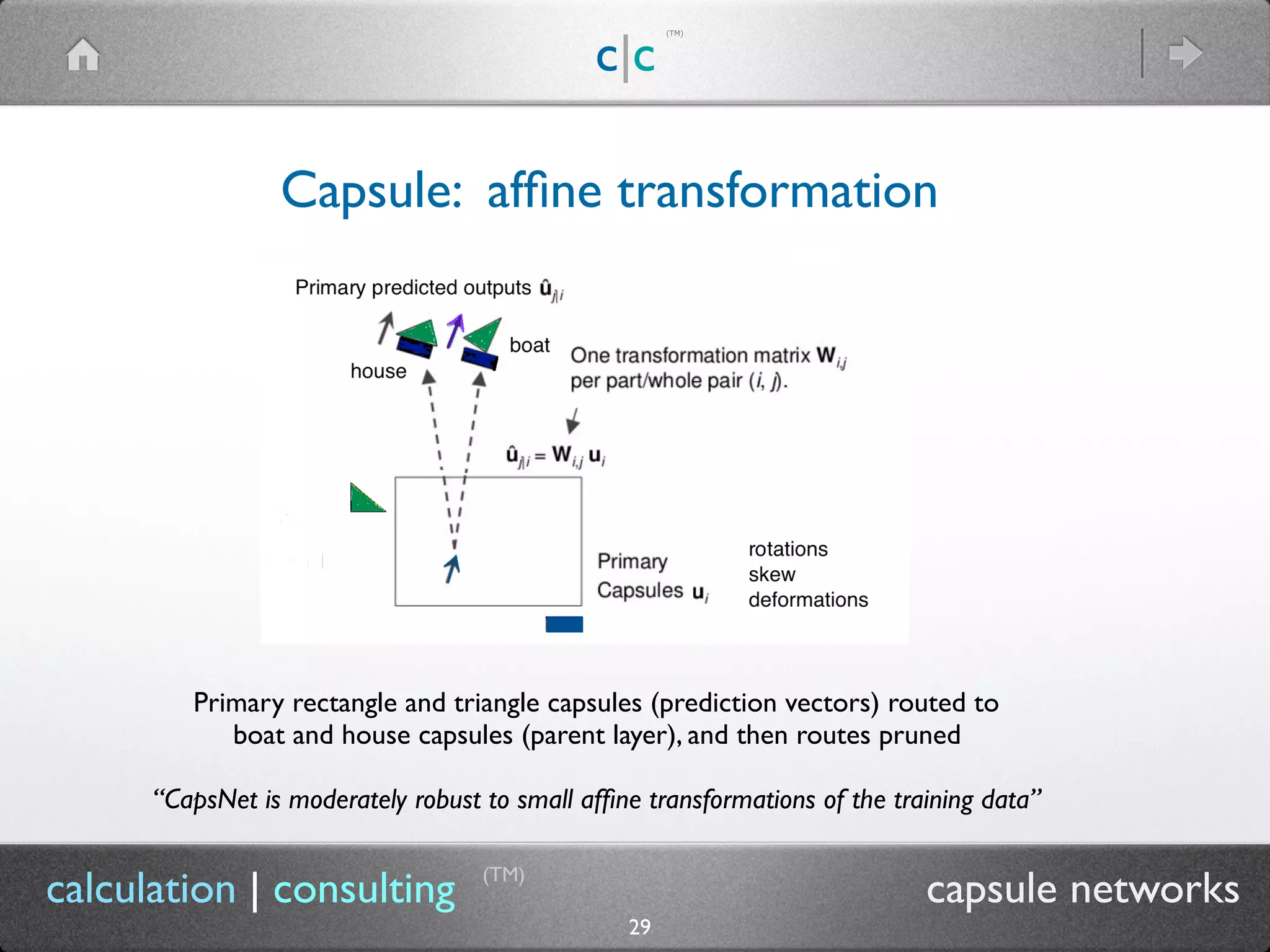
Capsule: affine transformation
Primary rectangle and triangle capsules (prediction vectors) routed to
boat and house capsules (parent layer), and then routes pruned
“CapsNet is moderately robust to small affine transformations of the training data”
c|c
(TM)
(TM)
30
calculation | consulting capsule networks
Capsule: squashing function
https://medium.com/ai%C2%B3-theory-practice-business/understanding-hintons-capsule-networks-part-ii-how-capsules-work-153b6ade9f66
length of the capsule vector ~ probability entity represented by capsule
c|c
(TM)
(TM)
31
calculation | consulting capsule networks
Routing by agreement
Algo selects data-specific routes b by matching
primary outputs and squashed (secondary) outputs
ij
first paper uses vector overlap / cosine distance to find cluster centers: ok, but can not tell great from good
second paper (matrix capsules) uses a Free Energy cost function
c|c
(TM)
(TM)
32
calculation | consulting capsule networks
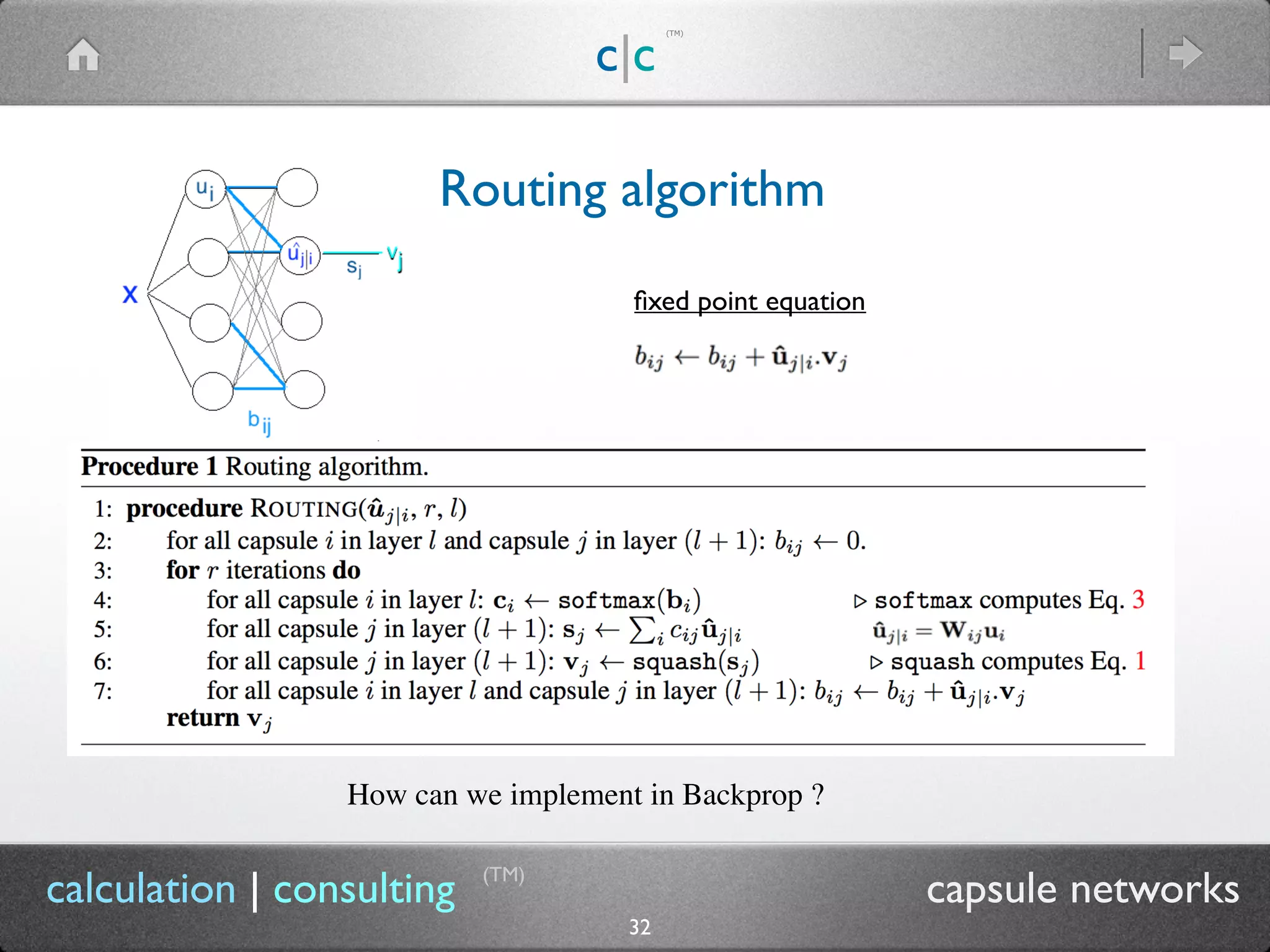
Routing algorithm
How can we implement in Backprop ?
fixed point equation
c|c
(TM)
(TM)
33
calculation | consulting capsule networks
Routing algo: EM fixed point equation
in forward pass of Backprop
(like an EM step)
must terminate to take dW
dot product ~ log likelihood (Energy*)
*Similar to fixed point equation for TAP Free Energy in the EMF RBM
**and in the later matrix capsule paper, a Free Energy is used explicitly
c|c
(TM)
(TM)
34
calculation | consulting capsule networks
Routing algo: fixed point unwound (3 steps)
Similar to a 3 layer FCN w/shared weights W
= 0
c|c
(TM)
(TM)
35
calculation | consulting capsule networks
Routing algorithm: keras Layers
https://keras.io/layers/writing-your-own-keras-layers/
c|c
(TM)
(TM)
36
calculation | consulting capsule networks
Routing algo: keras
c|c
(TM)
(TM)
37
calculation | consulting capsule networks
Routing algo: matrix capsules
cluster score = [ log p(x | mixture) - log p(x | uniform)]ii
cosine distance —> Free Energy cost:
EM to find mean, variance, and mixing proportion of Gaussians
“data-points that form a tight cluster from the perspective of one capsule
may be widely scattered from the perspective of another capsule”
p(x | mixture)
ih
c|c
(TM)
(TM)
38
calculation | consulting capsule networks
Matrix capsules: after 3 EM iterations
recent results from matrix capsule paper (more later)
c|c
(TM)
(TM)
39
calculation | consulting capsule networks
Capsule networks: architecture
+ unsupervised | reconstruction loss
supervised | multi-label max-norm loss each digit capsule ~ single digit
for MNIST data
|v| ~ Prob(digit)
image
size
c|c
(TM)
(TM)
40
calculation | consulting capsule networks
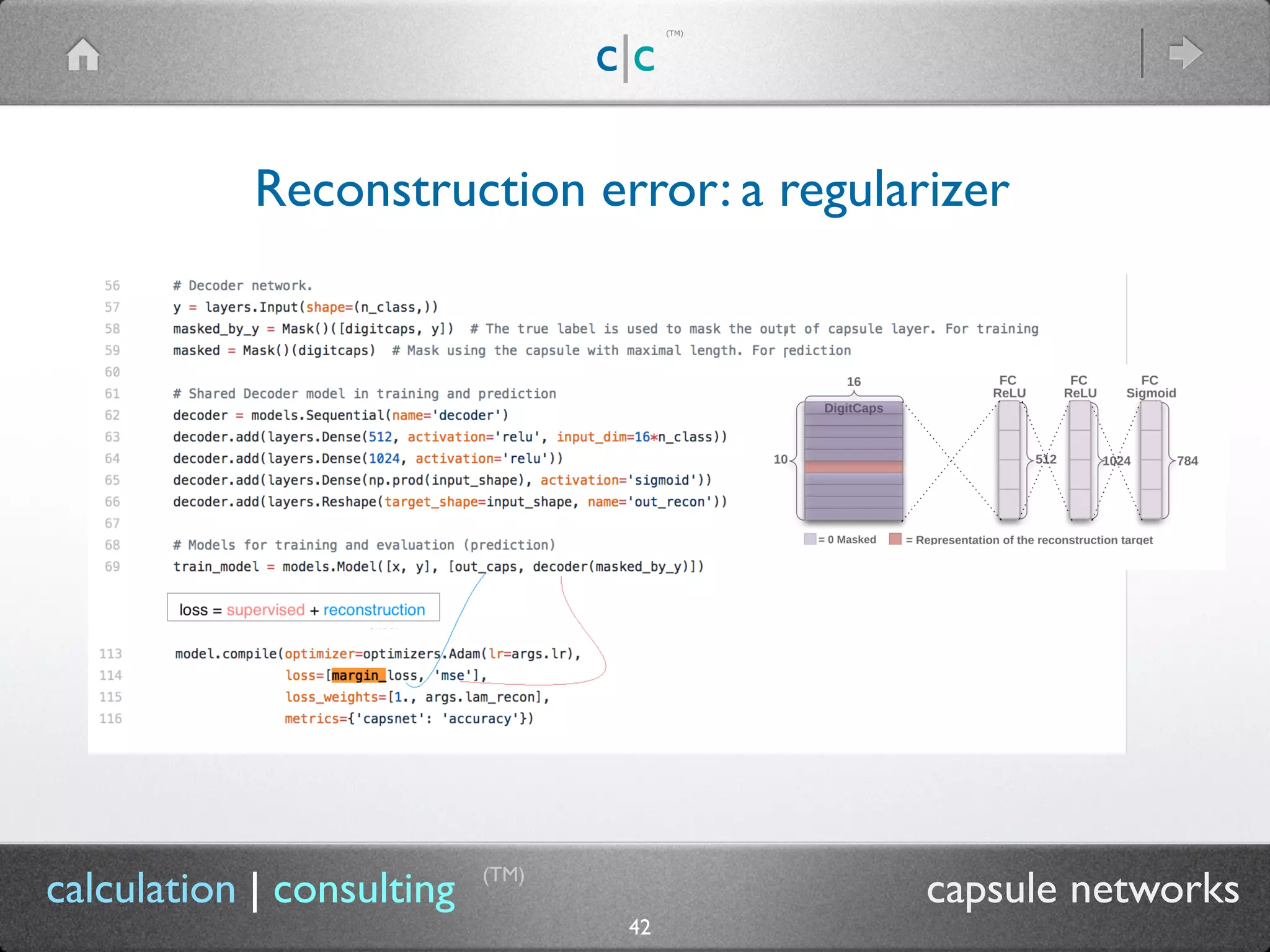
From max pool to max |vector|
mask selects (squashed) max vector (by length)
- does not throw away position information
- inputs vector into Fully Connected Net
- reconstructs the image from the vector
- similar to a variational auto-encoder
c|c
(TM)
(TM)
41
calculation | consulting capsule networks
From max pool to max |vector|
c|c
(TM)
(TM)
42
calculation | consulting capsule networks
Reconstruction error: a regularizer
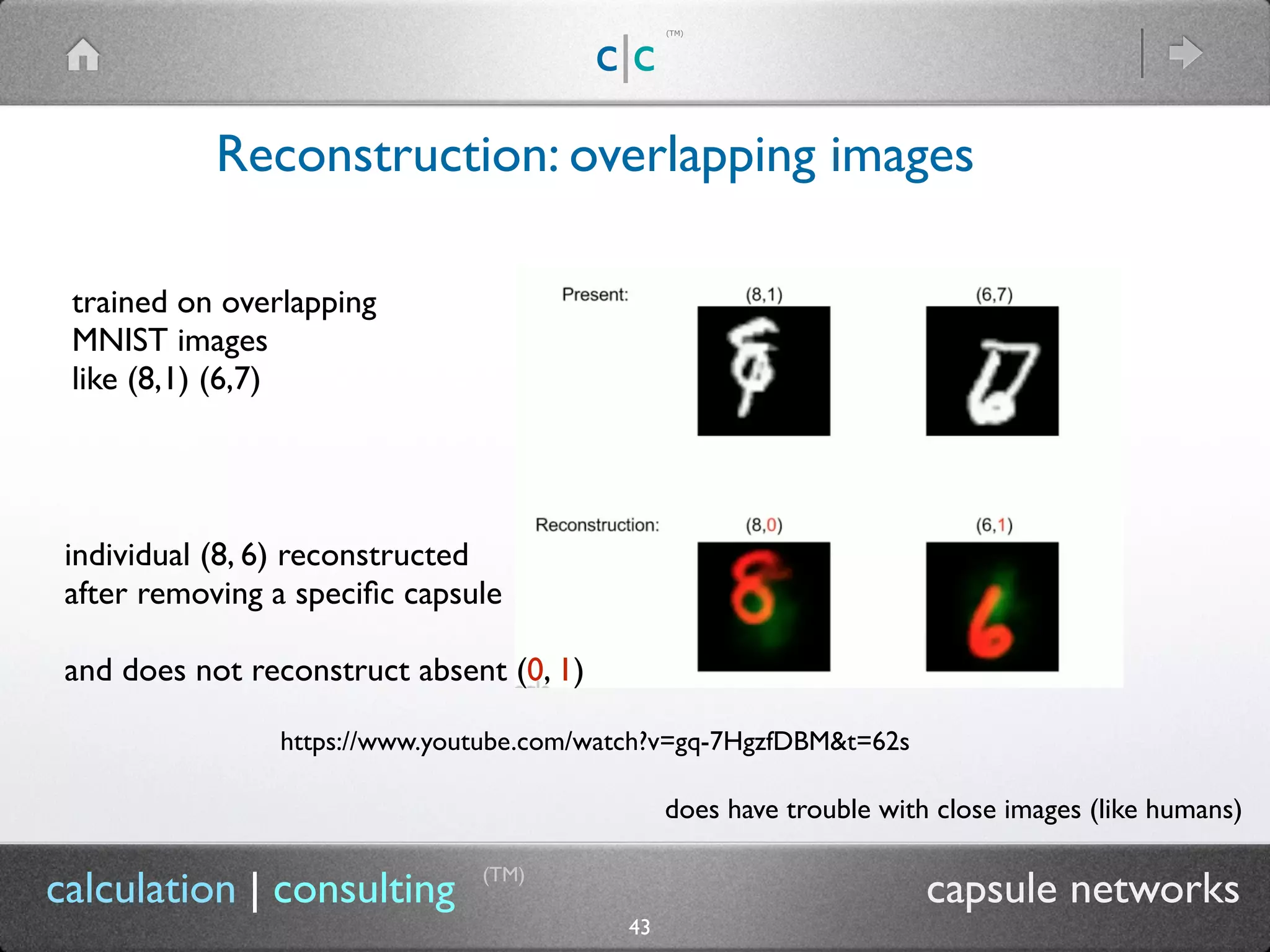
Reconstruction: overlapping images
c|c
(TM)
(TM)
43
calculation | consulting capsule networks
individual (8, 6) reconstructed
after removing a specific capsule
and does not reconstruct absent (0, 1)
trained on overlapping
MNIST images
like (8,1) (6,7)
does have trouble with close images (like humans)
https://www.youtube.com/watch?v=gq-7HgzfDBM&t=62s
c|c
(TM)
(TM)
44
calculation | consulting capsule networks
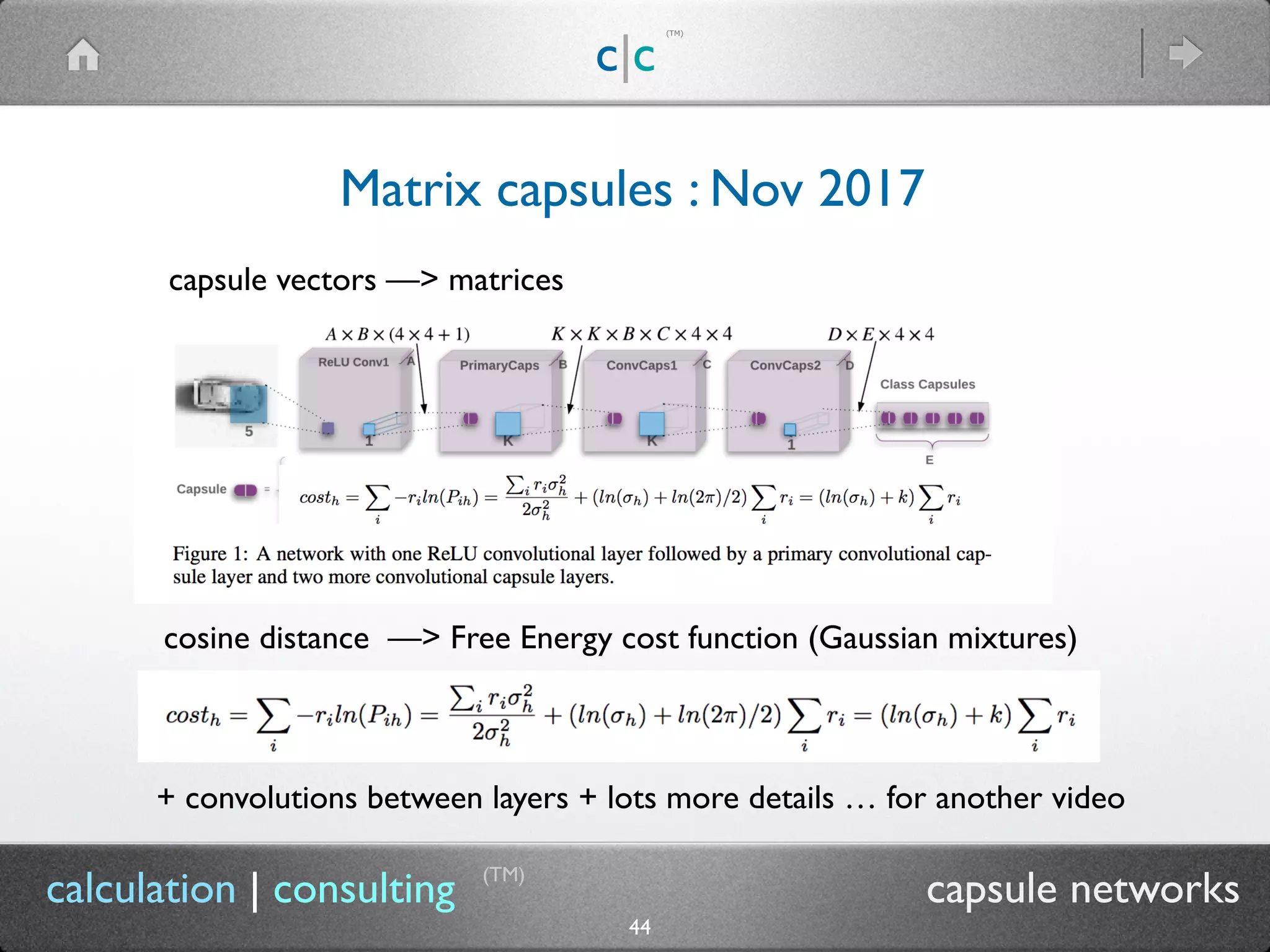
Matrix capsules : Nov 2017
capsule vectors —> matrices
cosine distance —> Free Energy cost function (Gaussian mixtures)
+ convolutions between layers + lots more details … for another video
(TM)
c|c
(TM)
c | c
charles@calculationconsulting.com

Capsule Networks

  • 1.
    calculation | consulting capsulenetworks (TM) c|c (TM) charles@calculationconsulting.com
  • 2.
  • 3.
    c|c (TM) (TM) 3 calculation | consultingcapsule networks Capsule networks by Hinton
  • 4.
    c|c (TM) (TM) 4 calculation | consultingcapsule networks Capsule networks by Hinton
  • 5.
    c|c (TM) (TM) 5 calculation | consultingcapsule networks Where ConvNets come from: LeNet 5 Y. LeCun, L. Bottou, Y. Bengio, and P. Haffner, Gradient-based learning applied to document recognition, Proc. IEEE 86(11): 2278–2324, 1998.
  • 6.
    c|c (TM) (TM) 6 calculation | consultingcapsule networks Convolutions usually w/ max pooling we get gross spatial invariance by ignoring exactly where a feature occurs “A vision system needs to use the same knowledge at all locations in the image” Hinton ConvNet: share weights + max pooling
  • 7.
    c|c (TM) (TM) 7 calculation | consultingcapsule networks Hierarchical model of the visual system HMax model, Riesenhuber and Poggio (1999) dotted line selects max pooled features from lower layer
  • 8.
    c|c (TM) (TM) 8 calculation | consultingcapsule networks Hierarchical model of the visual system Pooling proposed by Hubel andWiesel in1962 A. Receptive field (RF) of simple cell (green) formed by pooling over (center-surround) cells (yellow) in the same orientation row B. RF of complex cell (green) formed by pooling over over simple cells. here: (crude) translation invariance
  • 9.
    c|c (TM) (TM) 9 calculation | consultingcapsule networks Hierarchical model of the visual system ConvNets resemble hierarchical models (but notice the hyper-column) HMax model, Riesenhuber and Poggio (1999)
  • 10.
    c|c (TM) (TM) 10 calculation | consultingcapsule networks Hinton: why max pooling is bad ? (If) the brain embeds things in rectangular space, then Translation is easy; Rotation is hard Experiment: time for mind to process rotation ~ amount Conv Nets: Crude translation invariance No explicit pose (orientation) information Can not distinguish left from right (actually some people have stopped using pooling) A vision system needs to use the same knowledge at all locations in the image
  • 11.
    c|c (TM) (TM) 11 calculation | consultingcapsule networks 2 streams hypothesis: what and where Ventral: what objects are Dorsal: where objects are in space How do we know ? Neurological disorders Simultanagnosia: can only see one object at a time idea dates back to 1968 lots of other evidence as well https://www.youtube.com/watch?v=mCoYOFzSS9A
  • 12.
    c|c (TM) (TM) 12 calculation | consultingcapsule networks Cortical Microcolumns Capsules may encode orientation scale velocity color … Column through cortical layers of the brain 80-120 neurons (2X long inV1) share the same receptive field part of Hubel andWiesel, Nobel Prize 1981 also see recent review: https://www.sciencedirect.com/science/article/pii/S0166223615001484
  • 13.
    c|c (TM) (TM) 13 calculation | consultingcapsule networks Canonical object based frames of reference: Hinton 1981 Hinton has been thinking about this a long time A kind of inverse computer graphics
  • 14.
    c|c (TM) (TM) 14 calculation | consultingcapsule networks Capsule networks: inverse computer graphics computer graphics: rendering engine capsule network: inverse graphics matrix of pose information Hinton proposes that our brain does a kind-of inverse computer graphics transformation.
  • 15.
    c|c (TM) (TM) 15 calculation | consultingcapsule networks Invariance vs Equivariance Max pooling provides spatial Invariance, but Hinton argues we need spatial Equivariance. so use vectors and Affine transformations Invariance: similar results if image is shifted or rotated Equivariance: invariance under a Symmetry Transformations (S,A,…) Group homomorphism: f(g*x)=g*f(x)=f(x)*g-1 Geometric: i.e. triangle centers invariant under Similarity (S) centroid invariant under Affine (A) Statistics: mean: invariant under change of units median: more generally invariant; a better statistic
  • 16.
    c|c (TM) (TM) 16 calculation | consultingcapsule networks Segmenting highly overlapping objects Explaining away: Even if two hidden causes are independent, they can become dependent when we observe an effect that they can both influence. Hinton
  • 17.
    c|c (TM) (TM) 17 calculation | consultingcapsule networks Capsule networks: architecture + unsupervised | reconstruction loss supervised | max norm loss Hinton et. al. Dynamic Routing Between Capsules (2017)
  • 18.
    c|c (TM) (TM) 18 calculation | consultingcapsule networks Capsule networks by Hinton conv2D Keep first convolutional layer, but replace max pooling with …
  • 19.
    c|c (TM) (TM) 19 calculation | consultingcapsule networks Capsule networks by Hinton conv2D Reshape conv2d into primary capsule vectors (red), and replace max pooling with routing-by-agreement algo
  • 20.
    c|c (TM) (TM) 20 calculation | consultingcapsule networks Capsule networks by Hinton “Active capsules at one level (red) make predictions, via transformation matrices, for the instantiation parameters of higher-level capsules (blue). When multiple predictions agree, a higher level capsule (blue) becomes active” conv2D
  • 21.
    c|c (TM) (TM) 21 calculation | consultingcapsule networks Primary layer: Conv2D reshaped keras implementation: https://github.com/XifengGuo/CapsNet-Keras
  • 22.
    c|c (TM) (TM) 22 calculation | consultingcapsule networks Capsule networks: encodes poses Capsules can represent objects w/ different poses (3D orientations) Latest results (matrix capsules, below) improve best accuracy on SmallNORB by %45
  • 23.
    c|c (TM) (TM) 23 calculation | consultingcapsule networks Capsules capture visual features “A capsule is a group of neurons whose outputs represent different properties of the same entity.” Capsules encode SIFT-like features Perturbing an image causes specific capsules to activate
  • 24.
    c|c (TM) (TM) 24 calculation | consultingcapsule networks Place-coding vs Rate-coding Place-coding: convNet w/out pooling low level features for small receptive fields when a part moves, it may gets a new capsule position maps to active capsules (u) in primary layer Rate-coding: traditional neurological way of coding (1926) stimulus info encoded in rate of firing (as opposed to magnitude, population, timing, …) when a part rotates or moves, the capsule values change maps to real-values of capsule output vectors (v) rates encoded in vector values aside: are ReLUs a kind of rate coding ?
  • 25.
    c|c (TM) (TM) 25 calculation | consultingcapsule networks Hierarchy of parts: coupled layers A higher level entity is present if the lower / primary layer capsules agree on their predictions for its pose.
  • 26.
    c|c (TM) (TM) 26 calculation | consultingcapsule networks Routining algo: some pose prose An effective way to implement the “explaining away” that is needed for segmenting highly overlapping objects. Like an Attention mechanism: The competition … is between the higher-level capsules that a lower-level capsule might send its vote to. stuff Hinton says… A capsule is activated only if the transformed poses coming from the layer below match each other. This is a more effective way to capture covariance and leads to models with many fewer parameters that generalize better. …a powerful segmentation principle that allows knowledge of familiar shapes to drive segmentation, rather than just using low-level cues such as proximity or agreement in color or velocity.
  • 27.
    c|c (TM) (TM) 27 calculation | consultingcapsule networks Data-specific dynamic routes squash softmax “c are determined by an iterative dynamic routing process”ij weighted sum weighted mean prediction
  • 28.
    c|c (TM) (TM) 28 calculation | consultingcapsule networks Capsule vs traditional neuron https://github.com/naturomics/CapsNet-Tensorflow
  • 29.
    c|c (TM) (TM) 29 calculation | consultingcapsule networks Capsule: affine transformation Primary rectangle and triangle capsules (prediction vectors) routed to boat and house capsules (parent layer), and then routes pruned “CapsNet is moderately robust to small affine transformations of the training data”
  • 30.
    c|c (TM) (TM) 30 calculation | consultingcapsule networks Capsule: squashing function https://medium.com/ai%C2%B3-theory-practice-business/understanding-hintons-capsule-networks-part-ii-how-capsules-work-153b6ade9f66 length of the capsule vector ~ probability entity represented by capsule
  • 31.
    c|c (TM) (TM) 31 calculation | consultingcapsule networks Routing by agreement Algo selects data-specific routes b by matching primary outputs and squashed (secondary) outputs ij first paper uses vector overlap / cosine distance to find cluster centers: ok, but can not tell great from good second paper (matrix capsules) uses a Free Energy cost function
  • 32.
    c|c (TM) (TM) 32 calculation | consultingcapsule networks Routing algorithm How can we implement in Backprop ? fixed point equation
  • 33.
    c|c (TM) (TM) 33 calculation | consultingcapsule networks Routing algo: EM fixed point equation in forward pass of Backprop (like an EM step) must terminate to take dW dot product ~ log likelihood (Energy*) *Similar to fixed point equation for TAP Free Energy in the EMF RBM **and in the later matrix capsule paper, a Free Energy is used explicitly
  • 34.
    c|c (TM) (TM) 34 calculation | consultingcapsule networks Routing algo: fixed point unwound (3 steps) Similar to a 3 layer FCN w/shared weights W = 0
  • 35.
    c|c (TM) (TM) 35 calculation | consultingcapsule networks Routing algorithm: keras Layers https://keras.io/layers/writing-your-own-keras-layers/
  • 36.
    c|c (TM) (TM) 36 calculation | consultingcapsule networks Routing algo: keras
  • 37.
    c|c (TM) (TM) 37 calculation | consultingcapsule networks Routing algo: matrix capsules cluster score = [ log p(x | mixture) - log p(x | uniform)]ii cosine distance —> Free Energy cost: EM to find mean, variance, and mixing proportion of Gaussians “data-points that form a tight cluster from the perspective of one capsule may be widely scattered from the perspective of another capsule” p(x | mixture) ih
  • 38.
    c|c (TM) (TM) 38 calculation | consultingcapsule networks Matrix capsules: after 3 EM iterations recent results from matrix capsule paper (more later)
  • 39.
    c|c (TM) (TM) 39 calculation | consultingcapsule networks Capsule networks: architecture + unsupervised | reconstruction loss supervised | multi-label max-norm loss each digit capsule ~ single digit for MNIST data |v| ~ Prob(digit) image size
  • 40.
    c|c (TM) (TM) 40 calculation | consultingcapsule networks From max pool to max |vector| mask selects (squashed) max vector (by length) - does not throw away position information - inputs vector into Fully Connected Net - reconstructs the image from the vector - similar to a variational auto-encoder
  • 41.
    c|c (TM) (TM) 41 calculation | consultingcapsule networks From max pool to max |vector|
  • 42.
    c|c (TM) (TM) 42 calculation | consultingcapsule networks Reconstruction error: a regularizer
  • 43.
    Reconstruction: overlapping images c|c (TM) (TM) 43 calculation| consulting capsule networks individual (8, 6) reconstructed after removing a specific capsule and does not reconstruct absent (0, 1) trained on overlapping MNIST images like (8,1) (6,7) does have trouble with close images (like humans) https://www.youtube.com/watch?v=gq-7HgzfDBM&t=62s
  • 44.
    c|c (TM) (TM) 44 calculation | consultingcapsule networks Matrix capsules : Nov 2017 capsule vectors —> matrices cosine distance —> Free Energy cost function (Gaussian mixtures) + convolutions between layers + lots more details … for another video
  • 45.