On the Effects of Inoculation: an Example in Train Scheduling  Y. Semet * , M. Schoenauer INRIA Orsay, France Research funded by SNCF *:now with EUROBIOS (complexity science for business problems)
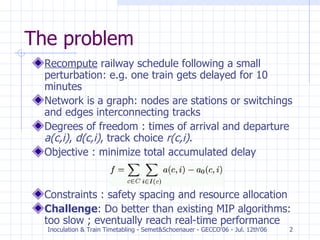
The problem Recompute  railway schedule following a small perturbation: e.g. one train gets delayed for 10 minutes Network is a graph: nodes are stations or switchings and edges interconnecting tracks Degrees of freedom : times of arrival and departure  a(c,i) ,  d(c,i) , track choice  r(c,i) . Objective : minimize total accumulated delay  Constraints : safety spacing and resource allocation Challenge : Do better than existing MIP algorithms: too slow ; eventually reach real-time performance
Zoom in: one node…
Zoom out: Space/Time Diagrams A global overview of the railway network  Visual representation of the phenotype Helps to graphically visualize constraints
Initial times Stopping times Safety spacing in both tracks and nodes Connecting trains Inter-routes shared resources conflicts: heart of the problem’s combinatorial difficulty Constraints
How to solve it ? Using an indirect approach. Widely used in Evolutionary Scheduling Direct approach impractical Indirect approach uses a mapping function: permutations + greedy scheduling heuristic [3 4 5 1 2 6 8 7] Scheduler Optimization plays  with permutations
Scheduler outline For each train  c  ( following the permutation) For each Node  i  (in order) For each route  r Initialize   a  and  d  (theoretical values) While  (conflict)  delay   a  and  d   or “ kick” obstacles Pick route yielding earliest  d  (greediness) Important:  semi-greedy  instead of actually greedy: optimality is enforced only at the node level, not at the train level
Solving conflicts: moving forward in time i Space Time j Train c’ is already scheduled Train c is being scheduled Safety spacing threshold a(c,j) : violation !! α α
Solving conflicts: moving forward in time i Space Time j Train c’ is already scheduled Train c is being scheduled Safety spacing threshold a(c,j) α α
Solving conflicts: “kicking” obstacles out i Space Time j Train c’ is already scheduled Train c is being scheduled α α
Solving conflicts : “kicking” obstacles out i Space Time j Train c is being scheduled α α Kick !
Solving conflicts : “kicking” obstacles out i Space Time j Train c is being scheduled
Solving conflicts : “kicking” obstacles out i Space Time j Train c is now scheduled Train c’ is being re-scheduled
Global picture : a ( μ + λ ) scheme + μ parents Keep  μ   best individuals   λ  offspring Sélection = [3 4 5 1 2 6 8 7]
The Swap  Mutation Swapping 2 close by elements ( d < R ),  T  times T  realization of a binomial law  Calibrated decrease  ( cf. simulated annealing ) [ 1  4   3  2   5  6  7  8 ] [ 1  2   3  4   5  6  7  8 ] R
Inoculation : The Art of the Start Initialization : an excellent way to provide the GA with relevant problem knowledge 3 problems in 1 for the GA :  Fixing initial constraint violations Finding a reasonable starting permutation The actual problem The Idea :  Solving 1. and 2. once and for all How : running the algorithm once with an “empty” incident (with delay=0) Solving 3. : Initialize population around the best permutation obtained (the  Inoculant I 0 )
A large and complex problem 541 trains, several 100s nodes 1 million variables 3 millions constraints e.g. : 1 train delayed for 10 minutes inside a large connecting node (gare St-Lazare in Paris) Scheduling takes 1s per individual on average Results average over 11 runs Comparisons (GA, CPLEX, GA+CPLEX) over 24 hours
Algorithmic Settings & Experiments GA parameters: (10+70 scheme) Evolutionary Programming Tournament Ordered Selection R=12 Inoculation Variants Mass Mutation Gradual Perturbation Layer Initialization Experimental plan: 2 choices related wrt exploration/exploitation Which Inoculation variant ? Constant mutation rate or not ? Results : Easy Instances : Layers + decreasing rate Hard Ones : Mass Mutation + constant rate
The Benefits of Inoculation Easy Instances
The Benefits of Inoculation Hard Instances
Conclusions Drawback: a lot of time and efforts as well as large expert knowledge required to design the scheduler : not easy to adapt to other contexts/problems But a clear success for this problem:  Natural formulation : usable for decision support Efficiency : good solutions quickly Inoculation: from tie/defeat to victory vs. CPLEX 1 minute of delay = 1000 $ 1 incident in 1 city per day = 21.9 million dollars yearly potential savings  And, if parallelized, not so far from real-time use {semet,marc}@lri.fr

Semet Gecco06

  • 1.
    On the Effectsof Inoculation: an Example in Train Scheduling Y. Semet * , M. Schoenauer INRIA Orsay, France Research funded by SNCF *:now with EUROBIOS (complexity science for business problems)
  • 2.
    The problem Recompute railway schedule following a small perturbation: e.g. one train gets delayed for 10 minutes Network is a graph: nodes are stations or switchings and edges interconnecting tracks Degrees of freedom : times of arrival and departure a(c,i) , d(c,i) , track choice r(c,i) . Objective : minimize total accumulated delay Constraints : safety spacing and resource allocation Challenge : Do better than existing MIP algorithms: too slow ; eventually reach real-time performance
  • 3.
    Zoom in: onenode…
  • 4.
    Zoom out: Space/TimeDiagrams A global overview of the railway network Visual representation of the phenotype Helps to graphically visualize constraints
  • 5.
    Initial times Stoppingtimes Safety spacing in both tracks and nodes Connecting trains Inter-routes shared resources conflicts: heart of the problem’s combinatorial difficulty Constraints
  • 6.
    How to solveit ? Using an indirect approach. Widely used in Evolutionary Scheduling Direct approach impractical Indirect approach uses a mapping function: permutations + greedy scheduling heuristic [3 4 5 1 2 6 8 7] Scheduler Optimization plays with permutations
  • 7.
    Scheduler outline Foreach train c ( following the permutation) For each Node i (in order) For each route r Initialize a and d (theoretical values) While (conflict) delay a and d or “ kick” obstacles Pick route yielding earliest d (greediness) Important: semi-greedy instead of actually greedy: optimality is enforced only at the node level, not at the train level
  • 8.
    Solving conflicts: movingforward in time i Space Time j Train c’ is already scheduled Train c is being scheduled Safety spacing threshold a(c,j) : violation !! α α
  • 9.
    Solving conflicts: movingforward in time i Space Time j Train c’ is already scheduled Train c is being scheduled Safety spacing threshold a(c,j) α α
  • 10.
    Solving conflicts: “kicking”obstacles out i Space Time j Train c’ is already scheduled Train c is being scheduled α α
  • 11.
    Solving conflicts :“kicking” obstacles out i Space Time j Train c is being scheduled α α Kick !
  • 12.
    Solving conflicts :“kicking” obstacles out i Space Time j Train c is being scheduled
  • 13.
    Solving conflicts :“kicking” obstacles out i Space Time j Train c is now scheduled Train c’ is being re-scheduled
  • 14.
    Global picture :a ( μ + λ ) scheme + μ parents Keep μ best individuals λ offspring Sélection = [3 4 5 1 2 6 8 7]
  • 15.
    Global picture :a ( μ + λ ) scheme + μ parents Keep μ best individuals λ offspring Sélection = [3 4 5 1 2 6 8 7]
  • 16.
    The Swap Mutation Swapping 2 close by elements ( d < R ), T times T realization of a binomial law Calibrated decrease ( cf. simulated annealing ) [ 1 4 3 2 5 6 7 8 ] [ 1 2 3 4 5 6 7 8 ] R
  • 17.
    Inoculation : TheArt of the Start Initialization : an excellent way to provide the GA with relevant problem knowledge 3 problems in 1 for the GA : Fixing initial constraint violations Finding a reasonable starting permutation The actual problem The Idea : Solving 1. and 2. once and for all How : running the algorithm once with an “empty” incident (with delay=0) Solving 3. : Initialize population around the best permutation obtained (the Inoculant I 0 )
  • 18.
    A large andcomplex problem 541 trains, several 100s nodes 1 million variables 3 millions constraints e.g. : 1 train delayed for 10 minutes inside a large connecting node (gare St-Lazare in Paris) Scheduling takes 1s per individual on average Results average over 11 runs Comparisons (GA, CPLEX, GA+CPLEX) over 24 hours
  • 19.
    Algorithmic Settings &Experiments GA parameters: (10+70 scheme) Evolutionary Programming Tournament Ordered Selection R=12 Inoculation Variants Mass Mutation Gradual Perturbation Layer Initialization Experimental plan: 2 choices related wrt exploration/exploitation Which Inoculation variant ? Constant mutation rate or not ? Results : Easy Instances : Layers + decreasing rate Hard Ones : Mass Mutation + constant rate
  • 20.
    The Benefits ofInoculation Easy Instances
  • 21.
    The Benefits ofInoculation Hard Instances
  • 22.
    The Benefits ofInoculation Hard Instances
  • 23.
    Conclusions Drawback: alot of time and efforts as well as large expert knowledge required to design the scheduler : not easy to adapt to other contexts/problems But a clear success for this problem: Natural formulation : usable for decision support Efficiency : good solutions quickly Inoculation: from tie/defeat to victory vs. CPLEX 1 minute of delay = 1000 $ 1 incident in 1 city per day = 21.9 million dollars yearly potential savings And, if parallelized, not so far from real-time use {semet,marc}@lri.fr