What is the AP Capstone Program?
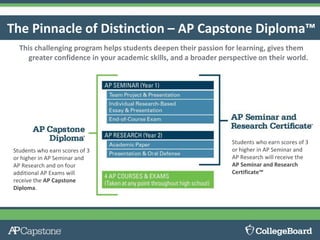
The Pinnacle of Distinction – AP Capstone Diploma™
This challenging program helps students deepen their passion for learning, gives them
greater confidence in your academic skills, and a broader perspective on their world.
Students who earn scores of 3
or higher in AP Seminar and
AP Research and on four
additional AP Exams will
receive the AP Capstone
Diploma.
Students who earn scores of 3
or higher in AP Seminar and
AP Research will receive the
AP Seminar and Research
Certificate™
AP Seminar
Typically taken in grade 10 or 11.
Students learn how to:
 Investigate real-world topics
from multiple perspectives
 Carefully analyze information,
write evidence-based
arguments and effectively
communicate them
 Work independently and with
a team to research a topic,
develop a written report and
deliver a presentation
Teachers & Students select and study 2-4 topics.
Example Topics
Democracy
Education
Environment
Revolution
Technology
Sustainability
Exam score based on:
1. Team Project &
Presentation
• 25%
2. Individual Research-
Based Essay &
Presentation
• 35%
3. End-of-Course Exam
• 40%
 Design, plan, and conduct a year-
long mentored, research-based
investigation
 Apply research methods and
practices to address a real-world
topic selected by the student
 Write a college-level research
paper
 Present and orally defend research
findings and methodology
AP Research
Students learn how to:
1. Academic Paper
(4,000 - 5,000 words)
• 75%
2. Presentation and Oral
Defense
• 25%
Exam score based on:
AP Seminar is a prerequisite to AP Research.
Linked Classes Here at Lake Brantley
…Research and group work take time
.
…There are other AP Classes with skills and
content that match well with the AP
Capstone focus on research and argument
…Where we can, we would like to provide
interdisciplinary support
Linked Classes Here at Lake Brantley
…Research and group work take time
.
…There are other AP Classes with skills and
content that match well with the AP
Capstone focus on research and argument
…Where we can, we would like to provide
interdisciplinary support
…So we have decided to team teach and
link AP Capstone courses to other AP
courses to provide a double-block class
Linked Classes Here at Lake Brantley
Next Year’s Sophomores:
 Next year’s sophomores will
take AP Seminar along with
AP Psychology
.
Next Year’s Juniors:
 Next year’s sophomores will
take AP Seminar along with
AP Language and Composition
Linked Classes Here at Lake Brantley
Next Year’s Sophomores:
 Next year’s sophomores will
take AP Seminar along with
AP Psychology
.
Next Year’s Juniors:
 Next year’s sophomores will
take AP Seminar along with
AP Language and Composition
Example Schedule:
2nd Period=
AP Psychology
3rd Period= AP
Seminar
Example Schedule:
4th Period= AP Language
and Composition
5th Period= AP Seminar
Each double-block class will be taught by two teachers
with the same students (roughly 24) per block for both
periods
Linked Classes Here at Lake Brantley
The classes that AP Research will be paired
with in the 2017-2018 school year have not
yet been decided,
though AP Language is a likely choice for
sophomores taking AP Psych/Seminar next
year, and AP Literature is a likely choice for
juniors taking AP Language/Seminar next
year
.
AP Capstone Program: The Benefits
AP Capstone: The Benefits
• Earn Distinction – Stand out in the college admission process and
have the opportunity to earn valuable college credit or placement
• Acquire Critical Skills – Students acquire challenging college-level
analysis, writing, and research skills that are increasingly valued by
colleges
• Choose what to study – Students choose their own research topic
and study issues and topics of interest and importance to them
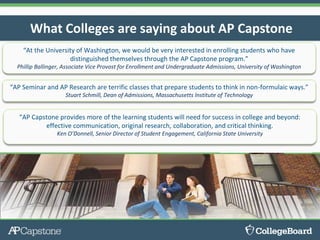
What Colleges are saying about AP Capstone
“At the University of Washington, we would be very interested in enrolling students who have
distinguished themselves through the AP Capstone program.”
Phillip Ballinger, Associate Vice Provost for Enrollment and Undergraduate Admissions, University of Washington
“AP Seminar and AP Research are terrific classes that prepare students to think in non-formulaic ways.”
Stuart Schmill, Dean of Admissions, Massachusetts Institute of Technology
“AP Capstone provides more of the learning students will need for success in college and beyond:
effective communication, original research, collaboration, and critical thinking.
Ken O’Donnell, Senior Director of Student Engagement, California State University
Below are some of the 140+ colleges that have endorsed AP Capstone for its
challenging interdisciplinary curricula. Also, over 100 colleges have
developed credit policies – a few are below outlined in green.
Visit www.collegeboard.org/apcapstone for the latest list of colleges with credit policies for AP Seminar and/or AP Research.
Next Steps: Help Your Child
Make the Best Choices
AP Capstone: Start the Conversation
Help your child prepare to talk to a teacher or counselor about AP Capstone. Here are some
questions to encourage your child to think about:
Is AP Capstone right for me?
Before you talk to a teacher or counselor, think about what interests you:
• What college majors are you considering? What careers excite you?
• Do I enjoy challenging myself to think in new ways?
• Do I like to collaborate and learn from others?
Ask your counselor or teacher the following questions:
• May I speak with a teacher familiar with AP Capstone?
• How will the courses be structured in the school schedule?
• Are there other courses that can help me succeed in AP Capstone?
What steps do I need to take?
• Go online and read the AP Capstone brochure to find out more
• Find out your school’s enrollment deadline and sign up!
How to Sign Up!
Next Year’s Sophomores:
 Sign up for AP Psychology!
 In the optional box, sign up for
AP Capstone (page 20 of
curriculum guide)
.
Next Year’s Juniors:
…Once you have indicated that you will like to be in the Capstone program,
teachers will follow up with an application
[Note: If you do not want to sign up for Capstone, but you would still like to
take AP Psychology or AP Language and Composition on their own… you
can definitely still do that!]
 Sign up for AP Language and
Composition!
 In the optional box, sign up for
AP Capstone (page 20 of
curriculum guide)
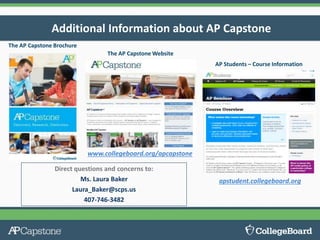
Additional Information about AP Capstone
The AP Capstone Brochure
The AP Capstone Website
www.collegeboard.org/apcapstone
AP Students – Course Information
apstudent.collegeboard.org
Direct questions and concerns to:
Ms. Laura Baker
Laura_Baker@scps.us
407-746-3482

Capstone Presentation 10 11

  • 1.
    What is theAP Capstone Program?
  • 2.
    The Pinnacle ofDistinction – AP Capstone Diploma™ This challenging program helps students deepen their passion for learning, gives them greater confidence in your academic skills, and a broader perspective on their world. Students who earn scores of 3 or higher in AP Seminar and AP Research and on four additional AP Exams will receive the AP Capstone Diploma. Students who earn scores of 3 or higher in AP Seminar and AP Research will receive the AP Seminar and Research Certificate™
  • 3.
    AP Seminar Typically takenin grade 10 or 11. Students learn how to:  Investigate real-world topics from multiple perspectives  Carefully analyze information, write evidence-based arguments and effectively communicate them  Work independently and with a team to research a topic, develop a written report and deliver a presentation Teachers & Students select and study 2-4 topics. Example Topics Democracy Education Environment Revolution Technology Sustainability Exam score based on: 1. Team Project & Presentation • 25% 2. Individual Research- Based Essay & Presentation • 35% 3. End-of-Course Exam • 40%
  • 4.
     Design, plan,and conduct a year- long mentored, research-based investigation  Apply research methods and practices to address a real-world topic selected by the student  Write a college-level research paper  Present and orally defend research findings and methodology AP Research Students learn how to: 1. Academic Paper (4,000 - 5,000 words) • 75% 2. Presentation and Oral Defense • 25% Exam score based on: AP Seminar is a prerequisite to AP Research.
  • 5.
    Linked Classes Hereat Lake Brantley …Research and group work take time . …There are other AP Classes with skills and content that match well with the AP Capstone focus on research and argument …Where we can, we would like to provide interdisciplinary support
  • 6.
    Linked Classes Hereat Lake Brantley …Research and group work take time . …There are other AP Classes with skills and content that match well with the AP Capstone focus on research and argument …Where we can, we would like to provide interdisciplinary support …So we have decided to team teach and link AP Capstone courses to other AP courses to provide a double-block class
  • 7.
    Linked Classes Hereat Lake Brantley Next Year’s Sophomores:  Next year’s sophomores will take AP Seminar along with AP Psychology . Next Year’s Juniors:  Next year’s sophomores will take AP Seminar along with AP Language and Composition
  • 8.
    Linked Classes Hereat Lake Brantley Next Year’s Sophomores:  Next year’s sophomores will take AP Seminar along with AP Psychology . Next Year’s Juniors:  Next year’s sophomores will take AP Seminar along with AP Language and Composition Example Schedule: 2nd Period= AP Psychology 3rd Period= AP Seminar Example Schedule: 4th Period= AP Language and Composition 5th Period= AP Seminar Each double-block class will be taught by two teachers with the same students (roughly 24) per block for both periods
  • 9.
    Linked Classes Hereat Lake Brantley The classes that AP Research will be paired with in the 2017-2018 school year have not yet been decided, though AP Language is a likely choice for sophomores taking AP Psych/Seminar next year, and AP Literature is a likely choice for juniors taking AP Language/Seminar next year .
  • 10.
  • 11.
    AP Capstone: TheBenefits • Earn Distinction – Stand out in the college admission process and have the opportunity to earn valuable college credit or placement • Acquire Critical Skills – Students acquire challenging college-level analysis, writing, and research skills that are increasingly valued by colleges • Choose what to study – Students choose their own research topic and study issues and topics of interest and importance to them
  • 12.
    What Colleges aresaying about AP Capstone “At the University of Washington, we would be very interested in enrolling students who have distinguished themselves through the AP Capstone program.” Phillip Ballinger, Associate Vice Provost for Enrollment and Undergraduate Admissions, University of Washington “AP Seminar and AP Research are terrific classes that prepare students to think in non-formulaic ways.” Stuart Schmill, Dean of Admissions, Massachusetts Institute of Technology “AP Capstone provides more of the learning students will need for success in college and beyond: effective communication, original research, collaboration, and critical thinking. Ken O’Donnell, Senior Director of Student Engagement, California State University
  • 13.
    Below are someof the 140+ colleges that have endorsed AP Capstone for its challenging interdisciplinary curricula. Also, over 100 colleges have developed credit policies – a few are below outlined in green. Visit www.collegeboard.org/apcapstone for the latest list of colleges with credit policies for AP Seminar and/or AP Research.
  • 14.
    Next Steps: HelpYour Child Make the Best Choices
  • 15.
    AP Capstone: Startthe Conversation Help your child prepare to talk to a teacher or counselor about AP Capstone. Here are some questions to encourage your child to think about: Is AP Capstone right for me? Before you talk to a teacher or counselor, think about what interests you: • What college majors are you considering? What careers excite you? • Do I enjoy challenging myself to think in new ways? • Do I like to collaborate and learn from others? Ask your counselor or teacher the following questions: • May I speak with a teacher familiar with AP Capstone? • How will the courses be structured in the school schedule? • Are there other courses that can help me succeed in AP Capstone? What steps do I need to take? • Go online and read the AP Capstone brochure to find out more • Find out your school’s enrollment deadline and sign up!
  • 16.
    How to SignUp! Next Year’s Sophomores:  Sign up for AP Psychology!  In the optional box, sign up for AP Capstone (page 20 of curriculum guide) . Next Year’s Juniors: …Once you have indicated that you will like to be in the Capstone program, teachers will follow up with an application [Note: If you do not want to sign up for Capstone, but you would still like to take AP Psychology or AP Language and Composition on their own… you can definitely still do that!]  Sign up for AP Language and Composition!  In the optional box, sign up for AP Capstone (page 20 of curriculum guide)
  • 17.
    Additional Information aboutAP Capstone The AP Capstone Brochure The AP Capstone Website www.collegeboard.org/apcapstone AP Students – Course Information apstudent.collegeboard.org Direct questions and concerns to: Ms. Laura Baker Laura_Baker@scps.us 407-746-3482

Editor's Notes

  • #2 Play introductory video “AP Capstone: A Paradigm Shift from Content to Skills” https://youtu.be/gNzjskIBLIM
  • #3 AP Capstone promotes student engagement with challenging college-level curricula and allows students to choose the AP courses in pursuit of the AP Capstone Diploma. The AP Capstone Diploma option provides a framework for students taking multiple AP Courses to distinguish themselves in the college admission process. The AP Seminar & Research Certificate recognizes students for completing a challenging college-level curricula which will serve as a foundation for success in college.
  • #4 AP Seminar is a foundational course that aims to equip students with the power to analyze and evaluate information with accuracy and precision in order to craft and communicate evidence-based arguments. Using an inquiry framework of questioning, understanding, evaluating, synthesizing, and transforming, students practice reading and analyzing articles, research studies, foundational, literary, and philosophical texts; listening to and viewing speeches, broadcasts, and personal accounts; experiencing artistic works and performances; conducting research and evaluating evidence; constructing and supporting arguments; and collaborating and communicating. The course topics and themes engage students in cross curricular conversations that explore the complexities of academic and real-world topics and themes through the examination of divergent perspectives.   Students engage in conversations about complex academic and world issues through a variety of lenses, considering multiple points of view to can gain a rich appreciation for and understanding of the complexity of important issues. Teachers have the flexibility to choose 2-4 appropriate topics or themes that allow for deep exploration based on:   Students are assessed through two through-course performance assessment tasks and a written exam. The following assessments are summative and will be used to calculate a final AP Score (using the 1-5 scale) for AP Seminar.
  • #5 The second course in the Capstone experience allows students to explore deeply an academic topic, problem, or issue of individual interest. Through this inquiry, students design, plan, and conduct a year-long mentored, research-based investigation to address a research question.   In the AP Research course, students further their skills acquired in the AP Seminar course by understanding research methodology; employing ethical research practices; and accessing, analyzing, and synthesizing information as they address a research question. The course culminates in an academic paper of 4,000 - 5,000 words and a presentation, with an oral defense. Those students who elect to investigate an artistic or other topic that lends itself to a performance, exhibit, or product will arrange for the panelists to view their work to provide additional context prior to the presentation and oral defense. This activity is not formally assessed. AP Seminar is a prerequisite to AP Research.
  • #6 AP Seminar is a foundational course that aims to equip students with the power to analyze and evaluate information with accuracy and precision in order to craft and communicate evidence-based arguments. Using an inquiry framework of questioning, understanding, evaluating, synthesizing, and transforming, students practice reading and analyzing articles, research studies, foundational, literary, and philosophical texts; listening to and viewing speeches, broadcasts, and personal accounts; experiencing artistic works and performances; conducting research and evaluating evidence; constructing and supporting arguments; and collaborating and communicating. The course topics and themes engage students in cross curricular conversations that explore the complexities of academic and real-world topics and themes through the examination of divergent perspectives.   Students engage in conversations about complex academic and world issues through a variety of lenses, considering multiple points of view to can gain a rich appreciation for and understanding of the complexity of important issues. Teachers have the flexibility to choose 2-4 appropriate topics or themes that allow for deep exploration based on:   Students are assessed through two through-course performance assessment tasks and a written exam. The following assessments are summative and will be used to calculate a final AP Score (using the 1-5 scale) for AP Seminar.
  • #7 AP Seminar is a foundational course that aims to equip students with the power to analyze and evaluate information with accuracy and precision in order to craft and communicate evidence-based arguments. Using an inquiry framework of questioning, understanding, evaluating, synthesizing, and transforming, students practice reading and analyzing articles, research studies, foundational, literary, and philosophical texts; listening to and viewing speeches, broadcasts, and personal accounts; experiencing artistic works and performances; conducting research and evaluating evidence; constructing and supporting arguments; and collaborating and communicating. The course topics and themes engage students in cross curricular conversations that explore the complexities of academic and real-world topics and themes through the examination of divergent perspectives.   Students engage in conversations about complex academic and world issues through a variety of lenses, considering multiple points of view to can gain a rich appreciation for and understanding of the complexity of important issues. Teachers have the flexibility to choose 2-4 appropriate topics or themes that allow for deep exploration based on:   Students are assessed through two through-course performance assessment tasks and a written exam. The following assessments are summative and will be used to calculate a final AP Score (using the 1-5 scale) for AP Seminar.
  • #8 AP Seminar is a foundational course that aims to equip students with the power to analyze and evaluate information with accuracy and precision in order to craft and communicate evidence-based arguments. Using an inquiry framework of questioning, understanding, evaluating, synthesizing, and transforming, students practice reading and analyzing articles, research studies, foundational, literary, and philosophical texts; listening to and viewing speeches, broadcasts, and personal accounts; experiencing artistic works and performances; conducting research and evaluating evidence; constructing and supporting arguments; and collaborating and communicating. The course topics and themes engage students in cross curricular conversations that explore the complexities of academic and real-world topics and themes through the examination of divergent perspectives.   Students engage in conversations about complex academic and world issues through a variety of lenses, considering multiple points of view to can gain a rich appreciation for and understanding of the complexity of important issues. Teachers have the flexibility to choose 2-4 appropriate topics or themes that allow for deep exploration based on:   Students are assessed through two through-course performance assessment tasks and a written exam. The following assessments are summative and will be used to calculate a final AP Score (using the 1-5 scale) for AP Seminar.
  • #9 AP Seminar is a foundational course that aims to equip students with the power to analyze and evaluate information with accuracy and precision in order to craft and communicate evidence-based arguments. Using an inquiry framework of questioning, understanding, evaluating, synthesizing, and transforming, students practice reading and analyzing articles, research studies, foundational, literary, and philosophical texts; listening to and viewing speeches, broadcasts, and personal accounts; experiencing artistic works and performances; conducting research and evaluating evidence; constructing and supporting arguments; and collaborating and communicating. The course topics and themes engage students in cross curricular conversations that explore the complexities of academic and real-world topics and themes through the examination of divergent perspectives.   Students engage in conversations about complex academic and world issues through a variety of lenses, considering multiple points of view to can gain a rich appreciation for and understanding of the complexity of important issues. Teachers have the flexibility to choose 2-4 appropriate topics or themes that allow for deep exploration based on:   Students are assessed through two through-course performance assessment tasks and a written exam. The following assessments are summative and will be used to calculate a final AP Score (using the 1-5 scale) for AP Seminar.
  • #10 AP Seminar is a foundational course that aims to equip students with the power to analyze and evaluate information with accuracy and precision in order to craft and communicate evidence-based arguments. Using an inquiry framework of questioning, understanding, evaluating, synthesizing, and transforming, students practice reading and analyzing articles, research studies, foundational, literary, and philosophical texts; listening to and viewing speeches, broadcasts, and personal accounts; experiencing artistic works and performances; conducting research and evaluating evidence; constructing and supporting arguments; and collaborating and communicating. The course topics and themes engage students in cross curricular conversations that explore the complexities of academic and real-world topics and themes through the examination of divergent perspectives.   Students engage in conversations about complex academic and world issues through a variety of lenses, considering multiple points of view to can gain a rich appreciation for and understanding of the complexity of important issues. Teachers have the flexibility to choose 2-4 appropriate topics or themes that allow for deep exploration based on:   Students are assessed through two through-course performance assessment tasks and a written exam. The following assessments are summative and will be used to calculate a final AP Score (using the 1-5 scale) for AP Seminar.
  • #13 With many colleges endorsing AP Capstone, many college and university admission professionals believe the AP Capstone curriculum and learning objectives are uniquely aligned with core objectives of higher education and the skills students need to succeed on their campuses.
  • #14 Over 130 colleges and universities have signed a Statement of Support endorsing AP Capstone for its challenging interdisciplinary curricula. Over 100 colleges and universities have developed credit policies for AP Seminar and/or AP Research – some of these are outlined in green. Students and parents should Visit www.collegeboard.org/apcapstone for the full list of college credit policies for AP Capstone. The College Board designed the AP Capstone diploma program in response to colleges' and universities' need to identify students who have challenged themselves with a challenging academic program and who can arrive on campus with the critical skills increasingly valued by colleges and beyond – independent research, collaborative teamwork, communication, and analytical writing. The AP Capstone experience will be most valuable for students seeking to build the skills critical to success in college and to stand out in the admissions process. Accordingly, while Capstone will help students in a variety of college courses, the AP Capstone diploma is primarily valuable for admissions consideration. AP Seminar and AP Research are newly launched. As of September 2015, over 100 colleges and universities award credit for the successful completion of an exam. The College Board is currently providing the detailed information that colleges, universities and state systems need to make sound, data-driven credit policy decisions. The colleges and universities that have confirmed that they will grant credit for AP Seminar and AP Research exam scores have done so because these courses build skills that specifically map to similar courses offered to their first-year students. However, there are other institutions that will not grant credit because the AP Capstone courses do not align with a first-year course.
  • #16 Presenter: Encourage families to talk openly and realistically with students about the time commitment, challenges, etc., without exaggerating the difficulties. Many students take multiple AP courses and thrive. Others find better success with one or two AP courses, depending on their other school, work and home commitments.
  • #17 AP Seminar is a foundational course that aims to equip students with the power to analyze and evaluate information with accuracy and precision in order to craft and communicate evidence-based arguments. Using an inquiry framework of questioning, understanding, evaluating, synthesizing, and transforming, students practice reading and analyzing articles, research studies, foundational, literary, and philosophical texts; listening to and viewing speeches, broadcasts, and personal accounts; experiencing artistic works and performances; conducting research and evaluating evidence; constructing and supporting arguments; and collaborating and communicating. The course topics and themes engage students in cross curricular conversations that explore the complexities of academic and real-world topics and themes through the examination of divergent perspectives.   Students engage in conversations about complex academic and world issues through a variety of lenses, considering multiple points of view to can gain a rich appreciation for and understanding of the complexity of important issues. Teachers have the flexibility to choose 2-4 appropriate topics or themes that allow for deep exploration based on:   Students are assessed through two through-course performance assessment tasks and a written exam. The following assessments are summative and will be used to calculate a final AP Score (using the 1-5 scale) for AP Seminar.
  • #18 Presenter: Encourage families to explore these resources on their own and with their children as they’re researching college opportunities and options.