2
3
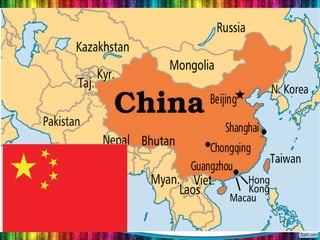
General facts about China
•Official Name: People’s Republic of China
•China’s Capital: Beijing
•Biggest City: Shanghai
•China's population: 1.411 billion
•China's Currency: The Yuan
4
There are seven major groups of dialects of the
Chinese language, which each have their own
variations, according to Mount Holyoke College.
1.Mandarin dialects are spoken by 71.5 percent of the
population
2.Wu (8.5 percent)
3.Yue (also called Cantonese 5 percent)
4.Xiang (4.8 percent)
5.Min (4.1 percent)
6.Hakka (3.7 percent)
7.Gan (2.4 percent).
Chinese Language
Chinese
Religion
5
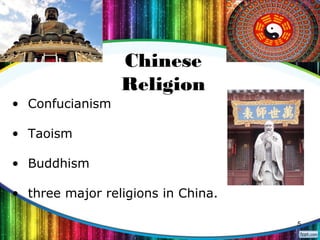
• Confucianism
• Taoism
• Buddhism
• three major religions in China.
6
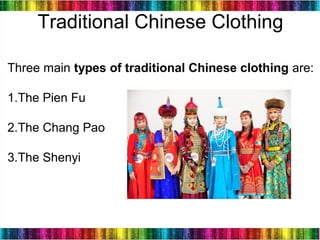
Traditional Chinese Clothing
Three main types of traditional Chinese clothing are:
1.The Pien Fu
2.The Chang Pao
3.The Shenyi
7
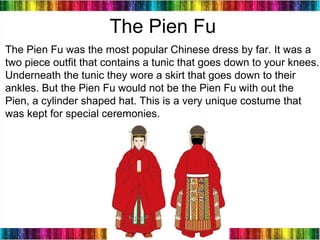
The Pien Fu
The Pien Fu was the most popular Chinese dress by far. It was a
two piece outfit that contains a tunic that goes down to your knees.
Underneath the tunic they wore a skirt that goes down to their
ankles. But the Pien Fu would not be the Pien Fu with out the
Pien, a cylinder shaped hat. This is a very unique costume that
was kept for special ceremonies.
8
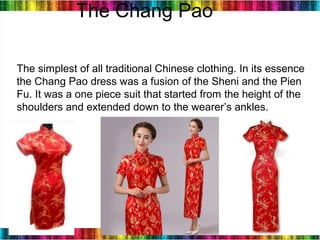
The Chang Pao
The simplest of all traditional Chinese clothing. In its essence
the Chang Pao dress was a fusion of the Sheni and the Pien
Fu. It was a one piece suit that started from the height of the
shoulders and extended down to the wearer’s ankles. 
9
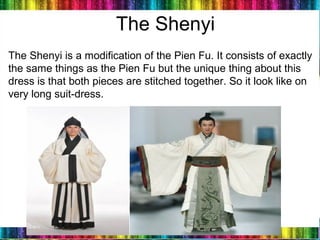
The Shenyi
The Shenyi is a modification of the Pien Fu. It consists of exactly
the same things as the Pien Fu but the unique thing about this
dress is that both pieces are stitched together. So it look like on
very long suit-dress.
10
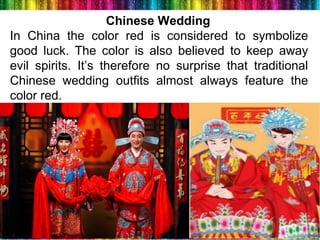
Chinese Wedding
In China the color red is considered to symbolize
good luck. The color is also believed to keep away
evil spirits. It’s therefore no surprise that traditional
Chinese wedding outfits almost always feature the
color red.
11
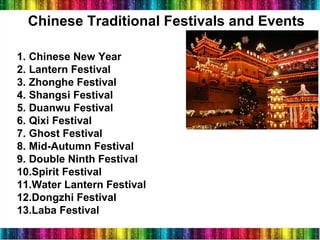
Chinese Traditional Festivals and Events
1. Chinese New Year
2. Lantern Festival
3. Zhonghe Festival
4. Shangsi Festival
5. Duanwu Festival
6. Qixi Festival
7. Ghost Festival
8. Mid-Autumn Festival
9. Double Ninth Festival
10.Spirit Festival
11.Water Lantern Festival
12.Dongzhi Festival
13.Laba Festival
12
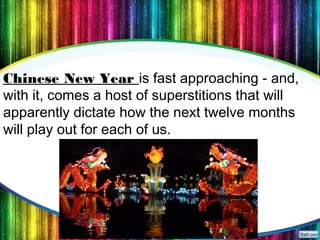
Chinese New Year is fast approaching - and,
with it, comes a host of superstitions that will
apparently dictate how the next twelve months
will play out for each of us.
13
Chinese Zodiac
13
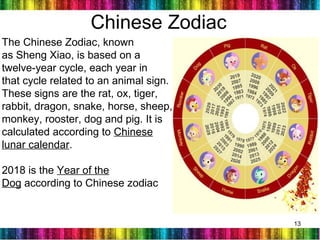
The Chinese Zodiac, known
as Sheng Xiao, is based on a
twelve-year cycle, each year in
that cycle related to an animal sign.
These signs are the rat, ox, tiger,
rabbit, dragon, snake, horse, sheep,
monkey, rooster, dog and pig. It is
calculated according to Chinese
lunar calendar.
2018 is the Year of the
Dog according to Chinese zodiac
14
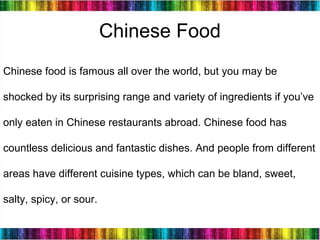
Chinese food is famous all over the world, but you may be
shocked by its surprising range and variety of ingredients if you’ve
only eaten in Chinese restaurants abroad. Chinese food has
countless delicious and fantastic dishes. And people from different
areas have different cuisine types, which can be bland, sweet,
salty, spicy, or sour.
Chinese Food
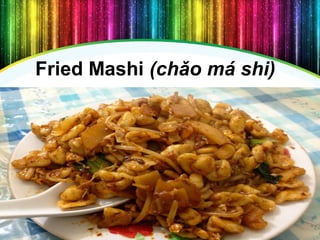
Fried Mashi (chǎo má shi)
15
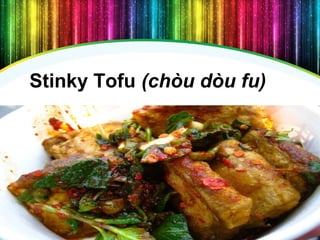
Stinky Tofu (chòu dòu fu)
16
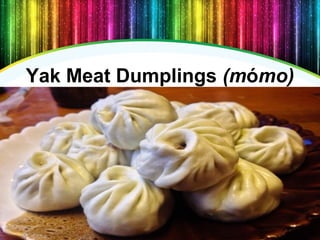
Yak Meat Dumplings (mómo)
17
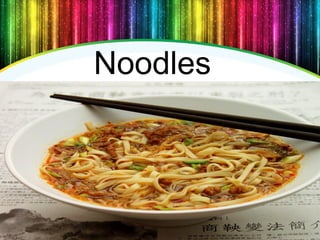
Noodles
18
19
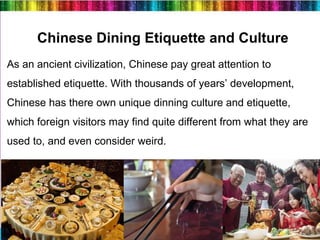
Chinese Dining Etiquette and Culture
As an ancient civilization, Chinese pay great attention to
established etiquette. With thousands of years’ development,
Chinese has there own unique dinning culture and etiquette,
which foreign visitors may find quite different from what they are
used to, and even consider weird.
20
China has a history of thousands of years, which gives it
a lot of historical sites. The seven most significant are
1.The Great Wall
2.The Forbidden City
3.The Terracotta Army,
4.The Potala Palace
5.The Summer Place
6.The Mogao Grottoes
7.The three Confucian sites.
All of these are UNESCO World Heritage.
Chinese Historical Places
21
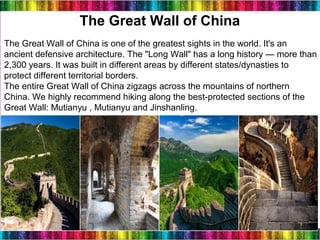
The Great Wall of China is one of the greatest sights in the world. It's an
ancient defensive architecture. The "Long Wall" has a long history — more than
2,300 years. It was built in different areas by different states/dynasties to
protect different territorial borders.
The entire Great Wall of China zigzags across the mountains of northern
China. We highly recommend hiking along the best-protected sections of the
Great Wall: Mutianyu , Mutianyu and Jinshanling.
The Great Wall of China
22
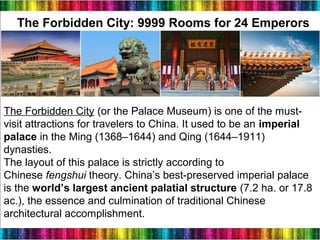
The Forbidden City: 9999 Rooms for 24 Emperors
The Forbidden City (or the Palace Museum) is one of the must-
visit attractions for travelers to China. It used to be an imperial
palace in the Ming (1368–1644) and Qing (1644–1911)
dynasties.
The layout of this palace is strictly according to
Chinese fengshui theory. China’s best-preserved imperial palace
is the world’s largest ancient palatial structure (7.2 ha. or 17.8
ac.), the essence and culmination of traditional Chinese
architectural accomplishment.
Video
23
24
結束
謝謝

The Chinese Culture

  • 2.
  • 3.
    3 General facts aboutChina •Official Name: People’s Republic of China •China’s Capital: Beijing •Biggest City: Shanghai •China's population: 1.411 billion •China's Currency: The Yuan
  • 4.
    4 There are sevenmajor groups of dialects of the Chinese language, which each have their own variations, according to Mount Holyoke College. 1.Mandarin dialects are spoken by 71.5 percent of the population 2.Wu (8.5 percent) 3.Yue (also called Cantonese 5 percent) 4.Xiang (4.8 percent) 5.Min (4.1 percent) 6.Hakka (3.7 percent) 7.Gan (2.4 percent). Chinese Language
  • 5.
    Chinese Religion 5 • Confucianism • Taoism •Buddhism • three major religions in China.
  • 6.
    6 Traditional Chinese Clothing Threemain types of traditional Chinese clothing are: 1.The Pien Fu 2.The Chang Pao 3.The Shenyi
  • 7.
    7 The Pien Fu ThePien Fu was the most popular Chinese dress by far. It was a two piece outfit that contains a tunic that goes down to your knees. Underneath the tunic they wore a skirt that goes down to their ankles. But the Pien Fu would not be the Pien Fu with out the Pien, a cylinder shaped hat. This is a very unique costume that was kept for special ceremonies.
  • 8.
    8 The Chang Pao Thesimplest of all traditional Chinese clothing. In its essence the Chang Pao dress was a fusion of the Sheni and the Pien Fu. It was a one piece suit that started from the height of the shoulders and extended down to the wearer’s ankles. 
  • 9.
    9 The Shenyi The Shenyiis a modification of the Pien Fu. It consists of exactly the same things as the Pien Fu but the unique thing about this dress is that both pieces are stitched together. So it look like on very long suit-dress.
  • 10.
    10 Chinese Wedding In Chinathe color red is considered to symbolize good luck. The color is also believed to keep away evil spirits. It’s therefore no surprise that traditional Chinese wedding outfits almost always feature the color red.
  • 11.
    11 Chinese Traditional Festivalsand Events 1. Chinese New Year 2. Lantern Festival 3. Zhonghe Festival 4. Shangsi Festival 5. Duanwu Festival 6. Qixi Festival 7. Ghost Festival 8. Mid-Autumn Festival 9. Double Ninth Festival 10.Spirit Festival 11.Water Lantern Festival 12.Dongzhi Festival 13.Laba Festival
  • 12.
    12 Chinese New Yearis fast approaching - and, with it, comes a host of superstitions that will apparently dictate how the next twelve months will play out for each of us.
  • 13.
    13 Chinese Zodiac 13 The ChineseZodiac, known as Sheng Xiao, is based on a twelve-year cycle, each year in that cycle related to an animal sign. These signs are the rat, ox, tiger, rabbit, dragon, snake, horse, sheep, monkey, rooster, dog and pig. It is calculated according to Chinese lunar calendar. 2018 is the Year of the Dog according to Chinese zodiac
  • 14.
    14 Chinese food isfamous all over the world, but you may be shocked by its surprising range and variety of ingredients if you’ve only eaten in Chinese restaurants abroad. Chinese food has countless delicious and fantastic dishes. And people from different areas have different cuisine types, which can be bland, sweet, salty, spicy, or sour. Chinese Food
  • 15.
    Fried Mashi (chǎomá shi) 15
  • 16.
    Stinky Tofu (chòudòu fu) 16
  • 17.
  • 18.
  • 19.
    19 Chinese Dining Etiquetteand Culture As an ancient civilization, Chinese pay great attention to established etiquette. With thousands of years’ development, Chinese has there own unique dinning culture and etiquette, which foreign visitors may find quite different from what they are used to, and even consider weird.
  • 20.
    20 China has ahistory of thousands of years, which gives it a lot of historical sites. The seven most significant are 1.The Great Wall 2.The Forbidden City 3.The Terracotta Army, 4.The Potala Palace 5.The Summer Place 6.The Mogao Grottoes 7.The three Confucian sites. All of these are UNESCO World Heritage. Chinese Historical Places
  • 21.
    21 The Great Wallof China is one of the greatest sights in the world. It's an ancient defensive architecture. The "Long Wall" has a long history — more than 2,300 years. It was built in different areas by different states/dynasties to protect different territorial borders. The entire Great Wall of China zigzags across the mountains of northern China. We highly recommend hiking along the best-protected sections of the Great Wall: Mutianyu , Mutianyu and Jinshanling. The Great Wall of China
  • 22.
    22 The Forbidden City:9999 Rooms for 24 Emperors The Forbidden City (or the Palace Museum) is one of the must- visit attractions for travelers to China. It used to be an imperial palace in the Ming (1368–1644) and Qing (1644–1911) dynasties. The layout of this palace is strictly according to Chinese fengshui theory. China’s best-preserved imperial palace is the world’s largest ancient palatial structure (7.2 ha. or 17.8 ac.), the essence and culmination of traditional Chinese architectural accomplishment.
  • 23.
  • 24.