DEPARTMENT OF HORTICULTURE
Content
s• Introduction
• Production, Imports & Exports
• Grades Of Cananga
• Uses
• Cultural Practice
• Harvesting & Yield
• Distillation Of Cananga Oil
• Research findings
• Conclusion
CANANGA
(Ylang-Ylang)
Scientific name: Cananga odorata(Lam) Hook.f. & thomson
Family: Anonaceae
Origin: Tropical Asia(Indonesia &Malaysia)
Introduction
Ylang-ylang tree known as Apurvachampa in Kannada and
perfume tree, Ylang-ylang, cananga, cadmia in English is
grown in gardens of India for its highly fragrant Cananga
oil and well known Ylang-ylang of commercial
importance.
It is also known as queen of perfumes.
In India it is not grown commercially.
Origin and distribution
It is origin of Malaysia and Indonesia . It is found
distributed from eastern Asia to Australia
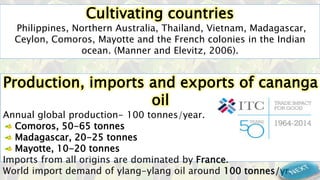
Cultivating countries
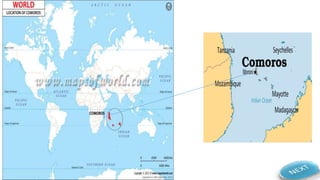
Philippines, Northern Australia, Thailand, Vietnam, Madagascar,
Ceylon, Comoros, Mayotte and the French colonies in the Indian
ocean. (Manner and Elevitz, 2006).
Production, imports and exports of cananga
oil
Annual global production- 100 tonnes/year.
Comoros, 50-65 tonnes
Madagascar, 20-25 tonnes
Mayotte, 10-20 tonnes
Imports from all origins are dominated by France.
World import demand of ylang-ylang oil around 100 tonnes/yr.
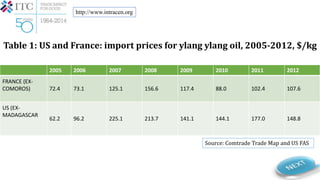
2005 2006 2007 2008 2009 2010 2011 2012
FRANCE (EX-
COMOROS) 72.4 73.1 125.1 156.6 117.4 88.0 102.4 107.6
US (EX-
MADAGASCAR
62.2 96.2 225.1 213.7 141.1 144.1 177.0 148.8
Table 1: US and France: import prices for ylang ylang oil, 2005-2012, $/kg
Source: Comtrade Trade Map and US FAS
http://www.intracen.org
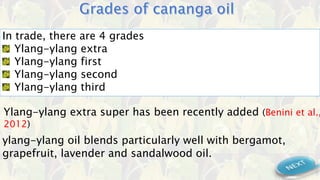
In trade, there are 4 grades
Ylang-ylang extra
Ylang-ylang first
Ylang-ylang second
Ylang-ylang third
Ylang-ylang extra super has been recently added (Benini et al.,
2012)
ylang-ylang oil blends particularly well with bergamot,
grapefruit, lavender and sandalwood oil.
Grade Aroma
Extra Strong floral, jasmine-like
First Floral and jasmine-like
Second Duller
Third Dull with sometimes burnt and harsh notes
(Bontin, 2006)
Table 2: Grades specifications of cananga
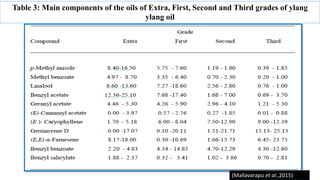
Table 3: Main components of the oils of Extra, First, Second and Third grades of ylang
ylang oil
(Mallavarapu et al.,2015)
Grade
Specific density
(at 27°C)
As % of total distilled oil
In Comoros
In
Madagascar
Extra & Extra “S” 0.950 – 0.970 24% 3%
First 0.934 – 0.945 10% 20%
Second 0.920 – 0.932 8% 17%
Third 0.900 – 0.916 58% 60%
Table 4: Ylang-ylang oil grades specifications and yield of Comoros and Madagascar
(Bontin,2006)
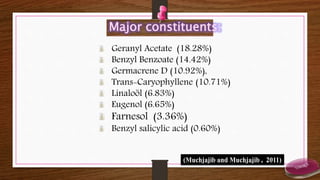
Geranyl Acetate (18.28%)
Benzyl Benzoate (14.42%)
Germacrene D (10.92%),
Trans-Caryophyllene (10.71%)
Linaloöl (6.83%)
Eugenol (6.65%)
Farnesol (3.36%)
Benzyl salicylic acid (0.60%)
Major constituents:
(Muchjajib and Muchjajib , 2011)
Economic part:
Mature yellow flowers.
Usage and
applications :
• Flowers - perfumes, cosmetics, lotions etc..
• Scent used medicinally for its calming effects,
quality organic herbal tinctures, creams and oils.
• Oil in Aromatherapy- sedative, antiseptic,
aphrodisiac and for treating trauma, acute anxiety
and phobias.
• Talcum powder perfumes and for fixation of floral
odours.
Table 5:Usage levels of ylang-ylang oil
ITEM
USAGE LEVEL (%)
NORMAL MAXIMUM
Soaps 0.020 0.30
Detergents 0.002 0.03
Creams and lotions 0.010 0.10
Perfumes 0.300 1.00
(Burdock and Carabin 2008)
Based on the consumption data, it was estimated that the individual
consumption of ylang-ylang oil is 0.006 mg. per day
(Burdock and Carabin 2008)
Table 6: Uses of Ylang-ylang oil in different types of foods and its
usage levels
FEMA: Flavour and Extracts Manufacturer’s Association
FOOD TYPE
USAGE LEVEL (PPM)
NORMAL MAXIMUM
Alcoholic beverages (FEMA) 0.99 2.91
Non-alcoholic beverages (FEMA) 0.98 2.85
Baked goods (FEMA) 3.03 5.03
Chewing gum (FEMA) 12.04 58.81
Frozen dairy products (FEMA) 2.92 4.89
Gelatin, pudding (FEMA) 1.03 3.00
Hard candy (FEMA) 1.05 1.38
Soft candy (FEMA) 3.00 4.98
(Burdock and Carabin 2008)
Botany:
Medium sized, perennial, tropical tree,
10-15m height, branches are pendulous or
slightly erect with drooping, leafy twigs.
The tree bark is smooth and greyish white to
silvery.
Leaves:
Dark green, 20 cm in length, alternate,
simple, elliptic-oblong, slightly pubescent,
and with prominent midrib, as with most of
the members of this family, the leaves are
arranged mainly along a plane.
Flowers:
Drooping in nature, axillary
clusters(4-12).
First they appear green and are
without fragrance and covered
with white hairs then roughly
twenty days later change to
white then a very fragrant yellow
& brown when mature.
(Martein et
al.,1993).
Twisted young
flowers
Drooping mature
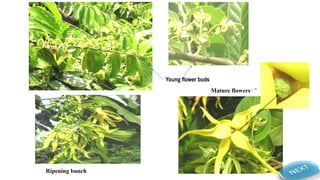
Young flower buds
Mature flowers
Ripening bunch
Seeds: There are 6-12 small,
pale brown, flattened ovoid seeds
in each fruit.
Fruits: greenish black in colour,
1.5 -2.5 cm in length, containing
6-12 stalked fruitlets, fleshy,
olive like and borne in axillary
clusters. (Stone,1970)
Artobotrys hexapetalus (L.f.) Bhandari
(Syn: Annona hexapetalus) Family: Annonaceae
It is commonly called as claimbing lang-
lang, ylang-ylang vine.
It is native to India and Tropical Asia
In kannada it is called as Manoranjani
flower
Other species
Cultural
practiceSoil: Sandy loam to clay loam.
Avoid saline and alkaline soils.
• pH 4.5-8.0
Climate : The tree grows well in the equatorial to
subtropical climates of Indian and Pacific oceans.
• Elevation: 800-1200m above mean sea level.
• RF: 700 – 5000mm
• Temperature: 5 – 350c
Propagation:
Cananga odorata is commonly propagated through seed.
Seeds are collected in the month of June/July. It can also
propagated by cuttings but success rate is less.
Seed propagation:
• Ripe fruits, which are turn from dark green to black are collected.
Separate the fresh seeds and sieve in running water, and air-dried
in shade.
• Seed is orthodox, meaning it remains viable when dried.
• Seeds are sown in light, well drained potting medium.
• The germination of fresh seed is said to be erratic. Seeds of 6-12
months old have higher germination rate.
• Hot water treatment i.e stratification gives better germination rate.
(Oyen and Dung 1999)
Transplanting:
30-50cm height seedlings i.e. 2month old, planted at spacing 5×6m
(333plants/ha). However care should be taken not to damage the long tap root.
Growth and Development:
Cananga is classified as a fast grower, more than 2m per year in its early years.
30-50cm & 2 month
old seedling
Spacing: 5×6m
Flowering starts 5th year onwards and continues upto 30
years.
Flowering is generally low during the periods December to
March and July to September and high during April to June
and October to December (Bontin, 2006).
The plant was reported to flower throughout the year in the
Pacific Islands. (Manner and Elevitz, 2006).
Flowering:
3 year old tree 30 year old tree
Ylang-Ylang
Harvest and Yield :
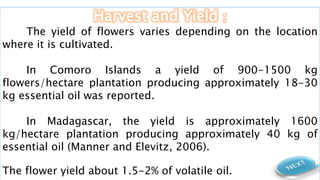
The yield of flowers varies depending on the location
where it is cultivated.
In Comoro Islands a yield of 900-1500 kg
flowers/hectare plantation producing approximately 18-30
kg essential oil was reported.
In Madagascar, the yield is approximately 1600
kg/hectare plantation producing approximately 40 kg of
essential oil (Manner and Elevitz, 2006).
The flower yield about 1.5-2% of volatile oil.
Harvesting of ylang-ylang flowers
Steam distillation of the flowers.
The first yield produces the finest
oil, known as “Extra” and is used in
aromatherapy.
The same flowers can be distilled a
second time for a grade ”1”, first 2
1/2 hours, a third for grade “2”, first
three to four hours, and lastly for a
grade ”3” which is mostly used for
removing varnishes.
This process can take up to fourteen
hours.
Distillation
Cananga flowers
Cananga oil :
It is known as every-body’s ylang-ylang. It is
produced by water/steam distillation of
flowers
Concrete:
It is obtained by “Petroleum ether” extraction of cananga
flowers
Absolute:
It is obtained by alcohol washing of concrete of cananga.
Yield: 75-82% of absolute, it has a typical balsamic floral
note.
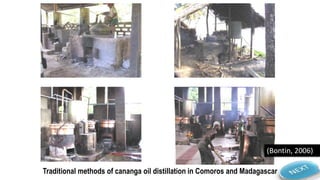
Traditional methods of cananga oil distillation in Comoros and Madagascar
(Bontin, 2006)
Products of cananga oil
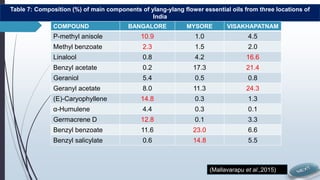
Table 7: Composition (%) of main components of ylang-ylang flower essential oils from three locations of
India
COMPOUND BANGALORE MYSORE VISAKHAPATNAM
P-methyl anisole 10.9 1.0 4.5
Methyl benzoate 2.3 1.5 2.0
Linalool 0.8 4.2 16.6
Benzyl acetate 0.2 17.3 21.4
Geraniol 5.4 0.5 0.8
Geranyl acetate 8.0 11.3 24.3
(E)-Caryophyllene 14.8 0.3 1.3
α-Humulene 4.4 0.3 0.1
Germacrene D 12.8 0.1 3.3
Benzyl benzoate 11.6 23.0 6.6
Benzyl salicylate 0.6 14.8 5.5
(Mallavarapu et al.,2015)
(Muchjajib and Muchjajib , 2011)
Picking time Essential oil
yield/300 g
of flowers (μl)
Oil content
(%)
8:00 am 1262.50 0.42
12:00 pm 1213.75 0.40
4:00 pm 1036.25 0.35
CV (%) 8.88
Table 8: Essential oil yield of ylang-ylang flowers
from different picking time.
(Muchjajib and Muchjajib , 2011)
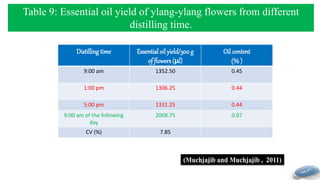
Distilling time Essential oil yield/300 g
of flowers(μl)
Oil content
(% )
9:00 am 1352.50 0.45
1:00 pm 1306.25 0.44
5:00 pm 1331.25 0.44
9:00 am of the following
day
2008.75 0.67
CV (%) 7.85
Table 9: Essential oil yield of ylang-ylang flowers from different
distilling time.
(Muchjajib and Muchjajib , 2011)
Table 10: Essential oil yield of ylang-ylang from different stages of
flower maturity.
Stages of flower maturity Essential oil
yield/300 g
of flowers(μl)
Oil content
(% v/w)
Green stage
(5-6 week after floral bud
initiation)
757.50 0.25
Yellowish Green stage
(7-8 week after floral bud
initiation)
1238.75 0.41
Yellow stage
(8-9 week after floral bud
initiation)
937.50 0.31
CV (%) 16.13
(Muchjajib and Muchjajib , 2011)
Table 11: Essential oil yield of ylang-ylang from different sizes
of flower at the mature stage.
Flowersize Essentialoilyield/300g
of flowers(μl)
Oilcontent
(%v/w)
Small, 1.18×5.08 cm 1.10
g/flower
965.00 0.32
Medium, 1.20×5.87 cm
1.56 g/flower
1467.50 0.49
Large, 1.37×7.14 cm 1.91
g/flower
2312.50 0.77
CV (%) 10.42
(Muchjajib and Muchjajib , 2011)
Volatile Organic Compound Emissions from
Different Stages of Cananga odorata Flower
Development
(Xiao-Wei Qin., et al 2014)
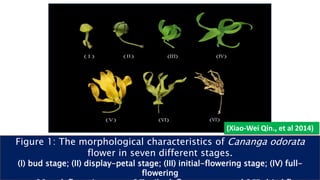
Figure 1: The morphological characteristics of Cananga odorata
flower in seven different stages.
(I) bud stage; (II) display-petal stage; (III) initial-flowering stage; (IV) full-
flowering
(Xiao-Wei Qin., et al 2014)
Figure 2: Two-dimensional (2D) DFA plots of flower from different stages by
electronic nose.
(I) bud stage; (II) display-petal stage; (III) initial-flowering stage;
(IV) full-flowering stage; (V) end-flowering stage; (VI) wilted-flower stage;
Initial-flowering stage
Full-flowering stage
End-flowering stage
Bud stage
Display-petal stage
Discriminant factor 1
Discriminantfactor2
(Xiao-Wei Qin., et al 2014)
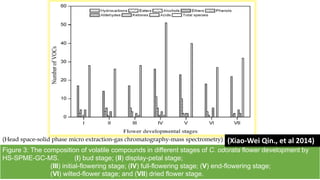
Figure 3: The composition of volatile compounds in different stages of C. odorata flower development by
HS-SPME-GC-MS. (I) bud stage; (II) display-petal stage;
(III) initial-flowering stage; (IV) full-flowering stage; (V) end-flowering stage;
(VI) wilted-flower stage; and (VII) dried flower stage.
(Head space-solid phase micro extraction-gas chromatography-mass spectrometry) (Xiao-Wei Qin., et al 2014)
Figure 5: Principal components analysis biplot showing relationship between the different stages of C.
odorata flower development and the volatile compounds(of combined variance): PC1 vs. PC2 plots
(I) bud stage, (II) display-petal stage, (III) initial-flowering stage, (IV) full-flowering stage,
(V) end-flowering stage, (VI) wilted-flower stage, and (VII) dried flower stage.
Black dots represent distribution of 92 volatile compounds in C. odorata flower.
PC 1 include
α-caryophyllene,
D-germacrene,
α-farnesene,
δ-cadinene,
α-citral,
β-caryophyllene
PC 2 include
benzyl benzoate,
methylbenzoate,
α-methoxybenzeneacetic acid,
neryl acetate,
geraniol acetate,
β-pinene,
β-cubebene,
(Z,E)-α-farnesene,
(Xiao-Wei Qin., et al 2014)
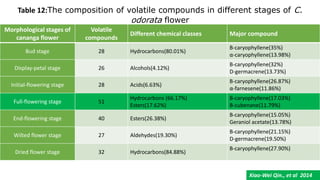
Morphological stages of
cananga flower
Volatile
compounds
Different chemical classes Major compound
Bud stage 28 Hydrocarbons(80.01%)
Β-caryophyllene(35%)
α-caryophyllene(13.98%)
Display-petal stage 26 Alcohols(4.12%)
Β-caryophyllene(32%)
D-germacrene(13.73%)
Initial-flowering stage 28 Acids(6.63%)
Β-caryophyllene(26.87%)
α-farnesene(11.86%)
Full-flowering stage 51
Hydrocarbons (66.17%)
Esters(17.62%)
Β-caryophyllene(17.03%)
B-cubenane(11.79%)
End-flowering stage 40 Esters(26.38%)
Β-caryophyllene(15.05%)
Geraniol acetate(13.78%)
Wilted flower stage 27 Aldehydes(19.30%)
Β-caryophyllene(21.15%)
D-germacrene(19.50%)
Dried flower stage 32 Hydrocarbons(84.88%)
Β-caryophyllene(27.90%)
Table 12:The composition of volatile compounds in different stages of C.
odorata flower
Xiao-Wei Qin., et al 2014
Distillation Assisted by Microwave for
Extracting Essential Oil from Java
Cananga Flowers
(Mahafud et al., 2015)
1. Three-neck flask
2. Microwave oven
3. Power Setting
4. Time setting
5. Temperature
indicator
6. Condenser
7. Separation funnel
8. Conicalflask
Figure 4: Experimental Apparatus of Hydro distillation assisted by Microwave
3
(Mahafud et al., 2015)
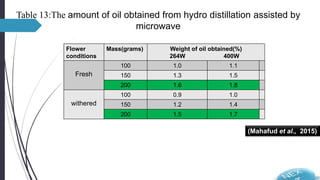
Table 13:The amount of oil obtained from hydro distillation assisted by
microwave
Flower
conditions
Mass(grams) Weight of oil obtained(%)
264W 400W
Fresh
100 1.0 1.1
150 1.3 1.5
200 1.6 1.8
withered
100 0.9 1.0
150 1.2 1.4
200 1.5 1.7
(Mahafud et al., 2015)
160 min
%yield in function time
(P=264W)
%yield in function time
(P=400W)
Figure 5& 6: Effect of distillation time on oil yield for hydro
distillation assisted by microwave (MHD)
(Mahafud et al., 2015)
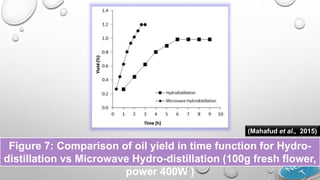
Figure 7: Comparison of oil yield in time function for Hydro-
distillation vs Microwave Hydro-distillation (100g fresh flower,
power 400W )
(Mahafud et al., 2015)
Propertieses (SNI/EOA) 264 W 400 W
Specific gravity
25oC
0,904 - 0,920 0.9065 - 0.911 0.9122 - 0.9157
Refractive Index
20oC
1,495 - 1,505 1.4997 - 1.5001 1.5001 - 1.5004
Table 14:Physical and chemical properties of oil obtained in the
present work
(Mahafud et al., 2015)
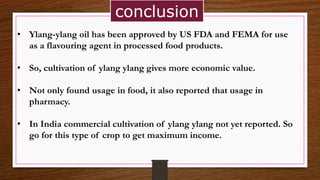
conclusion
• Ylang-ylang oil has been approved by US FDA and FEMA for use
as a flavouring agent in processed food products.
• So, cultivation of ylang ylang gives more economic value.
• Not only found usage in food, it also reported that usage in
pharmacy.
• In India commercial cultivation of ylang ylang not yet reported. So
go for this type of crop to get maximum income.
Cananga odorata by Jayakeerthi KR

Cananga odorata by Jayakeerthi KR

  • 2.
  • 3.
    Content s• Introduction • Production,Imports & Exports • Grades Of Cananga • Uses • Cultural Practice • Harvesting & Yield • Distillation Of Cananga Oil • Research findings • Conclusion
  • 4.
    CANANGA (Ylang-Ylang) Scientific name: Canangaodorata(Lam) Hook.f. & thomson Family: Anonaceae Origin: Tropical Asia(Indonesia &Malaysia)
  • 5.
    Introduction Ylang-ylang tree knownas Apurvachampa in Kannada and perfume tree, Ylang-ylang, cananga, cadmia in English is grown in gardens of India for its highly fragrant Cananga oil and well known Ylang-ylang of commercial importance. It is also known as queen of perfumes. In India it is not grown commercially. Origin and distribution It is origin of Malaysia and Indonesia . It is found distributed from eastern Asia to Australia
  • 6.
    Cultivating countries Philippines, NorthernAustralia, Thailand, Vietnam, Madagascar, Ceylon, Comoros, Mayotte and the French colonies in the Indian ocean. (Manner and Elevitz, 2006). Production, imports and exports of cananga oil Annual global production- 100 tonnes/year. Comoros, 50-65 tonnes Madagascar, 20-25 tonnes Mayotte, 10-20 tonnes Imports from all origins are dominated by France. World import demand of ylang-ylang oil around 100 tonnes/yr.
  • 8.
    2005 2006 20072008 2009 2010 2011 2012 FRANCE (EX- COMOROS) 72.4 73.1 125.1 156.6 117.4 88.0 102.4 107.6 US (EX- MADAGASCAR 62.2 96.2 225.1 213.7 141.1 144.1 177.0 148.8 Table 1: US and France: import prices for ylang ylang oil, 2005-2012, $/kg Source: Comtrade Trade Map and US FAS http://www.intracen.org
  • 9.
    In trade, thereare 4 grades Ylang-ylang extra Ylang-ylang first Ylang-ylang second Ylang-ylang third Ylang-ylang extra super has been recently added (Benini et al., 2012) ylang-ylang oil blends particularly well with bergamot, grapefruit, lavender and sandalwood oil.
  • 10.
    Grade Aroma Extra Strongfloral, jasmine-like First Floral and jasmine-like Second Duller Third Dull with sometimes burnt and harsh notes (Bontin, 2006) Table 2: Grades specifications of cananga
  • 11.
    Table 3: Maincomponents of the oils of Extra, First, Second and Third grades of ylang ylang oil (Mallavarapu et al.,2015)
  • 12.
    Grade Specific density (at 27°C) As% of total distilled oil In Comoros In Madagascar Extra & Extra “S” 0.950 – 0.970 24% 3% First 0.934 – 0.945 10% 20% Second 0.920 – 0.932 8% 17% Third 0.900 – 0.916 58% 60% Table 4: Ylang-ylang oil grades specifications and yield of Comoros and Madagascar (Bontin,2006)
  • 13.
    Geranyl Acetate (18.28%) BenzylBenzoate (14.42%) Germacrene D (10.92%), Trans-Caryophyllene (10.71%) Linaloöl (6.83%) Eugenol (6.65%) Farnesol (3.36%) Benzyl salicylic acid (0.60%) Major constituents: (Muchjajib and Muchjajib , 2011)
  • 14.
  • 15.
    Usage and applications : •Flowers - perfumes, cosmetics, lotions etc.. • Scent used medicinally for its calming effects, quality organic herbal tinctures, creams and oils. • Oil in Aromatherapy- sedative, antiseptic, aphrodisiac and for treating trauma, acute anxiety and phobias. • Talcum powder perfumes and for fixation of floral odours.
  • 16.
    Table 5:Usage levelsof ylang-ylang oil ITEM USAGE LEVEL (%) NORMAL MAXIMUM Soaps 0.020 0.30 Detergents 0.002 0.03 Creams and lotions 0.010 0.10 Perfumes 0.300 1.00 (Burdock and Carabin 2008) Based on the consumption data, it was estimated that the individual consumption of ylang-ylang oil is 0.006 mg. per day (Burdock and Carabin 2008)
  • 17.
    Table 6: Usesof Ylang-ylang oil in different types of foods and its usage levels FEMA: Flavour and Extracts Manufacturer’s Association FOOD TYPE USAGE LEVEL (PPM) NORMAL MAXIMUM Alcoholic beverages (FEMA) 0.99 2.91 Non-alcoholic beverages (FEMA) 0.98 2.85 Baked goods (FEMA) 3.03 5.03 Chewing gum (FEMA) 12.04 58.81 Frozen dairy products (FEMA) 2.92 4.89 Gelatin, pudding (FEMA) 1.03 3.00 Hard candy (FEMA) 1.05 1.38 Soft candy (FEMA) 3.00 4.98 (Burdock and Carabin 2008)
  • 18.
    Botany: Medium sized, perennial,tropical tree, 10-15m height, branches are pendulous or slightly erect with drooping, leafy twigs. The tree bark is smooth and greyish white to silvery. Leaves: Dark green, 20 cm in length, alternate, simple, elliptic-oblong, slightly pubescent, and with prominent midrib, as with most of the members of this family, the leaves are arranged mainly along a plane.
  • 19.
    Flowers: Drooping in nature,axillary clusters(4-12). First they appear green and are without fragrance and covered with white hairs then roughly twenty days later change to white then a very fragrant yellow & brown when mature. (Martein et al.,1993). Twisted young flowers Drooping mature
  • 20.
    Young flower buds Matureflowers Ripening bunch
  • 21.
    Seeds: There are6-12 small, pale brown, flattened ovoid seeds in each fruit. Fruits: greenish black in colour, 1.5 -2.5 cm in length, containing 6-12 stalked fruitlets, fleshy, olive like and borne in axillary clusters. (Stone,1970)
  • 22.
    Artobotrys hexapetalus (L.f.)Bhandari (Syn: Annona hexapetalus) Family: Annonaceae It is commonly called as claimbing lang- lang, ylang-ylang vine. It is native to India and Tropical Asia In kannada it is called as Manoranjani flower Other species
  • 23.
    Cultural practiceSoil: Sandy loamto clay loam. Avoid saline and alkaline soils. • pH 4.5-8.0 Climate : The tree grows well in the equatorial to subtropical climates of Indian and Pacific oceans. • Elevation: 800-1200m above mean sea level. • RF: 700 – 5000mm • Temperature: 5 – 350c Propagation: Cananga odorata is commonly propagated through seed. Seeds are collected in the month of June/July. It can also propagated by cuttings but success rate is less.
  • 24.
    Seed propagation: • Ripefruits, which are turn from dark green to black are collected. Separate the fresh seeds and sieve in running water, and air-dried in shade. • Seed is orthodox, meaning it remains viable when dried. • Seeds are sown in light, well drained potting medium. • The germination of fresh seed is said to be erratic. Seeds of 6-12 months old have higher germination rate. • Hot water treatment i.e stratification gives better germination rate. (Oyen and Dung 1999)
  • 25.
    Transplanting: 30-50cm height seedlingsi.e. 2month old, planted at spacing 5×6m (333plants/ha). However care should be taken not to damage the long tap root. Growth and Development: Cananga is classified as a fast grower, more than 2m per year in its early years. 30-50cm & 2 month old seedling Spacing: 5×6m
  • 26.
    Flowering starts 5thyear onwards and continues upto 30 years. Flowering is generally low during the periods December to March and July to September and high during April to June and October to December (Bontin, 2006). The plant was reported to flower throughout the year in the Pacific Islands. (Manner and Elevitz, 2006). Flowering:
  • 27.
    3 year oldtree 30 year old tree Ylang-Ylang
  • 28.
    Harvest and Yield: The yield of flowers varies depending on the location where it is cultivated. In Comoro Islands a yield of 900-1500 kg flowers/hectare plantation producing approximately 18-30 kg essential oil was reported. In Madagascar, the yield is approximately 1600 kg/hectare plantation producing approximately 40 kg of essential oil (Manner and Elevitz, 2006). The flower yield about 1.5-2% of volatile oil.
  • 29.
  • 30.
    Steam distillation ofthe flowers. The first yield produces the finest oil, known as “Extra” and is used in aromatherapy. The same flowers can be distilled a second time for a grade ”1”, first 2 1/2 hours, a third for grade “2”, first three to four hours, and lastly for a grade ”3” which is mostly used for removing varnishes. This process can take up to fourteen hours. Distillation Cananga flowers
  • 31.
    Cananga oil : Itis known as every-body’s ylang-ylang. It is produced by water/steam distillation of flowers Concrete: It is obtained by “Petroleum ether” extraction of cananga flowers Absolute: It is obtained by alcohol washing of concrete of cananga. Yield: 75-82% of absolute, it has a typical balsamic floral note.
  • 32.
    Traditional methods ofcananga oil distillation in Comoros and Madagascar (Bontin, 2006)
  • 33.
  • 34.
    Table 7: Composition(%) of main components of ylang-ylang flower essential oils from three locations of India COMPOUND BANGALORE MYSORE VISAKHAPATNAM P-methyl anisole 10.9 1.0 4.5 Methyl benzoate 2.3 1.5 2.0 Linalool 0.8 4.2 16.6 Benzyl acetate 0.2 17.3 21.4 Geraniol 5.4 0.5 0.8 Geranyl acetate 8.0 11.3 24.3 (E)-Caryophyllene 14.8 0.3 1.3 α-Humulene 4.4 0.3 0.1 Germacrene D 12.8 0.1 3.3 Benzyl benzoate 11.6 23.0 6.6 Benzyl salicylate 0.6 14.8 5.5 (Mallavarapu et al.,2015)
  • 35.
  • 36.
    Picking time Essentialoil yield/300 g of flowers (μl) Oil content (%) 8:00 am 1262.50 0.42 12:00 pm 1213.75 0.40 4:00 pm 1036.25 0.35 CV (%) 8.88 Table 8: Essential oil yield of ylang-ylang flowers from different picking time. (Muchjajib and Muchjajib , 2011)
  • 37.
    Distilling time Essentialoil yield/300 g of flowers(μl) Oil content (% ) 9:00 am 1352.50 0.45 1:00 pm 1306.25 0.44 5:00 pm 1331.25 0.44 9:00 am of the following day 2008.75 0.67 CV (%) 7.85 Table 9: Essential oil yield of ylang-ylang flowers from different distilling time. (Muchjajib and Muchjajib , 2011)
  • 38.
    Table 10: Essentialoil yield of ylang-ylang from different stages of flower maturity. Stages of flower maturity Essential oil yield/300 g of flowers(μl) Oil content (% v/w) Green stage (5-6 week after floral bud initiation) 757.50 0.25 Yellowish Green stage (7-8 week after floral bud initiation) 1238.75 0.41 Yellow stage (8-9 week after floral bud initiation) 937.50 0.31 CV (%) 16.13 (Muchjajib and Muchjajib , 2011)
  • 39.
    Table 11: Essentialoil yield of ylang-ylang from different sizes of flower at the mature stage. Flowersize Essentialoilyield/300g of flowers(μl) Oilcontent (%v/w) Small, 1.18×5.08 cm 1.10 g/flower 965.00 0.32 Medium, 1.20×5.87 cm 1.56 g/flower 1467.50 0.49 Large, 1.37×7.14 cm 1.91 g/flower 2312.50 0.77 CV (%) 10.42 (Muchjajib and Muchjajib , 2011)
  • 40.
    Volatile Organic CompoundEmissions from Different Stages of Cananga odorata Flower Development (Xiao-Wei Qin., et al 2014)
  • 41.
    Figure 1: Themorphological characteristics of Cananga odorata flower in seven different stages. (I) bud stage; (II) display-petal stage; (III) initial-flowering stage; (IV) full- flowering (Xiao-Wei Qin., et al 2014)
  • 42.
    Figure 2: Two-dimensional(2D) DFA plots of flower from different stages by electronic nose. (I) bud stage; (II) display-petal stage; (III) initial-flowering stage; (IV) full-flowering stage; (V) end-flowering stage; (VI) wilted-flower stage; Initial-flowering stage Full-flowering stage End-flowering stage Bud stage Display-petal stage Discriminant factor 1 Discriminantfactor2 (Xiao-Wei Qin., et al 2014)
  • 43.
    Figure 3: Thecomposition of volatile compounds in different stages of C. odorata flower development by HS-SPME-GC-MS. (I) bud stage; (II) display-petal stage; (III) initial-flowering stage; (IV) full-flowering stage; (V) end-flowering stage; (VI) wilted-flower stage; and (VII) dried flower stage. (Head space-solid phase micro extraction-gas chromatography-mass spectrometry) (Xiao-Wei Qin., et al 2014)
  • 44.
    Figure 5: Principalcomponents analysis biplot showing relationship between the different stages of C. odorata flower development and the volatile compounds(of combined variance): PC1 vs. PC2 plots (I) bud stage, (II) display-petal stage, (III) initial-flowering stage, (IV) full-flowering stage, (V) end-flowering stage, (VI) wilted-flower stage, and (VII) dried flower stage. Black dots represent distribution of 92 volatile compounds in C. odorata flower. PC 1 include α-caryophyllene, D-germacrene, α-farnesene, δ-cadinene, α-citral, β-caryophyllene PC 2 include benzyl benzoate, methylbenzoate, α-methoxybenzeneacetic acid, neryl acetate, geraniol acetate, β-pinene, β-cubebene, (Z,E)-α-farnesene, (Xiao-Wei Qin., et al 2014)
  • 45.
    Morphological stages of canangaflower Volatile compounds Different chemical classes Major compound Bud stage 28 Hydrocarbons(80.01%) Β-caryophyllene(35%) α-caryophyllene(13.98%) Display-petal stage 26 Alcohols(4.12%) Β-caryophyllene(32%) D-germacrene(13.73%) Initial-flowering stage 28 Acids(6.63%) Β-caryophyllene(26.87%) α-farnesene(11.86%) Full-flowering stage 51 Hydrocarbons (66.17%) Esters(17.62%) Β-caryophyllene(17.03%) B-cubenane(11.79%) End-flowering stage 40 Esters(26.38%) Β-caryophyllene(15.05%) Geraniol acetate(13.78%) Wilted flower stage 27 Aldehydes(19.30%) Β-caryophyllene(21.15%) D-germacrene(19.50%) Dried flower stage 32 Hydrocarbons(84.88%) Β-caryophyllene(27.90%) Table 12:The composition of volatile compounds in different stages of C. odorata flower Xiao-Wei Qin., et al 2014
  • 46.
    Distillation Assisted byMicrowave for Extracting Essential Oil from Java Cananga Flowers (Mahafud et al., 2015)
  • 47.
    1. Three-neck flask 2.Microwave oven 3. Power Setting 4. Time setting 5. Temperature indicator 6. Condenser 7. Separation funnel 8. Conicalflask Figure 4: Experimental Apparatus of Hydro distillation assisted by Microwave 3 (Mahafud et al., 2015)
  • 48.
    Table 13:The amountof oil obtained from hydro distillation assisted by microwave Flower conditions Mass(grams) Weight of oil obtained(%) 264W 400W Fresh 100 1.0 1.1 150 1.3 1.5 200 1.6 1.8 withered 100 0.9 1.0 150 1.2 1.4 200 1.5 1.7 (Mahafud et al., 2015)
  • 49.
    160 min %yield infunction time (P=264W) %yield in function time (P=400W) Figure 5& 6: Effect of distillation time on oil yield for hydro distillation assisted by microwave (MHD) (Mahafud et al., 2015)
  • 50.
    Figure 7: Comparisonof oil yield in time function for Hydro- distillation vs Microwave Hydro-distillation (100g fresh flower, power 400W ) (Mahafud et al., 2015)
  • 51.
    Propertieses (SNI/EOA) 264W 400 W Specific gravity 25oC 0,904 - 0,920 0.9065 - 0.911 0.9122 - 0.9157 Refractive Index 20oC 1,495 - 1,505 1.4997 - 1.5001 1.5001 - 1.5004 Table 14:Physical and chemical properties of oil obtained in the present work (Mahafud et al., 2015)
  • 52.
    conclusion • Ylang-ylang oilhas been approved by US FDA and FEMA for use as a flavouring agent in processed food products. • So, cultivation of ylang ylang gives more economic value. • Not only found usage in food, it also reported that usage in pharmacy. • In India commercial cultivation of ylang ylang not yet reported. So go for this type of crop to get maximum income.