CANADA SHARABLE NOTES
GEOGRAPHY
        3.8 million square miles (second largest nation only to Russia)
        Slightly larger than the United States
        Variety of landforms – mountains, lowlands, prairies, and arctic wilderness
        North Pole is in this region
        Covers most of the NORTHERN PART of North America
        Has coastlines on the Atlantic, Arctic, and Pacific Oceans, giving it the
         longest coastline of any country
        Canada has more lakes and inland waterways than any other country in the
         world
        Most of Canada has a cool or cold climate

Mountains
   Mount Logan (Yukon) at 19,850 feet high is the tallest mountain
   The Appalachians are in the east region
   The Rocky Mountains are in the west region


Lakes
        Canada has over two million lakes
        The United States shares the Great Lakes with Canada (Huron, Ontario,
         Michigan, Erie, Superior)


Rivers
        Mackenzie River is the longest river at 2,635 miles long.
        Saint Lawrence and the Yukon rivers are also important
   


MAJOR CITIES AND LOCATION INFORMATION
  - National Capital – Ottawa (located in the province of Ontario)
   -     Ottawa = Washington, D.C. (basically the same)
   -     Toronto, Montreal, Vancouver, Edmonton, Calgary are major cities

Provinces
    There are ten provinces and three territories.
    Nunavut – carved out of the Northwest Territory for the Inuit people to live
       in. Created in 1999.
CULTURE
     Most Canadians live near the United States border.
     Native Americans were the first Canadians.
     British and French later settled along the St. Lawrence River and Great
      Lakes.
     Cultural differences exist between the French speaking province of Quebec
      and the rest of Canada.
     Very diverse in population.
     Some people in French-speaking Quebec want independence from the rest of
      Canada.
     In 1995, voters narrowly defeated a proposal for independence.


ECONOMY

  -   One of the world’s most developed economies.
  -   Like the U.S., Canada has a strong free market economy
  -   Manufacturing and service industries
  -   Very rich in mineral deposits and forests.
  -   Fishing, mining, and lumbering also important to the economy
  -   Canada is the world's leading producer of newsprint.
  -   The North American Free Trade Agreement (NAFTA) has brought an
      economic boom—about 80 percent of Canada's trade is with the U.S.


GENERAL NOTES

  -   HDI ranking of #8 out of 170 (approximately)
  -   Only has 11 percent as many people as the U.S. making Canada one of the
      least densely inhabited and most prosperous countries
  -   Native Americans and the Inuit were the first Canadians.
  -   Canada was a colony of Great Britain until the Dominion of Canada was
      established in 1867.
  -   Canada's government is a confederation with a parliamentary democracy,
      headed by a prime minister.
  -   Its culture reflects the country's diverse ethnic heritage.
  -   Some 28 percent of Canadians are of British descent, 23 percent claim
      French descent (concentrated in Quebec), and 2 percent are aboriginal
      peoples
  -   Other minorities include Italians, Germans, Ukrainians, and Chinese.
  -   A bilingual country—its two official languages are French and English.
-    Highly urbanized population - most people live in four areas: 1 -southern
               Ontario, 2 - Montréal region, 3 -Vancouver city and southern Vancouver
               Island, and 4 - Calgary-Edmonton corridor.
          -    In fact, an estimated 75 percent of Canadians live within 100 miles of the
               U.S. border.


      Faces   three major challenges
             Holding separate regions together
             Working out trade issues with the United States
             Dealing with environmental issues


                                         CANADA QUICK FACTSHEET
Population                                                  Currency
33 Million (33,000,000 +)                                   Canadian dollar
80% Urban
                                                            Life Expectancy
Capital and Major Cities                                    79 (77 males, 84 females)
Ottawa // Toronto, Montreal, Vancouver, Edmonton, Calgary
                                                            Literacy Percent
Area                                                        99
9,984,670 sq. kilometers (3,855,101 sq. miles)
4 per sq. kilometer (10 per sq. mile)                       Internet Usuage
                                                            22 million (out of 33+)
Language
English, French (Bilingual country)                         Government
                                                            Confederation with Parliamentary Democracy
Religion
Roman Catholic, Protestant

Canada Notes

  • 1.
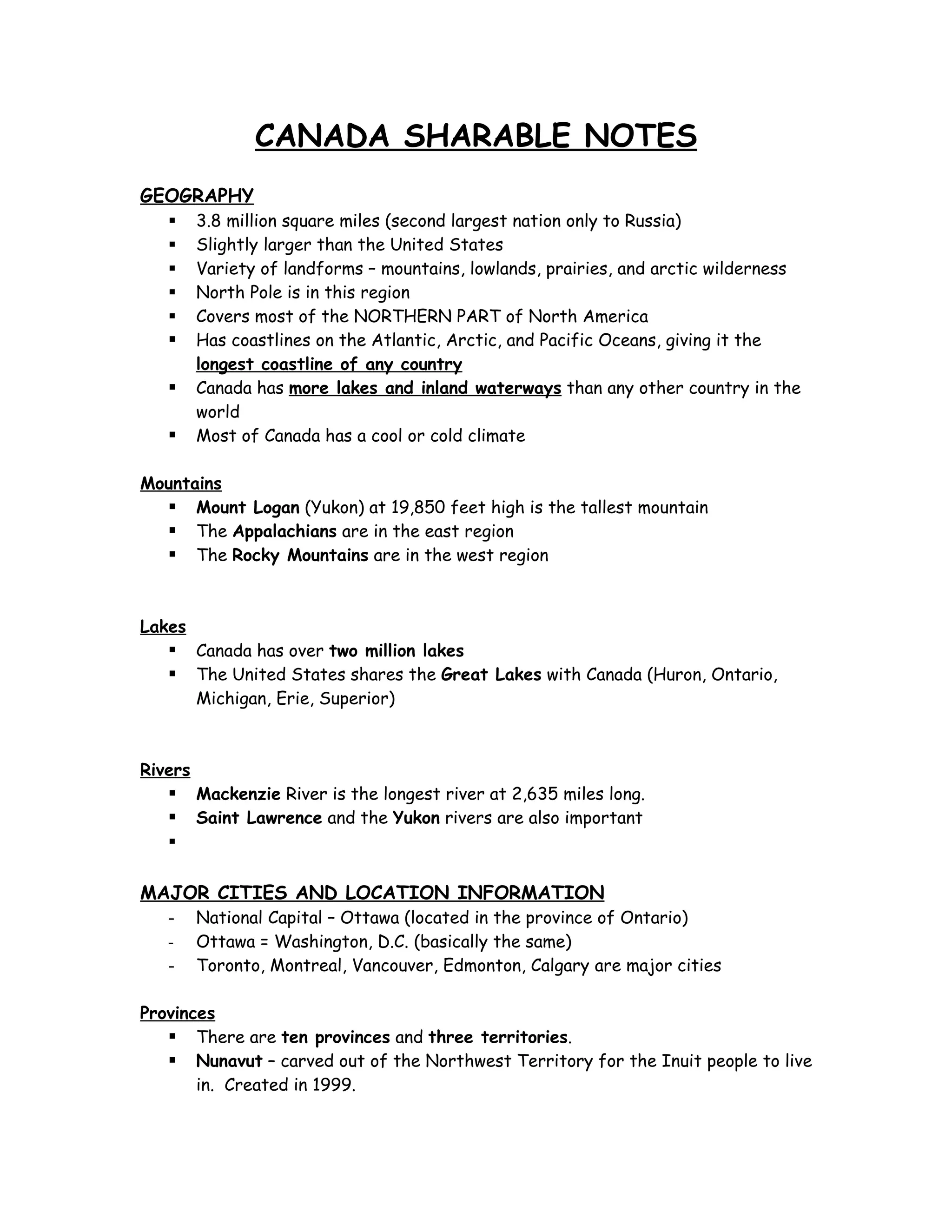
    CANADA SHARABLE NOTES GEOGRAPHY  3.8 million square miles (second largest nation only to Russia)  Slightly larger than the United States  Variety of landforms – mountains, lowlands, prairies, and arctic wilderness  North Pole is in this region  Covers most of the NORTHERN PART of North America  Has coastlines on the Atlantic, Arctic, and Pacific Oceans, giving it the longest coastline of any country  Canada has more lakes and inland waterways than any other country in the world  Most of Canada has a cool or cold climate Mountains  Mount Logan (Yukon) at 19,850 feet high is the tallest mountain  The Appalachians are in the east region  The Rocky Mountains are in the west region Lakes  Canada has over two million lakes  The United States shares the Great Lakes with Canada (Huron, Ontario, Michigan, Erie, Superior) Rivers  Mackenzie River is the longest river at 2,635 miles long.  Saint Lawrence and the Yukon rivers are also important  MAJOR CITIES AND LOCATION INFORMATION - National Capital – Ottawa (located in the province of Ontario) - Ottawa = Washington, D.C. (basically the same) - Toronto, Montreal, Vancouver, Edmonton, Calgary are major cities Provinces  There are ten provinces and three territories.  Nunavut – carved out of the Northwest Territory for the Inuit people to live in. Created in 1999.
  • 2.
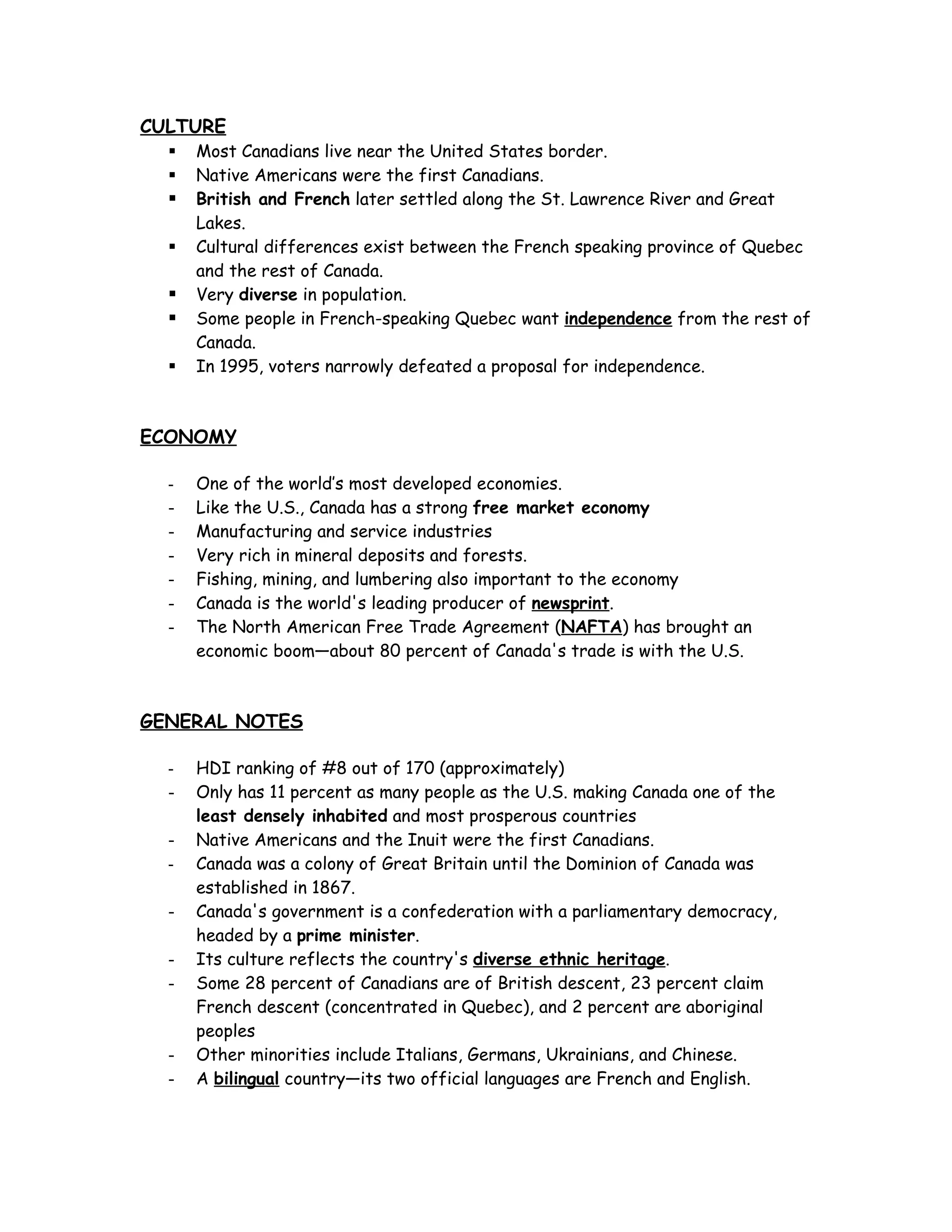
    CULTURE  Most Canadians live near the United States border.  Native Americans were the first Canadians.  British and French later settled along the St. Lawrence River and Great Lakes.  Cultural differences exist between the French speaking province of Quebec and the rest of Canada.  Very diverse in population.  Some people in French-speaking Quebec want independence from the rest of Canada.  In 1995, voters narrowly defeated a proposal for independence. ECONOMY - One of the world’s most developed economies. - Like the U.S., Canada has a strong free market economy - Manufacturing and service industries - Very rich in mineral deposits and forests. - Fishing, mining, and lumbering also important to the economy - Canada is the world's leading producer of newsprint. - The North American Free Trade Agreement (NAFTA) has brought an economic boom—about 80 percent of Canada's trade is with the U.S. GENERAL NOTES - HDI ranking of #8 out of 170 (approximately) - Only has 11 percent as many people as the U.S. making Canada one of the least densely inhabited and most prosperous countries - Native Americans and the Inuit were the first Canadians. - Canada was a colony of Great Britain until the Dominion of Canada was established in 1867. - Canada's government is a confederation with a parliamentary democracy, headed by a prime minister. - Its culture reflects the country's diverse ethnic heritage. - Some 28 percent of Canadians are of British descent, 23 percent claim French descent (concentrated in Quebec), and 2 percent are aboriginal peoples - Other minorities include Italians, Germans, Ukrainians, and Chinese. - A bilingual country—its two official languages are French and English.
  • 3.
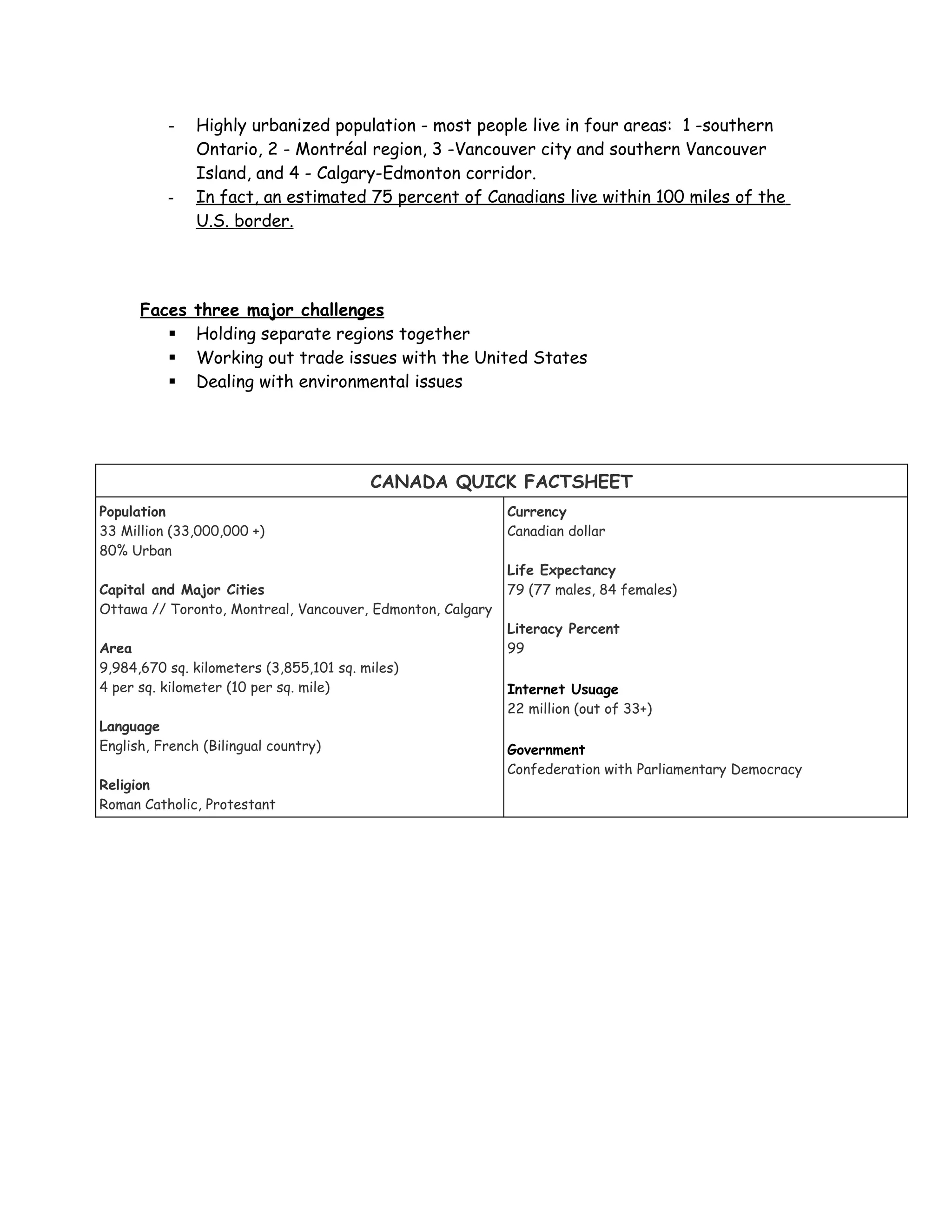
    - Highly urbanized population - most people live in four areas: 1 -southern Ontario, 2 - Montréal region, 3 -Vancouver city and southern Vancouver Island, and 4 - Calgary-Edmonton corridor. - In fact, an estimated 75 percent of Canadians live within 100 miles of the U.S. border. Faces three major challenges  Holding separate regions together  Working out trade issues with the United States  Dealing with environmental issues CANADA QUICK FACTSHEET Population Currency 33 Million (33,000,000 +) Canadian dollar 80% Urban Life Expectancy Capital and Major Cities 79 (77 males, 84 females) Ottawa // Toronto, Montreal, Vancouver, Edmonton, Calgary Literacy Percent Area 99 9,984,670 sq. kilometers (3,855,101 sq. miles) 4 per sq. kilometer (10 per sq. mile) Internet Usuage 22 million (out of 33+) Language English, French (Bilingual country) Government Confederation with Parliamentary Democracy Religion Roman Catholic, Protestant