Tech Talk 
Newsletter of The Rotary Foundation Cadre of Technical Advisers • October 2014 
M e s s a g e f r o m t h e C h a i r 
Phil Silvers 
Dear Fellow Cadre Members and Rotary Leaders: 
In mid-July, I used some airline miles to visit Evanston and prepare myself to work 
with the cadre during the upcoming three years. I conducted some focus groups with grants 
staff, area of focus managers, and cadre and Rotary Foundation program evaluation staff. I also 
met with Foundation Chairman John Kenny and General Secretary John Hewko. The purpose 
of these discussions was to gain clarity on the mission of the cadre, assess its effectiveness, and 
explore its potential — now that year one of the new grants model has been completed. 
Here is what I learned: 
 The contributions of cadre members are highly valued by the Foundation grants staff and 
The Rotary Foundation • www.rotary.org 
the area of focus managers. 
 Cadre members are engaged many ways in support of global grants: they provide consulting 
assistance to grant applicants, pre-award reviews, mid-project reviews, and routine, random, 
and targeted audits. 
 Much of the Rotary world does not know about the roles of the cadre. 
 As a result of a preliminary assessment of the year one implementation of the new grants 
model, greater use of the cadre is clearly warranted and welcomed. 
Plans for the Future of the Cadre 
As a result of these discussions, we see an emerging consensus on these future directions for the 
cadre: 
 Foundation staff will increase the use of the cadre earlier in the application process — 
especially to support first-time grant writers and those struggling with needs assessments, 
sustainability, and monitoring and evaluation. 
 In the near future, we will need to assess cadre members’ skills and experience with needs 
assessments, monitoring and evaluation, and sustainability — areas where sponsors need 
assistance. 
 To prepare Rotary leadership for the increased use of the cadre, Chairman Kenny, staff, and 
I prepared some talking points for Trustee presentations at the upcoming Rotary institutes. 
The points explain the various roles of the cadre in the grants approval process and in 
stewardship, as well as the need to expand the cadre in certain areas of focus and regions of 
the world. 
 Resources are being developed to assist Rotarians who are writing and authorizing grant 
applications. Particularly aimed at the proposal writer, this resource will offer advice on 
community needs assessments, monitoring and evaluation, and sustainability. 
 Cadre staff will develop a report to capture the different ways cadre members are providing 
assistance to Rotarians planning and implementing grant projects. 
I look forward to seeing cadre members and those Rotarians interested in learning more about 
the cadre program and stewardship at the next cadre training at the 2015 RI Convention in São 
Paulo, Brazil (date of training is TBA). If you have questions or suggestions about the work of 
the cadre, please contact me at silverlode@cox.net. Thank you for your support for effective 
Rotary Foundation programming! 
Phil Silvers, 
RI Director, 2008-10 
Chair, Cadre of Technical Advisers 2014-17 
2014-15 
Technical Coordinators 
CADRE CHAIR & VICE CHAIR 
Philip J. Silvers (USA) 
Francis F. Tusubira (Uganda) 
BASIC EDUCATION & LITERACY 
Maureen V. Duncan (USA) 
Ian W. Geddes (Scotland) 
Jones Y. Kyazze (Uganda) 
CHILD & MATERNAL HEALTH 
Himansu K. Basu (England) 
Catherine Noyer-Riveau (France) 
Deepak M. Purohit (India) 
DISEASE TREATMENT & PREVENTION 
Rajaratnam T. Arasu (Malaysia) 
Estela Emeric (Argentina) 
Frederick W. Hahn Jr. (USA) 
ECONOMIC & COMMUNITY 
DEVELOPMENT 
Deniel Banks (USA) 
Chalermchat Chun-In (Thailand) 
Jean-Claude Piers de Raveschoot 
(France) 
PEACE & CONFLICT RESOLUTION 
David I. Clifton Jr. (USA) 
Hugh Munro (Scotland) 
Mark Zober (Israel) 
WATER & SANITATION 
Kenneth W. Grabeau (USA) 
John Kevan (Australia) 
Vishwas Sahasrabhojanee (India)
Tech Talk Newsletter of The Rotary Foundation Cadre of Technical Advisers 
In Our Own Words 
A C om m u n i ty R ec ov er s —A Si te V i s i t to J o pl i n , Mi s s ou r i , U S A 
Ronald Gaydos, Rotary Club of Pittsburgh East, USA (District 7300) 
Page 2 
Editor’s note: Some identifying 
details, such as names of the project 
location and sponsors, have been 
omitted, to ensure confidentiality. 
I had been very interested in 
international service for Rotary because I 
feel that people everywhere are my 
fellow global citizens. As I’ve seen from 
international study and leading a Group 
Study Exchange, different appearance, 
language, or customs aren’t really 
significant barriers to people making 
strong connections. You could say that 
“the cadre called.” 
So I applied to become a cadre member 
in order to offer my development 
experience to projects that fill urgent 
needs in communities around the world. 
Rotary Foundation Cadre Specialist 
Christian Pepera welcomed me into the 
ranks by email. A couple months later an 
email came inviting me to go to Joplin, 
Missouri, in the U.S. to evaluate a major 
project that the Foundation had 
supported: a baseball field for children 
and youth with physical and intellectual 
challenges. Joplin had been hit by an 
EF5 tornado – the most intense damage 
category on the Enhanced Fujita scale – 
and had lost 162 people, hundreds of 
homes, five parks, and countless trees in 
those parks and in the tornado’s path. 
Not interested in reinventing the wheel, the 
project team worked with the Miracle 
League organization, which develops 
programming and design specifications for 
baseball fields for special-needs players. 
As many have experienced, if you meet 
another Rotarian, you’ve met a new friend. 
As always, this was the case for the local 
team I met in Joplin. After getting squared 
away with my transportation, the project 
leader led me to my hotel and I got settled 
in, ready for the first inspection meeting 
that evening at the Miracle League Field, 
which was near the area’s premier youth 
baseball stadium. 
My experience as a builder and project 
manager allowed me to take an expert look 
at the field, its structures, and the site work. 
I found only a minor problem that no one 
on the project team anticipated and could 
easily be corrected. This inspection meeting 
was followed by an all-star game – all of the 
Miracle League players who could come 
that evening for this special event – 
complete with uniforms, public address 
announcer, and cheering fans. I was invited 
to join in as a “buddy,” accompanying one 
of the players to help him stay engaged in 
the game and to protect him from any hit 
balls or other potential dangers. 
It was great to see the completed project in 
use and enjoyed by the community. This is 
what it’s all about! 
The next day I met with the project team to 
go over the paperwork: the budget, receipts, 
approvals, and fundraising records. 
Communicating with the project team 
before arriving onsite helps to make sure 
that the local team knows what the 
evaluation will involve so they can have 
records ready and team members available. 
The guidance of the Foundation cadre 
specialist was also very helpful, to make the 
structure of the trip thorough but simple. 
Even though we were all compadres in Rotary 
I needed to take an objective role in the 
evaluation. I dug into the details to be sure 
Foundation practices and guidelines 
were followed. After looking through 
everything, I found the project was in 
good hands. 
As one wise member of the project team 
said: “If you ask anyone if they would 
like a tornado, of course they would say 
no, but we made the best of this tragic 
event to bring the community together 
like it never was before!” It was certainly 
true. Signs of honoring each other and 
those lost were evident all over town. 
Now I feel a kinship to another 
community in another part of the world. 
Many cadre projects will be set in the 
face of hardship or tragedy. My cadre 
experience increased my grasp of and 
respect for what Rotary does around the 
world. 
Cadre member Ron Gaydos observed the 
community’s use of a specialized baseball field in 
the city of Joplin, Missouri, which was devastated by 
a tornado in 2011. 
Remember to visit the cadre’s 
shared site 
If you’re a registered cadre member, 
you can use the site by signing in to 
My Rotary at www.rotary.org and 
visiting the Rotary Workgroup section 
in your profile. The site serves as a 
document resource, survey tool, and 
news and information center. 
Contribute to discussion groups, 
download training documents, access 
the Tech Talk archive, view photo 
galleries, and more.
Tech Talk Newsletter of The Rotary Foundation TTeecchh TTaallkk NNeewwsslleetttteerr ooff TThhee RRoottaarryy FFoouunnddaattii ooCnna CCdaaredd rroeef ooTeff cTTheenccihhcanniilcc Aaalld AAviddsevvriisssee rrss 
Page 3 
Editor’s note: Some identifying 
details, such as names of the project 
location and sponsors, have been 
omitted, to ensure confidentiality. 
In my Rotarian life I have always been 
close to The Rotary Foundation, both as 
a contributor and as a designer or 
participant in projects for my club and 
for my district. Therefore, becoming a 
cadre member was almost inevitable. 
My most recent assignment involved the 
interim monitor site visit of a project in 
Modena, Italy. This project is providing 
post-earthquake restorations to a 
building used by a nonprofit organization 
that trains children under the age of 18 
affected by mental or physical disabilities 
in the trade of vinegar production. The 
assignment matched my skills very well 
as I’m a civil engineer with 30 years of 
experience restoring buildings. 
After studying the project documents, I 
sent emails with questions to both of the 
primary contacts and prepared for my 
onsite inspection. It seemed it was a 
good project — sustainable, well-designed, 
and with a sure expectation of 
success. But as always, before giving a 
final judgment it is necessary to check in 
person. 
I had a warm welcome and received 
friendly assistance from local Rotarians, but 
what is more important, I found that the 
restoration works were in progress and on 
schedule. I also found that since the 
earthquake, the children have been housed 
and trained at a temporary structure. This 
structure contains classrooms and a vinegar 
factory for the production of the traditional 
balsamic vinegar of Modena. Here, despite 
their disabilities, the children learn 
techniques and are given an opportunity to 
enter the workforce. 
In regard to sustainability, I found the plan 
was made by professionals and involves 
cooperating organizations (an association 
and a social cooperative) that have the skills 
to train the young people and have operated 
in the field for about 30 years. The final 
product, the traditional balsamic Modena 
vinegar, is very appreciated and sells well. 
The people in this region of Italy feel deeply 
about integrating young people with 
disabilities into daily life, a fact that emerged 
from a community needs assessment. 
I was very pleased to discover that local and 
national governments look at this initiative 
with a keen eye, so much so that Italy’s 
Minister for Reforms was present during 
my onsite visit. The community authorities 
also support the initiative by sponsoring 
children in need who could not otherwise 
afford to attend the program. 
But what has touched my soul is seeing not 
just that the children have acquired good 
manual and intellectual skills but that they 
are helping each other, sharing their skills 
with one another, compensating for each 
other’s disability. The program creates a 
virtuous circle that warms the heart. 
Good job, Rotarians. Keep on Doing Good 
in the World. 
The next cadre training will be held in 
conjunction with the 2015 Rotary 
International Convention in São 
Paulo. Details will be announced later 
this Rotary year. 
Recent Cadre Visits 
Part of the vinegar factory today 
Cadre member Maria Laiz Zanardo (left) visits 
with a young boy who benefited from a mobile 
dental unit provided by a Matching Grant in 
Bahia, Brazil. 
Beneficiaries stand in front of a water purification 
system donated to a school in India during cadre 
member PDG A.S. Chandrashekar’s visit. 
In Our Own Words 
Ear th qu ak e R es tor ati on s i n M oden a, I tal y 
Vincenzo Sassanelli, Rotary Club of Bari, Italy (District 2120)
Tech Talk Newsletter of The Rotary Foundation Tech Talk Newsletter of The Rotary Foundati oCna Cdared roef oTef cThencihcanilc Aald Avidsevrisse rs 
The Rotary Foundation’s Area of Focus Managers 
Area of focus managers provide support and guidance for Rotarians’ activities in The Rotary Foundation’s six areas of focus. 
Managers are available for consultation on new initiatives and project design and collaborate with cadre members to strengthen 
grant projects. Contact information for all of the area of focus managers can be found in this document. 
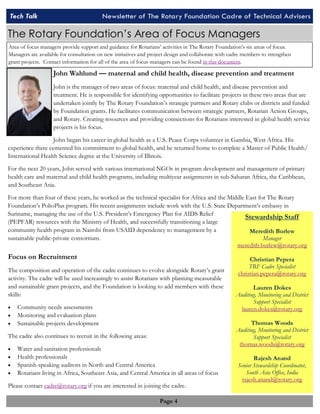
John Wahlund — maternal and child health, disease prevention and treatment 
John is the manager of two areas of focus: maternal and child health, and disease prevention and 
treatment. He is responsible for identifying opportunities to facilitate projects in these two areas that are 
undertaken jointly by The Rotary Foundation’s strategic partners and Rotary clubs or districts and funded 
by Foundation grants. He facilitates communication between strategic partners, Rotarian Action Groups, 
and Rotary. Creating resources and providing connections for Rotarians interested in global health service 
projects is his focus. 
John began his career in global health as a U.S. Peace Corps volunteer in Gambia, West Africa. His 
experience there cemented his commitment to global health, and he returned home to complete a Master of Public Health/ 
International Health Science degree at the University of Illinois. 
For the next 20 years, John served with various international NGOs in program development and management of primary 
health care and maternal and child health programs, including multiyear assignments in sub-Saharan Africa, the Caribbean, 
and Southeast Asia. 
For more than four of these years, he worked as the technical specialist for Africa and the Middle East for The Rotary 
Foundation’s PolioPlus program. His recent assignments include work with the U.S. State Department’s embassy in 
Suriname, managing the use of the U.S. President’s Emergency Plan for AIDS Relief 
(PEPFAR) resources with the Ministry of Health, and successfully transitioning a large 
community health program in Nairobi from USAID dependency to management by a 
sustainable public-private consortium. 
Focus on Recruitment 
The composition and operation of the cadre continues to evolve alongside Rotary’s grant 
activity. The cadre will be used increasingly to assist Rotarians with planning measurable 
and sustainable grant projects, and the Foundation is looking to add members with these 
skills: 
 Community needs assessments 
 Monitoring and evaluation plans 
 Sustainable projects development 
The cadre also continues to recruit in the following areas: 
 Water and sanitation professionals 
 Health professionals 
 Spanish-speaking auditors in North and Central America 
 Rotarians living in Africa, Southeast Asia, and Central America in all areas of focus 
Please contact cadre@rotary.org if you are interested in joining the cadre. 
Page 4 
Stewardship Staff 
Meredith Burlew 
Manager 
meredith.burlew@rotary.org 
Christian Pepera 
TRF Cadre Specialist 
christian.pepera@rotary.org 
Lauren Dokes 
Auditing, Monitoring and District 
Support Specialist 
lauren.dokes@rotary.org 
Thomas Woods 
Auditing, Monitoring and District 
Support Specialist 
thomas.woods@rotary.org 
Rajesh Anand 
Senior Stewardship Coordinator, 
South Asia Office, India 
rajesh.anand@rotary.org

Tech talk October 2014 - Rotary Cadre Foundation Communication

  • 1.
    Tech Talk Newsletterof The Rotary Foundation Cadre of Technical Advisers • October 2014 M e s s a g e f r o m t h e C h a i r Phil Silvers Dear Fellow Cadre Members and Rotary Leaders: In mid-July, I used some airline miles to visit Evanston and prepare myself to work with the cadre during the upcoming three years. I conducted some focus groups with grants staff, area of focus managers, and cadre and Rotary Foundation program evaluation staff. I also met with Foundation Chairman John Kenny and General Secretary John Hewko. The purpose of these discussions was to gain clarity on the mission of the cadre, assess its effectiveness, and explore its potential — now that year one of the new grants model has been completed. Here is what I learned:  The contributions of cadre members are highly valued by the Foundation grants staff and The Rotary Foundation • www.rotary.org the area of focus managers.  Cadre members are engaged many ways in support of global grants: they provide consulting assistance to grant applicants, pre-award reviews, mid-project reviews, and routine, random, and targeted audits.  Much of the Rotary world does not know about the roles of the cadre.  As a result of a preliminary assessment of the year one implementation of the new grants model, greater use of the cadre is clearly warranted and welcomed. Plans for the Future of the Cadre As a result of these discussions, we see an emerging consensus on these future directions for the cadre:  Foundation staff will increase the use of the cadre earlier in the application process — especially to support first-time grant writers and those struggling with needs assessments, sustainability, and monitoring and evaluation.  In the near future, we will need to assess cadre members’ skills and experience with needs assessments, monitoring and evaluation, and sustainability — areas where sponsors need assistance.  To prepare Rotary leadership for the increased use of the cadre, Chairman Kenny, staff, and I prepared some talking points for Trustee presentations at the upcoming Rotary institutes. The points explain the various roles of the cadre in the grants approval process and in stewardship, as well as the need to expand the cadre in certain areas of focus and regions of the world.  Resources are being developed to assist Rotarians who are writing and authorizing grant applications. Particularly aimed at the proposal writer, this resource will offer advice on community needs assessments, monitoring and evaluation, and sustainability.  Cadre staff will develop a report to capture the different ways cadre members are providing assistance to Rotarians planning and implementing grant projects. I look forward to seeing cadre members and those Rotarians interested in learning more about the cadre program and stewardship at the next cadre training at the 2015 RI Convention in São Paulo, Brazil (date of training is TBA). If you have questions or suggestions about the work of the cadre, please contact me at silverlode@cox.net. Thank you for your support for effective Rotary Foundation programming! Phil Silvers, RI Director, 2008-10 Chair, Cadre of Technical Advisers 2014-17 2014-15 Technical Coordinators CADRE CHAIR & VICE CHAIR Philip J. Silvers (USA) Francis F. Tusubira (Uganda) BASIC EDUCATION & LITERACY Maureen V. Duncan (USA) Ian W. Geddes (Scotland) Jones Y. Kyazze (Uganda) CHILD & MATERNAL HEALTH Himansu K. Basu (England) Catherine Noyer-Riveau (France) Deepak M. Purohit (India) DISEASE TREATMENT & PREVENTION Rajaratnam T. Arasu (Malaysia) Estela Emeric (Argentina) Frederick W. Hahn Jr. (USA) ECONOMIC & COMMUNITY DEVELOPMENT Deniel Banks (USA) Chalermchat Chun-In (Thailand) Jean-Claude Piers de Raveschoot (France) PEACE & CONFLICT RESOLUTION David I. Clifton Jr. (USA) Hugh Munro (Scotland) Mark Zober (Israel) WATER & SANITATION Kenneth W. Grabeau (USA) John Kevan (Australia) Vishwas Sahasrabhojanee (India)
  • 2.
    Tech Talk Newsletterof The Rotary Foundation Cadre of Technical Advisers In Our Own Words A C om m u n i ty R ec ov er s —A Si te V i s i t to J o pl i n , Mi s s ou r i , U S A Ronald Gaydos, Rotary Club of Pittsburgh East, USA (District 7300) Page 2 Editor’s note: Some identifying details, such as names of the project location and sponsors, have been omitted, to ensure confidentiality. I had been very interested in international service for Rotary because I feel that people everywhere are my fellow global citizens. As I’ve seen from international study and leading a Group Study Exchange, different appearance, language, or customs aren’t really significant barriers to people making strong connections. You could say that “the cadre called.” So I applied to become a cadre member in order to offer my development experience to projects that fill urgent needs in communities around the world. Rotary Foundation Cadre Specialist Christian Pepera welcomed me into the ranks by email. A couple months later an email came inviting me to go to Joplin, Missouri, in the U.S. to evaluate a major project that the Foundation had supported: a baseball field for children and youth with physical and intellectual challenges. Joplin had been hit by an EF5 tornado – the most intense damage category on the Enhanced Fujita scale – and had lost 162 people, hundreds of homes, five parks, and countless trees in those parks and in the tornado’s path. Not interested in reinventing the wheel, the project team worked with the Miracle League organization, which develops programming and design specifications for baseball fields for special-needs players. As many have experienced, if you meet another Rotarian, you’ve met a new friend. As always, this was the case for the local team I met in Joplin. After getting squared away with my transportation, the project leader led me to my hotel and I got settled in, ready for the first inspection meeting that evening at the Miracle League Field, which was near the area’s premier youth baseball stadium. My experience as a builder and project manager allowed me to take an expert look at the field, its structures, and the site work. I found only a minor problem that no one on the project team anticipated and could easily be corrected. This inspection meeting was followed by an all-star game – all of the Miracle League players who could come that evening for this special event – complete with uniforms, public address announcer, and cheering fans. I was invited to join in as a “buddy,” accompanying one of the players to help him stay engaged in the game and to protect him from any hit balls or other potential dangers. It was great to see the completed project in use and enjoyed by the community. This is what it’s all about! The next day I met with the project team to go over the paperwork: the budget, receipts, approvals, and fundraising records. Communicating with the project team before arriving onsite helps to make sure that the local team knows what the evaluation will involve so they can have records ready and team members available. The guidance of the Foundation cadre specialist was also very helpful, to make the structure of the trip thorough but simple. Even though we were all compadres in Rotary I needed to take an objective role in the evaluation. I dug into the details to be sure Foundation practices and guidelines were followed. After looking through everything, I found the project was in good hands. As one wise member of the project team said: “If you ask anyone if they would like a tornado, of course they would say no, but we made the best of this tragic event to bring the community together like it never was before!” It was certainly true. Signs of honoring each other and those lost were evident all over town. Now I feel a kinship to another community in another part of the world. Many cadre projects will be set in the face of hardship or tragedy. My cadre experience increased my grasp of and respect for what Rotary does around the world. Cadre member Ron Gaydos observed the community’s use of a specialized baseball field in the city of Joplin, Missouri, which was devastated by a tornado in 2011. Remember to visit the cadre’s shared site If you’re a registered cadre member, you can use the site by signing in to My Rotary at www.rotary.org and visiting the Rotary Workgroup section in your profile. The site serves as a document resource, survey tool, and news and information center. Contribute to discussion groups, download training documents, access the Tech Talk archive, view photo galleries, and more.
  • 3.
    Tech Talk Newsletterof The Rotary Foundation TTeecchh TTaallkk NNeewwsslleetttteerr ooff TThhee RRoottaarryy FFoouunnddaattii ooCnna CCdaaredd rroeef ooTeff cTTheenccihhcanniilcc Aaalld AAviddsevvriisssee rrss Page 3 Editor’s note: Some identifying details, such as names of the project location and sponsors, have been omitted, to ensure confidentiality. In my Rotarian life I have always been close to The Rotary Foundation, both as a contributor and as a designer or participant in projects for my club and for my district. Therefore, becoming a cadre member was almost inevitable. My most recent assignment involved the interim monitor site visit of a project in Modena, Italy. This project is providing post-earthquake restorations to a building used by a nonprofit organization that trains children under the age of 18 affected by mental or physical disabilities in the trade of vinegar production. The assignment matched my skills very well as I’m a civil engineer with 30 years of experience restoring buildings. After studying the project documents, I sent emails with questions to both of the primary contacts and prepared for my onsite inspection. It seemed it was a good project — sustainable, well-designed, and with a sure expectation of success. But as always, before giving a final judgment it is necessary to check in person. I had a warm welcome and received friendly assistance from local Rotarians, but what is more important, I found that the restoration works were in progress and on schedule. I also found that since the earthquake, the children have been housed and trained at a temporary structure. This structure contains classrooms and a vinegar factory for the production of the traditional balsamic vinegar of Modena. Here, despite their disabilities, the children learn techniques and are given an opportunity to enter the workforce. In regard to sustainability, I found the plan was made by professionals and involves cooperating organizations (an association and a social cooperative) that have the skills to train the young people and have operated in the field for about 30 years. The final product, the traditional balsamic Modena vinegar, is very appreciated and sells well. The people in this region of Italy feel deeply about integrating young people with disabilities into daily life, a fact that emerged from a community needs assessment. I was very pleased to discover that local and national governments look at this initiative with a keen eye, so much so that Italy’s Minister for Reforms was present during my onsite visit. The community authorities also support the initiative by sponsoring children in need who could not otherwise afford to attend the program. But what has touched my soul is seeing not just that the children have acquired good manual and intellectual skills but that they are helping each other, sharing their skills with one another, compensating for each other’s disability. The program creates a virtuous circle that warms the heart. Good job, Rotarians. Keep on Doing Good in the World. The next cadre training will be held in conjunction with the 2015 Rotary International Convention in São Paulo. Details will be announced later this Rotary year. Recent Cadre Visits Part of the vinegar factory today Cadre member Maria Laiz Zanardo (left) visits with a young boy who benefited from a mobile dental unit provided by a Matching Grant in Bahia, Brazil. Beneficiaries stand in front of a water purification system donated to a school in India during cadre member PDG A.S. Chandrashekar’s visit. In Our Own Words Ear th qu ak e R es tor ati on s i n M oden a, I tal y Vincenzo Sassanelli, Rotary Club of Bari, Italy (District 2120)
  • 4.
    Tech Talk Newsletterof The Rotary Foundation Tech Talk Newsletter of The Rotary Foundati oCna Cdared roef oTef cThencihcanilc Aald Avidsevrisse rs The Rotary Foundation’s Area of Focus Managers Area of focus managers provide support and guidance for Rotarians’ activities in The Rotary Foundation’s six areas of focus. Managers are available for consultation on new initiatives and project design and collaborate with cadre members to strengthen grant projects. Contact information for all of the area of focus managers can be found in this document. John Wahlund — maternal and child health, disease prevention and treatment John is the manager of two areas of focus: maternal and child health, and disease prevention and treatment. He is responsible for identifying opportunities to facilitate projects in these two areas that are undertaken jointly by The Rotary Foundation’s strategic partners and Rotary clubs or districts and funded by Foundation grants. He facilitates communication between strategic partners, Rotarian Action Groups, and Rotary. Creating resources and providing connections for Rotarians interested in global health service projects is his focus. John began his career in global health as a U.S. Peace Corps volunteer in Gambia, West Africa. His experience there cemented his commitment to global health, and he returned home to complete a Master of Public Health/ International Health Science degree at the University of Illinois. For the next 20 years, John served with various international NGOs in program development and management of primary health care and maternal and child health programs, including multiyear assignments in sub-Saharan Africa, the Caribbean, and Southeast Asia. For more than four of these years, he worked as the technical specialist for Africa and the Middle East for The Rotary Foundation’s PolioPlus program. His recent assignments include work with the U.S. State Department’s embassy in Suriname, managing the use of the U.S. President’s Emergency Plan for AIDS Relief (PEPFAR) resources with the Ministry of Health, and successfully transitioning a large community health program in Nairobi from USAID dependency to management by a sustainable public-private consortium. Focus on Recruitment The composition and operation of the cadre continues to evolve alongside Rotary’s grant activity. The cadre will be used increasingly to assist Rotarians with planning measurable and sustainable grant projects, and the Foundation is looking to add members with these skills:  Community needs assessments  Monitoring and evaluation plans  Sustainable projects development The cadre also continues to recruit in the following areas:  Water and sanitation professionals  Health professionals  Spanish-speaking auditors in North and Central America  Rotarians living in Africa, Southeast Asia, and Central America in all areas of focus Please contact cadre@rotary.org if you are interested in joining the cadre. Page 4 Stewardship Staff Meredith Burlew Manager meredith.burlew@rotary.org Christian Pepera TRF Cadre Specialist christian.pepera@rotary.org Lauren Dokes Auditing, Monitoring and District Support Specialist lauren.dokes@rotary.org Thomas Woods Auditing, Monitoring and District Support Specialist thomas.woods@rotary.org Rajesh Anand Senior Stewardship Coordinator, South Asia Office, India rajesh.anand@rotary.org