Driving Hospital Performance to the Next Level
White Paper
HealthcareProviderServices
Driving Hospital Performance to the Next Level
Tajinder Vohra, Senior Vice President, Genpact and Abi Karun, Vice President, Genpact
Introduction
While the first two waves of improvements in the healthcare industry were
led by technology and pharmaceutical development, the third wave has
largely been focused on using technology to manage and use information.
Healthcare providers have embraced these changes, albeit slower than in
most industries, but have yet to realize the full potential of the ‘Process’
dimension.
Hospital processes, both clinical and non clinical, have remained relatively
untouched by the advances in tools and techniques which are used
successfully in other industries to drive efficiency and effectiveness.
However, there is now a gradual movement towards incorporating practices
from other industries. While healthcare has many unique operational
nuances, there are significant functional processes that overlap across
industries e.g. insurance and financial services.
Lean and Six Sigma are methodologies, which until recently, were practiced
primarily in the manufacturing industry but are now being implemented
in the service industry as well. However, application of Lean Six Sigma
tools in service industries like Healthcare is not as straightforward as it is in
manufacturing. Healthcare has different levels of complexities and non-
deterministic flows which makes process optimization tougher. Lean and
other such frameworks when adapted to Healthcare, have the potential to
fully unleash the power of the processes within hospitals.
Genpact, a global leader in managing business processes for companies
around the world, has introduced a new, proprietary methodology called
Smart Enterprise Processes (SEPSM
). This methodology enables continuous
improvements in specific business processes in different industries by
leveraging multiple tools like Lean and an accumulated pool of knowledge
and benchmarks. It makes the improvement process very deterministic
instead of a discovery exercise.
This paper presents Genpact’s findings from applying Lean using SEPSM
to
specific processes in hospitals.
Challenges faced by Hospitals
The healthcare system globally is struggling with some significant
challenges: Infrastructure and capacity constraints, rising costs, service
quality and staff shortages.
Traditionally, most of these challenges have been addressed by solutions
that include heavy capital expenditure, expensive IT implementations,
surplus supplies and just-in-time training for medical staff.
Key Issues facing the global healthcare system include:
• 	Insufficient Capacity: Hospitals are experiencing severe capacity 		
	 constraints which affects service quality and physician and patient		
	 satisfaction. The problems range from a lack of available beds, to 		
	 Emergency Room (ER) overcrowding, to an increasing nursing shortage 	
	 and delays in patient care. These problems constrain a hospitals’ 		
	 ability to develop new patient services and enhance revenue streams.
• 	Sub-optimal Operational Performance: Hospitals are siloed in their 	
	 approach to delivering patient care. This siloed approach leads to multiple	
	 hand offs, inefficient use of infrastructure and drives potential patient 		
	 safety challenges.
Driving Hospital Performance to the Next Level
HealthcareProviderServiceS
• 	In-effective Cost and Material Management: Issues such as 		
	 overstocking and high stock of expiring and unused medicines, multiple 	
	 points of storage and inability to track actual consumption add to a 		
	 hospital’s challenges.
	
• 	Sustaining Performance: The lack of standard measurement systems 	
	 to track performance of hospitals also impacts efficiency levels. Even in 	
	 the best run hospitals, data and metrics are used only to diagnose past 	
	 issues and not to predict and proactively tackle potential issues related to 	
	 patient experience and safety.
Lean in Hospitals using SEPSM
(Smart Enterprise
Processes)
In most hospitals, clinical processes encompass only 10-30% of total
processes. Non-clinical or back office processes make up the balance.
Within this area lies an opportunity to dramatically decrease costs and
increase efficiency through the adoption of alternative business models.
Hospitals are unable to leverage their full potential and true value which can
be unlocked by applying the correct tools and methods to their individual
processes.
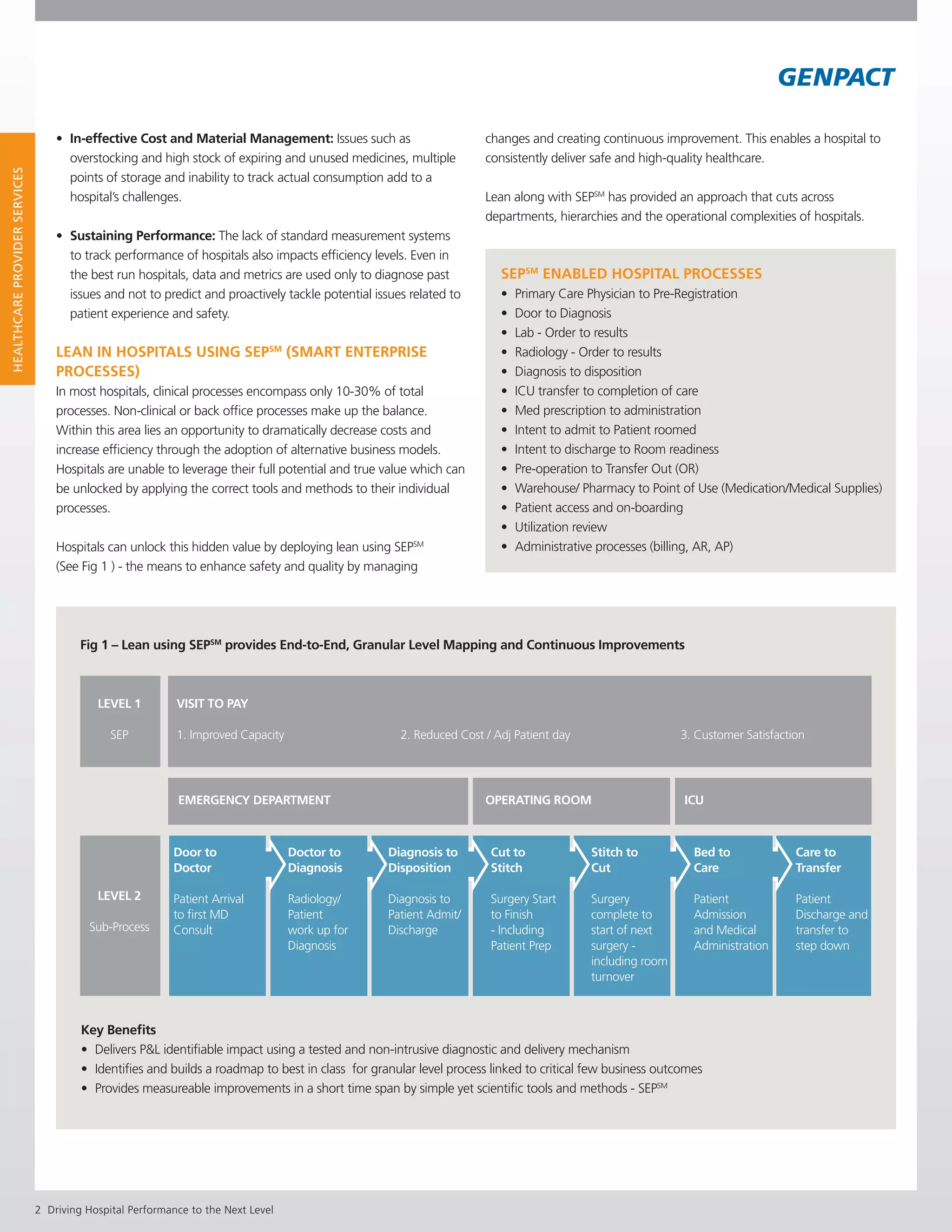
Hospitals can unlock this hidden value by deploying lean using SEPSM
(See Fig 1 ) - the means to enhance safety and quality by managing
SEPSM
enabled Hospital Processes
• 	Primary Care Physician to Pre-Registration
•	 Door to Diagnosis
•	 Lab - Order to results
•	 Radiology - Order to results
•	 Diagnosis to disposition
•	 ICU transfer to completion of care
•	 Med prescription to administration
•	 Intent to admit to Patient roomed
•	 Intent to discharge to Room readiness
•	 Pre-operation to Transfer Out (OR)
•	 Warehouse/ Pharmacy to Point of Use (Medication/Medical Supplies)
•	 Patient access and on-boarding
•	 Utilization review
•	 Administrative processes (billing, AR, AP)
Door to
Doctor
Patient Arrival
to first MD
Consult
Doctor to
Diagnosis
Radiology/
Patient
work up for
Diagnosis
Diagnosis to
Disposition
Diagnosis to
Patient Admit/
Discharge
Cut to
Stitch
Surgery Start
to Finish
- Including
Patient Prep
Stitch to
Cut
Surgery
complete to
start of next
surgery -
including room
turnover
Bed to
Care
Patient
Admission
and Medical
Administration
Care to
Transfer
Patient
Discharge and
transfer to
step down
LEVEL 2
Sub-Process
LEVEL 1
SEP
VISIT TO PAY
1. Improved Capacity 		2. Reduced Cost / Adj Patient day		 3. Customer Satisfaction
EMERGENCY DEPARTMENT OPERATING ROOM ICU
Fig 1 – Lean using SEPSM
provides End-to-End, Granular Level Mapping and Continuous Improvements
Key Benefits
• 	Delivers PL identifiable impact using a tested and non-intrusive diagnostic and delivery mechanism
•	 Identifies and builds a roadmap to best in class for granular level process linked to critical few business outcomes
•	 Provides measureable improvements in a short time span by simple yet scientific tools and methods - SEPSM
changes and creating continuous improvement. This enables a hospital to
consistently deliver safe and high-quality healthcare.
Lean along with SEPSM
has provided an approach that cuts across
departments, hierarchies and the operational complexities of hospitals.
Driving Hospital Performance to the Next Level
HealthcareProviderServiceS
Supply Management
•	 Pharmaceutical and non-pharmaceutical stock levels can be reduced 	
	 within the first 90 days to prevent overstocking without impacting 		
	 care-giving processes. This can be done by deploying Lean tools 		
	 – similar to those used in other industries like manufacturing.
•	 Overall supply costs can be further optimized by 8-12% by moving 	
	 from physician preference items to standardized supplies.
•	 Expiration of medication and obsolescence of supplies contribute 	
	1-3% of total operating costs of wards and can be reduced by 30% 	
	 within 90 days.
Payments/Cash Management
•	 Potential exists to improve First Time Right in Billing by up-to 25-30% 	
	 each by fixing avoidable and manageable root causes.
The Road Ahead
SEPSM
has proved to be an effective tool in improving processes in hospitals’
emergency rooms. V2C SEPSM
is ideal for developing and implementing
a blueprint of key processes. This allows hospitals to focus on clinical
excellence while being able to get maximum efficiency from support
functions. It shifts the focus from managing in silos to managing processes
that can be resilient and delivering sustained results.
Processes Improvements in the Visit to Cash Cycle
Genpact aggressively deploys Six Sigma/Lean tools to cut waste and
standardize processes and procedures. Through its proprietary scientific
methodology approach, Smart Enterprise Processes (SEPSM
), Genpact has
mapped 140 core processes that constitute 80 percent of the repeatable
activities within a hospital. These processes cover the entire cycle of
patients visiting for a treatment and hospitals getting the payment—called
Visit-to-Cash (V2C).
Genpact has worked with multiple hospitals to improve their business
outcomes - time to provide faster care to patients, improve patient flow
and equipment utilization. Genpact has developed best practices and
a deep knowledge base which enables it to drive best-in-class hospital
performance.
Some examples of how process can be improved across the V2C cycle
include:
Patient Experience
•	 Stitch-to-Cut cycle times impacting surgical suite availability can be 		
	 improved by 4-6% in 90 days by improving the patient flow process.
•	 Patient walk times can be reduced by 20% by optimizing process flow 	
	 and ergonomics.
FOR MORE INFORMATION: 			
Tajinder Vohra, Senior Vice President, Healthcare Services
Tajinder.vohra1@genpact.com
Abi Karun, Vice President, Healthcare Services
a.karun@genpact.com
Visit us at www.genpact.com/healthcare
Driving Hospital Performance to the Next Level
HealthcareProviderServiceS
About Genpact
Genpact is a global leader in business process and technology management, offering a
broad portfolio of enterprise GA and industry specific services, coupled with strong IT,
analytics and reengineering capabilities.
For more information, visit: www.genpact.com
Copyright © Genpact 2010. All Rights Reserved.

genpact-white-paper-driving_hospital_performance_to_the_next_level

  • 1.
    Driving Hospital Performanceto the Next Level White Paper HealthcareProviderServices Driving Hospital Performance to the Next Level Tajinder Vohra, Senior Vice President, Genpact and Abi Karun, Vice President, Genpact Introduction While the first two waves of improvements in the healthcare industry were led by technology and pharmaceutical development, the third wave has largely been focused on using technology to manage and use information. Healthcare providers have embraced these changes, albeit slower than in most industries, but have yet to realize the full potential of the ‘Process’ dimension. Hospital processes, both clinical and non clinical, have remained relatively untouched by the advances in tools and techniques which are used successfully in other industries to drive efficiency and effectiveness. However, there is now a gradual movement towards incorporating practices from other industries. While healthcare has many unique operational nuances, there are significant functional processes that overlap across industries e.g. insurance and financial services. Lean and Six Sigma are methodologies, which until recently, were practiced primarily in the manufacturing industry but are now being implemented in the service industry as well. However, application of Lean Six Sigma tools in service industries like Healthcare is not as straightforward as it is in manufacturing. Healthcare has different levels of complexities and non- deterministic flows which makes process optimization tougher. Lean and other such frameworks when adapted to Healthcare, have the potential to fully unleash the power of the processes within hospitals. Genpact, a global leader in managing business processes for companies around the world, has introduced a new, proprietary methodology called Smart Enterprise Processes (SEPSM ). This methodology enables continuous improvements in specific business processes in different industries by leveraging multiple tools like Lean and an accumulated pool of knowledge and benchmarks. It makes the improvement process very deterministic instead of a discovery exercise. This paper presents Genpact’s findings from applying Lean using SEPSM to specific processes in hospitals. Challenges faced by Hospitals The healthcare system globally is struggling with some significant challenges: Infrastructure and capacity constraints, rising costs, service quality and staff shortages. Traditionally, most of these challenges have been addressed by solutions that include heavy capital expenditure, expensive IT implementations, surplus supplies and just-in-time training for medical staff. Key Issues facing the global healthcare system include: • Insufficient Capacity: Hospitals are experiencing severe capacity constraints which affects service quality and physician and patient satisfaction. The problems range from a lack of available beds, to Emergency Room (ER) overcrowding, to an increasing nursing shortage and delays in patient care. These problems constrain a hospitals’ ability to develop new patient services and enhance revenue streams. • Sub-optimal Operational Performance: Hospitals are siloed in their approach to delivering patient care. This siloed approach leads to multiple hand offs, inefficient use of infrastructure and drives potential patient safety challenges.
  • 2.
    Driving Hospital Performanceto the Next Level HealthcareProviderServiceS • In-effective Cost and Material Management: Issues such as overstocking and high stock of expiring and unused medicines, multiple points of storage and inability to track actual consumption add to a hospital’s challenges. • Sustaining Performance: The lack of standard measurement systems to track performance of hospitals also impacts efficiency levels. Even in the best run hospitals, data and metrics are used only to diagnose past issues and not to predict and proactively tackle potential issues related to patient experience and safety. Lean in Hospitals using SEPSM (Smart Enterprise Processes) In most hospitals, clinical processes encompass only 10-30% of total processes. Non-clinical or back office processes make up the balance. Within this area lies an opportunity to dramatically decrease costs and increase efficiency through the adoption of alternative business models. Hospitals are unable to leverage their full potential and true value which can be unlocked by applying the correct tools and methods to their individual processes. Hospitals can unlock this hidden value by deploying lean using SEPSM (See Fig 1 ) - the means to enhance safety and quality by managing SEPSM enabled Hospital Processes • Primary Care Physician to Pre-Registration • Door to Diagnosis • Lab - Order to results • Radiology - Order to results • Diagnosis to disposition • ICU transfer to completion of care • Med prescription to administration • Intent to admit to Patient roomed • Intent to discharge to Room readiness • Pre-operation to Transfer Out (OR) • Warehouse/ Pharmacy to Point of Use (Medication/Medical Supplies) • Patient access and on-boarding • Utilization review • Administrative processes (billing, AR, AP) Door to Doctor Patient Arrival to first MD Consult Doctor to Diagnosis Radiology/ Patient work up for Diagnosis Diagnosis to Disposition Diagnosis to Patient Admit/ Discharge Cut to Stitch Surgery Start to Finish - Including Patient Prep Stitch to Cut Surgery complete to start of next surgery - including room turnover Bed to Care Patient Admission and Medical Administration Care to Transfer Patient Discharge and transfer to step down LEVEL 2 Sub-Process LEVEL 1 SEP VISIT TO PAY 1. Improved Capacity 2. Reduced Cost / Adj Patient day 3. Customer Satisfaction EMERGENCY DEPARTMENT OPERATING ROOM ICU Fig 1 – Lean using SEPSM provides End-to-End, Granular Level Mapping and Continuous Improvements Key Benefits • Delivers PL identifiable impact using a tested and non-intrusive diagnostic and delivery mechanism • Identifies and builds a roadmap to best in class for granular level process linked to critical few business outcomes • Provides measureable improvements in a short time span by simple yet scientific tools and methods - SEPSM changes and creating continuous improvement. This enables a hospital to consistently deliver safe and high-quality healthcare. Lean along with SEPSM has provided an approach that cuts across departments, hierarchies and the operational complexities of hospitals.
  • 3.
    Driving Hospital Performanceto the Next Level HealthcareProviderServiceS Supply Management • Pharmaceutical and non-pharmaceutical stock levels can be reduced within the first 90 days to prevent overstocking without impacting care-giving processes. This can be done by deploying Lean tools – similar to those used in other industries like manufacturing. • Overall supply costs can be further optimized by 8-12% by moving from physician preference items to standardized supplies. • Expiration of medication and obsolescence of supplies contribute 1-3% of total operating costs of wards and can be reduced by 30% within 90 days. Payments/Cash Management • Potential exists to improve First Time Right in Billing by up-to 25-30% each by fixing avoidable and manageable root causes. The Road Ahead SEPSM has proved to be an effective tool in improving processes in hospitals’ emergency rooms. V2C SEPSM is ideal for developing and implementing a blueprint of key processes. This allows hospitals to focus on clinical excellence while being able to get maximum efficiency from support functions. It shifts the focus from managing in silos to managing processes that can be resilient and delivering sustained results. Processes Improvements in the Visit to Cash Cycle Genpact aggressively deploys Six Sigma/Lean tools to cut waste and standardize processes and procedures. Through its proprietary scientific methodology approach, Smart Enterprise Processes (SEPSM ), Genpact has mapped 140 core processes that constitute 80 percent of the repeatable activities within a hospital. These processes cover the entire cycle of patients visiting for a treatment and hospitals getting the payment—called Visit-to-Cash (V2C). Genpact has worked with multiple hospitals to improve their business outcomes - time to provide faster care to patients, improve patient flow and equipment utilization. Genpact has developed best practices and a deep knowledge base which enables it to drive best-in-class hospital performance. Some examples of how process can be improved across the V2C cycle include: Patient Experience • Stitch-to-Cut cycle times impacting surgical suite availability can be improved by 4-6% in 90 days by improving the patient flow process. • Patient walk times can be reduced by 20% by optimizing process flow and ergonomics. FOR MORE INFORMATION: Tajinder Vohra, Senior Vice President, Healthcare Services Tajinder.vohra1@genpact.com Abi Karun, Vice President, Healthcare Services a.karun@genpact.com Visit us at www.genpact.com/healthcare
  • 4.
    Driving Hospital Performanceto the Next Level HealthcareProviderServiceS About Genpact Genpact is a global leader in business process and technology management, offering a broad portfolio of enterprise GA and industry specific services, coupled with strong IT, analytics and reengineering capabilities. For more information, visit: www.genpact.com Copyright © Genpact 2010. All Rights Reserved.