© 2017 Lehigh Valley Health Network
Setting an Organizational Agenda
Our Journey to Solve Patient Access
Through Applied Science
PATIENT ACCESS EXECUTIVE SUMMIT
James Demopoulos MHA, MPH
Sr. Vice President of Operations
Lehigh Valley Physician Group
▪ Lehigh Valley Physician Group
▪ 1,450 employed providers
▪ 200 practices
▪ 2.5 million annual visits
▪ 3,500 colleagues
▪ Lehigh Valley Health Network
▪ Top 30 U.S. NWR, Top 50
Healthgrades, MSK Partner
▪ 8 Campuses, 18,000 employees
2
3
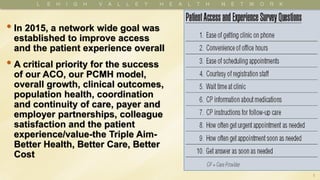
• In 2015, a network wide goal was
established to improve access
and the patient experience overall
• A critical priority for the success
of our ACO, our PCMH model,
overall growth, clinical outcomes,
population health, coordination
and continuity of care, payer and
employer partnerships, colleague
satisfaction and the patient
experience/value-the Triple Aim-
Better Health, Better Care, Better
Cost
4
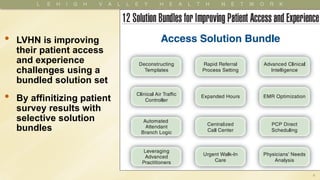
• LVHN is improving
their patient access
and experience
challenges using a
bundled solution set
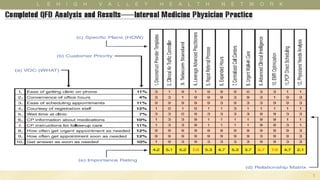
• By affinitizing patient
survey results with
selective solution
bundles
5
3.TelecomStandard
Templates, Telecomm, Clinical ATC, MyLVHN
engagement, practice profiles, enterprise scheduling,
advanced practitioner utilization, Exceptional Experience
staff training:
Implement countermeasures & leverage collaborative
leadership of practice triads across all practices
MPC
FY16
LVPP
LVPP - SP Children's
Neurology
Endo
Oncology
Women’s
Med
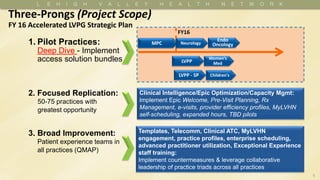
2. Focused Replication:
50-75 practices with
greatest opportunity
3. Broad Improvement:
Patient experience teams in
all practices (QMAP)
1. Pilot Practices:
Deep Dive - Implement
access solution bundles
Clinical Intelligence/Epic Optimization/Capacity Mgmt:
Implement Epic Welcome, Pre-Visit Planning, Rx
Management, e-visits, provider efficiency profiles, MyLVHN
self-scheduling, expanded hours, TBD pilots
Three-Prongs (Project Scope)
FY 16 Accelerated LVPG Strategic Plan
6
7
.
Telecom Standardization
Bundled Solution Number 3
8
Project Name: Access Always - MPC
Process Owner: Joane Young Prepared by: Naser Chowdhury Contact: naser_m.Chowdhury@lvhn.org
Team Members:
Creation Date: 5/1/15 Revision Date: 5 Sept 2016Jean Daversa, Joan Young, Naser Chowdhury, Molly
Thompson, Dr. Michael Ehrig, Denise Hylton
Process
Step/Input
Potential
Failure
Mode
Potential
Effect(s) of
Failure
S
E
V
Potential Cause(s) /
Mechanism(s) of
Failure Input
Variables (X's)
O
C
C
Current
Process
Controls to
Prevent
Failure
Mode
Current
Process
Controls to
Detect
Failure
Mode
D
E
T
R
P
N
Recommended Actions
Person
Responsible
for Actions
Target
Complet
ion Date
Actions Taken
S
E
V
O
C
C
D
E
T
R
P
N
Scheduling Phones
a,. Patient
Satisfaction
b. Process
Efficiency
c. Volume &
Revenue
10
Ratio of personnel on
phone to volume of
calls
10 None None 8 800
1.Clinical air traffic controller
2.Auto attendant br. logic
3. E-Scheduling
4. Time study - Balance call
volume/cycle time/takt
time/FTE
Jean Daversa
& Joan Young
05/29/15
1. Phone tree standard
established
2. Observation data being
collected
10 6 3 180
Scheduling Phones
a,. Patient
Satisfaction
b. Process
Efficiency
c. Volume &
Revenue
10
Patients call about
medication refill
errors
8 None None 8 640
1. Advanced clinical
intelligence
2. EMR optimization
Jean
Daversa/
Joan Young
06/15/15
1.Current and future states:
mapping and standard work
created
2. RX refill policy to be attached
3. Approval needed by Dr Ehrig
10 5 3 150
Rooming
Arrived
Status
a,. Patient
Satisfaction
b. Process
Efficiency
c. Volume &
Revenue
10
Provider recognizes
patient has arrived to
practice but still
registering at front.
8 None None 6 480
1.Deconstruct provider
template
2.Advanced clinical
intelligence
3. EMR Optimization
4.Patient arrival time &
scripting work
Jean
Daversa/
Joan Young
06/15/15
1. Pilot underway with Dr. ;
initial results positive;
2.Standard work drafted and
will be communicated to
providers May 27
10 6 3 180
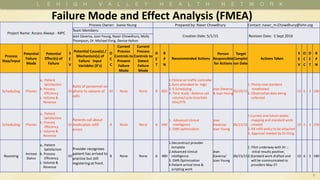
Failure Mode and Effect Analysis (FMEA)
9
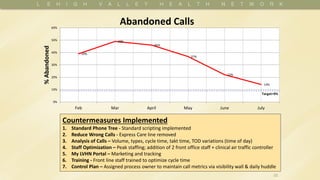
Countermeasures Implemented
1. Standard Phone Tree - Standard scripting implemented
2. Reduce Wrong Calls - Express Care line removed
3. Analysis of Calls – Volume, types, cycle time, takt time, TOD variations (time of day)
4. Staff Optimization – Peak staffing; addition of 2 front office staff + clinical air traffic controller
5. My LVHN Portal – Marketing and tracking
6. Training - Front line staff trained to optimize cycle time
7. Control Plan – Assigned process owner to maintain call metrics via visibility wall & daily huddle
10
39%
49%
46%
37%
22%
14%
0%
10%
20%
30%
40%
50%
60%
Feb Mar April May June July
%Abandoned
Abandoned Calls
Target=9%
.
Deconstructing Provider Template
Bundled Solution Number 1
11
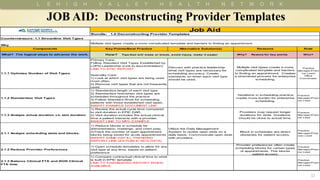
JOB AID: Deconstructing Provider Templates
Why? Resons for key points Who?
Primary Care:
Follow Standard Visit Types Established by
LVPG Leadership (Link to documentation)
LINK TO EPIC REPORT
Specialty Care:
1) Look at which visit types are being used
most often.
2) Remove visit types that are not frequently
used.
Discuss with practice leadership
what visit types are necessary for
scheduling accuracy. Create
standards on when each visit type
should be used.
Practice
Manager/Pract
ice Lead/
Office
Coordinator
1) Standardize length of each visit type
2) Standardize how/when visit types are
scheduled throughout the practice
3) Follow Standard Work for scheduling
patients with those established visit types.
INSERT EXAMPLE DOCUMENT LINK
Practice
Manager/Pract
ice Lead
1) Review the actual cycle time compared
to visit duration in EPIC DAR.
2) Visit duration includes the actual clinical
time a patient interacts with a provider.
INSERT LINK TO MPC EXAMPLE
Practice
Manager/Pract
ice Lead
1) Reduce blocks in schedule for
administration, meetings, and chart prep.
2)Track the number of open appointment
blocks being saved for acute appointmemts
INSERT SAME DAY ILL TRENDING
REPORT LINK (EA PUBLIC NCG DATA)
Utilize the Daily Management
System to review open slots on a
daily basis. Communicate open slots
with providers.
Practice
Manager/Phys
ican Lead
1) Open schedule templates to allow for any
visit type at any time, based on patient
preference
Practice
Manager/Pract
ice Lead
1) Compare contractual clinical time to what
is built in EPIC template
LINK TO DASHBAORD REPORT WHEN
AVAILABLE
Practice
Manager/Pract
ice Lead
Job Aid
Bundle: 1.0 Deconstructing Provider Templates
Countermeasure: 1.1 Streamline Visit Types
What? The logical steps to advance the work.
1.1.1 Optimize Number of Visit Types
1.1.2 Standardize Visit Types
Why
2.1.3 Balance Clinical FTE and NON Clinical
FTE time
Role
2.1.1 Analyze scheduling slots and blocks.
2.1.2 Reduce Provider Preferences
Variations in scheduling practice
create more burden for enterprise
scheduling.
Providers may request longer
durations for visits. Durations
should be close to actual time.
Multiple visit types create a more complicated template and barriers to finding an appointment.
ReasonsKey Points/Best Practice
Multiple visit types create a more
complicated template and barriers
to finding an appointment. Creates
a stremlined process for enterprise
scheduling.
Components
Provider preferences often create
scheduling blocks for certain types
of appointments. This blocks
patient access.
Block in schedules are direct
obstacles for patient access.
1.1.3 Analyze actual duration vs. slot duration
Alternative Solution(s)
How? Tips that will make or break, avoid injury, make it easier
12
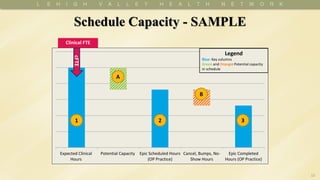
Schedule Capacity - SAMPLE
Expected Clinical
Hours
Potential Capacity Epic Scheduled Hours
(OP Practice)
Cancel, Bumps, No-
Show Hours
Epic Completed
Hours (OP Practice)
Legend
Blue: Key columns
Green and Orange: Potential capacity
in schedule
13
1 2 3
A
B
Clinical FTE
cFTE
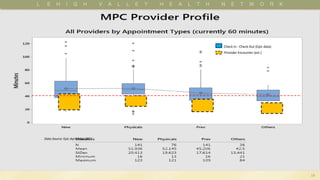
14
Data Source: Epic April/May 2015
Check In - Check Out (Epic data)
Provider Encounter (est.)
.
Advanced Clinical Intelligence
Bundled Solution Number 9
15
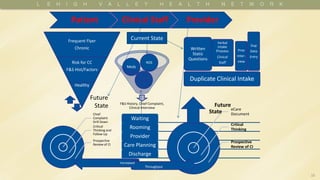
16
F&S History, Chief Complaint,
Clinical Interview
Allergies
Meds
ROS
Duplicate Clinical Intake
Written
Static
Questions
Verbal
Intake
Process
Clinical
Staff
Prov
Inter-
view
Dup
Data
Entry
MA’s LPN’s Physicians
Frequent Flyer
Chronic
Risk for CC
F&S Hist/Factors
Healthy
Patient Clinical Staff Provider
Waiting
Rooming
Provider
Care Planning
Discharge
Chief
Complaint
Drill Down
Critical
Thinking and
Follow Up
Prospective
Review of CI
Current State
Future
State eCare
Document
Critical
Thinking
Prospective
Review of CI
Future
State
Increased
Throughput
JOB AID: Advanced Clinical Intelligence
Why? Reasons for key points Who?
Every colleague has the ability to promote and
encourage patients to sign up for MyLVHN, our
patient portal. From patient scheduling, front-
desk registration, rooming, provider encounter
and check-out colleagues should discuss the
benefits such as prescription refill requests,
scheduling well check-ups, paying copays, etc.
A good opening to start the conversation with
patients is simply asking "Do you have a
smartphone or computer at home?" to identify if a
patient would have access to this tool.
All reference materials including FAQs, talking
points, best practice recommendations and
tipsheets are available via the Epic
Transformation Share Point Site
Understanding not every patient may be
comfortable with using technology, a
good opening question to start the
conversation can be "Do you have a
smartphone or computer at home?" This
sets up if MyLVHN is an option.
However, patients can also have a
"proxy" assigned in a caregiver/guardian
would like to help manage care for their
loved one via MyLVHN. If a patient still
refuses, respect their decision.
SharePoint site
● Utilize standard workflow for PEQs (PDF & Tip
sheets – Epic Transformation SharePoint)
For some practices, especially high
volume, there were some concerns for
the impact of PEQs on workflow. As
one pilot practice suggested, they
started with just piloting the tablet
usage in one of their many pods at
check-in initially to monitor the impact,
get patient/staff satisfaction and then
slowly rolled out to all areas of check-in.
Clinical
Support
Staff/Provid
ers/Patient
Service
Reps.
Allows patients to complete registration items in
advance of appointment.
What can they do:
– Verify and update demographics
– Verify and update meds and allergies
– Answer patient questionnaires
– Pay copayments
● Utilize standard workflow for PEQs (PDF & Tip
sheets – Epic Transformation SharePoint)
Again, not all patients may not welcome
signing up for MyLVHN. In the case
where a patient does not have MyLVHN,
in the future, a patient may use the
tablets currently used for PEQs to
complete aspect of registration/check-
in. Currently, if a patient does not have
MyLVHN, please follow your normal
instructions for patients to check-in.
Patient
Services
Representa
tives and
clinical
support
staff
Pilot Practices Only
• E-visits can replace in-person visits for
routine issues like pink eye or sinus
infections, freeing up your providers for
more complex appointments.
Role
Why
• Complete most of check-in process
from the convenience of home via
MyLVHN
• Save patients time when they arrive at
practice
• Extension to our expanded online
scheduling and questionnaire
capabilities
• Registration process benefits for
patient services representatives
• Better patient experience at the office
front desk
-Minimizes arrival “paperwork”
-Minimizes concerns about privacy
1.1.4 Utilize E-Visits (Pilot Practices only)
• Patient entered questionnaires allow
patients to answer questions prior to
their visit. This saves valuable charting
time for the clinical staff and provider,
who now only needs to verify the
answers, rather than enter the answers
at time of visit.
• Pilot practices have benefits from
decreasing average encounter times
from 3-12 minutes.
How? Tips that will make or break, avoid injury, make it easier
ReasonsKey Points/Best PracticeComponents
● Increase patient satisfaction:
allows providers to more frequently
interact with patients who are able to
communicate directly to their providers.
● Improve practice efficiencies:
since patients can view results online,
schedule appointments, message
providers, etc. it decreases the amounts
of calls to the practice and relieves time
for staff and providers to focus on direct
patient care appointment.
● Patient engagement: patients are
involved in their care outside the walls of
LVHN, messaging their care teams,
viewing their health histories and
results, and taking a proactive stance to
manage their health.
Alternative Solution(s)
1.1.3 Utilize eCheck-In
Job Aide
Bundle: 9.0 Advanced Clinical Intelligence
Countermeasure: 1.1
What? The logical steps to advance the work.
1.1.2 Utilize Patient Entered Questionnaires
(PEQs)
1.1.1 Promote use of MyLVHN
All
Colleagues
17
.
EMR Optimization
Bundled Solution Number 10
18
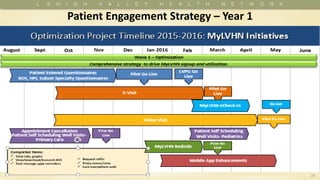
Patient Engagement Strategy – Year 1
19
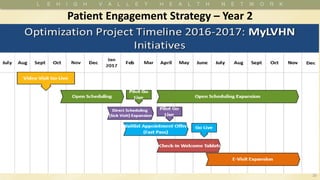
Patient Engagement Strategy – Year 2
20
LVPG Operations Dashboard
• By Department Specialty
21
22
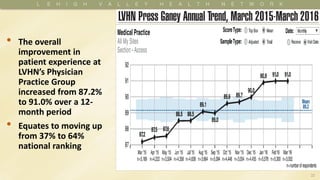
• The overall
improvement in
patient experience at
LVHN’s Physician
Practice Group
increased from 87.2%
to 91.0% over a 12-
month period
• Equates to moving up
from 37% to 64%
national ranking
23
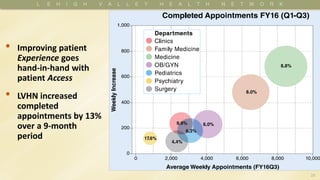
• Improving patient
Experience goes
hand-in-hand with
patient Access
• LVHN increased
completed
appointments by 13%
over a 9-month
period
24
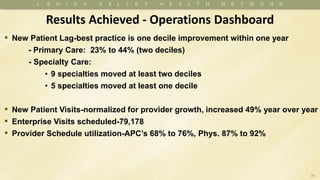
Results Achieved - Operations Dashboard
▪ New Patient Lag-best practice is one decile improvement within one year
- Primary Care: 23% to 44% (two deciles)
- Specialty Care:
• 9 specialties moved at least two deciles
• 5 specialties moved at least one decile
▪ New Patient Visits-normalized for provider growth, increased 49% year over year
▪ Enterprise Visits scheduled-79,178
▪ Provider Schedule utilization-APC’s 68% to 76%, Phys. 87% to 92%
25
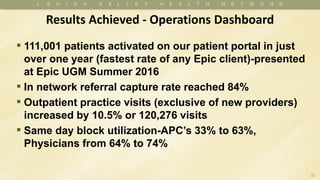
▪ 111,001 patients activated on our patient portal in just
over one year (fastest rate of any Epic client)-presented
at Epic UGM Summer 2016
▪ In network referral capture rate reached 84%
▪ Outpatient practice visits (exclusive of new providers)
increased by 10.5% or 120,276 visits
▪ Same day block utilization-APC’s 33% to 63%,
Physicians from 64% to 74%
Results Achieved - Operations Dashboard
26
Beg
QMAP Template/
Solution Bundles
Develop Action Plan/
Countermeasures
Define and Report
Improvement Metrics
Implement Changes
Report Progress/Did
the Metric Change?
1
4
3
2
1
5
Yes
No
1. Survey Results
2. VOC/QFD Analysis
3. ID Solution Bundles
4. ID Countermeasures Aligned
with Solution Bundles
5. Define Process Metrics for Each
Countermeasures
6. Develop Job-Aids for implementing
Countermeasures
Begin Next Cycle
Ops & Physician Practices Development Team
Action Plan LVPG Neurosurgery – CC/MH (Care Team - Schedule & Structure)
Item # Date Issue Action Who When Update
1 11.22.16
Inability to respond to patient concerns in a
timely manner
Increase training of MA team to better handle questions
which are typically forwarded to RN or provider.
Clinical Manager, RN 12/5/16
MAs are handling more calls and working to respond more quickly to clinical concerns.
Additionally, MAs are better utilizing APCs and RN to retrieve information rather than
waiting for answers.
Increase clinical support staff by adding an RN to assist in
call triage and clinical responses
Practice Leadership FY18 Approved for FY18. Recruiting will begin when budget is final. Target of start of FY18
2 11.22.16
Inconsistent rooming process causing less
efficient rooming and unnecessary delays.
Work with HR to fill all vacant MA positions. Increase speed
of interview and screening process to improve selection
process.
HR, Practice Leadership
Prior to formal
action plan All MA Positions currently filled. 2 newest MA’s in training process.
Return to more standardized clinical teams to ensure
improved efficiency
Clinical Manager, Practice Director
Upon full
compliment
of MA
support
With all MA positions filled we now focus on aligning MA, APC and surgeon to return to a
more care team focused approach. No longer a need to pull from one team to cover
another as all teams are currently fully staffed.
Effective Countermeasures:
 Successfully recruited for all budgeted MA positions.
 Approved for increase in clinical support to provide more timely
response times
 Improved stability of MA assignments in alignment with provider
schedules
Barriers:
 Limited pool of strong MA candidates
 Difficulty creating consistent workflow without full compliment of
clinical support staff.
 Increasing volume and demand with increase of surgeons

2. Setting an Organizational Agenda

  • 1.
    © 2017 LehighValley Health Network Setting an Organizational Agenda Our Journey to Solve Patient Access Through Applied Science PATIENT ACCESS EXECUTIVE SUMMIT James Demopoulos MHA, MPH Sr. Vice President of Operations Lehigh Valley Physician Group
  • 2.
    ▪ Lehigh ValleyPhysician Group ▪ 1,450 employed providers ▪ 200 practices ▪ 2.5 million annual visits ▪ 3,500 colleagues ▪ Lehigh Valley Health Network ▪ Top 30 U.S. NWR, Top 50 Healthgrades, MSK Partner ▪ 8 Campuses, 18,000 employees 2
  • 3.
    3 • In 2015,a network wide goal was established to improve access and the patient experience overall • A critical priority for the success of our ACO, our PCMH model, overall growth, clinical outcomes, population health, coordination and continuity of care, payer and employer partnerships, colleague satisfaction and the patient experience/value-the Triple Aim- Better Health, Better Care, Better Cost
  • 4.
    4 • LVHN isimproving their patient access and experience challenges using a bundled solution set • By affinitizing patient survey results with selective solution bundles
  • 5.
  • 6.
    Templates, Telecomm, ClinicalATC, MyLVHN engagement, practice profiles, enterprise scheduling, advanced practitioner utilization, Exceptional Experience staff training: Implement countermeasures & leverage collaborative leadership of practice triads across all practices MPC FY16 LVPP LVPP - SP Children's Neurology Endo Oncology Women’s Med 2. Focused Replication: 50-75 practices with greatest opportunity 3. Broad Improvement: Patient experience teams in all practices (QMAP) 1. Pilot Practices: Deep Dive - Implement access solution bundles Clinical Intelligence/Epic Optimization/Capacity Mgmt: Implement Epic Welcome, Pre-Visit Planning, Rx Management, e-visits, provider efficiency profiles, MyLVHN self-scheduling, expanded hours, TBD pilots Three-Prongs (Project Scope) FY 16 Accelerated LVPG Strategic Plan 6
  • 7.
  • 8.
  • 9.
    Project Name: AccessAlways - MPC Process Owner: Joane Young Prepared by: Naser Chowdhury Contact: naser_m.Chowdhury@lvhn.org Team Members: Creation Date: 5/1/15 Revision Date: 5 Sept 2016Jean Daversa, Joan Young, Naser Chowdhury, Molly Thompson, Dr. Michael Ehrig, Denise Hylton Process Step/Input Potential Failure Mode Potential Effect(s) of Failure S E V Potential Cause(s) / Mechanism(s) of Failure Input Variables (X's) O C C Current Process Controls to Prevent Failure Mode Current Process Controls to Detect Failure Mode D E T R P N Recommended Actions Person Responsible for Actions Target Complet ion Date Actions Taken S E V O C C D E T R P N Scheduling Phones a,. Patient Satisfaction b. Process Efficiency c. Volume & Revenue 10 Ratio of personnel on phone to volume of calls 10 None None 8 800 1.Clinical air traffic controller 2.Auto attendant br. logic 3. E-Scheduling 4. Time study - Balance call volume/cycle time/takt time/FTE Jean Daversa & Joan Young 05/29/15 1. Phone tree standard established 2. Observation data being collected 10 6 3 180 Scheduling Phones a,. Patient Satisfaction b. Process Efficiency c. Volume & Revenue 10 Patients call about medication refill errors 8 None None 8 640 1. Advanced clinical intelligence 2. EMR optimization Jean Daversa/ Joan Young 06/15/15 1.Current and future states: mapping and standard work created 2. RX refill policy to be attached 3. Approval needed by Dr Ehrig 10 5 3 150 Rooming Arrived Status a,. Patient Satisfaction b. Process Efficiency c. Volume & Revenue 10 Provider recognizes patient has arrived to practice but still registering at front. 8 None None 6 480 1.Deconstruct provider template 2.Advanced clinical intelligence 3. EMR Optimization 4.Patient arrival time & scripting work Jean Daversa/ Joan Young 06/15/15 1. Pilot underway with Dr. ; initial results positive; 2.Standard work drafted and will be communicated to providers May 27 10 6 3 180 Failure Mode and Effect Analysis (FMEA) 9
  • 10.
    Countermeasures Implemented 1. StandardPhone Tree - Standard scripting implemented 2. Reduce Wrong Calls - Express Care line removed 3. Analysis of Calls – Volume, types, cycle time, takt time, TOD variations (time of day) 4. Staff Optimization – Peak staffing; addition of 2 front office staff + clinical air traffic controller 5. My LVHN Portal – Marketing and tracking 6. Training - Front line staff trained to optimize cycle time 7. Control Plan – Assigned process owner to maintain call metrics via visibility wall & daily huddle 10 39% 49% 46% 37% 22% 14% 0% 10% 20% 30% 40% 50% 60% Feb Mar April May June July %Abandoned Abandoned Calls Target=9%
  • 11.
  • 12.
    JOB AID: DeconstructingProvider Templates Why? Resons for key points Who? Primary Care: Follow Standard Visit Types Established by LVPG Leadership (Link to documentation) LINK TO EPIC REPORT Specialty Care: 1) Look at which visit types are being used most often. 2) Remove visit types that are not frequently used. Discuss with practice leadership what visit types are necessary for scheduling accuracy. Create standards on when each visit type should be used. Practice Manager/Pract ice Lead/ Office Coordinator 1) Standardize length of each visit type 2) Standardize how/when visit types are scheduled throughout the practice 3) Follow Standard Work for scheduling patients with those established visit types. INSERT EXAMPLE DOCUMENT LINK Practice Manager/Pract ice Lead 1) Review the actual cycle time compared to visit duration in EPIC DAR. 2) Visit duration includes the actual clinical time a patient interacts with a provider. INSERT LINK TO MPC EXAMPLE Practice Manager/Pract ice Lead 1) Reduce blocks in schedule for administration, meetings, and chart prep. 2)Track the number of open appointment blocks being saved for acute appointmemts INSERT SAME DAY ILL TRENDING REPORT LINK (EA PUBLIC NCG DATA) Utilize the Daily Management System to review open slots on a daily basis. Communicate open slots with providers. Practice Manager/Phys ican Lead 1) Open schedule templates to allow for any visit type at any time, based on patient preference Practice Manager/Pract ice Lead 1) Compare contractual clinical time to what is built in EPIC template LINK TO DASHBAORD REPORT WHEN AVAILABLE Practice Manager/Pract ice Lead Job Aid Bundle: 1.0 Deconstructing Provider Templates Countermeasure: 1.1 Streamline Visit Types What? The logical steps to advance the work. 1.1.1 Optimize Number of Visit Types 1.1.2 Standardize Visit Types Why 2.1.3 Balance Clinical FTE and NON Clinical FTE time Role 2.1.1 Analyze scheduling slots and blocks. 2.1.2 Reduce Provider Preferences Variations in scheduling practice create more burden for enterprise scheduling. Providers may request longer durations for visits. Durations should be close to actual time. Multiple visit types create a more complicated template and barriers to finding an appointment. ReasonsKey Points/Best Practice Multiple visit types create a more complicated template and barriers to finding an appointment. Creates a stremlined process for enterprise scheduling. Components Provider preferences often create scheduling blocks for certain types of appointments. This blocks patient access. Block in schedules are direct obstacles for patient access. 1.1.3 Analyze actual duration vs. slot duration Alternative Solution(s) How? Tips that will make or break, avoid injury, make it easier 12
  • 13.
    Schedule Capacity -SAMPLE Expected Clinical Hours Potential Capacity Epic Scheduled Hours (OP Practice) Cancel, Bumps, No- Show Hours Epic Completed Hours (OP Practice) Legend Blue: Key columns Green and Orange: Potential capacity in schedule 13 1 2 3 A B Clinical FTE cFTE
  • 14.
    14 Data Source: EpicApril/May 2015 Check In - Check Out (Epic data) Provider Encounter (est.)
  • 15.
  • 16.
    16 F&S History, ChiefComplaint, Clinical Interview Allergies Meds ROS Duplicate Clinical Intake Written Static Questions Verbal Intake Process Clinical Staff Prov Inter- view Dup Data Entry MA’s LPN’s Physicians Frequent Flyer Chronic Risk for CC F&S Hist/Factors Healthy Patient Clinical Staff Provider Waiting Rooming Provider Care Planning Discharge Chief Complaint Drill Down Critical Thinking and Follow Up Prospective Review of CI Current State Future State eCare Document Critical Thinking Prospective Review of CI Future State Increased Throughput
  • 17.
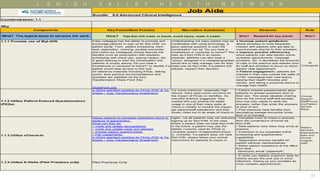
    JOB AID: AdvancedClinical Intelligence Why? Reasons for key points Who? Every colleague has the ability to promote and encourage patients to sign up for MyLVHN, our patient portal. From patient scheduling, front- desk registration, rooming, provider encounter and check-out colleagues should discuss the benefits such as prescription refill requests, scheduling well check-ups, paying copays, etc. A good opening to start the conversation with patients is simply asking "Do you have a smartphone or computer at home?" to identify if a patient would have access to this tool. All reference materials including FAQs, talking points, best practice recommendations and tipsheets are available via the Epic Transformation Share Point Site Understanding not every patient may be comfortable with using technology, a good opening question to start the conversation can be "Do you have a smartphone or computer at home?" This sets up if MyLVHN is an option. However, patients can also have a "proxy" assigned in a caregiver/guardian would like to help manage care for their loved one via MyLVHN. If a patient still refuses, respect their decision. SharePoint site ● Utilize standard workflow for PEQs (PDF & Tip sheets – Epic Transformation SharePoint) For some practices, especially high volume, there were some concerns for the impact of PEQs on workflow. As one pilot practice suggested, they started with just piloting the tablet usage in one of their many pods at check-in initially to monitor the impact, get patient/staff satisfaction and then slowly rolled out to all areas of check-in. Clinical Support Staff/Provid ers/Patient Service Reps. Allows patients to complete registration items in advance of appointment. What can they do: – Verify and update demographics – Verify and update meds and allergies – Answer patient questionnaires – Pay copayments ● Utilize standard workflow for PEQs (PDF & Tip sheets – Epic Transformation SharePoint) Again, not all patients may not welcome signing up for MyLVHN. In the case where a patient does not have MyLVHN, in the future, a patient may use the tablets currently used for PEQs to complete aspect of registration/check- in. Currently, if a patient does not have MyLVHN, please follow your normal instructions for patients to check-in. Patient Services Representa tives and clinical support staff Pilot Practices Only • E-visits can replace in-person visits for routine issues like pink eye or sinus infections, freeing up your providers for more complex appointments. Role Why • Complete most of check-in process from the convenience of home via MyLVHN • Save patients time when they arrive at practice • Extension to our expanded online scheduling and questionnaire capabilities • Registration process benefits for patient services representatives • Better patient experience at the office front desk -Minimizes arrival “paperwork” -Minimizes concerns about privacy 1.1.4 Utilize E-Visits (Pilot Practices only) • Patient entered questionnaires allow patients to answer questions prior to their visit. This saves valuable charting time for the clinical staff and provider, who now only needs to verify the answers, rather than enter the answers at time of visit. • Pilot practices have benefits from decreasing average encounter times from 3-12 minutes. How? Tips that will make or break, avoid injury, make it easier ReasonsKey Points/Best PracticeComponents ● Increase patient satisfaction: allows providers to more frequently interact with patients who are able to communicate directly to their providers. ● Improve practice efficiencies: since patients can view results online, schedule appointments, message providers, etc. it decreases the amounts of calls to the practice and relieves time for staff and providers to focus on direct patient care appointment. ● Patient engagement: patients are involved in their care outside the walls of LVHN, messaging their care teams, viewing their health histories and results, and taking a proactive stance to manage their health. Alternative Solution(s) 1.1.3 Utilize eCheck-In Job Aide Bundle: 9.0 Advanced Clinical Intelligence Countermeasure: 1.1 What? The logical steps to advance the work. 1.1.2 Utilize Patient Entered Questionnaires (PEQs) 1.1.1 Promote use of MyLVHN All Colleagues 17
  • 18.
  • 19.
  • 20.
  • 21.
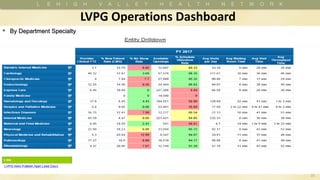
    LVPG Operations Dashboard •By Department Specialty 21
  • 22.
    22 • The overall improvementin patient experience at LVHN’s Physician Practice Group increased from 87.2% to 91.0% over a 12- month period • Equates to moving up from 37% to 64% national ranking
  • 23.
    23 • Improving patient Experiencegoes hand-in-hand with patient Access • LVHN increased completed appointments by 13% over a 9-month period
  • 24.
    24 Results Achieved -Operations Dashboard ▪ New Patient Lag-best practice is one decile improvement within one year - Primary Care: 23% to 44% (two deciles) - Specialty Care: • 9 specialties moved at least two deciles • 5 specialties moved at least one decile ▪ New Patient Visits-normalized for provider growth, increased 49% year over year ▪ Enterprise Visits scheduled-79,178 ▪ Provider Schedule utilization-APC’s 68% to 76%, Phys. 87% to 92%
  • 25.
    25 ▪ 111,001 patientsactivated on our patient portal in just over one year (fastest rate of any Epic client)-presented at Epic UGM Summer 2016 ▪ In network referral capture rate reached 84% ▪ Outpatient practice visits (exclusive of new providers) increased by 10.5% or 120,276 visits ▪ Same day block utilization-APC’s 33% to 63%, Physicians from 64% to 74% Results Achieved - Operations Dashboard
  • 26.
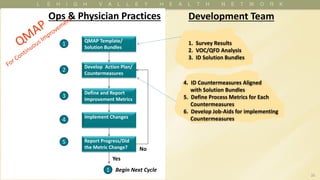
    26 Beg QMAP Template/ Solution Bundles DevelopAction Plan/ Countermeasures Define and Report Improvement Metrics Implement Changes Report Progress/Did the Metric Change? 1 4 3 2 1 5 Yes No 1. Survey Results 2. VOC/QFD Analysis 3. ID Solution Bundles 4. ID Countermeasures Aligned with Solution Bundles 5. Define Process Metrics for Each Countermeasures 6. Develop Job-Aids for implementing Countermeasures Begin Next Cycle Ops & Physician Practices Development Team
  • 27.
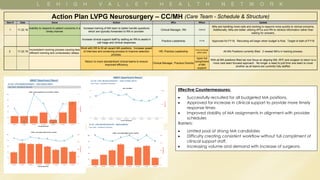
    Action Plan LVPGNeurosurgery – CC/MH (Care Team - Schedule & Structure) Item # Date Issue Action Who When Update 1 11.22.16 Inability to respond to patient concerns in a timely manner Increase training of MA team to better handle questions which are typically forwarded to RN or provider. Clinical Manager, RN 12/5/16 MAs are handling more calls and working to respond more quickly to clinical concerns. Additionally, MAs are better utilizing APCs and RN to retrieve information rather than waiting for answers. Increase clinical support staff by adding an RN to assist in call triage and clinical responses Practice Leadership FY18 Approved for FY18. Recruiting will begin when budget is final. Target of start of FY18 2 11.22.16 Inconsistent rooming process causing less efficient rooming and unnecessary delays. Work with HR to fill all vacant MA positions. Increase speed of interview and screening process to improve selection process. HR, Practice Leadership Prior to formal action plan All MA Positions currently filled. 2 newest MA’s in training process. Return to more standardized clinical teams to ensure improved efficiency Clinical Manager, Practice Director Upon full compliment of MA support With all MA positions filled we now focus on aligning MA, APC and surgeon to return to a more care team focused approach. No longer a need to pull from one team to cover another as all teams are currently fully staffed. Effective Countermeasures:  Successfully recruited for all budgeted MA positions.  Approved for increase in clinical support to provide more timely response times  Improved stability of MA assignments in alignment with provider schedules Barriers:  Limited pool of strong MA candidates  Difficulty creating consistent workflow without full compliment of clinical support staff.  Increasing volume and demand with increase of surgeons