© 2016 Eaton. All Rights Reserved..
CAN BUS, ETHERNET AND CONTROLLER
BEHAVIOUR
ZAENALA ASIQI
E9795760
2
© 2016 Eaton. All Rights Reserved..
CAN BUS HYSTORY
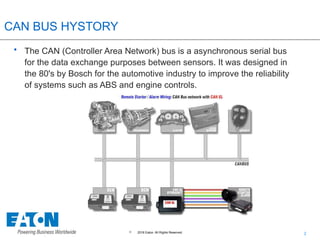
• The CAN (Controller Area Network) bus is a asynchronous serial bus
for the data exchange purposes between sensors. It was designed in
the 80's by Bosch for the automotive industry to improve the reliability
of systems such as ABS and engine controls.
3
© 2016 Eaton. All Rights Reserved..
CAN BUS PROPERTY
Basic CAN bus properties: High electromagnetic immunity, thanks to the differential
bit transmission.
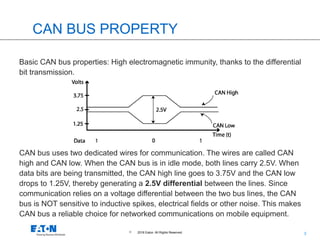
CAN bus uses two dedicated wires for communication. The wires are called CAN
high and CAN low. When the CAN bus is in idle mode, both lines carry 2.5V. When
data bits are being transmitted, the CAN high line goes to 3.75V and the CAN low
drops to 1.25V, thereby generating a 2.5V differential between the lines. Since
communication relies on a voltage differential between the two bus lines, the CAN
bus is NOT sensitive to inductive spikes, electrical fields or other noise. This makes
CAN bus a reliable choice for networked communications on mobile equipment.
4
© 2016 Eaton. All Rights Reserved..
CAN BUS PROPERTY
• The CAN bus uses broadcast transmission method in multi
master configuration, without any supervisor unit.
• Data throughput of the CAN bus is 1Mbps at the distance max.
40 meters. With the increase of distance the speed decreases. It
is worth to remember, that including headers the real speed
efficiency is about 50% (even with 29-bit ID).
5
© 2016 Eaton. All Rights Reserved..
CAN BUS Cable Length VS Baudrate
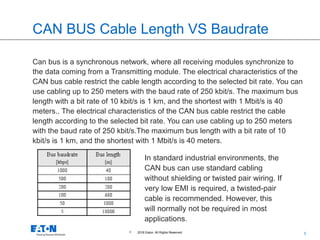
Can bus is a synchronous network, where all receiving modules synchronize to
the data coming from a Transmitting module. The electrical characteristics of the
CAN bus cable restrict the cable length according to the selected bit rate. You can
use cabling up to 250 meters with the baud rate of 250 kbit/s. The maximum bus
length with a bit rate of 10 kbit/s is 1 km, and the shortest with 1 Mbit/s is 40
meters.. The electrical characteristics of the CAN bus cable restrict the cable
length according to the selected bit rate. You can use cabling up to 250 meters
with the baud rate of 250 kbit/s.The maximum bus length with a bit rate of 10
kbit/s is 1 km, and the shortest with 1 Mbit/s is 40 meters.
In standard industrial environments, the
CAN bus can use standard cabling
without shielding or twisted pair wiring. If
very low EMI is required, a twisted-pair
cable is recommended. However, this
will normally not be required in most
applications.
6
© 2016 Eaton. All Rights Reserved..
CAN BUS Application
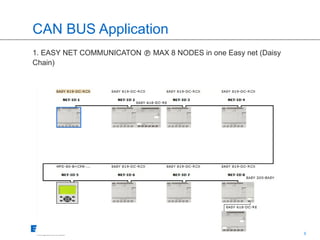
1. EASY NET COMMUNICATON MAX 8 NODES in one Easy net (Daisy

Chain)
7
© 2016 Eaton. All Rights Reserved..
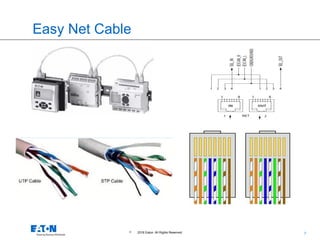
Easy Net Cable
8
© 2016 Eaton. All Rights Reserved..
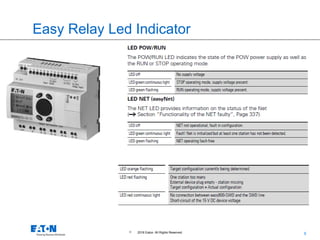
Easy Relay Led Indicator
9
© 2016 Eaton. All Rights Reserved..
CAN BUS APPLICATION
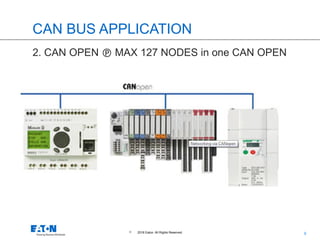
2. CAN OPEN MAX 127 NODES in one CAN OPEN

10
© 2016 Eaton. All Rights Reserved..
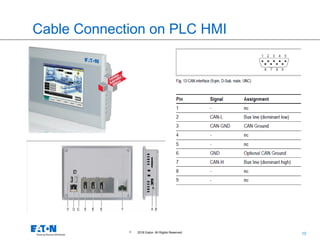
Cable Connection on PLC HMI
11
© 2016 Eaton. All Rights Reserved..
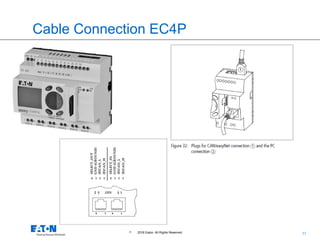
Cable Connection EC4P
12
© 2016 Eaton. All Rights Reserved..
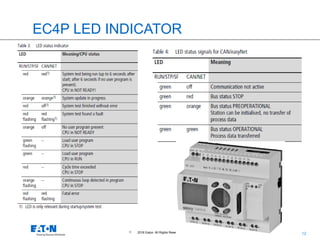
EC4P LED INDICATOR
13
© 2016 Eaton. All Rights Reserved..
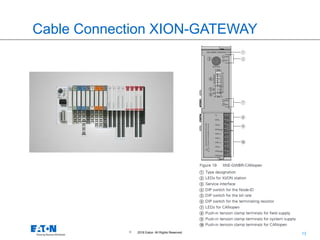
Cable Connection XION-GATEWAY
14
© 2016 Eaton. All Rights Reserved..
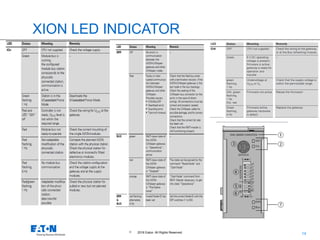
XION LED INDICATOR
15
© 2016 Eaton. All Rights Reserved..
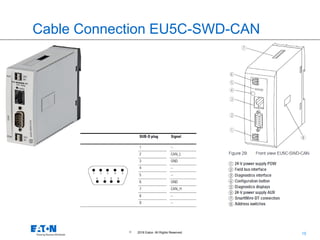
Cable Connection EU5C-SWD-CAN
16
© 2016 Eaton. All Rights Reserved..
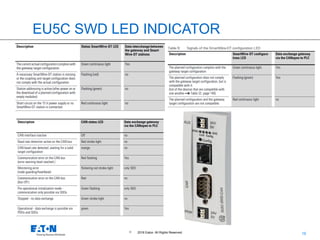
EU5C SWD LED INDICATOR
17
© 2016 Eaton. All Rights Reserved..

CAN BUS, ETHERNET AND CONTROLLER BEHAVIOUR.pptx

  • 1.
    © 2016 Eaton.All Rights Reserved.. CAN BUS, ETHERNET AND CONTROLLER BEHAVIOUR ZAENALA ASIQI E9795760
  • 2.
    2 © 2016 Eaton.All Rights Reserved.. CAN BUS HYSTORY • The CAN (Controller Area Network) bus is a asynchronous serial bus for the data exchange purposes between sensors. It was designed in the 80's by Bosch for the automotive industry to improve the reliability of systems such as ABS and engine controls.
  • 3.
    3 © 2016 Eaton.All Rights Reserved.. CAN BUS PROPERTY Basic CAN bus properties: High electromagnetic immunity, thanks to the differential bit transmission. CAN bus uses two dedicated wires for communication. The wires are called CAN high and CAN low. When the CAN bus is in idle mode, both lines carry 2.5V. When data bits are being transmitted, the CAN high line goes to 3.75V and the CAN low drops to 1.25V, thereby generating a 2.5V differential between the lines. Since communication relies on a voltage differential between the two bus lines, the CAN bus is NOT sensitive to inductive spikes, electrical fields or other noise. This makes CAN bus a reliable choice for networked communications on mobile equipment.
  • 4.
    4 © 2016 Eaton.All Rights Reserved.. CAN BUS PROPERTY • The CAN bus uses broadcast transmission method in multi master configuration, without any supervisor unit. • Data throughput of the CAN bus is 1Mbps at the distance max. 40 meters. With the increase of distance the speed decreases. It is worth to remember, that including headers the real speed efficiency is about 50% (even with 29-bit ID).
  • 5.
    5 © 2016 Eaton.All Rights Reserved.. CAN BUS Cable Length VS Baudrate Can bus is a synchronous network, where all receiving modules synchronize to the data coming from a Transmitting module. The electrical characteristics of the CAN bus cable restrict the cable length according to the selected bit rate. You can use cabling up to 250 meters with the baud rate of 250 kbit/s. The maximum bus length with a bit rate of 10 kbit/s is 1 km, and the shortest with 1 Mbit/s is 40 meters.. The electrical characteristics of the CAN bus cable restrict the cable length according to the selected bit rate. You can use cabling up to 250 meters with the baud rate of 250 kbit/s.The maximum bus length with a bit rate of 10 kbit/s is 1 km, and the shortest with 1 Mbit/s is 40 meters. In standard industrial environments, the CAN bus can use standard cabling without shielding or twisted pair wiring. If very low EMI is required, a twisted-pair cable is recommended. However, this will normally not be required in most applications.
  • 6.
    6 © 2016 Eaton.All Rights Reserved.. CAN BUS Application 1. EASY NET COMMUNICATON MAX 8 NODES in one Easy net (Daisy  Chain)
  • 7.
    7 © 2016 Eaton.All Rights Reserved.. Easy Net Cable
  • 8.
    8 © 2016 Eaton.All Rights Reserved.. Easy Relay Led Indicator
  • 9.
    9 © 2016 Eaton.All Rights Reserved.. CAN BUS APPLICATION 2. CAN OPEN MAX 127 NODES in one CAN OPEN 
  • 10.
    10 © 2016 Eaton.All Rights Reserved.. Cable Connection on PLC HMI
  • 11.
    11 © 2016 Eaton.All Rights Reserved.. Cable Connection EC4P
  • 12.
    12 © 2016 Eaton.All Rights Reserved.. EC4P LED INDICATOR
  • 13.
    13 © 2016 Eaton.All Rights Reserved.. Cable Connection XION-GATEWAY
  • 14.
    14 © 2016 Eaton.All Rights Reserved.. XION LED INDICATOR
  • 15.
    15 © 2016 Eaton.All Rights Reserved.. Cable Connection EU5C-SWD-CAN
  • 16.
    16 © 2016 Eaton.All Rights Reserved.. EU5C SWD LED INDICATOR
  • 17.
    17 © 2016 Eaton.All Rights Reserved..

Editor's Notes

  • #1 Tips: Title on this slide should be kept short. Transparency bar is separate piece behind text. Please copy and paste the one in this slide to re-create. Headlines should be set with an initial cap (sentence case) and the rest in lower case. Only product names or acronyms in the headline should begin with a capital letter.