Campus LAN and Wireless LAN Design Guide
Campus Design: HIGH-DENSITY LARGE, MEDIUM-DENSITY & SMALL-SITE
…
HIGH-DENSITY LARGE CAMPUS DESIGN
The high-density large campus design has multiple distribution layers
connected to a core layer and dense demands in the access layer for wired
ports and WLAN devices. The preferred design has capacity for supporting
over 15,000 wired and wireless users and devices, is highly available for
critical business continuity, and has the capabilities to support advanced
features such NetFlow and network virtualization and segmentation. You may
select this design for cases where densities may not be as high as supported;
however, the requirements dictate needs for critical business continuity or
advanced capabilities.
Campus Core
If there are three or more interconnected distributions or requirements for
connectivity at a common location, you use a Layer 3 LAN core in order to
simplify the connectivity and management. You use one of the two core
options in order to meet the core needs in the high-density large campus
design. The flagship platforms for these options:
• Cisco Nexus 7700 Series—Family members in the Cisco Nexus Series
have a variety of density options and can be segmented into virtual device
contexts, allowing the same devices to be used for a campus core and a data
center core. When there are requirements for core switches to be
independently managed with the ability to have virtual PortChannels between
the switches, or a need for high-density 10/40/100 Gigabit Ethernet, these
switches are the preferred option.
• Catalyst 6800 Series with Supervisor 6T—Family members in the
Catalyst Series accommodate a variety of core densities, covering the features
commonly used in a campus core. You can merge the devices into a VSS
mode, with options for redundant supervisors in each member switch offering
a highly available configuration, managed as a single device
Campus Wired Distribution, Wired Access, and Wireless
In the high-density large campus, you make choices for the wired distribution
and access based on the most highly available platforms for the role, the
highest density and widest selection of interface options, redundant power
and modular control plane, with the most advanced software feature
capabilities. In the high density large campus design, centralized wireless is
the preferred option, using APs with 802.11ac Wave 2 and CleanAir
capabilities.
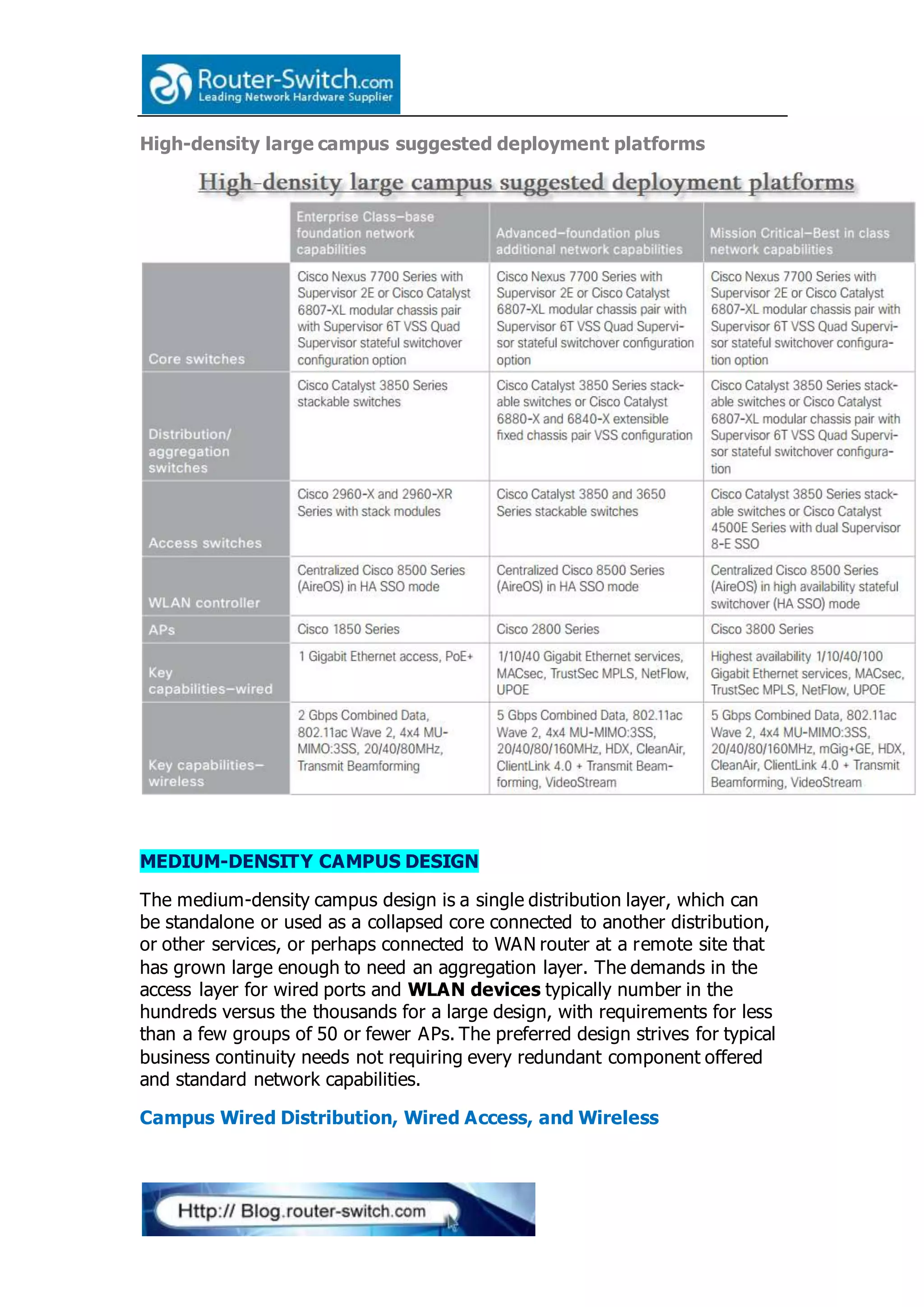
High-density large campus suggested deployment platforms
MEDIUM-DENSITY CAMPUS DESIGN
The medium-density campus design is a single distribution layer, which can
be standalone or used as a collapsed core connected to another distribution,
or other services, or perhaps connected to WAN router at a remote site that
has grown large enough to need an aggregation layer. The demands in the
access layer for wired ports and WLAN devices typically number in the
hundreds versus the thousands for a large design, with requirements for less
than a few groups of 50 or fewer APs. The preferred design strives for typical
business continuity needs not requiring every redundant component offered
and standard network capabilities.
Campus Wired Distribution, Wired Access, and Wireless
You make choices for the wired distribution and access with a bias towards
size and flexibility in order to accommodate the space and power
requirements of medium sized installations in a way that can elastically
expand as an organization grows. Where densities and advanced software
feature capabilities are not as strong of a requirement, options with a more
economical and common sparing preference are shown. In the medium-
density campus design, converged access and centralized wireless using
FlexConnect are the preferred options. These are equivalent to the small-site
campus design with the addition of a distribution layer.
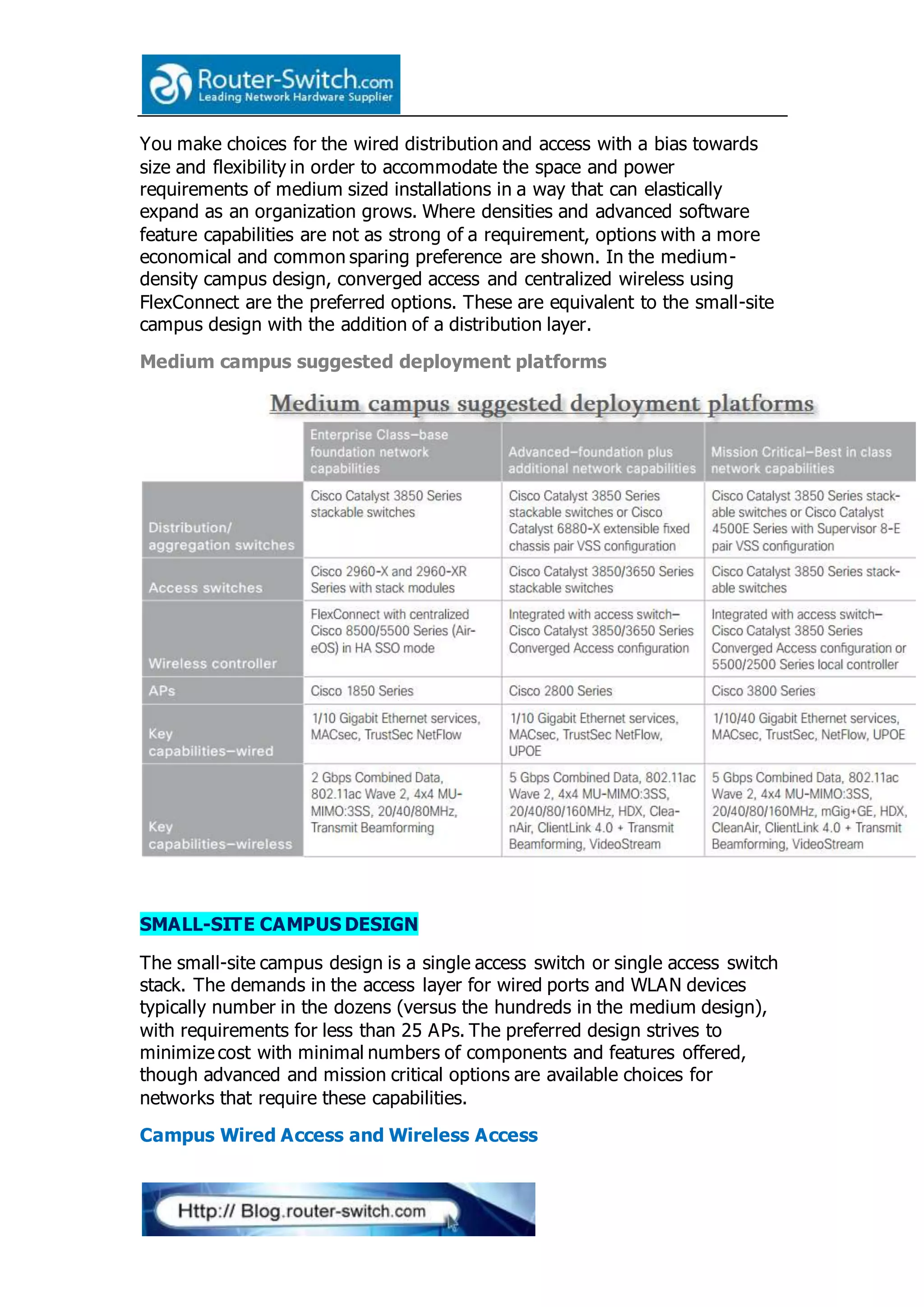
Medium campus suggested deployment platforms
SMALL-SITE CAMPUS DESIGN
The small-site campus design is a single access switch or single access switch
stack. The demands in the access layer for wired ports and WLAN devices
typically number in the dozens (versus the hundreds in the medium design),
with requirements for less than 25 APs. The preferred design strives to
minimize cost with minimal numbers of components and features offered,
though advanced and mission critical options are available choices for
networks that require these capabilities.
Campus Wired Access and Wireless Access
In the small-site campus design, you make choices for the wired access with
a bias towards size and flexibility in order to accommodate the space and
power requirements of small sites. Densities and advanced software feature
capabilities are not as strong of a requirement, so options with the most
economical preference are shown. In the small-site campus design,
converged access and centralized wireless using FlexConnect are the
preferred options.
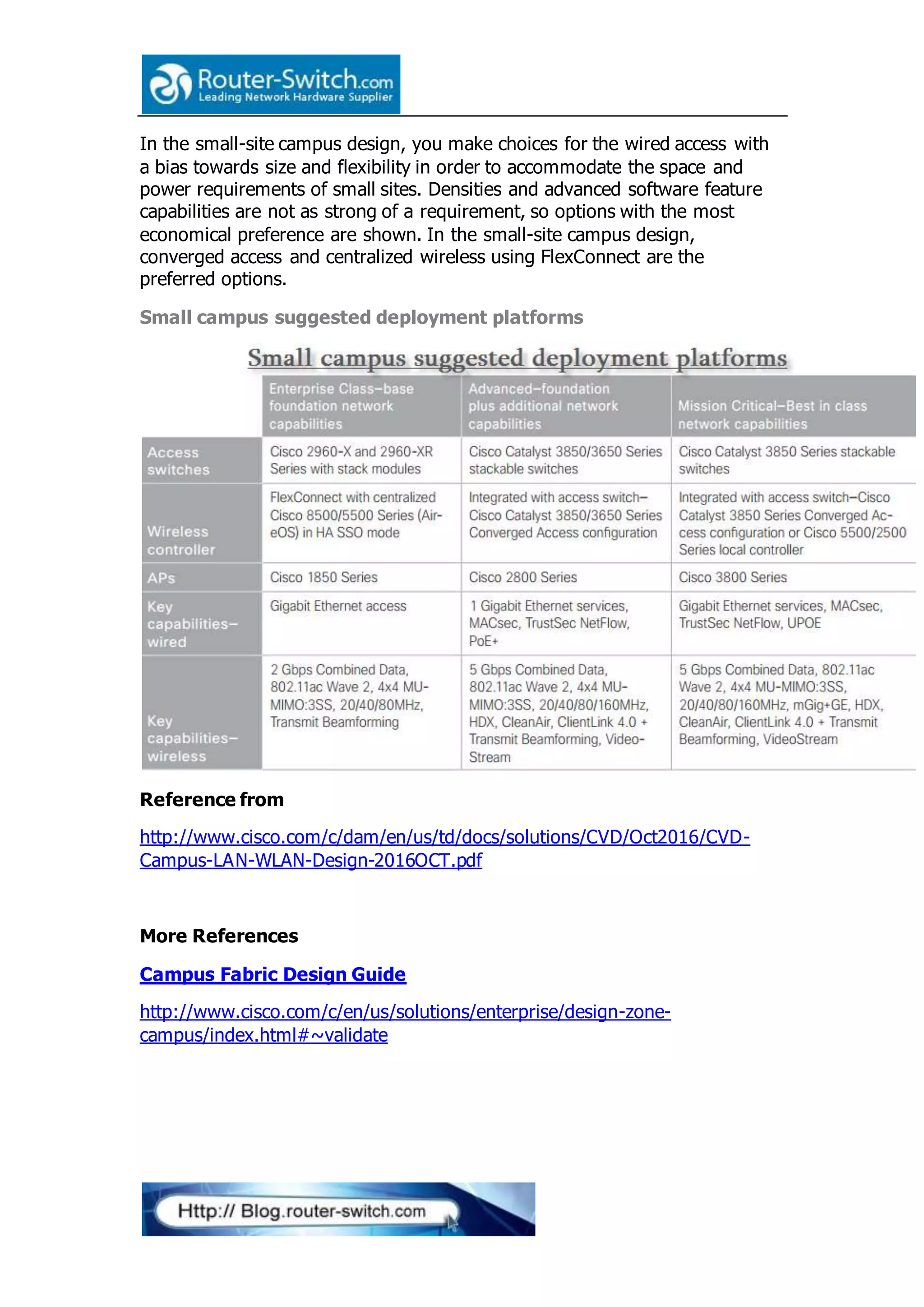
Small campus suggested deployment platforms
Reference from
http://www.cisco.com/c/dam/en/us/td/docs/solutions/CVD/Oct2016/CVD-
Campus-LAN-WLAN-Design-2016OCT.pdf
More References
Campus Fabric Design Guide
http://www.cisco.com/c/en/us/solutions/enterprise/design-zone-
campus/index.html#~validate

Campus lan and wireless lan design guide

  • 1.
    Campus LAN andWireless LAN Design Guide Campus Design: HIGH-DENSITY LARGE, MEDIUM-DENSITY & SMALL-SITE … HIGH-DENSITY LARGE CAMPUS DESIGN The high-density large campus design has multiple distribution layers connected to a core layer and dense demands in the access layer for wired ports and WLAN devices. The preferred design has capacity for supporting over 15,000 wired and wireless users and devices, is highly available for critical business continuity, and has the capabilities to support advanced features such NetFlow and network virtualization and segmentation. You may select this design for cases where densities may not be as high as supported; however, the requirements dictate needs for critical business continuity or advanced capabilities. Campus Core If there are three or more interconnected distributions or requirements for connectivity at a common location, you use a Layer 3 LAN core in order to simplify the connectivity and management. You use one of the two core options in order to meet the core needs in the high-density large campus design. The flagship platforms for these options: • Cisco Nexus 7700 Series—Family members in the Cisco Nexus Series have a variety of density options and can be segmented into virtual device contexts, allowing the same devices to be used for a campus core and a data center core. When there are requirements for core switches to be independently managed with the ability to have virtual PortChannels between the switches, or a need for high-density 10/40/100 Gigabit Ethernet, these switches are the preferred option. • Catalyst 6800 Series with Supervisor 6T—Family members in the Catalyst Series accommodate a variety of core densities, covering the features commonly used in a campus core. You can merge the devices into a VSS mode, with options for redundant supervisors in each member switch offering a highly available configuration, managed as a single device Campus Wired Distribution, Wired Access, and Wireless In the high-density large campus, you make choices for the wired distribution and access based on the most highly available platforms for the role, the highest density and widest selection of interface options, redundant power and modular control plane, with the most advanced software feature capabilities. In the high density large campus design, centralized wireless is the preferred option, using APs with 802.11ac Wave 2 and CleanAir capabilities.
  • 2.
    High-density large campussuggested deployment platforms MEDIUM-DENSITY CAMPUS DESIGN The medium-density campus design is a single distribution layer, which can be standalone or used as a collapsed core connected to another distribution, or other services, or perhaps connected to WAN router at a remote site that has grown large enough to need an aggregation layer. The demands in the access layer for wired ports and WLAN devices typically number in the hundreds versus the thousands for a large design, with requirements for less than a few groups of 50 or fewer APs. The preferred design strives for typical business continuity needs not requiring every redundant component offered and standard network capabilities. Campus Wired Distribution, Wired Access, and Wireless
  • 3.
    You make choicesfor the wired distribution and access with a bias towards size and flexibility in order to accommodate the space and power requirements of medium sized installations in a way that can elastically expand as an organization grows. Where densities and advanced software feature capabilities are not as strong of a requirement, options with a more economical and common sparing preference are shown. In the medium- density campus design, converged access and centralized wireless using FlexConnect are the preferred options. These are equivalent to the small-site campus design with the addition of a distribution layer. Medium campus suggested deployment platforms SMALL-SITE CAMPUS DESIGN The small-site campus design is a single access switch or single access switch stack. The demands in the access layer for wired ports and WLAN devices typically number in the dozens (versus the hundreds in the medium design), with requirements for less than 25 APs. The preferred design strives to minimize cost with minimal numbers of components and features offered, though advanced and mission critical options are available choices for networks that require these capabilities. Campus Wired Access and Wireless Access
  • 4.
    In the small-sitecampus design, you make choices for the wired access with a bias towards size and flexibility in order to accommodate the space and power requirements of small sites. Densities and advanced software feature capabilities are not as strong of a requirement, so options with the most economical preference are shown. In the small-site campus design, converged access and centralized wireless using FlexConnect are the preferred options. Small campus suggested deployment platforms Reference from http://www.cisco.com/c/dam/en/us/td/docs/solutions/CVD/Oct2016/CVD- Campus-LAN-WLAN-Design-2016OCT.pdf More References Campus Fabric Design Guide http://www.cisco.com/c/en/us/solutions/enterprise/design-zone- campus/index.html#~validate