Chapter I
“Journalism can never be silent: that is its greatest virtue and its greatest fault.”
— Henry Anatole Grunwald
History of Journalism
The word journal comes from the Latin word, diurna,
which means “daily”. In ancient Rome, short bulletins of battle,
fires and election compiled by government officials were posted
up in public places. These were called acta diurna which meant
“daily events”.
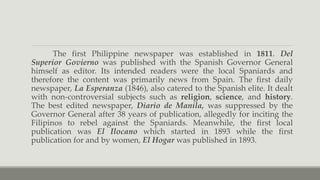
The knowledge of the art of printing spread to the West from
China. In 15th century, Johannes Gutenberg developed a
movable type.
In middle of the 16th century, the morning newspaper took
shape in Europe.
Printing Press
The first Philippine newspaper was established in 1811. Del
Superior Govierno was published with the Spanish Governor General
himself as editor. Its intended readers were the local Spaniards and
therefore the content was primarily news from Spain. The first daily
newspaper, La Esperanza (1846), also catered to the Spanish elite. It dealt
with non-controversial subjects such as religion, science, and history.
The best edited newspaper, Diario de Manila, was suppressed by the
Governor General after 38 years of publication, allegedly for inciting the
Filipinos to rebel against the Spaniards. Meanwhile, the first local
publication was El Ilocano which started in 1893 while the first
publication for and by women, El Hogar was published in 1893.
The history of the free press in the Philippines has its roots in
nationalistic newspapers published in Europe and in the Philippines
during the Spanish colonial rule. These newspapers were mainly
published and written by the so-called ilustrados.
Foremost, among the nationalistic newspapers was the La
Solidaridad, the mouthpiece of the revolution and the fortnightly organ
of the Propaganda Movement. Published in Spain, it first appeared in
1889 with the policy “to work peacefully for social and economic reforms,
to expose the real plight of the Philippines, and to champion liberalism
and democracy.”
Definitions of Journalism
Noah Webster defines journalism as the occupation of writing for
the publication in newspapers and other periodicals.
According to Eyfemia C. Estrada and Rosarion P. Nem Singh,
journalism is the art of writing for publication and other periodicals
embracing all thoughts and actions that have significance and interest to
the readers.
Eric Hodgins of Time Magazine defines it as, “Journalism is the
conveying of information from here to there with accuracy, insight and
dispatch and in such a manner that the truth is served and the rightness
of things is made slowly, even if not immediately, more evident”.
Journalism is the gathering, organizing, and distribution of news
through the wide variety of print and non-print media outlets.
The term 'journalism' also refers to the news and information itself.
It is important to notice the variety of information media today. The
news and information can be presented in many different ways,
including articles, reports, broadcasts, or even tweets.
Journalism is a form of communication, but it's distinct from other
forms. It is unique because it's a one-way message from the journalist to
the audience. It's most unique because the message is not the journalist's
personal story or subjective thoughts. Instead, the journalist acts as a
conduit, narrating an objective story about something that happened or
is happening, based on his or her observations and discoveries.
SCOPE OF JOURNALISM
Journalism may be divided into three areas, namely:
written
oral
visual
Periodicals such as newspapers and magazines fall under written
journalism. A periodical, defined broadly, is a publication that comes out
at regular period of interval – daily, weekly, fortnightly, monthly, bi-
monthly, quarterly, annually, etc.
A newspaper, compared to a magazine, prints more news, has no
special cover, and is printed on newsprint. News is printed on the front
page as well as on the inside and the back pages.
A magazine, on the other hand, print more features and human-
interest stories, has special covers and oftentimes printed in book-paper.
If ever news is printed, it is brief and found in the inside pages.
Periodicals, brochures, journals, book, and graphic arts classified
under print media. Radio and radio broadcasting falls under oral
journalism, while television, movies and documentaries fall under visual
journalism.
Radio and television are example of broadcast media while movies and
documentaries are example of film media.
Journalism is widely regarded as glamorous and exciting profession.
Despite the low salary, the beating deadlines, and the long and often
irregular hours of work, many talented young people are still attracted to
the newsroom. Maybe because of the three benefits of being a press.
Three Benefits of Being a Press
1. Power of the Press
- The power of the press has long been recognized, accepted and supported.
2. The Glory of Byline
- The author’s name appearing with the story or article is called a byline.
Many established writers can still recall the thrill of seeing his first byline.
Through the byline, he could be recognized as a person of influence, a purveyor
of wisdom, a molder of opinions and a shaper of society.
3. The First to Know
- Few experiences can equal the excitement of being the first to know. This
could refer to the important events or to personal concerns of famous people; to
the historically significant, to the changes in weather or simply a surprise party
for a friend.
The Elements of Journalism
1. Journalism’s first obligation is to the truth.
2. Its first loyalty is to citizens.
3. Its essence is a discipline of verification.
4. Its practitioners must maintain an independence from those they cover.
5. It must serve as an independent monitor of power.
6. It must provide a forum for public criticism and compromise
7. It must strive to keep the significant interesting and relevant.
8. It must keep the news comprehensive and proportional.
9.Its practitioners must be allowed to exercise their personal conscience.
Most Common Ethical Questions
Related to Journalism
1. Confidentiality of Information / Off the Record
- Sometimes people will disclose information only if the reporter agrees to keep it off the
record. Tradition binds the journalism to honor this confidentiality. The reporter may also resort to
attributing the statement to “a reliable source”, a common practice.
2. Objectivity
- It is a detached, impersonal, unprejudiced and subjectivity as based on personal bias.
3. Fairness
- The whole point in advocating objectivity is to be fair in presenting the news because the
reporter exercises the power to give or deny information. It is therefore the reporter’s sacred trust
to give a true picture. To do this, he has to dig diligently for facts, interview persons concerned,
observe; research and finally write within the time constraints of his job.
NATIONAL AND CAMPUS PAPERS
COMPARED
A newspaper is a printed publication which is published and sold
at regular interval. Its main purpose is to provide news for its readers. The
paper also tries to explain what the news means, so it prints comments
and opinions. Another purpose is to entertain and teach with
photographs, cartoons and other interesting features.
The paper which is publish every day is called daily. Papers
published once a week are called weeklies. A national paper is one that
can be bought easily anywhere in country.
National papers fall into two categories: the popular papers and
heavy quality papers. Popular paper presents their news in a bright
lively fashion, with easy-to-read articles and many photographs. Heavy
or quality papers emphasize the more serious subjects, and print longer
articles about them.
Some newspaper publishers produce Sunday papers. Sometime with
similar templates as the daily papers. These are not Sunday editions of
the daily. They have different editors and different staffs. As people have
more time for reading on a Sunday, a Sunday paper has more pages and
contains more articles than a daily paper, thus, it cost more.
FUNCTIONS OF THE CAMPUS PAPER
A campus paper publication, either mimeograph or printed, put
out by staff member who are either student or faculty members of a
school or university.
The campus paper has many functions. The traditional roles of the
campus paper were specified by Harold Spears and C.H. Lawshe Jr. in
their book, “An Introduction to Journalism”.
A. Aids of the Students
1. To provide an opportunity for interesting writing
2. To give students opportunity to learn how to read the newspapers
3. To act as a stimulus to better work
4. To develop students’ power of observation and discrimination
concerning relative merits of news articles
5. To serve an outlet and motivation for journalistic writing
6. To offer training in organization, business methods, commercial arts,
bookkeeping and business management
7. To develop qualities of cooperation, tact, accuracy, tolerance,
responsibility and leadership
B. Aids to the school and community
1. To inform the community as to the work of school
2. To publish school news
3. To create and express school opinion
4. To make known the achievement of the school
5. To help unify the school
6. To encourage and stimulate worthwhile activities
7. To develop right standard of conduct
8. To provide an outlet for student suggestion for the betterment of the school
9. To develop better interschool relationship
10.To develop better spirit
11.To develop cooperation between parents and the school

Campus Journalism chpte - Chapter 1.pptx

  • 1.
  • 2.
    “Journalism can neverbe silent: that is its greatest virtue and its greatest fault.” — Henry Anatole Grunwald
  • 3.
    History of Journalism Theword journal comes from the Latin word, diurna, which means “daily”. In ancient Rome, short bulletins of battle, fires and election compiled by government officials were posted up in public places. These were called acta diurna which meant “daily events”. The knowledge of the art of printing spread to the West from China. In 15th century, Johannes Gutenberg developed a movable type. In middle of the 16th century, the morning newspaper took shape in Europe. Printing Press
  • 4.
    The first Philippinenewspaper was established in 1811. Del Superior Govierno was published with the Spanish Governor General himself as editor. Its intended readers were the local Spaniards and therefore the content was primarily news from Spain. The first daily newspaper, La Esperanza (1846), also catered to the Spanish elite. It dealt with non-controversial subjects such as religion, science, and history. The best edited newspaper, Diario de Manila, was suppressed by the Governor General after 38 years of publication, allegedly for inciting the Filipinos to rebel against the Spaniards. Meanwhile, the first local publication was El Ilocano which started in 1893 while the first publication for and by women, El Hogar was published in 1893.
  • 5.
    The history ofthe free press in the Philippines has its roots in nationalistic newspapers published in Europe and in the Philippines during the Spanish colonial rule. These newspapers were mainly published and written by the so-called ilustrados. Foremost, among the nationalistic newspapers was the La Solidaridad, the mouthpiece of the revolution and the fortnightly organ of the Propaganda Movement. Published in Spain, it first appeared in 1889 with the policy “to work peacefully for social and economic reforms, to expose the real plight of the Philippines, and to champion liberalism and democracy.”
  • 6.
    Definitions of Journalism NoahWebster defines journalism as the occupation of writing for the publication in newspapers and other periodicals. According to Eyfemia C. Estrada and Rosarion P. Nem Singh, journalism is the art of writing for publication and other periodicals embracing all thoughts and actions that have significance and interest to the readers. Eric Hodgins of Time Magazine defines it as, “Journalism is the conveying of information from here to there with accuracy, insight and dispatch and in such a manner that the truth is served and the rightness of things is made slowly, even if not immediately, more evident”.
  • 7.
    Journalism is thegathering, organizing, and distribution of news through the wide variety of print and non-print media outlets. The term 'journalism' also refers to the news and information itself. It is important to notice the variety of information media today. The news and information can be presented in many different ways, including articles, reports, broadcasts, or even tweets. Journalism is a form of communication, but it's distinct from other forms. It is unique because it's a one-way message from the journalist to the audience. It's most unique because the message is not the journalist's personal story or subjective thoughts. Instead, the journalist acts as a conduit, narrating an objective story about something that happened or is happening, based on his or her observations and discoveries.
  • 8.
    SCOPE OF JOURNALISM Journalismmay be divided into three areas, namely: written oral visual
  • 9.
    Periodicals such asnewspapers and magazines fall under written journalism. A periodical, defined broadly, is a publication that comes out at regular period of interval – daily, weekly, fortnightly, monthly, bi- monthly, quarterly, annually, etc. A newspaper, compared to a magazine, prints more news, has no special cover, and is printed on newsprint. News is printed on the front page as well as on the inside and the back pages.
  • 10.
    A magazine, onthe other hand, print more features and human- interest stories, has special covers and oftentimes printed in book-paper. If ever news is printed, it is brief and found in the inside pages. Periodicals, brochures, journals, book, and graphic arts classified under print media. Radio and radio broadcasting falls under oral journalism, while television, movies and documentaries fall under visual journalism. Radio and television are example of broadcast media while movies and documentaries are example of film media.
  • 11.
    Journalism is widelyregarded as glamorous and exciting profession. Despite the low salary, the beating deadlines, and the long and often irregular hours of work, many talented young people are still attracted to the newsroom. Maybe because of the three benefits of being a press.
  • 12.
    Three Benefits ofBeing a Press 1. Power of the Press - The power of the press has long been recognized, accepted and supported. 2. The Glory of Byline - The author’s name appearing with the story or article is called a byline. Many established writers can still recall the thrill of seeing his first byline. Through the byline, he could be recognized as a person of influence, a purveyor of wisdom, a molder of opinions and a shaper of society. 3. The First to Know - Few experiences can equal the excitement of being the first to know. This could refer to the important events or to personal concerns of famous people; to the historically significant, to the changes in weather or simply a surprise party for a friend.
  • 13.
    The Elements ofJournalism 1. Journalism’s first obligation is to the truth. 2. Its first loyalty is to citizens. 3. Its essence is a discipline of verification. 4. Its practitioners must maintain an independence from those they cover. 5. It must serve as an independent monitor of power. 6. It must provide a forum for public criticism and compromise 7. It must strive to keep the significant interesting and relevant. 8. It must keep the news comprehensive and proportional. 9.Its practitioners must be allowed to exercise their personal conscience.
  • 14.
    Most Common EthicalQuestions Related to Journalism 1. Confidentiality of Information / Off the Record - Sometimes people will disclose information only if the reporter agrees to keep it off the record. Tradition binds the journalism to honor this confidentiality. The reporter may also resort to attributing the statement to “a reliable source”, a common practice. 2. Objectivity - It is a detached, impersonal, unprejudiced and subjectivity as based on personal bias. 3. Fairness - The whole point in advocating objectivity is to be fair in presenting the news because the reporter exercises the power to give or deny information. It is therefore the reporter’s sacred trust to give a true picture. To do this, he has to dig diligently for facts, interview persons concerned, observe; research and finally write within the time constraints of his job.
  • 15.
    NATIONAL AND CAMPUSPAPERS COMPARED A newspaper is a printed publication which is published and sold at regular interval. Its main purpose is to provide news for its readers. The paper also tries to explain what the news means, so it prints comments and opinions. Another purpose is to entertain and teach with photographs, cartoons and other interesting features. The paper which is publish every day is called daily. Papers published once a week are called weeklies. A national paper is one that can be bought easily anywhere in country.
  • 16.
    National papers fallinto two categories: the popular papers and heavy quality papers. Popular paper presents their news in a bright lively fashion, with easy-to-read articles and many photographs. Heavy or quality papers emphasize the more serious subjects, and print longer articles about them. Some newspaper publishers produce Sunday papers. Sometime with similar templates as the daily papers. These are not Sunday editions of the daily. They have different editors and different staffs. As people have more time for reading on a Sunday, a Sunday paper has more pages and contains more articles than a daily paper, thus, it cost more.
  • 17.
    FUNCTIONS OF THECAMPUS PAPER A campus paper publication, either mimeograph or printed, put out by staff member who are either student or faculty members of a school or university. The campus paper has many functions. The traditional roles of the campus paper were specified by Harold Spears and C.H. Lawshe Jr. in their book, “An Introduction to Journalism”.
  • 18.
    A. Aids ofthe Students 1. To provide an opportunity for interesting writing 2. To give students opportunity to learn how to read the newspapers 3. To act as a stimulus to better work 4. To develop students’ power of observation and discrimination concerning relative merits of news articles 5. To serve an outlet and motivation for journalistic writing 6. To offer training in organization, business methods, commercial arts, bookkeeping and business management 7. To develop qualities of cooperation, tact, accuracy, tolerance, responsibility and leadership
  • 19.
    B. Aids tothe school and community 1. To inform the community as to the work of school 2. To publish school news 3. To create and express school opinion 4. To make known the achievement of the school 5. To help unify the school 6. To encourage and stimulate worthwhile activities 7. To develop right standard of conduct 8. To provide an outlet for student suggestion for the betterment of the school 9. To develop better interschool relationship 10.To develop better spirit 11.To develop cooperation between parents and the school