JOURNALISM
IN GENERAL
CARL PATRICK S. TADEO
Teacher-I, Olongapo City National High School
Olongapo City National High School
Special Program in Journalism
Objective/s:
At the end of this presentation, you
should be able to:
•define journalism in general;
•identify the different concept of
journalism based on different authors;
and
•differentiate the various scope of
journalism.
Journalism
•Etymology: (Latin) ‘diurnal’ - daily
•Ancient Rome, short bulletins of
battles, fires, and elections
compiled by government officials
were posted up in public places.
These were called acta diurna or
“daily events.”
Journalism
•The occupation of writing for
publication in newspapers and
other periodicals. – Noah Webster
Journalism
•Something that embraces all forms in
which or through which the news and
comments on the news reach the
public. All that happens in the world, if
such happenings hold interest for the
public, and all the thoughts, actions,
and ideas which these happenings
stimulate, become basic materials for
the journalist. - Fraser F. Bond
Journalism
•Enjoyable co-curricular activity of the
school paper staff in collecting,
organizing, and presenting news; in
writing editorials, columns, literary
articles, and features; in copyreading,
proofreading, dummying, and writing
headlines – all for the purpose of putting
out a school organ. – School Paper Advisers
of the City Schools of Manila
Journalism: Its Basic
Definition• It is concerned with the collection and
dissemination of news through print media
as well as electronic media.
• It involves various areas of work like
reporting, writing, editing,
photographing, broadcasting or cable
casting news items.
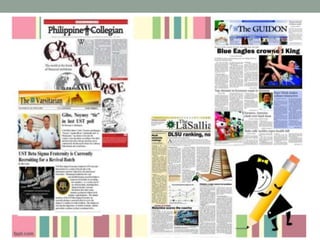
• It convers the printed media that comes in
the form of broadsheets, tabloids,
newsletters and magazines.
Scope of Journalism
•Written – periodicals
•Oral – radio
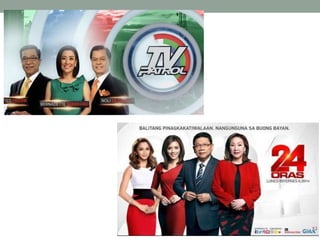
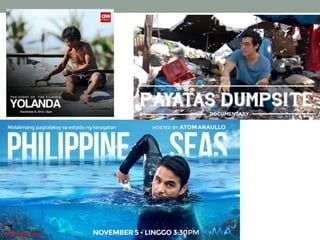
•Visual – television, movie,
documentaries
News Media (Forms of Mass
Media)
•Print media – newspaper,
newsmagazines
•Broadcast MEDIA – radio and
television
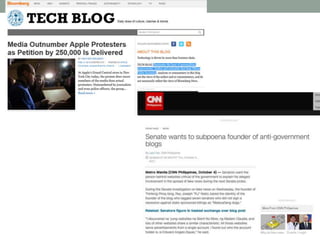
•ONLINE MEDIA (online
newspaper, news blogs)
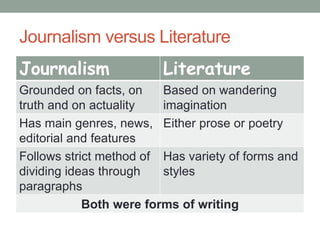
Journalism versus Literature
Journalism Literature
Grounded on facts, on
truth and on actuality
Based on wandering
imagination
Has main genres, news,
editorial and features
Either prose or poetry
Follows strict method of
dividing ideas through
paragraphs
Has variety of forms and
styles
Both were forms of writing
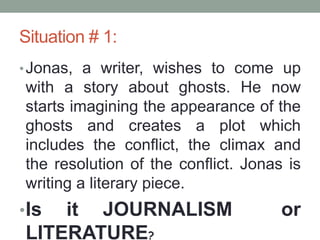
Situation # 1:
•Jonas, a writer, wishes to come up
with a story about ghosts. He now
starts imagining the appearance of the
ghosts and creates a plot which
includes the conflict, the climax and
the resolution of the conflict. Jonas is
writing a literary piece.
•Is it JOURNALISM or
LITERATURE?
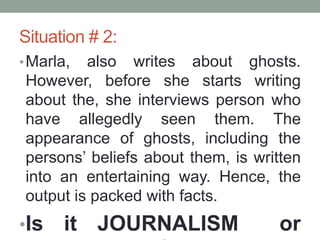
Situation # 2:
•Marla, also writes about ghosts.
However, before she starts writing
about the, she interviews person who
have allegedly seen them. The
appearance of ghosts, including the
persons’ beliefs about them, is written
into an entertaining way. Hence, the
output is packed with facts.
•Is it JOURNALISM or
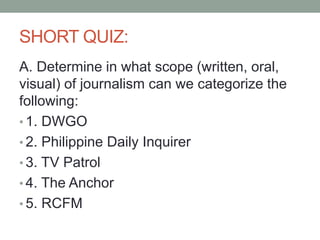
SHORT QUIZ:
A. Determine in what scope (written, oral,
visual) of journalism can we categorize the
following:
• 1. DWGO
• 2. Philippine Daily Inquirer
• 3. TV Patrol
• 4. The Anchor
• 5. RCFM
SHORT QUIZ:
• B. Determine what form (PRINT,
BROADCAST, ONLINE)of media is shown
by the following:
• 1. Blog News
• 2. Bulgar
• 3. CNN News
• 4. CLRAA Newsletter
• 5. Brigada News FM
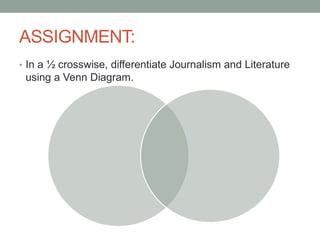
ASSIGNMENT:
• In a ½ crosswise, differentiate Journalism and Literature
using a Venn Diagram.
REFERENCES:
• Bulusan, Ferdinand. (2016). Campus Journalism within
your reach. Lorimar Publishing, Inc.: Quezon City
JOURNALISM: ITS
TYPES AND TENETS
CARL PATRICK S. TADEO
Teacher-I, Olongapo City National High School
Olongapo City National High School
Special Program in Journalism
Journalism
•Journalism is concerned it is a
form of writing that tells people
about things that really happened,
but that they might not have been
known about already.
Definition of Journalism
•“The COLLECTION and EDITING
of NEWS for presentation through
MEDIA.”
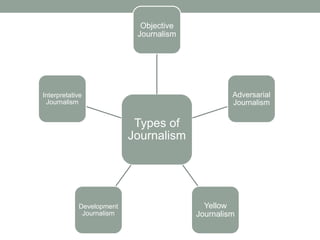
Types of
Journalism
Objective
Journalism
Adversarial
Journalism
Yellow
Journalism
Development
Journalism
Interpretative
Journalism
Objective Journalism
•It is the type of reporting events
that confines itself to facts and
answers the questions what, who,
where, when, why and how.
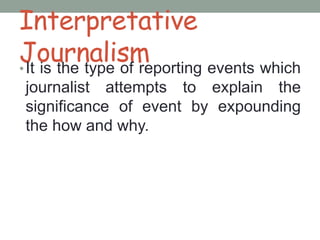
Interpretative
Journalism•It is the type of reporting events which
journalist attempts to explain the
significance of event by expounding
the how and why.
Adversarial Journalism
•It acts as “watchdog” that fiscalizes the
three branches of the government:
executive, legislative and judiciary.
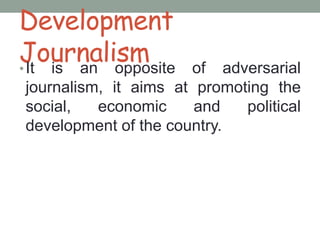
Development
Journalism•It is an opposite of adversarial
journalism, it aims at promoting the
social, economic and political
development of the country.
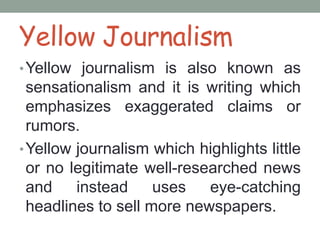
Yellow Journalism
•Yellow journalism is also known as
sensationalism and it is writing which
emphasizes exaggerated claims or
rumors.
•Yellow journalism which highlights little
or no legitimate well-researched news
and instead uses eye-catching
headlines to sell more newspapers.
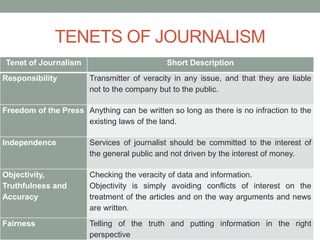
TENETS OF JOURNALISM
Tenet of Journalism Short Description
Responsibility Transmitter of veracity in any issue, and that they are liable
not to the company but to the public.
Freedom of the Press Anything can be written so long as there is no infraction to the
existing laws of the land.
Independence Services of journalist should be committed to the interest of
the general public and not driven by the interest of money.
Objectivity,
Truthfulness and
Accuracy
Checking the veracity of data and information.
Objectivity is simply avoiding conflicts of interest on the
treatment of the articles and on the way arguments and news
are written.
Fairness Telling of the truth and putting information in the right
perspective
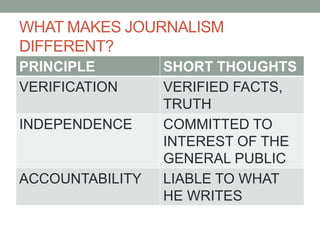
WHAT MAKES JOURNALISM
DIFFERENT?
PRINCIPLE SHORT THOUGHTS
VERIFICATION VERIFIED FACTS,
TRUTH
INDEPENDENCE COMMITTED TO
INTEREST OF THE
GENERAL PUBLIC
ACCOUNTABILITY LIABLE TO WHAT
HE WRITES
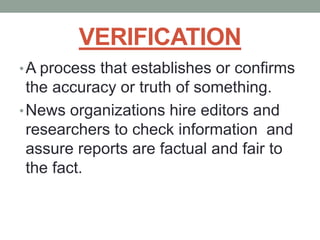
VERIFICATION
•A process that establishes or confirms
the accuracy or truth of something.
•News organizations hire editors and
researchers to check information and
assure reports are factual and fair to
the fact.
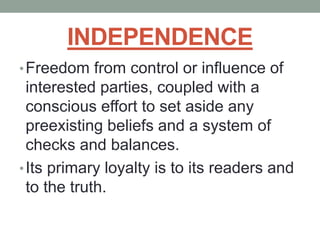
INDEPENDENCE
•Freedom from control or influence of
interested parties, coupled with a
conscious effort to set aside any
preexisting beliefs and a system of
checks and balances.
•Its primary loyalty is to its readers and
to the truth.
•“The power of our work comes
from INDEPENDENT reporting- a
power that is diluted if we are seen
as losing detachment or
cheerleading for any type of
agenda.”
•Politics Editory Carrie Budof
Brown
ACCOUNTABILITY
•Journalists stand behind their
work with…
•11 that identify the reporter.
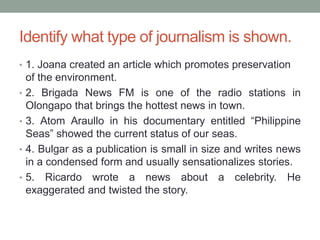
Identify what type of journalism is shown.
• 1. Joana created an article which promotes preservation
of the environment.
• 2. Brigada News FM is one of the radio stations in
Olongapo that brings the hottest news in town.
• 3. Atom Araullo in his documentary entitled “Philippine
Seas” showed the current status of our seas.
• 4. Bulgar as a publication is small in size and writes news
in a condensed form and usually sensationalizes stories.
• 5. Ricardo wrote a news about a celebrity. He
exaggerated and twisted the story.
Conclusion
• Journalism as one part of mass
communication and media studies.
Journalism is the practice of investigation
and reporting of events, issues and trends
to a broad audience in a timely fashion.
• Journalism also covers cultural aspects of
society such as arts and entertainment. The
field includes editing, photojournalism and
documentary.
Journalism in General

Journalism in General

  • 1.
    JOURNALISM IN GENERAL CARL PATRICKS. TADEO Teacher-I, Olongapo City National High School Olongapo City National High School Special Program in Journalism
  • 2.
    Objective/s: At the endof this presentation, you should be able to: •define journalism in general; •identify the different concept of journalism based on different authors; and •differentiate the various scope of journalism.
  • 3.
    Journalism •Etymology: (Latin) ‘diurnal’- daily •Ancient Rome, short bulletins of battles, fires, and elections compiled by government officials were posted up in public places. These were called acta diurna or “daily events.”
  • 4.
    Journalism •The occupation ofwriting for publication in newspapers and other periodicals. – Noah Webster
  • 5.
    Journalism •Something that embracesall forms in which or through which the news and comments on the news reach the public. All that happens in the world, if such happenings hold interest for the public, and all the thoughts, actions, and ideas which these happenings stimulate, become basic materials for the journalist. - Fraser F. Bond
  • 6.
    Journalism •Enjoyable co-curricular activityof the school paper staff in collecting, organizing, and presenting news; in writing editorials, columns, literary articles, and features; in copyreading, proofreading, dummying, and writing headlines – all for the purpose of putting out a school organ. – School Paper Advisers of the City Schools of Manila
  • 7.
    Journalism: Its Basic Definition•It is concerned with the collection and dissemination of news through print media as well as electronic media. • It involves various areas of work like reporting, writing, editing, photographing, broadcasting or cable casting news items. • It convers the printed media that comes in the form of broadsheets, tabloids, newsletters and magazines.
  • 8.
    Scope of Journalism •Written– periodicals •Oral – radio •Visual – television, movie, documentaries
  • 16.
    News Media (Formsof Mass Media) •Print media – newspaper, newsmagazines •Broadcast MEDIA – radio and television •ONLINE MEDIA (online newspaper, news blogs)
  • 17.
    Journalism versus Literature JournalismLiterature Grounded on facts, on truth and on actuality Based on wandering imagination Has main genres, news, editorial and features Either prose or poetry Follows strict method of dividing ideas through paragraphs Has variety of forms and styles Both were forms of writing
  • 18.
    Situation # 1: •Jonas,a writer, wishes to come up with a story about ghosts. He now starts imagining the appearance of the ghosts and creates a plot which includes the conflict, the climax and the resolution of the conflict. Jonas is writing a literary piece. •Is it JOURNALISM or LITERATURE?
  • 19.
    Situation # 2: •Marla,also writes about ghosts. However, before she starts writing about the, she interviews person who have allegedly seen them. The appearance of ghosts, including the persons’ beliefs about them, is written into an entertaining way. Hence, the output is packed with facts. •Is it JOURNALISM or
  • 20.
    SHORT QUIZ: A. Determinein what scope (written, oral, visual) of journalism can we categorize the following: • 1. DWGO • 2. Philippine Daily Inquirer • 3. TV Patrol • 4. The Anchor • 5. RCFM
  • 21.
    SHORT QUIZ: • B.Determine what form (PRINT, BROADCAST, ONLINE)of media is shown by the following: • 1. Blog News • 2. Bulgar • 3. CNN News • 4. CLRAA Newsletter • 5. Brigada News FM
  • 22.
    ASSIGNMENT: • In a½ crosswise, differentiate Journalism and Literature using a Venn Diagram.
  • 23.
    REFERENCES: • Bulusan, Ferdinand.(2016). Campus Journalism within your reach. Lorimar Publishing, Inc.: Quezon City
  • 24.
    JOURNALISM: ITS TYPES ANDTENETS CARL PATRICK S. TADEO Teacher-I, Olongapo City National High School Olongapo City National High School Special Program in Journalism
  • 25.
    Journalism •Journalism is concernedit is a form of writing that tells people about things that really happened, but that they might not have been known about already.
  • 26.
    Definition of Journalism •“TheCOLLECTION and EDITING of NEWS for presentation through MEDIA.”
  • 27.
  • 28.
    Objective Journalism •It isthe type of reporting events that confines itself to facts and answers the questions what, who, where, when, why and how.
  • 29.
    Interpretative Journalism•It is thetype of reporting events which journalist attempts to explain the significance of event by expounding the how and why.
  • 30.
    Adversarial Journalism •It actsas “watchdog” that fiscalizes the three branches of the government: executive, legislative and judiciary.
  • 31.
    Development Journalism•It is anopposite of adversarial journalism, it aims at promoting the social, economic and political development of the country.
  • 32.
    Yellow Journalism •Yellow journalismis also known as sensationalism and it is writing which emphasizes exaggerated claims or rumors. •Yellow journalism which highlights little or no legitimate well-researched news and instead uses eye-catching headlines to sell more newspapers.
  • 33.
    TENETS OF JOURNALISM Tenetof Journalism Short Description Responsibility Transmitter of veracity in any issue, and that they are liable not to the company but to the public. Freedom of the Press Anything can be written so long as there is no infraction to the existing laws of the land. Independence Services of journalist should be committed to the interest of the general public and not driven by the interest of money. Objectivity, Truthfulness and Accuracy Checking the veracity of data and information. Objectivity is simply avoiding conflicts of interest on the treatment of the articles and on the way arguments and news are written. Fairness Telling of the truth and putting information in the right perspective
  • 34.
    WHAT MAKES JOURNALISM DIFFERENT? PRINCIPLESHORT THOUGHTS VERIFICATION VERIFIED FACTS, TRUTH INDEPENDENCE COMMITTED TO INTEREST OF THE GENERAL PUBLIC ACCOUNTABILITY LIABLE TO WHAT HE WRITES
  • 35.
    VERIFICATION •A process thatestablishes or confirms the accuracy or truth of something. •News organizations hire editors and researchers to check information and assure reports are factual and fair to the fact.
  • 36.
    INDEPENDENCE •Freedom from controlor influence of interested parties, coupled with a conscious effort to set aside any preexisting beliefs and a system of checks and balances. •Its primary loyalty is to its readers and to the truth.
  • 37.
    •“The power ofour work comes from INDEPENDENT reporting- a power that is diluted if we are seen as losing detachment or cheerleading for any type of agenda.” •Politics Editory Carrie Budof Brown
  • 38.
    ACCOUNTABILITY •Journalists stand behindtheir work with… •11 that identify the reporter.
  • 39.
    Identify what typeof journalism is shown. • 1. Joana created an article which promotes preservation of the environment. • 2. Brigada News FM is one of the radio stations in Olongapo that brings the hottest news in town. • 3. Atom Araullo in his documentary entitled “Philippine Seas” showed the current status of our seas. • 4. Bulgar as a publication is small in size and writes news in a condensed form and usually sensationalizes stories. • 5. Ricardo wrote a news about a celebrity. He exaggerated and twisted the story.
  • 40.
    Conclusion • Journalism asone part of mass communication and media studies. Journalism is the practice of investigation and reporting of events, issues and trends to a broad audience in a timely fashion. • Journalism also covers cultural aspects of society such as arts and entertainment. The field includes editing, photojournalism and documentary.