California: “ A History” Victoria Herrera History 141 Online
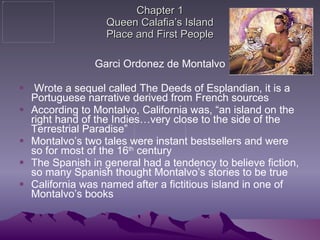
Chapter 1 Queen Calafia’s Island Place and First People Garci Ordonez de Montalvo Wrote a sequel called The Deeds of Esplandian, it is a Portuguese narrative derived from French sources According to Montalvo, California was, “an island on the right hand of the Indies…very close to the side of the Terrestrial Paradise” Montalvo’s two tales were instant bestsellers and were so for most of the 16 th  century  The Spanish in general had a tendency to believe fiction, so many Spanish thought Montalvo’s stories to be true California was named after a fictitious island in one of Montalvo’s books
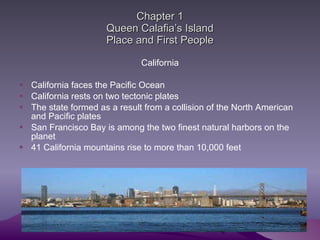
Chapter 1 Queen Calafia’s Island Place and First People California California faces the Pacific Ocean California rests on two tectonic plates The state formed as a result from a collision of the North American and Pacific plates San Francisco Bay is among the two finest natural harbors on the planet  41 California mountains rise to more than 10,000 feet
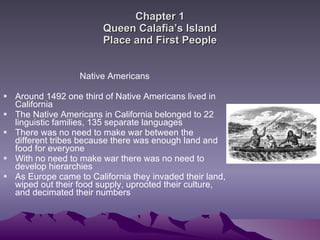
Chapter 1 Queen Calafia’s Island Place and First People Native Americans Around 1492 one third of Native Americans lived in California The Native Americans in California belonged to 22 linguistic families, 135 separate languages  There was no need to make war between the different tribes because there was enough land and food for everyone  With no need to make war there was no need to develop hierarchies  As Europe came to California they invaded their land, wiped out their food supply, uprooted their culture, and decimated their numbers
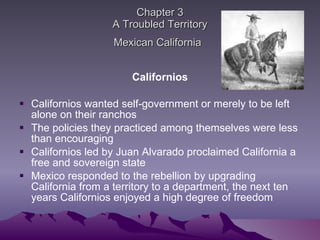
Chapter 3 A Troubled Territory Mexican California   Californios Californios wanted self-government or merely to be left alone on their ranchos The policies they practiced among themselves were less than encouraging  Californios led by Juan Alvarado proclaimed California a free and sovereign state Mexico responded to the rebellion by upgrading California from a territory to a department, the next ten years Californios enjoyed a high degree of freedom
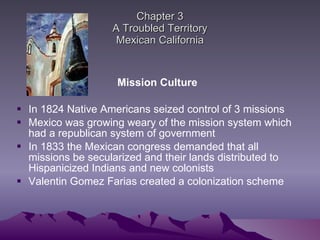
Chapter 3 A Troubled Territory Mexican California Mission Culture In 1824 Native Americans seized control of 3 missions Mexico was growing weary of the mission system which had a republican system of government  In 1833 the Mexican congress demanded that all missions be secularized and their lands distributed to Hispanicized Indians and new colonists  Valentin Gomez Farias created a colonization scheme
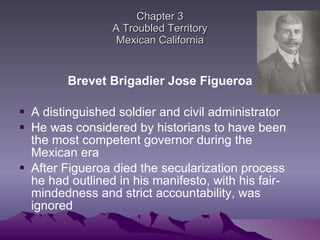
Chapter 3 A Troubled Territory Mexican California Brevet Brigadier Jose Figueroa A distinguished soldier and civil administrator He was considered by historians to have been the most competent governor during the Mexican era After Figueroa died the secularization process he had outlined in his manifesto, with his fair-mindedness and strict accountability, was ignored
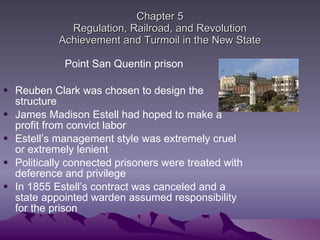
Chapter 5 Regulation, Railroad, and Revolution Achievement and Turmoil in the New State Point San Quentin prison Reuben Clark was chosen to design the structure  James Madison Estell had hoped to make a profit from convict labor Estell’s management style was extremely cruel or extremely lenient Politically connected prisoners were treated with deference and privilege  In 1855 Estell’s contract was canceled and a state appointed warden assumed responsibility for the prison
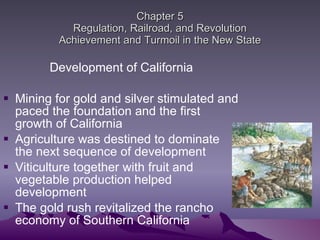
Chapter 5 Regulation, Railroad, and Revolution Achievement and Turmoil in the New State Development of California Mining for gold and silver stimulated and paced the foundation and the first growth of California Agriculture was destined to dominate the next sequence of development  Viticulture together with fruit and vegetable production helped development The gold rush revitalized the rancho economy of Southern California
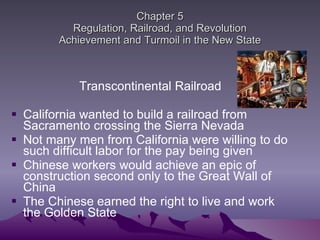
Chapter 5 Regulation, Railroad, and Revolution Achievement and Turmoil in the New State Transcontinental Railroad  California wanted to build a railroad from Sacramento crossing the Sierra Nevada Not many men from California were willing to do such difficult labor for the pay being given Chinese workers would achieve an epic of construction second only to the Great Wall of China The Chinese earned the right to live and work the Golden State

California

  • 1.
    California: “ AHistory” Victoria Herrera History 141 Online
  • 2.
    Chapter 1 QueenCalafia’s Island Place and First People Garci Ordonez de Montalvo Wrote a sequel called The Deeds of Esplandian, it is a Portuguese narrative derived from French sources According to Montalvo, California was, “an island on the right hand of the Indies…very close to the side of the Terrestrial Paradise” Montalvo’s two tales were instant bestsellers and were so for most of the 16 th century The Spanish in general had a tendency to believe fiction, so many Spanish thought Montalvo’s stories to be true California was named after a fictitious island in one of Montalvo’s books
  • 3.
    Chapter 1 QueenCalafia’s Island Place and First People California California faces the Pacific Ocean California rests on two tectonic plates The state formed as a result from a collision of the North American and Pacific plates San Francisco Bay is among the two finest natural harbors on the planet 41 California mountains rise to more than 10,000 feet
  • 4.
    Chapter 1 QueenCalafia’s Island Place and First People Native Americans Around 1492 one third of Native Americans lived in California The Native Americans in California belonged to 22 linguistic families, 135 separate languages There was no need to make war between the different tribes because there was enough land and food for everyone With no need to make war there was no need to develop hierarchies As Europe came to California they invaded their land, wiped out their food supply, uprooted their culture, and decimated their numbers
  • 5.
    Chapter 3 ATroubled Territory Mexican California Californios Californios wanted self-government or merely to be left alone on their ranchos The policies they practiced among themselves were less than encouraging Californios led by Juan Alvarado proclaimed California a free and sovereign state Mexico responded to the rebellion by upgrading California from a territory to a department, the next ten years Californios enjoyed a high degree of freedom
  • 6.
    Chapter 3 ATroubled Territory Mexican California Mission Culture In 1824 Native Americans seized control of 3 missions Mexico was growing weary of the mission system which had a republican system of government In 1833 the Mexican congress demanded that all missions be secularized and their lands distributed to Hispanicized Indians and new colonists Valentin Gomez Farias created a colonization scheme
  • 7.
    Chapter 3 ATroubled Territory Mexican California Brevet Brigadier Jose Figueroa A distinguished soldier and civil administrator He was considered by historians to have been the most competent governor during the Mexican era After Figueroa died the secularization process he had outlined in his manifesto, with his fair-mindedness and strict accountability, was ignored
  • 8.
    Chapter 5 Regulation,Railroad, and Revolution Achievement and Turmoil in the New State Point San Quentin prison Reuben Clark was chosen to design the structure James Madison Estell had hoped to make a profit from convict labor Estell’s management style was extremely cruel or extremely lenient Politically connected prisoners were treated with deference and privilege In 1855 Estell’s contract was canceled and a state appointed warden assumed responsibility for the prison
  • 9.
    Chapter 5 Regulation,Railroad, and Revolution Achievement and Turmoil in the New State Development of California Mining for gold and silver stimulated and paced the foundation and the first growth of California Agriculture was destined to dominate the next sequence of development Viticulture together with fruit and vegetable production helped development The gold rush revitalized the rancho economy of Southern California
  • 10.
    Chapter 5 Regulation,Railroad, and Revolution Achievement and Turmoil in the New State Transcontinental Railroad California wanted to build a railroad from Sacramento crossing the Sierra Nevada Not many men from California were willing to do such difficult labor for the pay being given Chinese workers would achieve an epic of construction second only to the Great Wall of China The Chinese earned the right to live and work the Golden State