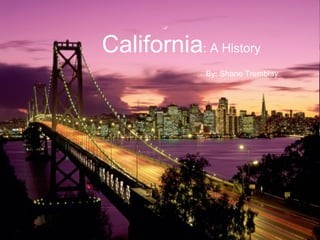
California: A History By: Shane Tremblay California : A History By: Shane Tremblay
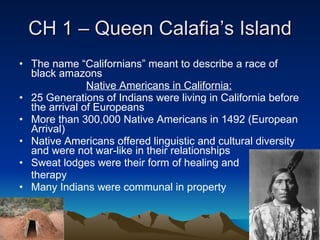
CH 1 – Queen Calafia’s Island The name “Californians” meant to describe a race of black amazons   Native Americans in California: 25 Generations of Indians were living in California before the arrival of Europeans More than 300,000 Native Americans in 1492 (European Arrival) Native Americans offered linguistic and cultural diversity and were not war-like in their relationships Sweat lodges were their form of healing and  therapy Many Indians were communal in property
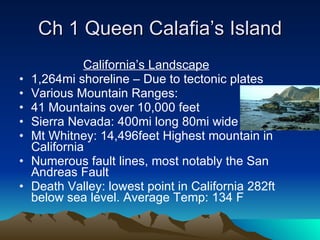
Ch 1 Queen Calafia’s Island California’s Landscape 1,264mi shoreline – Due to tectonic plates Various Mountain Ranges:  41 Mountains over 10,000 feet Sierra Nevada: 400mi long 80mi wide Mt Whitney: 14,496feet Highest mountain in California Numerous fault lines, most notably the San Andreas Fault Death Valley: lowest point in California 282ft below sea level. Average Temp: 134 F
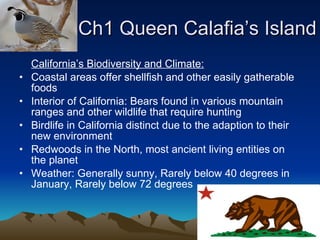
Ch1 Queen Calafia’s Island California’s Biodiversity and Climate: Coastal areas offer shellfish and other easily gatherable foods Interior of California: Bears found in various mountain ranges and other wildlife that require hunting Birdlife in California distinct due to the adaption to their new environment Redwoods in the North, most ancient living entities on the planet Weather: Generally sunny, Rarely below 40 degrees in January, Rarely below 72 degrees
Ch 4 – Striking it Rich California Developing California is ceded to the United States through the Treaty of Guadalupe Hildalgo Debate over slavery in California Mid 1800s cities begin to develop Mormons arrive 1846 and brought social solidarity as well as manual labor which was in high demand at the time The first water powered saw-mill reveals Gold in california
Ch 4 – Striking it Rich California Gold Rush: Mass Migration 1849 Gold Rush established California as a state and “matured” it as a state entity (as California is admitted in 1849) With the gold rush came an increase in the Native American population (up to 255,000) Huge migration from China, Australia, and Mexico (getting to California at this time is still a formidable obstacle) $594 Million in ingots – Equivalent to $10 Billion in 2001 dollars
Ch 4 – Striking it Rich Consequences of Mining California is seen as a dream, a way to make it to a better life, however, one in twelve miners lost their lives Violence becomes prevalent in mines Lynching also becomes an effective way to eliminate competition Annual rate of 506 deaths per 100,000 Destruction of the natural environment and urbanization occurs
Ch 5 – Regulation, Railroad, and Revolution Regulation: Major problem: Large influx of people, with no one to administer land The State questions the validity of the old Spanish land treaties, as a result, many people lose their land to the government Corporations and Railroads become increasingly unregulated in California leading to an increase in power among top leaders 1873 Stock Market collapses, resulting in mass lynching of Chinese 1875 Banking system collapses,  Chinese become scapegoats for failed  expectations
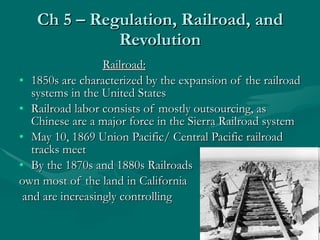
Ch 5 – Regulation, Railroad, and Revolution Railroad: 1850s are characterized by the expansion of the railroad systems in the United States Railroad labor consists of mostly outsourcing, as Chinese are a major force in the Sierra Railroad system May 10, 1869 Union Pacific/ Central Pacific railroad tracks meet By the 1870s and 1880s Railroads  own most of the land in California and are increasingly controlling
Ch 5 – Regulation, Railroad, and Revolution Revolution: “Businessmen’s Revolution” Between 1850 and 1854 the Capital is moved from San Francisco Bay to San Jose, to Vallejo, and back to San Francisco  Religion provided an immediate and compelling way for newcomers to organize and reorient themselves Gold Rush creates a cattle boom

California by Shane Tremblay

  • 1.
    California: A HistoryBy: Shane Tremblay California : A History By: Shane Tremblay
  • 2.
    CH 1 –Queen Calafia’s Island The name “Californians” meant to describe a race of black amazons Native Americans in California: 25 Generations of Indians were living in California before the arrival of Europeans More than 300,000 Native Americans in 1492 (European Arrival) Native Americans offered linguistic and cultural diversity and were not war-like in their relationships Sweat lodges were their form of healing and therapy Many Indians were communal in property
  • 3.
    Ch 1 QueenCalafia’s Island California’s Landscape 1,264mi shoreline – Due to tectonic plates Various Mountain Ranges: 41 Mountains over 10,000 feet Sierra Nevada: 400mi long 80mi wide Mt Whitney: 14,496feet Highest mountain in California Numerous fault lines, most notably the San Andreas Fault Death Valley: lowest point in California 282ft below sea level. Average Temp: 134 F
  • 4.
    Ch1 Queen Calafia’sIsland California’s Biodiversity and Climate: Coastal areas offer shellfish and other easily gatherable foods Interior of California: Bears found in various mountain ranges and other wildlife that require hunting Birdlife in California distinct due to the adaption to their new environment Redwoods in the North, most ancient living entities on the planet Weather: Generally sunny, Rarely below 40 degrees in January, Rarely below 72 degrees
  • 5.
    Ch 4 –Striking it Rich California Developing California is ceded to the United States through the Treaty of Guadalupe Hildalgo Debate over slavery in California Mid 1800s cities begin to develop Mormons arrive 1846 and brought social solidarity as well as manual labor which was in high demand at the time The first water powered saw-mill reveals Gold in california
  • 6.
    Ch 4 –Striking it Rich California Gold Rush: Mass Migration 1849 Gold Rush established California as a state and “matured” it as a state entity (as California is admitted in 1849) With the gold rush came an increase in the Native American population (up to 255,000) Huge migration from China, Australia, and Mexico (getting to California at this time is still a formidable obstacle) $594 Million in ingots – Equivalent to $10 Billion in 2001 dollars
  • 7.
    Ch 4 –Striking it Rich Consequences of Mining California is seen as a dream, a way to make it to a better life, however, one in twelve miners lost their lives Violence becomes prevalent in mines Lynching also becomes an effective way to eliminate competition Annual rate of 506 deaths per 100,000 Destruction of the natural environment and urbanization occurs
  • 8.
    Ch 5 –Regulation, Railroad, and Revolution Regulation: Major problem: Large influx of people, with no one to administer land The State questions the validity of the old Spanish land treaties, as a result, many people lose their land to the government Corporations and Railroads become increasingly unregulated in California leading to an increase in power among top leaders 1873 Stock Market collapses, resulting in mass lynching of Chinese 1875 Banking system collapses, Chinese become scapegoats for failed expectations
  • 9.
    Ch 5 –Regulation, Railroad, and Revolution Railroad: 1850s are characterized by the expansion of the railroad systems in the United States Railroad labor consists of mostly outsourcing, as Chinese are a major force in the Sierra Railroad system May 10, 1869 Union Pacific/ Central Pacific railroad tracks meet By the 1870s and 1880s Railroads own most of the land in California and are increasingly controlling
  • 10.
    Ch 5 –Regulation, Railroad, and Revolution Revolution: “Businessmen’s Revolution” Between 1850 and 1854 the Capital is moved from San Francisco Bay to San Jose, to Vallejo, and back to San Francisco Religion provided an immediate and compelling way for newcomers to organize and reorient themselves Gold Rush creates a cattle boom