WELCOME TO OUR PRESENTATION
PRESENTED TO
1.Md Zulker Naim Jibon(191003009)
2.Md Sazzed Hossain(191003029)
3.Bishal Chakma(191003033)
4.Elex Chakma(191003064)
PRESENTED TO
Mutasim Uddin
Lecturer
Green University of Bangladesh
TOPIC
Calendering Finishing
Introduction
 Calendering is a process where fabric is compressed by passing it
between two or more rollers under controlled conditions of time,
temperature and pressure
Objectives of calendering
 To upgrade the fabric hand and to impart a smooth, silky touch to the
fabric.
 To compress the fabric and reduce its thickness.
 To improve the opacity of the fabric.
 To reduce the airpermeability of the fabric changing its porosity.
 To impart different degree of lustre to the fabric.
 To reduce the yarn slippage.
Preparation for Calendering
 The fabric is folded lengthwise with the front side or face inside and
stitched together along the edges.
 The fabric is then run rough rollers that polish the surface and make
fabric smoother and lustrous.
 High temperature and high pressure required.
 Fabric that goes through calendering process feel than glossy and
papery.
 Before calendering softening and filling agents should be added to
produce lustre.
Types of calendaring machines
 Ordinary Calender.
 Swizzing Calender.
 Chasing Calender.
 Friction Calender.
 Schreiner Calender.
 Embossing Calender.
 Felt Calender.
Ordinary Calender
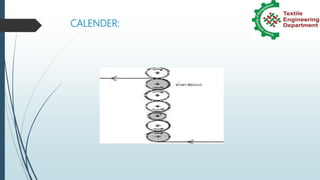
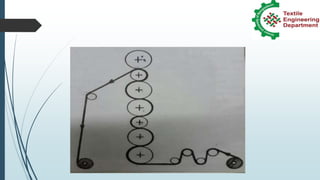
 Ordinary is one type of calendaring machine. In a typical 3,5,6,7or10 bowl
calender, the arrangement of the bowl is shown below:
 The calendaringeffect produced depends upon the:
 The moisture content of the fabric.
 The number of bowls used in the calender.
 The composition of the bowls.
 The arrangement of bowls.
 Pressure.
 Speed of the machine.
CALENDER:
 This is a 7 bowl calender. Swizzing calender effect can be obtained by
passing the cloth through the nips of the calender rollers in which the
surface speed of all the rollers is the same.
 This process closes the gap of the cloth giving it a smooth appearance.
 Before calendaring, softening and filling.
 agents should be added to produce luster.
 the bowls in this machine are rotated in the same speed. The normal
speed of the machine is 90yards/min.
Swizzing calendering
Friction Calender
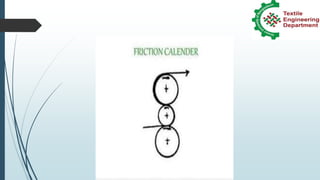
 For producing this effect, the top four bowls of a 7bowl calender can be
lifted up, disconnecting the contact the third and the fourth bowls so as
to use only three bowls.
 The friction calender with a 7 bowl calender after disconnecting the top
four bowls.
 Friction calendering gives a higher gloss and greater closing of the rns, it
is produced by bringing the cloth in contact with heated polished chilled
iron bowl which is rotating at a fas r speed than the cloth itself.
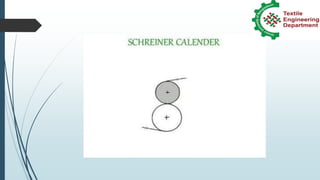
Schreiner Calender
 The usual schreiner calender consistsof bowls, the upper bowl is made
up of specially polished steel bowl and the lower bowl is made of
compressed coron.
 The top metallic bowl is engraved with parallel line normally 200
lines/2inch at 20 angle.
 The metallic bowl is heated by gas usually at 50c.
 The top bowl is fixed and the lower is movable.
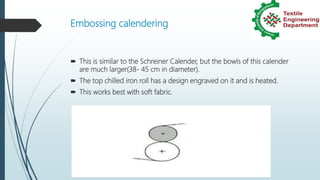
Embossing calendering
 This is similar to the Schreiner Calender, but the bowls of this calender
are much larger(38- 45 cm in diameter).
 The top chilled iron roll has a design engraved on it and is heated.
 This works best with soft fabric.
Advantages Calendering
 It improves appearance of the material.
 It improves the wearing qualities
 It increases the sale value of the material.
 It improves the serviceability of the fabric.
 It improves the natural attractiveness of the fabric.
Calendering Finishing.pptx

Calendering Finishing.pptx

  • 1.
    WELCOME TO OURPRESENTATION PRESENTED TO 1.Md Zulker Naim Jibon(191003009) 2.Md Sazzed Hossain(191003029) 3.Bishal Chakma(191003033) 4.Elex Chakma(191003064) PRESENTED TO Mutasim Uddin Lecturer Green University of Bangladesh
  • 2.
  • 3.
    Introduction  Calendering isa process where fabric is compressed by passing it between two or more rollers under controlled conditions of time, temperature and pressure
  • 4.
    Objectives of calendering To upgrade the fabric hand and to impart a smooth, silky touch to the fabric.  To compress the fabric and reduce its thickness.  To improve the opacity of the fabric.  To reduce the airpermeability of the fabric changing its porosity.  To impart different degree of lustre to the fabric.  To reduce the yarn slippage.
  • 5.
    Preparation for Calendering The fabric is folded lengthwise with the front side or face inside and stitched together along the edges.  The fabric is then run rough rollers that polish the surface and make fabric smoother and lustrous.  High temperature and high pressure required.  Fabric that goes through calendering process feel than glossy and papery.  Before calendering softening and filling agents should be added to produce lustre.
  • 6.
    Types of calendaringmachines  Ordinary Calender.  Swizzing Calender.  Chasing Calender.  Friction Calender.  Schreiner Calender.  Embossing Calender.  Felt Calender.
  • 7.
    Ordinary Calender  Ordinaryis one type of calendaring machine. In a typical 3,5,6,7or10 bowl calender, the arrangement of the bowl is shown below:  The calendaringeffect produced depends upon the:  The moisture content of the fabric.  The number of bowls used in the calender.  The composition of the bowls.  The arrangement of bowls.  Pressure.  Speed of the machine.
  • 8.
  • 9.
     This isa 7 bowl calender. Swizzing calender effect can be obtained by passing the cloth through the nips of the calender rollers in which the surface speed of all the rollers is the same.  This process closes the gap of the cloth giving it a smooth appearance.  Before calendaring, softening and filling.  agents should be added to produce luster.  the bowls in this machine are rotated in the same speed. The normal speed of the machine is 90yards/min. Swizzing calendering
  • 11.
    Friction Calender  Forproducing this effect, the top four bowls of a 7bowl calender can be lifted up, disconnecting the contact the third and the fourth bowls so as to use only three bowls.  The friction calender with a 7 bowl calender after disconnecting the top four bowls.  Friction calendering gives a higher gloss and greater closing of the rns, it is produced by bringing the cloth in contact with heated polished chilled iron bowl which is rotating at a fas r speed than the cloth itself.
  • 13.
    Schreiner Calender  Theusual schreiner calender consistsof bowls, the upper bowl is made up of specially polished steel bowl and the lower bowl is made of compressed coron.  The top metallic bowl is engraved with parallel line normally 200 lines/2inch at 20 angle.  The metallic bowl is heated by gas usually at 50c.  The top bowl is fixed and the lower is movable.
  • 15.
    Embossing calendering  Thisis similar to the Schreiner Calender, but the bowls of this calender are much larger(38- 45 cm in diameter).  The top chilled iron roll has a design engraved on it and is heated.  This works best with soft fabric.
  • 16.
    Advantages Calendering  Itimproves appearance of the material.  It improves the wearing qualities  It increases the sale value of the material.  It improves the serviceability of the fabric.  It improves the natural attractiveness of the fabric.