CALCULUS
INTRODUCTION
Definition of Calculus
Classification of Calculus
Differentiation
Formulas of Differentiation
Example of Differentiation
Integration
Formulas of Integration
Example of Integration
DEFINATION OF CALCULUS
The branch of
mathematics that deals
with the finding and
properties of derivatives
and integrals of
functions, by methods
originally based on the
summation of
infinitesimal differences.
CLASSIFICATION OF CALCULUS
 Differential Calculus :
A branch of
mathematics
concerned chiefly
with the study of the
rate of change of
functions with respect
to their variables
especially through
the use of derivatives
and differentials.
 Integral Calculus:
A branch of
mathematics
concerned with the
theory and
applications (as in
the determination of
lengths, areas, and
volumes and in the
solution of
differential
equations) of
integrals and
integration
The two main types of Calculus:
DIFFERENTIATION:
 The process of finding a derivative is called
differentiation. The reverse process is called
anti-differentiation. The fundamental
theorem of calculus states that anti-
differentiation is the same as integration.
Differentiation and integration constitute
the two fundamental operations in single-
variable calculus.
FORMULAS OF DIFFERENTIATION
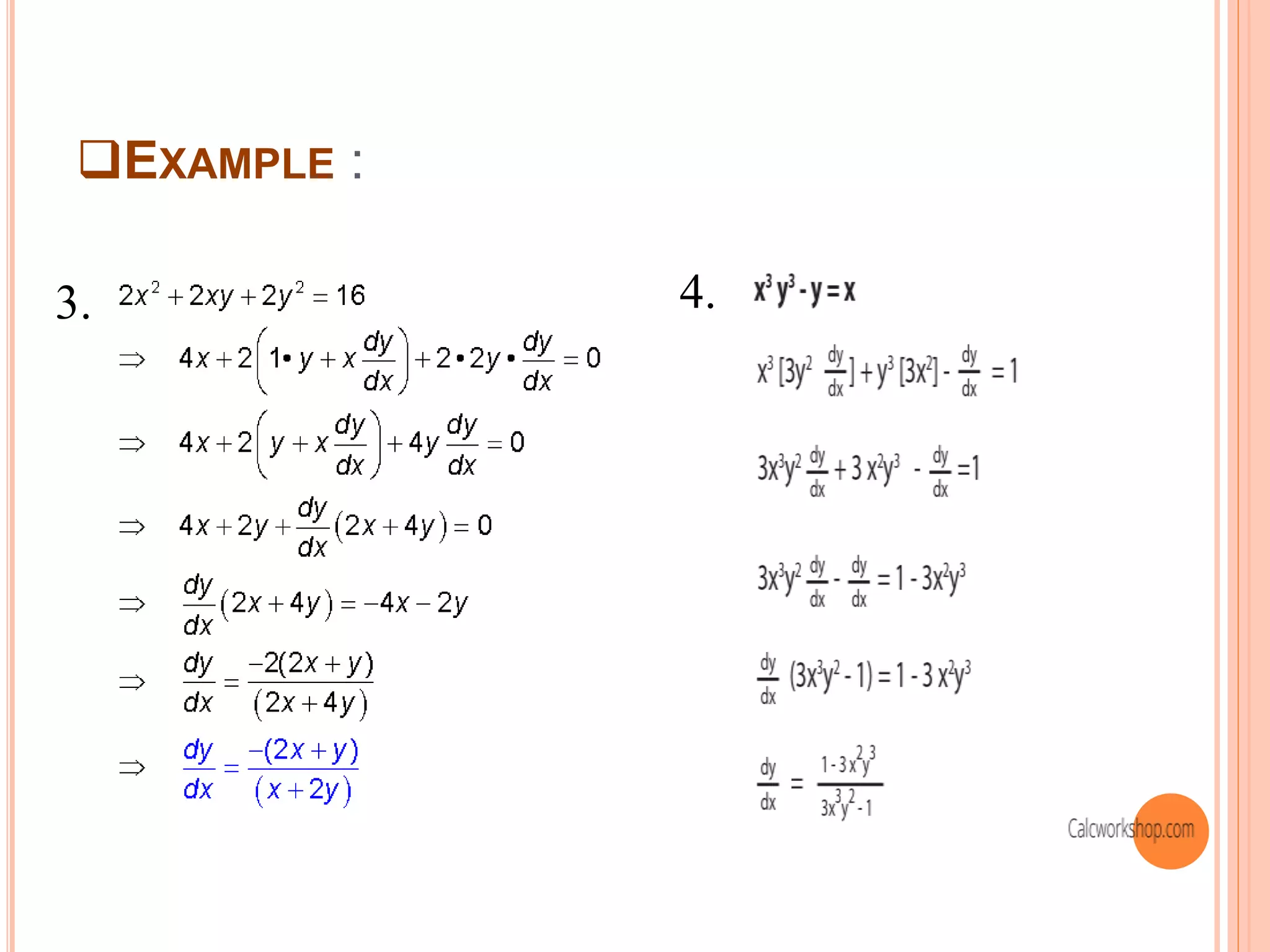
EXAMPLE :
1. 2.
EXAMPLE :
3. 4.
INTEGRATION :
 The process of evaluating an
indefinite integral or a definite
Integral.
 The indefinite integral ∫f(x)dx is defined as a
function g such as its derivative D.[g(x)]=f(x).
 The definite integral is a number
whose value depends on the function f and the
numbers a and b, and it is defined as the limit
of Riemann sum.
 the arbitrary constant c is called a
constant of integration .
FORMULAS OF INTEGRATION
EXAMPLE :
1. 2.
EXAMPLE:
3.
4.
THANK YOU

Calculus

  • 1.
  • 2.
    INTRODUCTION Definition of Calculus Classificationof Calculus Differentiation Formulas of Differentiation Example of Differentiation Integration Formulas of Integration Example of Integration
  • 3.
    DEFINATION OF CALCULUS Thebranch of mathematics that deals with the finding and properties of derivatives and integrals of functions, by methods originally based on the summation of infinitesimal differences.
  • 4.
    CLASSIFICATION OF CALCULUS Differential Calculus : A branch of mathematics concerned chiefly with the study of the rate of change of functions with respect to their variables especially through the use of derivatives and differentials.  Integral Calculus: A branch of mathematics concerned with the theory and applications (as in the determination of lengths, areas, and volumes and in the solution of differential equations) of integrals and integration The two main types of Calculus:
  • 5.
    DIFFERENTIATION:  The processof finding a derivative is called differentiation. The reverse process is called anti-differentiation. The fundamental theorem of calculus states that anti- differentiation is the same as integration. Differentiation and integration constitute the two fundamental operations in single- variable calculus.
  • 6.
  • 7.
  • 8.
  • 9.
    INTEGRATION :  Theprocess of evaluating an indefinite integral or a definite Integral.  The indefinite integral ∫f(x)dx is defined as a function g such as its derivative D.[g(x)]=f(x).  The definite integral is a number whose value depends on the function f and the numbers a and b, and it is defined as the limit of Riemann sum.  the arbitrary constant c is called a constant of integration .
  • 10.
  • 11.
  • 12.
  • 13.