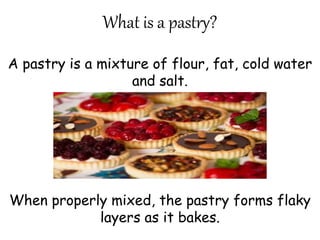
A pastry is a mixture of flour, fat, cold water
and salt.
When properly mixed, the pastry forms flaky
layers as it bakes.
What is a pastry?
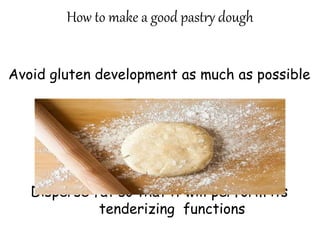
How to make a good pastry dough
Avoid gluten development as much as possible
Disperse fat so that it will perform its
tenderizing functions
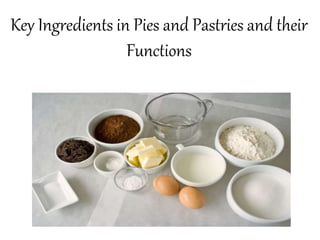
Key Ingredients in Pies and Pastries and their
Functions
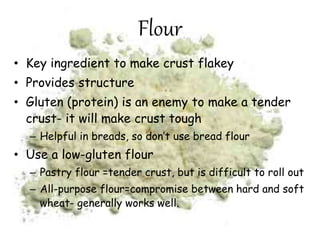
Flour
• Key ingredient to make crust flakey
• Provides structure
• Gluten (protein) is an enemy to make a tender
crust- it will make crust tough
– Helpful in breads, so don’t use bread flour
• Use a low-gluten flour
– Pastry flour =tender crust, but is difficult to roll out
– All-purpose flour=compromise between hard and soft
wheat- generally works well.
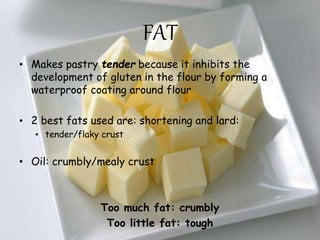
FAT
• Makes pastry tender because it inhibits the
development of gluten in the flour by forming a
waterproof coating around flour
• 2 best fats used are: shortening and lard:
• tender/flaky crust
• Oil: crumbly/mealy crust
Too much fat: crumbly
Too little fat: tough
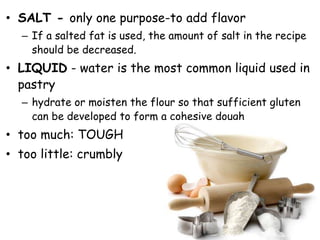
• SALT - only one purpose-to add flavor
– If a salted fat is used, the amount of salt in the recipe
should be decreased.
• LIQUID - water is the most common liquid used in
pastry
– hydrate or moisten the flour so that sufficient gluten
can be developed to form a cohesive dough
• too much: TOUGH
• too little: crumbly
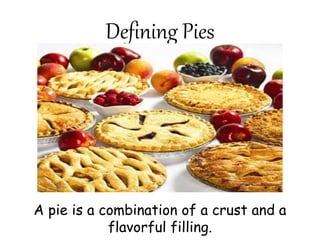
Defining Pies
A pie is a combination of a crust and a
flavorful filling.
4 Kinds of Pies
• Fruit- usually 2 crusts
– Prepared pie filling or make filling from canned, frozen, dried, or fresh fruit
• Cream- 1 crust pies
– use a cornstarch-thickened pudding mixture to make a cream filling, often
have meringue topping
• Custard- 1 crust
– filled with custard made from milk, eggs, and sugar (may contain other
ingredients)
– Pumpkin pie is a popular custard
• Chiffon pie- 1 crust
– light and airy, filled with a mixture containing gelatin and cooked beaten egg
whites
– Some also contain whipped cream
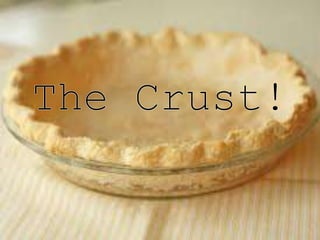
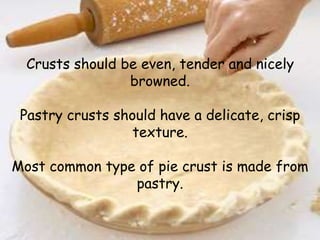
Crusts should be even, tender and nicely
browned.
Pastry crusts should have a delicate, crisp
texture.
Most common type of pie crust is made from
pastry.
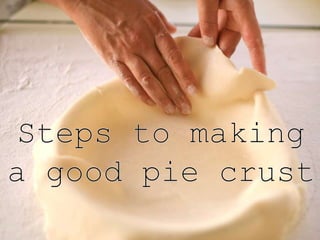
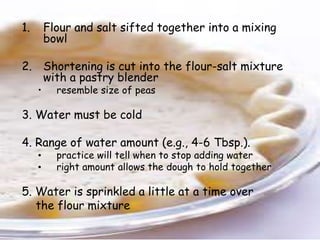
1. Flour and salt sifted together into a mixing
bowl
2. Shortening is cut into the flour-salt mixture
with a pastry blender
• resemble size of peas
3. Water must be cold
4. Range of water amount (e.g., 4-6 Tbsp.).
• practice will tell when to stop adding water
• right amount allows the dough to hold together
5. Water is sprinkled a little at a time over
the flour mixture
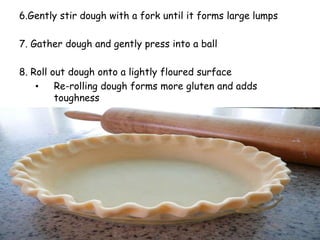
6.Gently stir dough with a fork until it forms large lumps
7. Gather dough and gently press into a ball
8. Roll out dough onto a lightly floured surface
• Re-rolling dough forms more gluten and adds
toughness
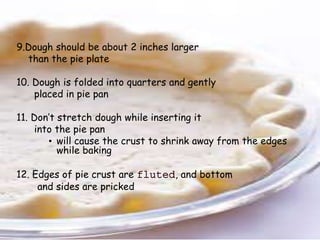
9.Dough should be about 2 inches larger
than the pie plate
10. Dough is folded into quarters and gently
placed in pie pan
11. Don’t stretch dough while inserting it
into the pie pan
• will cause the crust to shrink away from the edges
while baking
12. Edges of pie crust are , and bottom
and sides are pricked
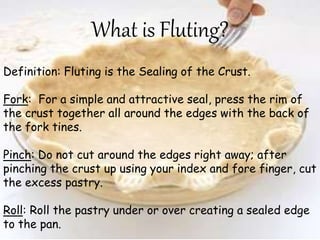
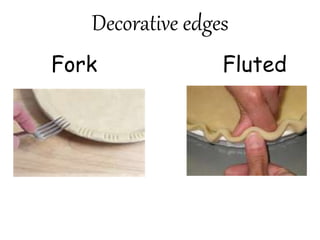
Definition: Fluting is the Sealing of the Crust.
Fork: For a simple and attractive seal, press the rim of
the crust together all around the edges with the back of
the fork tines.
Pinch: Do not cut around the edges right away; after
pinching the crust up using your index and fore finger, cut
the excess pastry.
Roll: Roll the pastry under or over creating a sealed edge
to the pan.
What is Fluting?
Decorative edges
Fork Fluted
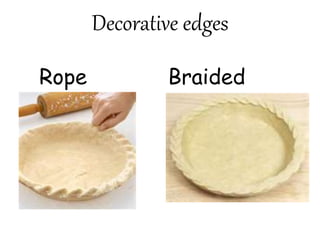
Decorative edges
Rope Braided
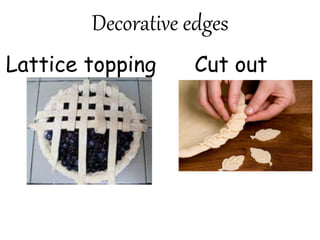
Decorative edges
Lattice topping Cut out
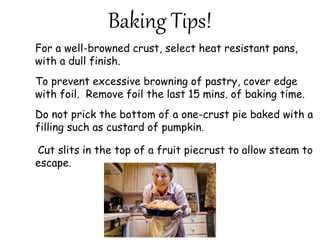
Baking Tips!
For a well-browned crust, select heat resistant pans,
with a dull finish.
To prevent excessive browning of pastry, cover edge
with foil. Remove foil the last 15 mins. of baking time.
Do not prick the bottom of a one-crust pie baked with a
filling such as custard of pumpkin.
Cut slits in the top of a fruit piecrust to allow steam to
escape.
pies and pastry.ppt
pies and pastry.ppt
pies and pastry.ppt

pies and pastry.ppt

  • 2.
    A pastry isa mixture of flour, fat, cold water and salt. When properly mixed, the pastry forms flaky layers as it bakes. What is a pastry?
  • 3.
    How to makea good pastry dough Avoid gluten development as much as possible Disperse fat so that it will perform its tenderizing functions
  • 4.
    Key Ingredients inPies and Pastries and their Functions
  • 5.
    Flour • Key ingredientto make crust flakey • Provides structure • Gluten (protein) is an enemy to make a tender crust- it will make crust tough – Helpful in breads, so don’t use bread flour • Use a low-gluten flour – Pastry flour =tender crust, but is difficult to roll out – All-purpose flour=compromise between hard and soft wheat- generally works well.
  • 6.
    FAT • Makes pastrytender because it inhibits the development of gluten in the flour by forming a waterproof coating around flour • 2 best fats used are: shortening and lard: • tender/flaky crust • Oil: crumbly/mealy crust Too much fat: crumbly Too little fat: tough
  • 7.
    • SALT -only one purpose-to add flavor – If a salted fat is used, the amount of salt in the recipe should be decreased. • LIQUID - water is the most common liquid used in pastry – hydrate or moisten the flour so that sufficient gluten can be developed to form a cohesive dough • too much: TOUGH • too little: crumbly
  • 8.
    Defining Pies A pieis a combination of a crust and a flavorful filling.
  • 9.
    4 Kinds ofPies • Fruit- usually 2 crusts – Prepared pie filling or make filling from canned, frozen, dried, or fresh fruit • Cream- 1 crust pies – use a cornstarch-thickened pudding mixture to make a cream filling, often have meringue topping • Custard- 1 crust – filled with custard made from milk, eggs, and sugar (may contain other ingredients) – Pumpkin pie is a popular custard • Chiffon pie- 1 crust – light and airy, filled with a mixture containing gelatin and cooked beaten egg whites – Some also contain whipped cream
  • 11.
    Crusts should beeven, tender and nicely browned. Pastry crusts should have a delicate, crisp texture. Most common type of pie crust is made from pastry.
  • 13.
    1. Flour andsalt sifted together into a mixing bowl 2. Shortening is cut into the flour-salt mixture with a pastry blender • resemble size of peas 3. Water must be cold 4. Range of water amount (e.g., 4-6 Tbsp.). • practice will tell when to stop adding water • right amount allows the dough to hold together 5. Water is sprinkled a little at a time over the flour mixture
  • 14.
    6.Gently stir doughwith a fork until it forms large lumps 7. Gather dough and gently press into a ball 8. Roll out dough onto a lightly floured surface • Re-rolling dough forms more gluten and adds toughness
  • 15.
    9.Dough should beabout 2 inches larger than the pie plate 10. Dough is folded into quarters and gently placed in pie pan 11. Don’t stretch dough while inserting it into the pie pan • will cause the crust to shrink away from the edges while baking 12. Edges of pie crust are , and bottom and sides are pricked
  • 16.
    Definition: Fluting isthe Sealing of the Crust. Fork: For a simple and attractive seal, press the rim of the crust together all around the edges with the back of the fork tines. Pinch: Do not cut around the edges right away; after pinching the crust up using your index and fore finger, cut the excess pastry. Roll: Roll the pastry under or over creating a sealed edge to the pan. What is Fluting?
  • 17.
  • 18.
  • 19.
  • 20.
    Baking Tips! For awell-browned crust, select heat resistant pans, with a dull finish. To prevent excessive browning of pastry, cover edge with foil. Remove foil the last 15 mins. of baking time. Do not prick the bottom of a one-crust pie baked with a filling such as custard of pumpkin. Cut slits in the top of a fruit piecrust to allow steam to escape.